



You’ve seen the stats. Employee engagement scores are stagnant or declining across most industries, despite companies pouring millions into wellness apps, team-building exercises, and culture consultants. We keep asking why engagement isn’t improving, but here’s what we’re missing: what if engagement itself is the wrong metric?
Most organizations treat engagement as the destination. It’s actually a symptom of something deeper. We’ve built an entire industry around tracking how employees feel about their work without addressing what makes them feel that way in the first place. The oversight isn’t in our solutions but in our diagnosis.
TL;DR
Too long? Here’s the short version:
We measure feelings instead of the conditions that create those feelings. Pointless.
Most disengagement happens when people are accountable for stuff they can’t actually control. (Autonomy gap, and it’s killing you.)
Information hoarding destroys trust faster than any asshole manager ever could.
People can handle intense work. They can’t handle intense work forever with no recovery. We’ve eliminated downtime and called it optimization.
Skill gaps are widening. Training budgets are shrinking. People are drowning and pretending they’re fine.
Collaboration sounds great until you realize it means your best people spend all day in meetings while low performers hide in the crowd.
Your engagement survey asks leading questions designed to make you feel better, not give you useful data.
Fix the conditions. Engagement follows. Chase the engagement number directly, and you get neither engagement nor results.
Why Engagement Metrics Miss the Operational Reality
Pull up any engagement survey. I’ll wait. Notice how every question basically asks “How do you feel about X?” Your manager, your work, the company mission statement nobody remembers. We’re drowning in feelings data.
The problem? Feelings are downstream from conditions.
An employee might report high engagement while working in a system that’s slowly burning them out. Another might report low engagement while working in conditions that are merely frustrating, not fundamentally broken. The metric can’t distinguish between the two scenarios because it’s measuring the wrong layer of the problem.
Think about what actually happens when engagement scores drop. Companies respond with initiatives: recognition programs, communication campaigns, team events. These interventions target the symptom (how people feel) rather than the cause (what’s making them feel that way). You end up with organizations that have excellent pizza parties and terrible workflows.
Nothing says “we value you” like lukewarm pizza and a manager who pronounces it “pye-zah.” Really feeling the engagement now.

Here’s what I see happening:
|
What We Actually Measure |
What We Should Measure |
Why We Don’t |
|---|---|---|
|
How people feel about their manager |
Whether they can make the decisions they’re accountable for |
Feelings are easier to survey |
|
Survey response rates |
Information access and flow |
Can’t benchmark “does everyone know what’s actually happening” |
|
Quarterly sentiment trends |
Recovery time between high-intensity periods |
Nobody’s tracking this |
|
Recognition program participation |
Skill gaps vs. role requirements |
Admitting the gap means admitting we under-invest in training |
There are more, but this gives you the pattern.
The operational reality matters more than the emotional response to it. When someone can’t get their work done because they’re waiting on approvals from three different departments, that’s not an engagement problem. That’s a process problem. When they report feeling frustrated on a survey, we treat it as a morale issue and send them to a wellness webinar.
What is employee engagement if not a reflection of the systems we’ve built? The definition of employee engagement has become so abstracted from actual work conditions that we’ve lost sight of what we’re trying to measure. You’re tracking outputs without understanding inputs.
Engagement metrics also suffer from survivorship bias. The most disengaged employees have already left. Your survey captures the people who are still there, which skews results toward the middle. You’re measuring the engagement level of people who haven’t quit yet, not the engagement level of your actual workforce potential.
Real example (details changed): Software team, mid-sized SaaS company. Engagement scores steady at 6.8 out of 10 for three quarters. Management’s thrilled. Stability! They buy a peer recognition platform.
Both senior engineers quit the same week six months later.
Exit interviews: deployment approvals needed four people across three time zones. Two-week delays, standard. The survey never asked about approval bottlenecks. It asked if they felt “valued by leadership.” They’d said yes because their manager was great! The system that made their actual work impossible? Never measured.
There’s also a timing problem. Annual or quarterly surveys create massive lag time between when problems emerge and when they’re detected. By the time low engagement shows up in your data, the conditions that caused it have been in place for months. You’re always responding to old information.
The real issue is that we’ve confused correlation with causation. Engaged employees perform better, so we assume that if we can boost engagement scores, performance will follow. But employee engagement doesn’t cause performance. The conditions that enable good work create both engagement and performance simultaneously.
Fix the conditions, and both metrics improve. Chase the engagement number, and you get neither.
The Autonomy Gap: When Decision-Making Authority Doesn’t Match Responsibility
Sarah (not her real name, but you probably work with a Sarah) got promoted to sales director last March. Twelve million dollar target. Sounds impressive. She couldn’t approve discounts over 5%. Couldn’t adjust pricing. Couldn’t modify contracts. Couldn’t hire. Couldn’t fire. Couldn’t change territory assignments.
She missed her Q3 number by 18% because a $2M deal needed a 15% discount she couldn’t approve. Six weeks for sign-off. Client went elsewhere. Her performance review said “needs improvement.”
She quit in January.
This is what I mean by the autonomy gap, but honestly, “gap” is too polite. It’s a canyon.
You’re responsible for hitting your quarterly targets, but you can’t approve the budget needed to reach them. You’re accountable for your team’s output, but you can’t hire, fire, or adjust compensation. You own the customer relationship, but you can’t modify the product or adjust pricing to meet their needs.
This gap between responsibility and authority is the single biggest driver of disengagement that no one’s measuring.
We’ve created organizational structures where accountability flows down but decision-making power doesn’t. People are expected to deliver results using tools, processes, and resources they didn’t choose and can’t change.
The gap shows up differently at each level. Individual contributors are responsible for execution but can’t influence strategy or resource allocation. Middle managers are responsible for team performance but can’t make meaningful changes to how work gets done.
Even senior leaders often find themselves accountable for outcomes that depend on decisions made above their pay grade.
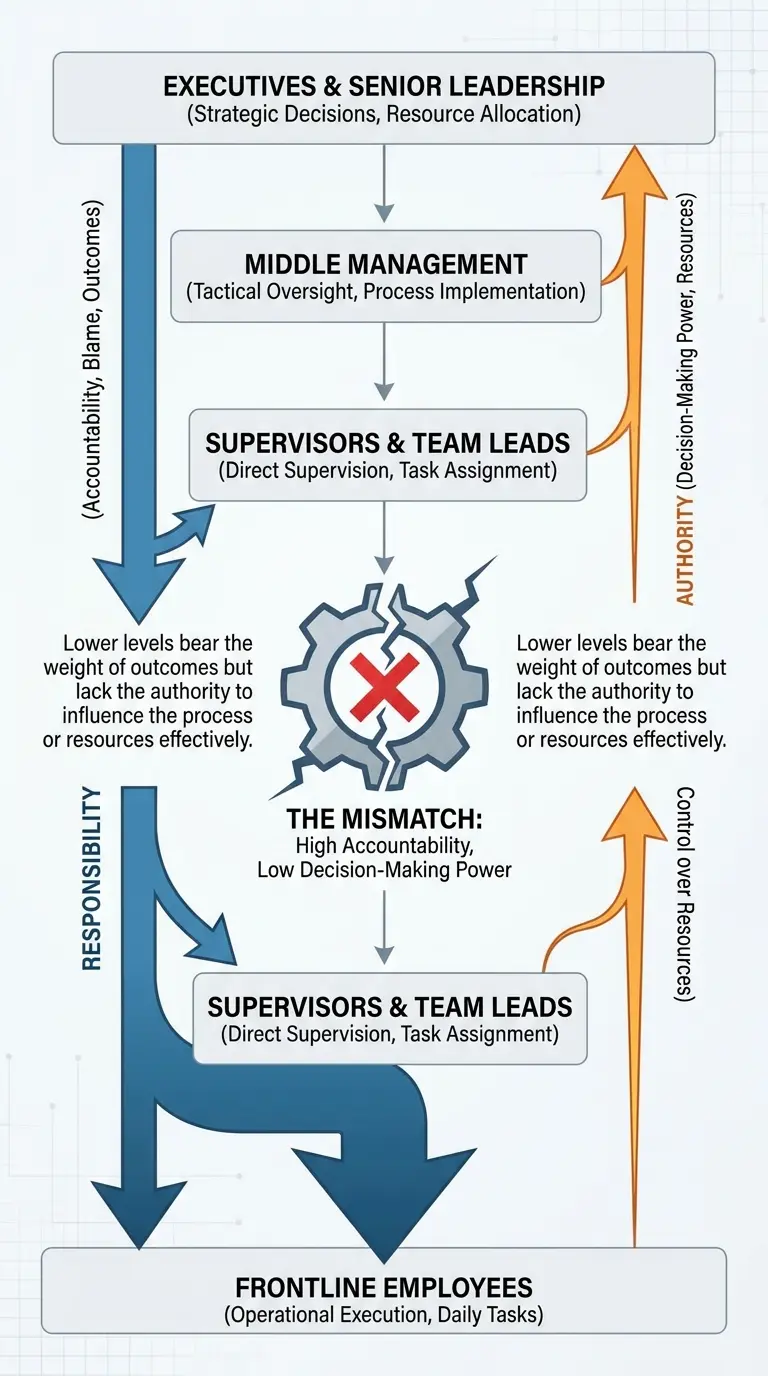
What makes this particularly toxic is the performance review system. We evaluate people based on results they couldn’t fully control, then wonder why they’re frustrated. Someone misses their goals because a key initiative got defunded halfway through the quarter, and it shows up as underperformance on their record.
Organizations create these gaps for what seem like good reasons. Centralized decision-making ensures consistency. Approval processes prevent costly mistakes. Standardized procedures maintain quality. But each control we add widens the autonomy gap for someone trying to do their job.
The gap also compounds over time. When people can’t make decisions, they stop trying. They escalate everything, which creates bottlenecks. Those bottlenecks slow down work, which leads to more controls and approval layers. You end up with organizations where everyone’s waiting on someone else to make a decision.
We talk about empowerment constantly, but empowerment without authority is just extra work. Giving someone ownership of an outcome while withholding the ability to influence it isn’t empowerment. It’s just a more sophisticated way to assign blame when things go wrong.
Fixing this requires actually redistributing decision rights, not just talking about trust and empowerment. It means identifying where responsibility and authority are mismatched and either giving people more control or reducing their accountability. Most organizations would rather keep the gap and wonder why employee engagement stays low.
And you’ll keep the gap. You’ll watch engagement tank and act shocked. Every quarter, same meeting, same confused executives asking “why aren’t people more engaged?” Because you won’t give them the authority to do what you’re holding them accountable for.
That’s why.
Information Asymmetry Is Killing Trust Faster Than Bad Management
Your manager knows the company’s considering layoffs but can’t tell you. Leadership decided to sunset your product line three months ago, but you’re still working on the roadmap. The reorganization that will eliminate your department is being planned while you’re being asked to set annual goals.
Information asymmetry (god, even that phrase sounds like a consulting deck) is simpler than that: your boss knows layoffs are coming and you don’t. You’re building a roadmap for a product they killed three months ago. That’s not “asymmetry,” that’s lying by omission.
You can’t make good choices when you don’t know what’s actually happening.
The standard response is that some information needs to be confidential. Fair enough. But most information asymmetry isn’t about legitimate confidentiality. It’s about control, politics, and the assumption that employees can’t handle reality.
We withhold information because we’re worried about how people will react, then we’re surprised when they don’t trust us.
Information gaps create a specific kind of damage. When people don’t have context for decisions, they fill the gap with assumptions. Those assumptions are almost always worse than the truth. Someone sees the executive team in a closed-door meeting and assumes layoffs. A project gets delayed without explanation, and everyone assumes it’s being canceled.
Silence breeds worst-case thinking.

The gap also makes it impossible to align work with actual priorities. You’re spending time on an initiative that leadership has already decided to kill, but no one told you. You’re optimizing for a metric that’s about to change. You’re building skills for a role that won’t exist next quarter. Misaligned effort feels like wasted effort, and wasted effort kills engagement faster than almost anything else.
I once watched a team spend six months building a feature for a product line that leadership had already decided to kill. Nobody told them. They found out when the shutdown announcement went company-wide. Six months of work, late nights, weekend pushes. Gone. And management wondered why those people seemed “disengaged” afterward.
You can’t do that to people and expect trust.
Information asymmetry concentrates power. If you’re the only person who knows what’s really happening, you become indispensable. If you control access to critical information, you control decision-making. This creates incentives to hoard rather than share, even when sharing would benefit the organization.
|
Information Type |
Typical Restriction Rationale |
Actual Cost of Withholding |
Better Approach |
|---|---|---|---|
|
Strategic direction changes |
“Still being finalized” |
Teams work on initiatives that will be cancelled |
Share direction with confidence levels attached |
|
Budget reallocation decisions |
“Don’t want to cause panic” |
People can’t prioritize work effectively |
Explain trade-offs and reasoning behind changes |
|
Reorganization plans |
“Legally can’t disclose early” |
Talent starts leaving based on rumors |
Share timeline and criteria as early as legally possible |
|
Performance metrics changes |
“Waiting for the right time” |
People optimize for metrics that no longer matter |
Announce changes when decided, not when convenient |
We’ve also built information systems that reinforce asymmetry. Slack channels with selective membership. Email chains that exclude key people. Meetings where decisions get made but notes never get shared. SharePoint folders with Byzantine permission structures. Each barrier we add protects information that probably didn’t need protecting.
Side note: the phrase “need to know basis” is doing so much work in corporate America. It sounds like national security protocol. You’re selling software, Janet, not guarding nuclear codes. But I digress.
The worst part is how information asymmetry interacts with the autonomy gap. You can’t exercise good judgment if you don’t know what’s happening. You can’t make smart decisions without context. Even when people have authority, they can’t use it effectively if they’re working with partial information.
Transparency isn’t about sharing everything. It’s about making sure people have the information they need to do their jobs and make informed choices about their careers. When you withhold that information, you’re not protecting the company. You’re just making it harder for people to trust you.
Recovery Time Matters More Than Workload
We obsess over workload balance and total hours, but we ignore the spacing between intense work periods. Someone can handle an 80-hour week if they get real recovery time afterward. That same person will burn out on 40-hour weeks if every single week is high-intensity with no breaks.
The human brain and body need recovery cycles. This isn’t about work-life balance or wellness. It’s about basic performance capacity.
Sustained high-intensity work without recovery degrades cognitive function, decision-making quality, and creative problem-solving. The degradation is measurable and predictable.
Most organizations have eliminated recovery time without realizing it. Every week is a sprint week. Every month is a critical month. Every quarter is make-or-break. There’s no such thing as a slow period anymore because we’ve optimized them away. If there’s any slack in the system, we fill it with more work.
Look, I’m probably oversimplifying the physiology here (I’m not a neuroscientist). But you don’t need a PhD to notice that people who never get a break eventually break. We’ve known this forever. We just pretend we don’t because acknowledging it would mean saying no to some opportunities, and we’re terrible at that.
The problem compounds because recovery isn’t just about time off. You need cognitive recovery (time when you’re not making complex decisions), emotional recovery (time when you’re not managing relationships or conflict), and creative recovery ( time when you’re not generating new ideas). Different types of work deplete different resources.
Someone might take vacation but spend the entire time thinking about work problems. That’s not recovery. Someone might have a light week but spend it in back-to-back meetings managing team conflicts. Also not recovery. We confuse reduced hours with reduced intensity, but they’re not the same thing.

Organizations also create recovery debt. You work at unsustainable intensity for months, planning to recover later. But later never comes because there’s always another urgent project. The debt accumulates until performance collapses, and we call it burnout. But it’s not a sudden failure. It’s the predictable result of insufficient recovery over time.
The spacing matters as much as the total load. Two months of high-intensity work followed by two weeks of genuine recovery is sustainable. Four months of moderate intensity with no recovery isn’t. We’re designing work patterns that guarantee degradation, then wondering why people seem disengaged.
Current work design also ignores individual variation in recovery needs. Some people need more recovery time between intense periods. Some people need different types of recovery. We treat everyone the same and then label the people who can’t sustain constant intensity as having poor resilience or work ethic.
What gets measured gets managed, and we don’t measure recovery. We measure output, hours, and deliverables. No one’s tracking whether people are getting adequate recovery time between high-intensity periods. No one’s monitoring recovery debt accumulation. We only notice when someone breaks.
Fixing this means building recovery into work design, not leaving it to individual responsibility. It means identifying high-intensity periods and mandating lower-intensity periods afterward. It means protecting recovery time as fiercely as we protect deadlines. Most organizations would rather push people harder and replace them when they burn out.
To improve employee engagement, we need to acknowledge that recovery isn’t optional. It’s a requirement for sustained performance.
The Competence Crisis No One Wants to Acknowledge
Here’s the thing nobody wants to say out loud: a lot of people are doing jobs they don’t actually know how to do.
Not because they’re incompetent. Because the job changed.
Three years ago, you were fully capable. You knew your role, you delivered, everyone was happy. Then the tools changed. The processes changed. Your responsibilities expanded. New expectations showed up in your performance review that nobody ever trained you on. And now you’re… what? Supposed to just figure it out?
You’re working twice as hard to compensate for skill gaps you’re not allowed to admit exist. Because admitting you don’t know how to do something feels like professional suicide. So you fake it, stress about it, Google it at midnight, and hope nobody notices you’re drowning.
The psychological cost of this is brutal. You know you’re underperforming. You’re exhausted from trying to compensate. And you can’t ask for help because that would expose the gap.
Organizations are making this worse. We promote people before they’re ready. Take our best engineer and make them a manager with zero management training. We expand job scopes without expanding capability development. We roll out new systems with a 45-minute training webinar and expect mastery.
I’ve watched this happen: Marketing person, great at her job for three years, gets promoted to team lead. Now she’s responsible for performance reviews, conflict resolution, resource allocation, strategic planning. None of which she’s ever done. No training. Just “congratulations, you’re a leader now, figure it out.”
She spent evenings watching YouTube videos on management. Read leadership books. Tried to handle an underperforming employee, the conversation went sideways, HR got involved. Her boss told her to “show more leadership presence.” She requested management training three times. Budget didn’t allow for it.
Fourteen months later, she took a demotion just to escape a job she was never equipped to do.
And here’s the part that makes me angry: we call this an engagement problem. We see someone struggling and assume they lack motivation or resilience. We send them to a wellness webinar. We don’t acknowledge that we handed them a job they don’t know how to do and then blamed them for not doing it well.

The competence gap is widening. Technology changes faster. Business models evolve more rapidly. The half-life of skills is shrinking. And we’re… cutting training budgets? Reducing onboarding time? Expecting people to be productive immediately?
Junior employees come in with different skill sets than we expect. They’re digital natives, sure, but that doesn’t mean they know your enterprise software or how to navigate organizational politics. They have gaps we’re not prepared for, and we’re not adjusting.
This creates a specific flavor of disengagement. It’s not that people don’t care. They’re spending so much energy just trying to appear competent that there’s nothing left for actual engagement. We see exhaustion and assume motivation problem. Wrong.
Full disclosure: I’ve been that manager who promoted someone without training them. Twice. Both times I told myself they’d “figure it out” because I had. Turns out I’d had a mentor who spent hours coaching me. I just didn’t realize it at the time because he made it look casual. I handed someone a job and called it opportunity. They called it drowning. I was wrong.
What makes this a crisis (and I’m using that word deliberately) is that it’s accelerating. The gap keeps widening. And we keep pretending it’s about individual motivation rather than systemic under-investment in development.
Most organizations won’t fix this. Because fixing it means admitting we’ve been under-investing in training while expanding role requirements. It means acknowledging that performance problems are often capability problems. Easier to blame motivation.
But if you’re wondering why your engagement scores are stuck? Look at the competence gap. Look at how many people are quietly drowning in jobs they were never taught to do.
Social Density and the Collaboration Paradox
Collaboration is good, right? More collaboration is better?
Wrong.
We’ve designed work that requires constant coordination. More meetings, more cross-functional projects, more stakeholder management. And the collaboration costs aren’t distributed evenly. Not even close.
Your best people carry the entire burden.
Think about it: who gets invited to every meeting? Who gets pulled into every decision? Who gets the “quick question” Slack messages at 8pm? Your high performers. Because they’re capable, they’re reliable, and everyone wants their input.
Meanwhile, your low performers? Nobody’s asking them anything. People route around them. They have low “social density” (fewer active work relationships, fewer demands on their time).
So your most capable people become bottlenecks. They spend entire days in meetings and responding to requests. No time for deep work. Their output drops. Not because they’re less capable, but because they’re drowning in collaboration overhead.
And here’s the paradox: increasing collaboration often decreases productivity.
Need input from five people to make a decision? You just added five coordination costs. Require three approvals for a simple change? You tripled implementation time. We’ve optimized for inclusion and consensus at the expense of getting anything done.
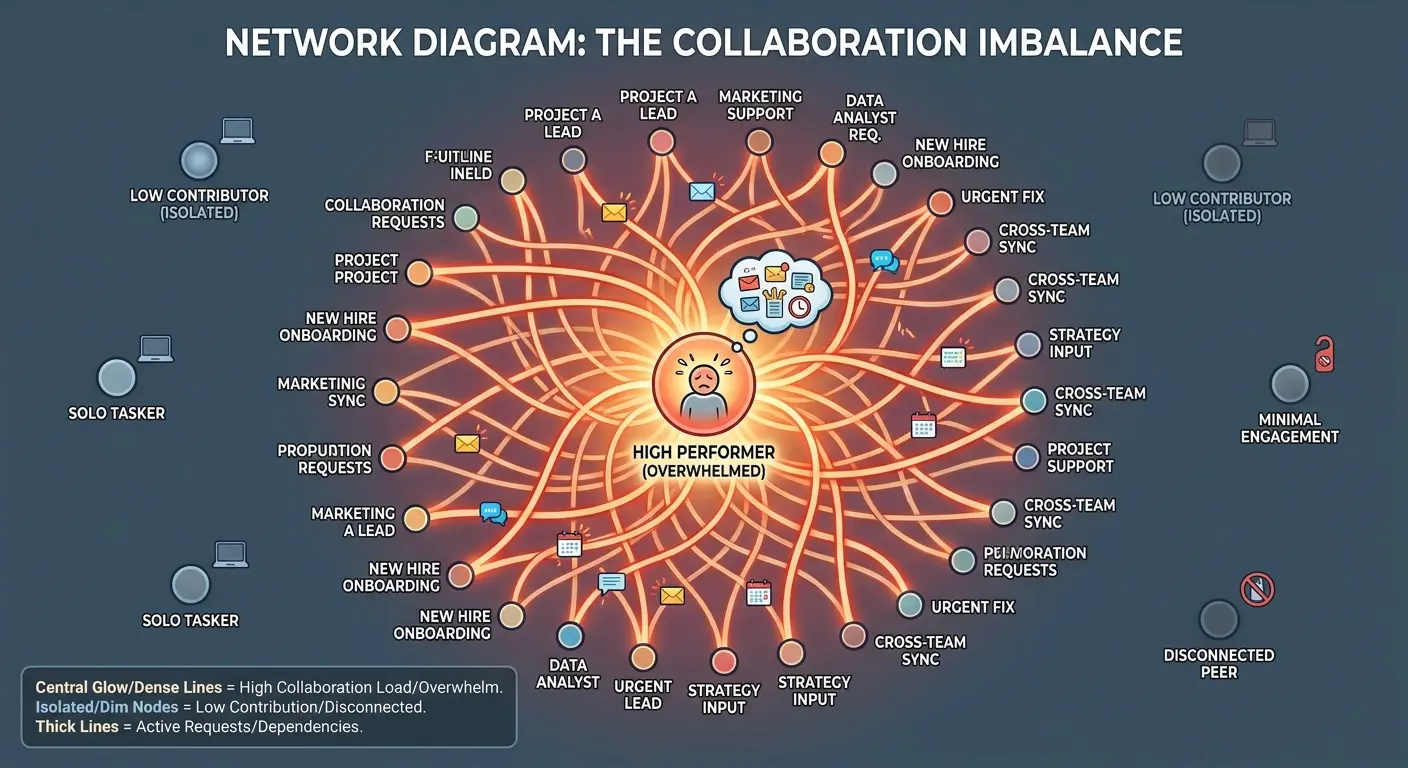
Collaboration also creates perfect hiding places. In a highly collaborative environment, you can’t tell who’s contributing and who’s just… present. Someone can attend every meeting, be on every email chain, and contribute almost nothing of substance. The social camouflage works because we measure participation, not impact.
Your high performers notice this. They’re working nights and weekends while their colleagues leave at five. They’re the ones people email when something’s urgent. They’re solving problems that aren’t their responsibility because nobody else will.
Eventually? They stop caring. Or they leave.
And your engagement survey completely misses this. Your high performers might report decent scores because they’re too busy to think about it. Your low performers report high engagement because they’re not stressed. The survey can’t capture that your collaboration patterns are slowly destroying your best people.
Different work requires different levels of collaboration. Some work benefits from multiple perspectives and shared ownership. Other work is better done by one person with minimal interruption. We’ve stopped distinguishing between the two. Everything is collaborative now, even when collaboration adds no value.

The remote work shift made this worse in some ways and better in others. Remote work exposed how much collaboration was performative presence. But it also made coordination harder and increased the communication burden. We replaced hallway conversations with Slack threads and Zoom calls, which often takes more time and energy.
Fixing social density problems means being selective about collaboration. It means protecting your high performers from constant requests. It means creating space for individual work that doesn’t require coordination. It means acknowledging that some people contribute more to collaborative work than others and adjusting expectations accordingly.
Most organizations won’t do this because it requires admitting that not all collaboration is valuable and not all team members contribute equally. We’d rather maintain the fiction that everyone’s equally engaged and equally productive while our best people quietly burn out.
Why Your Engagement Survey Questions Are Designed to Fail
Your engagement survey asks if you feel valued by your manager. It asks if you understand the company’s strategy. It asks if you’d recommend this as a great place to work.
These questions are designed to generate favorable responses, not useful information.
When you ask “Do you feel valued?” you’re measuring perception in a vacuum. Someone might feel valued because their manager says nice things, even while working in objectively terrible conditions. Someone else might not feel valued despite working in conditions that are actually quite good. The feeling tells you nothing about whether the underlying conditions need to change.
And most engagement surveys use leading questions. “Do you have opportunities for growth and development?” is leading. It assumes opportunities exist and you just need to find them. A better question would be “What prevents you from developing the skills you need?” But that might generate answers you don’t want to hear.
My favorite survey question is “Do you feel you have opportunities for growth?” Translation: “Have you considered that your stagnation might be a you problem?”
The response scales are broken too. “Strongly disagree to strongly agree” forces people into a framework that might not match their experience. Maybe the question itself is wrong. Maybe the premise doesn’t apply. Maybe they have a nuanced view that can’t be captured on a five-point scale.
We lose all that information.

Survey timing skews results. Annual surveys capture a snapshot that might not represent normal conditions. Someone might be having a great week when it arrives. Or a terrible one. Quarterly surveys create survey fatigue. People stop thinking and just click through.
And here’s the participation bias nobody talks about: the most disengaged people don’t complete the survey. They’ve already checked out. Why would they spend 20 minutes telling you how they feel? Your 70% response rate is missing data from the 30% who are probably most disengaged.
Organizations keep using these surveys because they produce trendable numbers. You can track scores over time, compare departments, benchmark against industry averages. The data is quantifiable and reportable.
Even if it’s completely useless for understanding what’s actually wrong.
The real failure? Engagement surveys ask about symptoms instead of conditions. How you feel instead of what’s preventing you from doing your job. Satisfaction instead of the structural problems creating dissatisfaction.
You end up with data that tells you people are unhappy but not why or what to do about it.
Better measurement would focus on operational friction. How often do you wait on approvals that delay your work? How many meetings could be eliminated without affecting outcomes? What information do you need but can’t access? How much time gets spent on work that doesn’t align with stated priorities?
These questions point toward fixable problems. Not abstract feelings.
We could also measure recovery patterns, autonomy gaps, information access, and skill development opportunities. These are concrete conditions that either exist or don’t. They’re not subject to individual perception in the same way that “feeling valued” is. They’re also directly actionable.
The survey industry has no incentive to change this. They sell standardized instruments that allow for benchmarking. Custom surveys that ask about specific operational conditions don’t allow for industry comparison. They’re harder to sell and harder to interpret.
So we keep using surveys that generate useless data because the alternative would disrupt an entire industry.
If you’re serious about understanding engagement, measure the conditions that enable it, not the feeling itself. Different questions. Different methods. Probably different vendors.
And accept that you might not get neat numbers that trend nicely in your quarterly board deck.
When we define employee engagement properly, we recognize it as an outcome of workplace conditions, not a standalone metric to be manipulated.
Building Systems That Make Engagement Inevitable
Engagement should be a byproduct of good system design, not a goal you chase directly. When work systems are designed well, employee engagement happens automatically. People want to do work that they’re capable of doing, that matters, and that they have some control over. Build those conditions into your systems, and engagement takes care of itself.
I don’t have a perfect blueprint for this. Every organization is different, and what works at a 50-person startup won’t work at a 5,000-person enterprise. But here’s what I’ve seen work more often than not.
Start with decision rights. Map out where responsibility and authority are mismatched. Give people decision-making power over the outcomes they’re accountable for, or reduce their accountability to match their actual authority. This isn’t about empowerment theater. It’s about making sure people can do what you’re asking them to do.
Information flow comes next. Identify what information people need to do their jobs and make informed career decisions. Build systems that default to transparency rather than confidentiality. If information needs to be restricted, require explicit justification. Most information hoarding is habitual, not necessary.
Design work patterns that include recovery. Identify high-intensity periods and mandate lower-intensity periods afterward. Track recovery debt the same way you track technical debt. Protect recovery time from being filled with more work. This requires saying no to some opportunities, which most organizations hate doing.
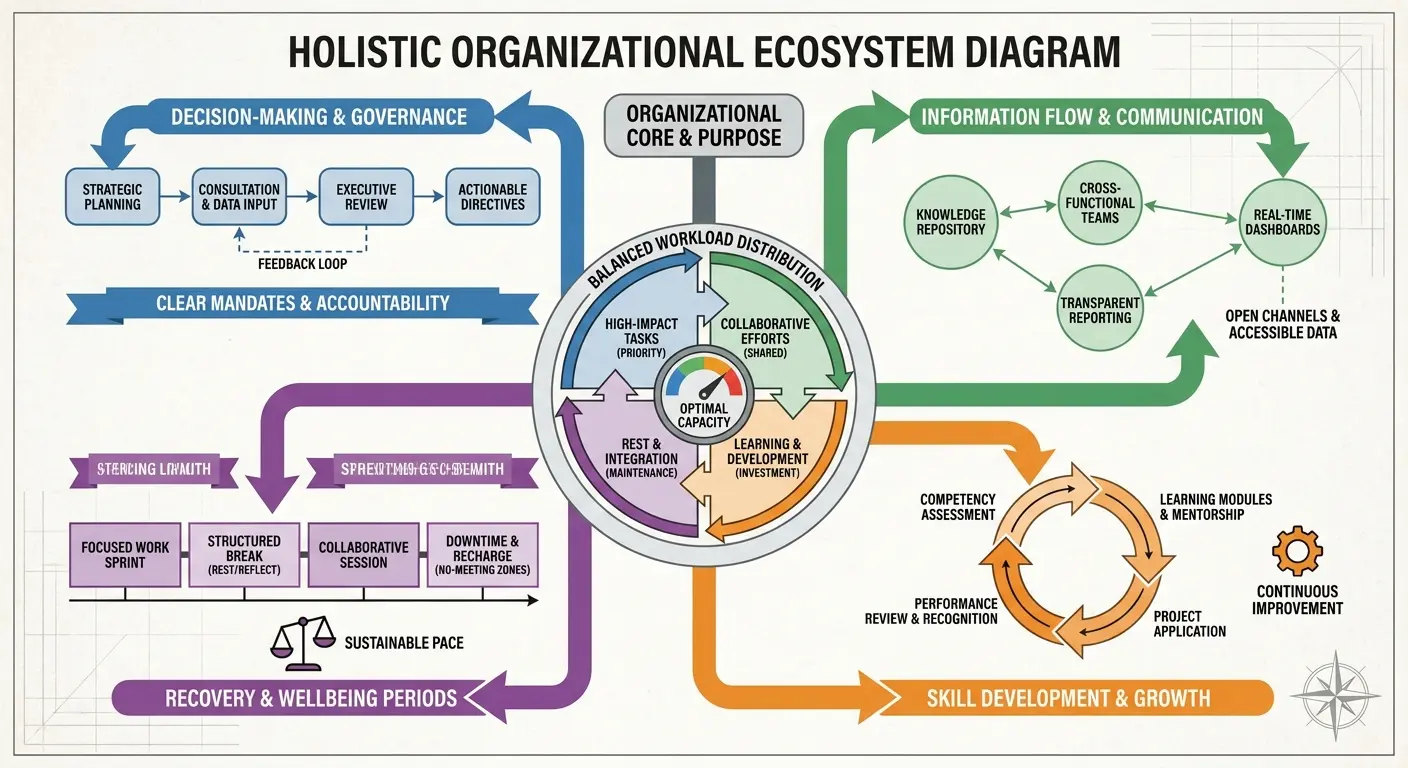
Address the competence gap directly. Increase training budgets to match the rate of skill requirement growth. Build learning time into job expectations rather than treating it as something people do on their own time. Create real onboarding periods where productivity expectations are reduced while people develop capabilities.
(And before you say “but we have a training budget,” you have a LinkedIn Learning subscription that nobody opens. That’s not a training budget. That’s a checkbox.)
Redesign collaboration patterns to distribute the burden more evenly. Identify your high-social-density people and actively protect their time. Create collaboration protocols that specify when coordination is required and when it’s optional. Give people permission to say no to meetings and requests that don’t align with their core responsibilities.
Fix your measurement systems. Stop using engagement surveys that measure feelings. Start measuring the conditions that create engagement: decision authority, information access, recovery time, skill development, and collaboration burden. Track operational friction points and eliminate them one by one.
All of this requires treating engagement as a system design problem rather than a people problem. The current approach assumes that if engagement is low, something’s wrong with employees (their motivation, their resilience, their attitude). The system design approach assumes that if engagement is low, something’s wrong with the conditions you’ve created.
System design also requires patience. You can’t fix structural problems with quick initiatives. You need sustained attention over time . You need to resist the temptation to add more employee engagement programs when what you really need is to fix your information flow or redistribute decision rights.
The hardest part is that system design requires admitting that current systems are broken. It requires acknowledging that you’ve been optimizing for the wrong things (efficiency, control, consistency) at the expense of the conditions that enable engagement. Most executives would rather blame individual employees than confront the systems they’ve built.
Employee engagement strategies that focus on conditions rather than sentiment produce lasting results. Employee engagement solutions that address structural problems outperform those that treat symptoms. When you enhance employee engagement by redesigning the conditions rather than trying to boost the metric, both engagement and performance improve.
The work isn’t flashy. There’s no recognition program or wellness app. You’re just fixing the things that were making it hard for people to do their jobs. But that’s what works.
Will this fix everything? No. Are there gaps in this approach? Absolutely. Will it be expensive and difficult? Yes.
But it’s less expensive than replacing your entire workforce every two years because nobody can sustain the conditions you’ve created.
Building systems that make engagement inevitable means accepting that you can’t motivate your way out of structural problems. You have to fix the structure. That’s more expensive and more difficult than launching another engagement initiative, which is why most organizations won’t do it. But if you’re serious about engagement, it’s the only approach that delivers.
Final Thoughts
So here’s where we end up:
We keep trying to solve engagement by changing how people feel about broken systems. Better approach? Fix the systems so people don’t have to feel bad about them in the first place.
This isn’t about empathy or communication (though those don’t hurt). It’s about recognizing that engagement is downstream from conditions. When you create conditions where people can do good work, have control over their outcomes, access the information they need, recover between intense periods, develop necessary skills, and collaborate without drowning in it?
Engagement happens automatically.
The measurement problem matters because what you measure shapes what you optimize for. Measure feelings, you’ll try to change feelings. Measure conditions, you’ll fix conditions. One approach generates temporary sentiment improvements. The other builds sustainable high performance.
Most organizations won’t make these changes. They’re hard. They’re expensive. They require admitting that current approaches aren’t working. So they’ll keep launching engagement initiatives, running surveys, wondering why the numbers don’t improve.
The organizations that figure this out will have an enormous competitive advantage. Not because their people are more engaged. Because they’ve built systems that make good work possible.

Understanding what is employee engagement at its core means recognizing it as an outcome, not an input. The drivers of employee engagement aren’t motivational speeches or recognition programs. They’re the structural conditions that enable people to succeed. A comprehensive employee engagement plan focuses on fixing autonomy gaps, information flow, recovery patterns, skill development, and collaboration design rather than implementing more engagement solutions that treat symptoms.
Employee engagement examples that work share a common thread: they address underlying conditions rather than surface-level morale. Driving employee engagement requires examining the systems that either enable or prevent good work. An effective employee engagement plan starts with diagnosis of structural problems, not deployment of feel-good initiatives.
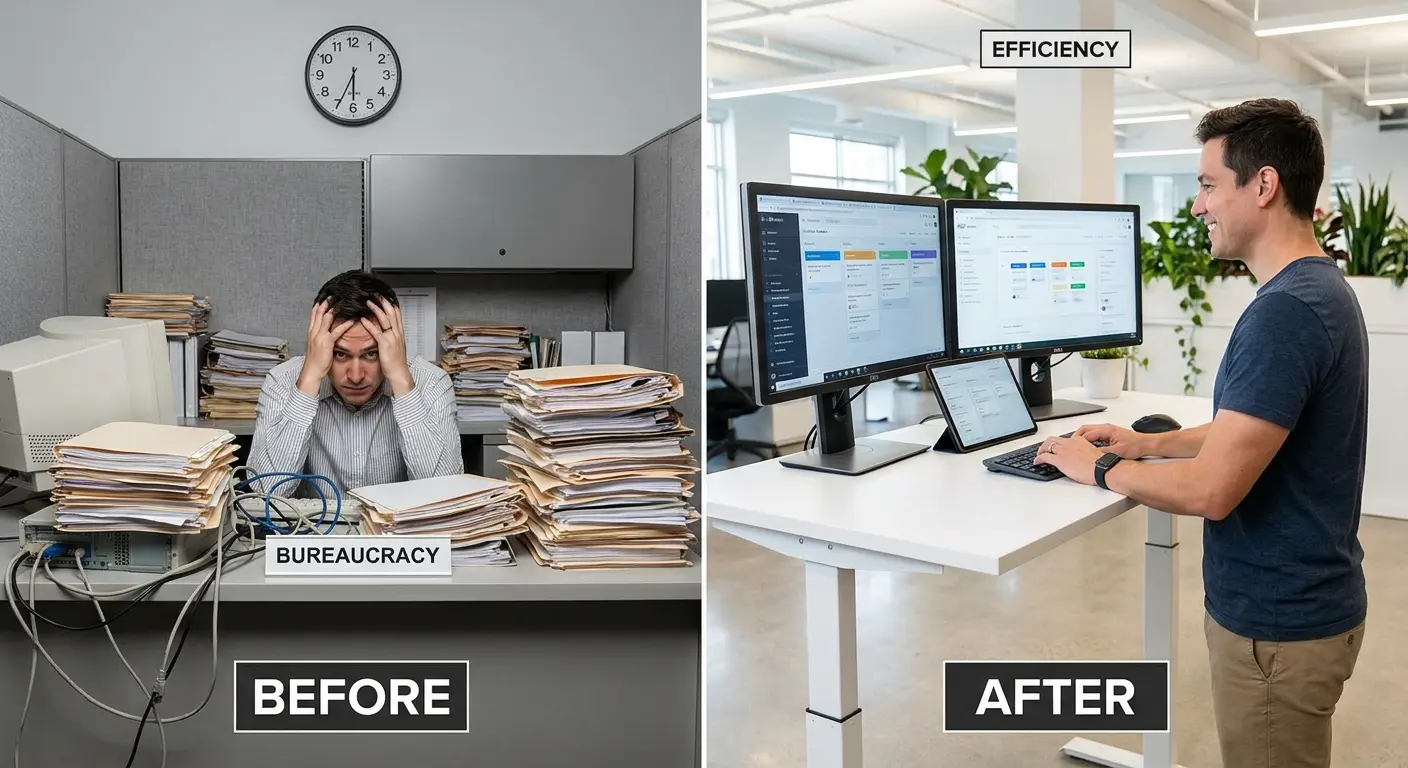
Engagement isn’t the goal. Never was. It’s just the canary in the coal mine, the signal that tells you whether your systems are working.
Stop trying to revive the canary with pizza parties and recognition programs. Fix the air quality.
Fix the autonomy gaps. Fix the information flow. Build in recovery time. Address the competence crisis. Redesign collaboration patterns. Measure conditions instead of feelings.
It’s not flashy. There’s no app for it. You’re just fixing the things that were making it hard for people to do their jobs.
But that’s what actually works.
Most companies won’t do it. They’ll stick with engagement initiatives that treat symptoms while the structural problems get worse. They’ll wonder why their best people keep leaving.
If you’re one of the few who actually fixes the systems instead of chasing the metric? You’re going to run laps around your competition.
Not because your people are more “engaged.”
Because they can actually do their jobs.