



Everyone thinks SWOT is dead. “It’s too basic,” they say. “We did one in 2019 and it was useless.”
Yeah, because you did it wrong.
I’ve watched this play out dozens of times. Six executives walk into a conference room at 2pm on a Thursday. Someone pulls up a blank SWOT template. “Okay, what are our strengths?” Crickets. Then someone says “customer service?” and everyone nods because they want this meeting to end by 3pm. Two hours later, you’ve got a slide deck full of obvious observations that nobody will look at again until next year’s planning session.
That’s not SWOT’s fault. That’s your fault.
The framework isn’t the problem. You’re treating SWOT like a static checklist when it should function as a dynamic interrogation system. Most companies stop at surface-level identification when the real value lives in the collision points between quadrants. Yeah, understanding what is swot analysis comes down to this: it’s a strategic planning method for evaluating Strengths, Weaknesses, Opportunities, and Threats. Everyone knows that part. It’s everything that comes after where people screw up.
TL;DR
- SWOT fails because teams treat it as a one-time checklist instead of an ongoing interrogation system
- Real insights emerge where quadrants intersect (strengths that amplify opportunities, weaknesses that worsen threats)
- Running temporal SWOT across three time horizons reveals blind spots that single-point analysis misses
- Your competitors’ threats section often contains your best opportunity intel
- Weaknesses can become differentiation points when repositioned correctly
- Different stakeholders see different SWOT realities, and reconciling these perspectives uncovers hidden gaps
- Assigning probability scores transforms vague SWOT observations into actual decision-making tools
- SWOT should update quarterly at minimum, with trigger-based reviews when market conditions shift
- Some situations require abandoning SWOT for frameworks better suited to complexity or rapid change
- Action plans must map directly to specific quadrant intersections, not generic “leverage strengths” bullshit
Why SWOT Fails (And It’s Not the Framework’s Fault)
Here’s what actually happens in most SWOT sessions: zero preparation.
You can’t walk into a conference room with zero context and expect anything useful. But that’s exactly what companies do. I’ve seen executive teams spend two hours filling quadrants with every random thought that surfaces, then act surprised when the output is garbage.
Before you even open the template, you need groundwork. Market research. Competitive intelligence. Customer feedback data. Financial performance metrics. Before asking what does swot stand for (Strengths, Weaknesses, Opportunities, Threats) or what does swot analysis stand for, you need raw material to analyze, not just opinions floating around the room.
The execution mistakes? They’re consistent across industries. Doesn’t matter if you’re selling software or sandwiches, everyone makes the same mistakes:
Teams rush through without establishing evaluation criteria. They generate lists without context. Prioritization never happens. And here’s the big one: they fail to connect SWOT findings to actual decisions. It becomes a box-checking requirement instead of something that changes what you do on Monday morning.
The Facilitation Problem Nobody Mentions
Whoever runs your SWOT session controls the quality of your output.
Most facilitators treat the exercise as democratic brainstorming where every contribution carries equal weight. This produces noise, not signal. Actually, that’s not quite right. It produces a wall of sticky notes that mean absolutely nothing.
Strong facilitation means challenging vague statements. “Our customer service is a strength” is meaningless. Compared to whom? Measured how? Valued by which customer segments? You need to push until you reach concrete, defensible observations.

The best SWOT sessions I’ve participated in had facilitators who asked “so what?” after every single entry. Strengths that don’t connect to opportunities are just facts. Weaknesses that don’t intersect with threats are improvement areas, not strategic priorities. Who cares?
You’re Confusing Symptoms with Root Causes
Teams list “low brand awareness” as a weakness when the actual weakness is insufficient marketing budget or unclear value proposition. They identify “increased competition” as a threat without examining why competitors are gaining ground.
SWOT requires diagnostic thinking.
Surface-level observations fill space but don’t inform strategy. When you identify a swot weakness, you need to trace it back to its origin. Is your slow product development cycle actually a weakness, or is it a symptom of risk-averse leadership, siloed departments, or outdated technology infrastructure?
One of our clients (SaaS company, about 40 employees) listed “slow feature releases” as a weakness in their initial SWOT. We pushed deeper. Turns out the real weakness was a legacy codebase that required three weeks of regression testing for any change. The symptom was slow releases. The root cause was technical debt that had been accumulating for five years.
They’d been planning to hire more developers. Wrong answer. What they actually needed was a code modernization project. Without diagnostic thinking, they would’ve thrown $300K at hiring when the problem was architectural. More devs would’ve made things worse, not better.
The same applies to opportunities. “Expanding into new markets” isn’t an opportunity until you specify which markets, why you’re positioned to succeed there, and what capability gaps you need to close first.
The Prioritization Gap
Everything can’t be equally important. But I regularly see SWOT analyses with fifteen strengths, twelve weaknesses, ten opportunities, and eight threats.
No organization can act on that volume of inputs simultaneously. You just can’t.
Prioritization should happen during the SWOT process, not after. Each quadrant needs ranking criteria established upfront. For strengths: how defensible is this advantage, and how much does it matter to our target customers? For weaknesses: what’s the competitive impact if we don’t address this? For opportunities: what’s the potential return versus required investment? For threats: what’s the probability of occurrence and the severity of impact?
Rank everything. Force tough choices.
The top three items in each quadrant should be obvious by the time you finish. If they’re not, you haven’t done the work.
The Collision Method: Where Quadrants Intersect
Traditional SWOT stops at categorization. You sort observations into four boxes, then move to strategy development as if those boxes exist independently.
They don’t.
Your strengths mean nothing in isolation. They matter only when applied to opportunities or used to neutralize threats. Your weaknesses become critical when they prevent you from capturing opportunities or when they amplify incoming threats.
Here’s what I mean:
|
Intersection Type |
Strategic Question |
Action Priority |
|---|---|---|
|
Strength × Opportunity |
How can we use this advantage to capture this market opening? |
High (Offensive Strategy) |
|
Strength × Threat |
Can we deploy this capability to neutralize this danger? |
Medium (Defensive Strategy) |
|
Weakness × Opportunity |
Does this gap prevent us from pursuing this potential? |
Medium (Build or Partner Decision) |
|
Weakness × Threat |
Does this limitation expose us to this risk? |
Critical (Immediate Mitigation) |
|
Strength × Weakness |
Can we use strong areas to compensate for weak areas? |
Low (Internal Optimization) |
|
Opportunity × Threat |
Does pursuing this opening expose us to new dangers? |
Medium (Risk Assessment Required) |
Strength-Opportunity Multiplication
This intersection should drive your offensive strategy. Which strengths position you to capture which swot opportunities most effectively? You’re looking for multiplicative combinations where strength plus opportunity equals disproportionate advantage.
Maybe you’ve got strong customer relationships (strength) and you’ve identified growing demand for integrated solutions (opportunity). The collision point? Offering bundled services to existing customers before competitors can establish relationships in that space. The strength accelerates your ability to capture the opportunity.
Map every strength against every opportunity. Most combinations will be weak or nonexistent. That’s fine. You’re looking for the handful where the match is obvious and powerful.
Weakness-Threat Amplification
This intersection reveals your vulnerabilities.
When weaknesses align with threats, you face existential risk. A company with weak cybersecurity infrastructure facing increasing regulatory scrutiny and rising cyber threats sits at a dangerous collision point. That’s not theoretical. That’s a company about to get destroyed.
These intersections demand immediate attention. You can’t ignore weaknesses that directly expose you to active threats. Prioritization becomes simple: address the weakness-threat collisions first, everything else second.
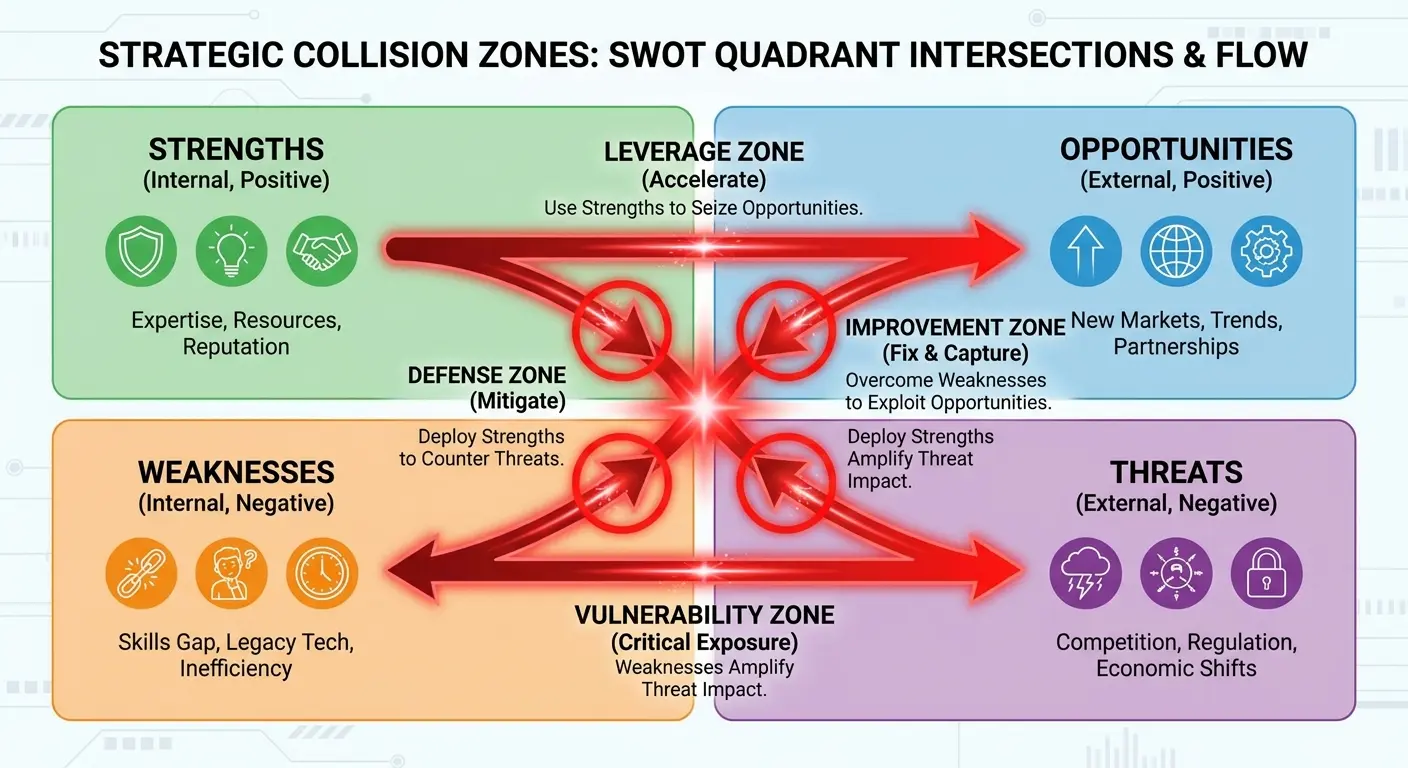
Some weakness-threat combinations are tolerable. Weak international presence doesn’t matter much if your threats are domestic. But when they align? You’ve identified your strategic emergency.
Strength-Threat Defense
You can deploy strengths defensively, and people forget this.
Strong brand loyalty can buffer against new competitor entry. Deep technical expertise can counteract commoditization threats. Efficient operations can withstand margin pressure.
This intersection often gets overlooked because teams focus on using strengths offensively. But defensive applications of strength are equally strategic. Which threats can you neutralize or minimize by leveraging existing strengths?
Sometimes the best use of a strength isn’t capturing new opportunity. It’s protecting current position. That’s not defensive thinking, that’s smart resource allocation.
Weakness-Opportunity Conflicts
Opportunities you can’t capture because of existing weaknesses are particularly frustrating. You see the potential but lack the capability to execute.
This intersection forces a critical question: do we build the capability, partner to access it, or skip the opportunity entirely?
A B2B services firm we worked with identified enterprise-level opportunities but had a weakness in handling complex, long-cycle sales. Their average deal closed in 45 days with three decision-makers. Enterprise deals required 6-9 months with committees of eight to twelve stakeholders.
The collision point demanded a decision: invest $400K in enterprise sales capability and wait 18 months for ROI, partner with an enterprise-focused firm and split margins, or focus on mid-market opportunities that matched current strengths.
They chose the third option. Revenue grew 40% by dominating a segment they could actually serve.
Not every opportunity deserves pursuit. Weakness-opportunity conflicts help you identify which opportunities to abandon.
Temporal SWOT: Past, Present, Future Analysis
SWOT typically captures a single moment. You analyze your current state, then build strategy from that snapshot.
This misses the motion of things.
Strengths don’t remain strengths forever. Weaknesses can be corrected. Opportunities close. New threats emerge. Running SWOT across three time horizons (past, present, future) reveals patterns that single-point analysis conceals.
Retrospective SWOT: Learning from Trajectory
Conduct a SWOT for your organization three years ago. What were your strengths then? Which ones still exist? Which have degraded or disappeared entirely? What weaknesses have you successfully addressed, and which have persisted or worsened?
This retrospective view reveals your organization’s actual capability to change.
If your weaknesses from three years ago are identical to today’s weaknesses, you have an execution problem. If your strengths have eroded, you’re not maintaining competitive advantage. Simple as that.
The retrospective also shows which opportunities you captured and which you missed. Pattern recognition here is valuable. Do you consistently overestimate your ability to execute on certain opportunity types? Do you underestimate specific threat categories?
Present SWOT: The Standard Analysis
Your current-state SWOT serves as the baseline. This is the traditional analysis most teams conduct. But now you’re positioning it within a temporal context rather than treating it as the complete picture.
Present-state SWOT should be your most detailed analysis. You have the most information about current conditions and the clearest view of immediate factors.
But don’t stop here.
Prospective SWOT: Anticipating Migration
Project forward three years. Which current strengths are likely to erode or become irrelevant? What weaknesses will become critical if unaddressed? Which opportunities will close, and what new ones might emerge? What threats are forming now but won’t impact you until later?
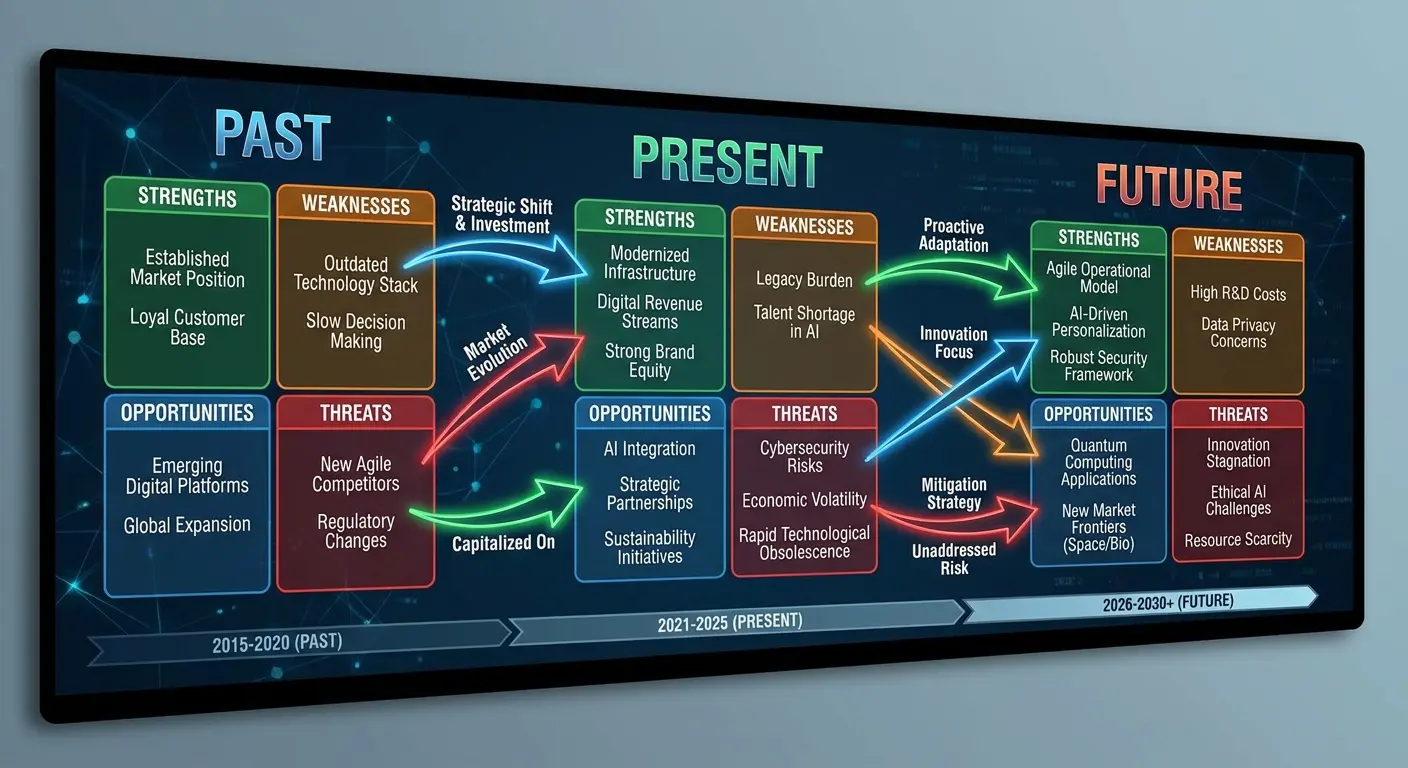
This forward-looking analysis forces you to think about strategic decay. Your competitive advantages have half-lives. Technology strengths become obsolete. Relationships retire or move. Cost advantages get competed away.
If you’re not actively maintaining and evolving your strengths, they’re already weakening.
The prospective view also identifies which weaknesses are becoming urgent. A minor capability gap today might become a major competitive disadvantage in three years if market conditions shift. Address it now while it’s still manageable.
Cross-Temporal Pattern Recognition
The real insight comes from comparing all three time horizons. What’s the trajectory of each factor?
You’re looking for:
- Strengths that are degrading (act to reinforce or replace them)
- Weaknesses that are persistent (fundamental issues requiring structural change)
- Opportunities that are recurring (systematic advantages you should exploit more consistently)
- Threats that are accelerating (require immediate response)
For each factor, document:
- Three Years Ago Status: Where did this rank? (High/Medium/Low impact)
- Current Status: Where does it rank today?
- Three Years Forward Projection: Where will it likely rank?
- Trajectory : Strengthening / Stable / Weakening / New Factor / Disappearing
- Action Required: Reinforce / Maintain / Address / Exploit / Monitor / Abandon
Factors that appear in the same quadrant across all three time periods are either core characteristics or chronic issues. Factors that migrate between quadrants reveal the dynamic nature of your position.
Competitive Blind Spots Hidden in Your Threats
Most teams treat the threats quadrant as a passive list of external dangers. They document competitive moves, market shifts, and regulatory changes, then move on.
This wastes the intelligence embedded in threat analysis.
Every threat you identify reveals something about your strategic position, your market, or your competitors. The question isn’t just “what threatens us?” but “why does this threaten us, and what does that reveal?”
Much like understanding competitive strategy frameworks, threat analysis requires examining not just what competitors do, but why certain actions threaten your position.
Asymmetric Threat Analysis
A factor that threatens you might not threaten your competitors. Why?
You’ve identified a relative weakness or a positioning difference. If regulatory changes threaten you but benefit competitors, you’re positioned differently in terms of compliance burden, business model, or market segment.
This asymmetry contains intelligence. You can reposition to reduce the threat’s impact, or you can accept the positioning difference and double down on advantages that offset the vulnerability.
I worked with a client who identified data privacy regulations as a major threat. Their competitors, who collected less customer data, faced minimal impact. The threat analysis revealed that the client’s data-intensive approach (previously seen as a strength) was becoming a liability.
The choice: reduce data collection and lose analytical advantage, or invest heavily in compliance infrastructure and maintain the data advantage. They chose the latter, but only because threat analysis forced explicit recognition of the trade-off.
Your Competitors’ Threats Are Your Opportunities
If new technology threatens established competitors, it might represent opportunity for you. If market consolidation threatens smaller players, you might be positioned to acquire distressed assets. If changing customer preferences threaten traditional offerings, your alternative approach might gain traction.
Systematically analyze each threat from your competitors’ perspective. Does this threat impact them more or less than it impacts you?
Threats that disproportionately affect competitors represent offensive opportunities.

This requires understanding competitors’ SWOT, not just your own. You don’t need perfect information. Educated assessment based on public information, customer feedback, and market observation is sufficient to identify relative vulnerability.
Threat Clustering Reveals Market Shifts
When multiple threats cluster around a common theme, you’re seeing a fundamental market shift.
Three separate threats related to customer acquisition costs, customer retention challenges, and increased competition for attention all point to the same underlying shift: customer acquisition is becoming more difficult and expensive.
Clustering helps you see the forest instead of individual trees. You’re not facing five separate threats. You’re facing one major market transformation manifesting in multiple ways. Your strategic response should address the root shift, not each symptom independently.
Group your threats by underlying cause. Technology threats. Competitive threats. Economic threats. Regulatory threats. Then look for themes within each category. Are multiple threats pointing to the same fundamental change in your operating environment?
Threat Timing and Probability
Not all threats are equally likely or equally imminent.
Assigning probability and timeline to each threat transforms the list from anxiety-inducing to actionable. High probability, near-term threats demand immediate response. Low probability, distant threats warrant monitoring but not resource allocation.
The dangerous quadrant? High probability, distant threats. They’re easy to deprioritize despite their inevitability.
Score each threat on two dimensions: likelihood (high, medium, low) and timeline (immediate, near-term, long-term). This creates a prioritization matrix that focuses attention on threats that actually matter.
Turning Weaknesses Into Market Positioning
The default response to identifying weaknesses is planning to fix them.
Sometimes that’s correct. Often it’s a waste of resources.
Not every weakness matters to every customer. Some weaknesses are actually positioning choices that attract certain segments while repelling others. The question isn’t “how do we eliminate this weakness?” but “does this weakness prevent us from serving our target customers effectively?”
Positioning Through Limitation
Companies that openly acknowledge limitations often build stronger customer relationships than those claiming universal capability.
A consultancy that only serves mid-market companies and explicitly turns away enterprise clients isn’t weak. It’s focused.
Your weakness might be someone else’s preference. Can’t offer 24/7 support? Some customers prefer working with small, focused teams during business hours. Don’t have a massive product catalog? Some buyers want simplicity and expertise in a narrow domain.
Reframing requires honesty about who you’re for and who you’re not for. Once you accept that you can’t serve everyone, weaknesses transform into positioning statements.
The Resource Constraint Advantage
Limited resources force prioritization. Well-funded competitors can pursue multiple strategies simultaneously. You can’t.
This limitation forces you to choose, and choosing creates clarity.
Customers often prefer vendors who’ve made clear strategic choices over those trying to be everything to everyone. Your resource constraints forced focus, and that focus became expertise, speed, or specialization.
A boutique agency with eight employees competed against firms with 200+ staff for a major account. Their “weakness” of limited capacity became their pitch: “We can only take on three clients at a time, which means your project gets partner-level attention daily, not junior staff supervised occasionally. The big firms will assign you to a team you’ll never see again. You’ll have our founders in every meeting.”
They won the account specifically because their resource constraint forced a service model the client preferred.
Strategic Weakness Acceptance
Some weaknesses aren’t worth fixing.
If addressing a weakness requires resources that could be better spent amplifying strengths, leave the weakness alone.
This requires clear-eyed assessment of opportunity cost. Yes, improving your weakness would be beneficial. But what are you not doing in order to make that improvement? Could those same resources generate more value by doubling down on existing strengths?

Document the weaknesses you’re choosing not to address and why. This prevents them from resurfacing in every planning session. You’ve made an active choice to accept the limitation, and that choice should be explicit.
Finding the Right Customers for Your Weaknesses
Different market segments weight factors differently. Your weakness might be irrelevant to a specific customer type.
A software company with weak documentation might struggle with enterprise buyers who need extensive onboarding materials but thrive with technical users who prefer learning by doing.
Segment analysis reveals which weaknesses actually matter. Map your weaknesses against your customer segments. Which segments care deeply about this weakness? Which segments are indifferent?
Focus on segments where your weakness profile matches their priority profile.
This isn’t about lowering standards. You’re identifying customers who genuinely don’t value the things you’re weak at and deeply value the things you’re strong at. That’s strategic fit, not settling.
The Stakeholder Lens: Multiple SWOT Perspectives
Your leadership team’s SWOT reflects one perspective. Your sales team would produce a different analysis. Your customers would produce another.
Each perspective is partial, and the gaps between them reveal blind spots.
Running SWOT from multiple stakeholder viewpoints surfaces assumptions you didn’t know you were making. What you consider a strength might not be valued by customers. What executives see as an opportunity might look impossible to the people who’d have to execute it.
Internal Perspective Gaps
Your executive team sees different strengths and weaknesses than your front-line employees.
Executives often overestimate organizational capabilities because they see strategy and intention rather than execution reality. Front-line staff see implementation challenges that executives miss.
Conduct separate SWOT sessions with different internal groups. Don’t blend them into one session where hierarchy suppresses dissenting views. You want unfiltered perspectives, not consensus.
The gaps between these analyses are your action items. When executives list something as a strength that front-line staff list as a weakness, you’ve found a perception-reality gap that needs investigation. Either the strength isn’t being executed consistently, or executives are out of touch with operational reality.
The Customer View
Your customers’ SWOT of your company reveals what actually matters in the market. What they identify as your strengths are your real competitive advantages. What they see as weaknesses are the factors actually influencing buying decisions.
You can gather this through structured interviews. Ask customers what they see as your company’s greatest strengths compared to alternatives. Ask what weaknesses or gaps they’ve noticed. Ask what opportunities they wish you’d pursue. Ask what external factors threaten the value you provide to them.
Customer-generated SWOT often contradicts internal SWOT dramatically. Features you think are strengths go unmentioned. Capabilities you’ve undervalued appear prominently. This disconnect is valuable data about where you’re investing versus where value is perceived.
Competitive Perspective Simulation
Try to construct your competitors’ SWOT of their own position. What do they likely see as their strengths? Where might they see opportunity?
This exercise forces you to understand competitive strategy, not just competitive position.
If you understand what competitors see as their strengths and opportunities, you can anticipate their moves. You’re not reacting to what they do. You’re predicting what they’ll do based on their likely assessment.
This simulation also reveals where competitors might see you as a threat. Understanding how you appear in competitors’ threat quadrant helps you anticipate competitive response to your moves.
Investor or Board Perspective
External stakeholders with financial interest see different factors as strengths and weaknesses. Investors care about scalability, defensibility, and market size. They might dismiss operational strengths that don’t translate to financial performance or strategic value.
Understanding the investor perspective on your SWOT helps you communicate strategy more effectively. You’re translating between operational reality and financial implications. When you identify a strength, you can articulate why it matters financially. When you acknowledge a weakness, you can explain the plan to address it in terms investors care about.
Board members often have cross-industry perspective that reveals threats or opportunities you’ve missed. Their SWOT input brings pattern recognition from other markets and business models.
Quantifying the Unquantifiable in SWOT
SWOT analyses typically produce qualitative lists. “Strong brand” sits next to “experienced team” with no indication of relative importance. “Increasing competition” appears alongside “regulatory uncertainty” without any assessment of likelihood or impact.
Quantification transforms SWOT from discussion starter to decision-making tool.
You don’t need perfect precision. You need relative scoring that enables comparison and prioritization.
Impact Scoring for Strengths and Weaknesses
Rate each strength and weakness on impact: how much does this factor affect business performance? Use a simple 1-10 scale or low-medium-high categories.
High-impact strengths are your core competitive advantages. These deserve continued investment and protection. Low-impact strengths are nice to have but shouldn’t drive strategy. Medium-impact strengths might be worth amplifying if the cost is reasonable.
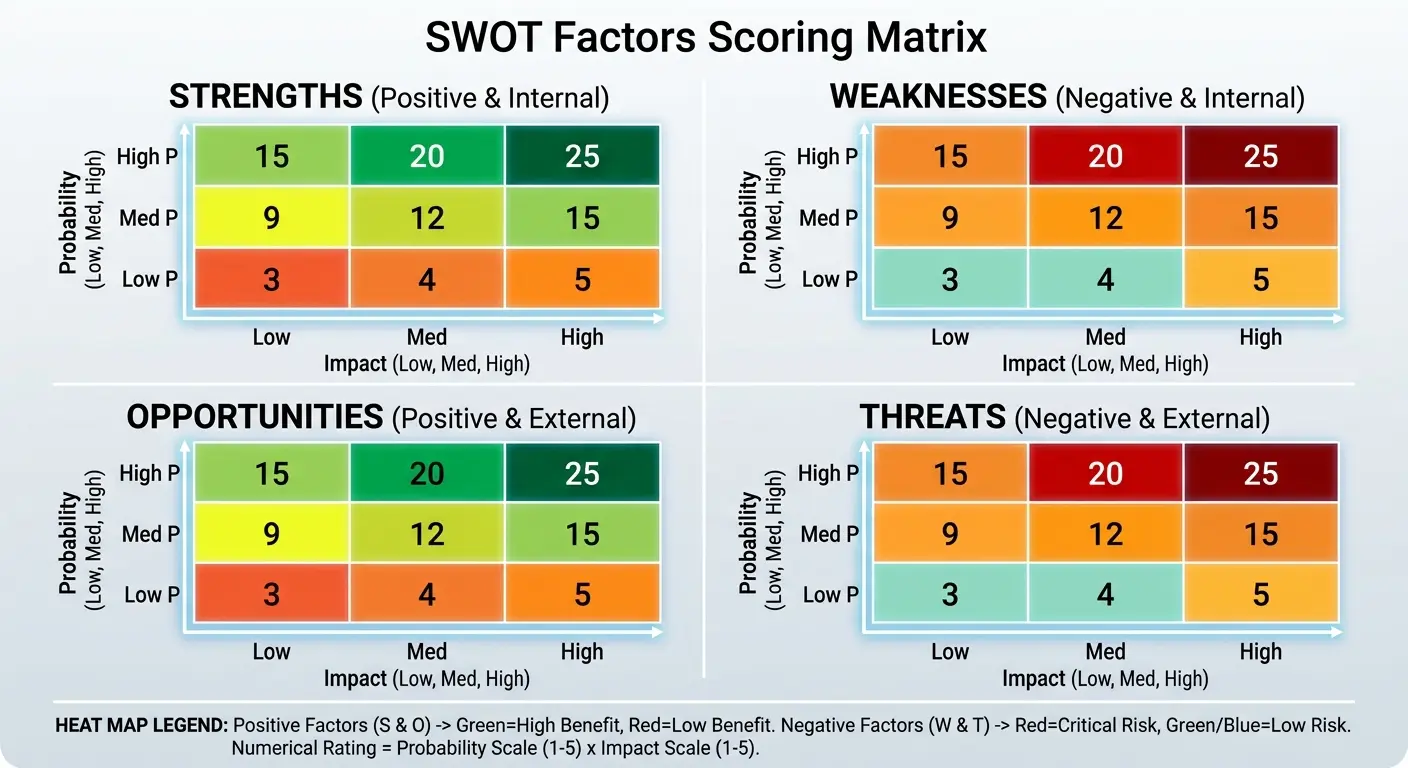
High-impact weaknesses demand attention regardless of how difficult they are to fix. Low-impact weaknesses can be accepted or deprioritized. Medium-impact weaknesses require cost-benefit analysis: what’s the effort to address versus the performance gain?
Impact scoring forces you to differentiate between factors that matter and factors that are merely true. Both can appear in SWOT, but only high-impact factors should drive resource allocation.
Probability and Timeline for Opportunities and Threats
Opportunities and threats are future-oriented. They haven’t happened yet. Probability scoring helps you distinguish between likely scenarios and remote possibilities.
Rate each opportunity: what’s the probability this opportunity will materialize? What’s the timeline for when it becomes actionable? High-probability, near-term opportunities should be your focus. Low-probability opportunities might not warrant any resource allocation.
The same framework applies to threats. High-probability, near-term threats need immediate response. Low-probability, distant threats need monitoring. High-probability, distant threats are the dangerous ones because they’re easy to procrastinate on despite their inevitability.
I’m throwing a table here because it’s the clearest way to show this, but don’t just copy these questions. They’re starting points:
|
Probability |
Timeline |
Priority Level |
Recommended Action |
|---|---|---|---|
|
High |
Immediate (0-6 months) |
Critical |
Act now, allocate resources immediately |
|
High |
Near-term (6-18 months) |
High |
Plan and prepare, begin resource allocation |
|
High |
Long-term (18+ months) |
Medium-High |
Monitor closely, develop contingency plans |
|
Medium |
Immediate |
High |
Investigate further, prepare rapid response |
|
Medium |
Near-term |
Medium |
Include in planning cycle, assign owner |
|
Medium |
Long-term |
Low-Medium |
Periodic review, watch for probability changes |
|
Low |
Immediate |
Medium |
Quick assessment, minimal resource commitment |
|
Low |
Near-term |
Low |
Monitor only, no active resource allocation |
|
Low |
Long-term |
Very Low |
Annual review, remove if stays low probability |
Combining probability and timeline creates a prioritization matrix. You’re allocating attention and resources based on likelihood and urgency, not just the existence of the factor.
Confidence Levels in Your Assessment
Some SWOT entries are based on solid data. Others are educated guesses or assumptions.
Marking confidence levels helps you identify where you need better information.
High confidence: We have data, customer feedback, or direct experience confirming this factor. Medium confidence: We have indirect evidence or reasonable inference supporting this assessment. Low confidence: This is speculation or assumption that needs validation.
Low-confidence entries shouldn’t drive major decisions. They should trigger research questions. Before you invest resources based on a perceived opportunity, validate that the opportunity actually exists. Before you panic about a threat, confirm that it’s real and relevant.
Confidence scoring also reveals organizational blind spots. If most of your customer-related entries are low confidence, you need better customer insight. If competitive entries are low confidence, you need better competitive intelligence.
Tracking Scores Over Time
Quantified SWOT enables longitudinal tracking. You can measure whether strengths are strengthening or weakening. You can track whether threats are materializing or dissipating. You can assess whether your actions are having intended effects.
Run the same scoring exercise quarterly. Compare results. Are high-impact weaknesses improving? Are you successfully capturing high-probability opportunities? Are threats you identified six months ago becoming more or less likely?
This creates accountability. You’re not just identifying factors. You’re monitoring them.
SWOT as a Living Document
Annual SWOT analysis is better than no SWOT analysis. But markets don’t change on annual cycles. Competitors don’t time their moves to your planning calendar. Customer preferences shift continuously.
SWOT should be a living document that updates as conditions change. This doesn’t mean constant revision. You need a system that captures significant changes without creating analysis paralysis.
Trigger-Based SWOT Review
Certain events should automatically trigger SWOT review. Major competitive moves. Significant market shifts. Technology disruptions. Regulatory changes. Internal capability additions or losses.
SWOT Review Trigger Checklist:
Initiate immediate SWOT review when:
- Major competitor launches product directly challenging your core offering
- Key executive or technical leader with unique expertise departs
- Regulatory change impacts your business model or operations
- Customer churn rate increases by 15%+ in single quarter
- New technology emerges that could disrupt your product/service
- Major partnership or distribution channel is gained or lost
- Market conditions shift dramatically (economic downturn, supply chain disruption)
- Competitor announces merger/acquisition changing competitive landscape
- Customer feedback reveals emerging need you cannot currently meet
- Your company completes significant capability addition (new hire, technology, process)
Define your trigger events in advance. When a competitor launches a product that directly challenges your core offering, that’s a trigger. When customer feedback reveals an emerging need you can’t currently meet, that’s a trigger. When a key team member with unique expertise leaves, that’s a trigger.
Trigger-based review keeps SWOT current without requiring constant monitoring. You’re updating in response to meaningful change, not on arbitrary timelines.
Quadrant Ownership
Assign responsibility for monitoring each quadrant. Someone owns tracking competitive threats. Someone owns identifying emerging opportunities. Someone owns assessing whether strengths are being maintained. Someone owns monitoring whether weaknesses are being addressed.
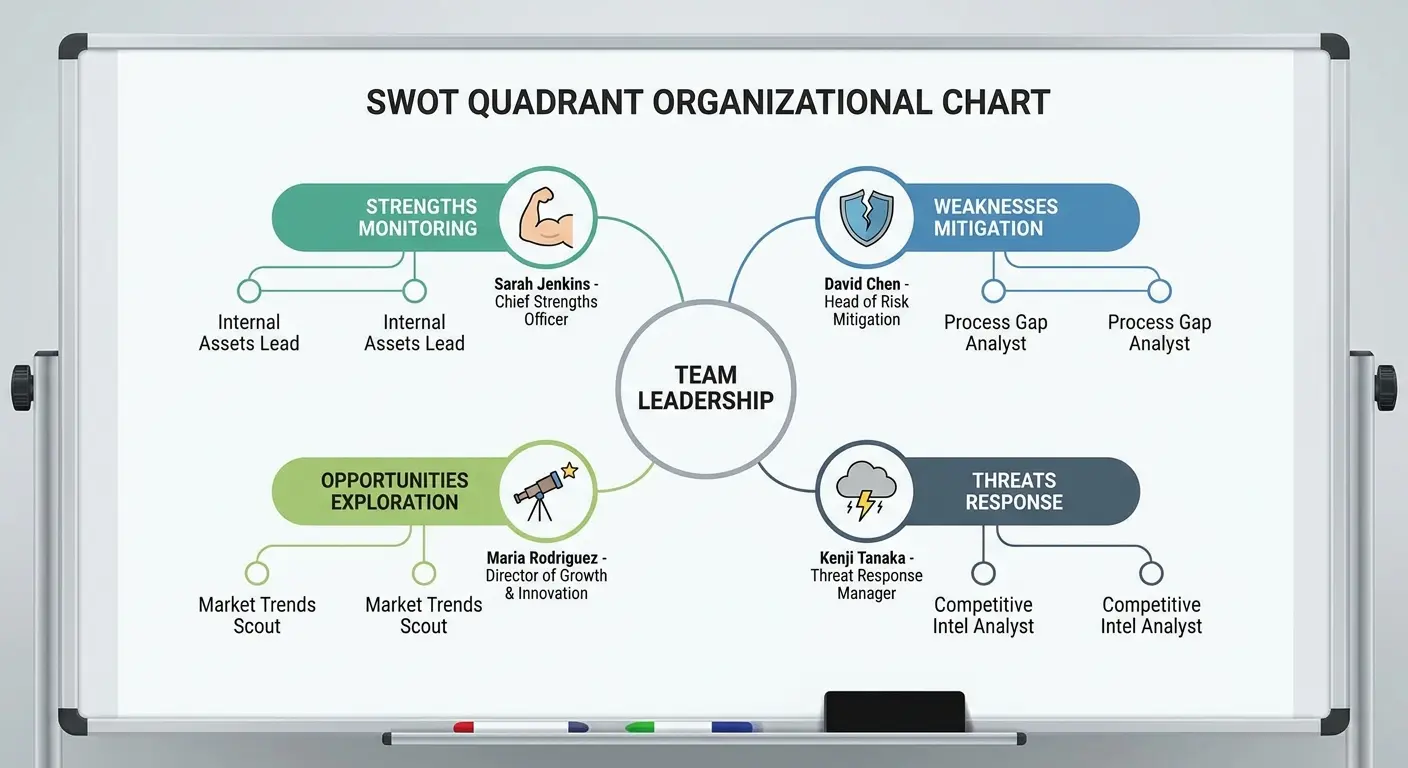
Ownership doesn’t mean one person makes all decisions about that quadrant. Ownership means someone is explicitly responsible for staying informed and raising flags when updates are needed.
This prevents SWOT from becoming stale. Without ownership, everyone assumes someone else is monitoring, and nothing gets monitored. With clear ownership, you have defined accountability.
Quarterly SWOT Check-ins
Even without trigger events, review SWOT quarterly. This creates a regular rhythm for assessment without excessive frequency.
Quarterly reviews should be efficient. You’re not redoing the entire analysis. You’re asking: what’s changed? What new factors have emerged? What existing factors have shifted in importance or likelihood? What’s no longer relevant?
Most quarters, changes will be minor. Some quarters will reveal significant shifts that require deeper analysis. The regular cadence ensures you catch changes reasonably close to when they occur.
Integrating SWOT Into Decision-Making
SWOT shouldn’t live in a strategy document separate from operational decisions. Reference it when evaluating new initiatives, making investment choices, or responding to competitive moves.
Before approving a new project, check SWOT: does this leverage our strengths? Does it address a weakness? Does it capture an opportunity or mitigate a threat? If the answer to all four questions is no, why are you doing it?
SWOT becomes useful when it informs actual decisions. Keep it accessible. Reference it in meetings. Use it as a framework for evaluating proposals. Make it a working tool, not a planning artifact.
When to Abandon Your SWOT Entirely
SWOT works well for stable markets with identifiable competitors and relatively predictable dynamics.
It struggles in other contexts.
Knowing when to use a different framework is as important as knowing how to use SWOT effectively. Understanding what is a swot analysis means also understanding its limitations. Don’t force SWOT into situations where it can’t deliver value.
Rapid Disruption Environments
When your market is experiencing fundamental disruption, SWOT’s internal-external and positive-negative framework becomes too simplistic. You need scenario planning or systems thinking approaches that can handle multiple possible futures and complex interdependencies.
Disruption means the rules are changing. Your current strengths might become irrelevant. New factors that don’t fit neatly into SWOT categories emerge. The framework assumes a degree of continuity that disruption violates.
Use SWOT for stable core business while applying different frameworks to evaluate disrupted segments or emerging opportunities. You can run both simultaneously for different parts of your portfolio.
Highly Complex Stakeholder Environments
SWOT struggles when you’re balancing many stakeholders with conflicting interests. Healthcare organizations, government agencies, and heavily regulated industries often face complexity that SWOT oversimplifies.
Stakeholder mapping, systems dynamics, or multi-criteria decision analysis might serve you better. These frameworks are designed to handle competing priorities and complex trade-offs that SWOT flattens.
SWOT can still provide value as one input among several frameworks. But don’t rely on it exclusively when stakeholder complexity is high.
Pre-Launch or Highly Uncertain Ventures
SWOT assumes you have enough information to assess strengths, weaknesses, opportunities, and threats. Early-stage ventures or entirely new markets often lack this information.
In high-uncertainty environments, you need frameworks built for learning and adaptation. Lean startup methodology, discovery-driven planning, or real options analysis might be more appropriate. These frameworks assume uncertainty and focus on structured learning rather than assessment of known factors.
Once you have enough market feedback and operational experience, SWOT becomes useful. But premature SWOT analysis produces speculation rather than insight.
When You Need Detailed Competitive Strategy
SWOT identifies competitive factors but doesn’t provide detailed competitive strategy frameworks. If your strategic question is specifically about competitive positioning, use Porter’s Five Forces, value chain analysis, or game theory approaches.
These frameworks go deeper into competitive dynamics than SWOT’s threat and opportunity quadrants can. Much like understanding competitive strategy frameworks, SWOT might identify that competition is intensifying, but it won’t tell you whether to compete on cost, differentiation, or focus strategy.
Use SWOT for broad assessment, then drill into specific frameworks for detailed competitive strategy development.
Combining Frameworks Strategically
You don’t have to choose one framework exclusively. SWOT can be your starting point for broad assessment, then you apply specialized frameworks to specific questions that emerge.
SWOT might reveal that your business model is a weakness. That triggers business model canvas analysis. SWOT might identify a major opportunity in a new customer segment. That triggers jobs-to-be-done research. SWOT identifies intensifying competition. That triggers detailed competitive analysis using industry-specific frameworks.
Think of SWOT as diagnostic rather than prescriptive. It helps you identify what needs attention. Other frameworks help you determine what to do about it.
Implementation: From Matrix to Action
Completed SWOT analyses pile up in planning documents that nobody references after the session ends.
The framework only matters if it changes what you do.
Implementation requires translating insights into specific actions with clear ownership and success metrics. This isn’t automatic. You need a structured process for moving from analysis to execution. Knowing how to do a swot analysis is only half the battle. Knowing how to conduct a swot analysis that drives action is what separates effective strategic planning from wasted effort.
Mapping Actions to Quadrant Intersections
Back to those collision points. Your action plans should map directly to specific quadrant intersections, not generic “leverage strengths” bullshit.
For each high-priority strength-opportunity combination, define specific initiatives. What exactly will you do to use this strength to capture this opportunity? Who owns it? What resources are required? What’s the timeline?
For each critical weakness-threat combination, define mitigation plans. How will you address the weakness or reduce the threat? What’s the investment required? What’s the urgency?
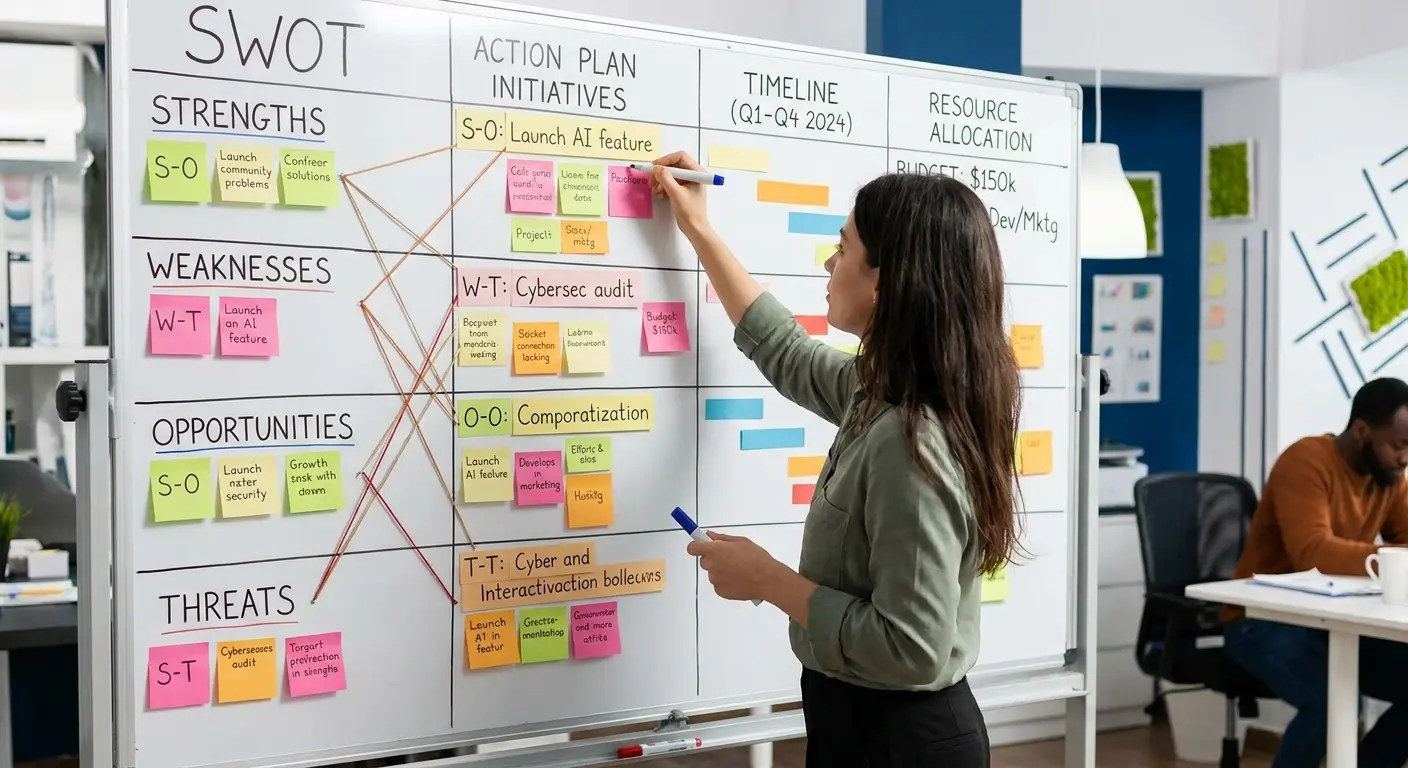
Generic action items like “improve customer service” or “expand market presence” aren’t actionable. “Deploy our proprietary customer data platform (strength) to create personalized onboarding sequences for enterprise customers entering the market (opportunity)” is actionable.
See the difference?
Resource Allocation Alignment
Your budget should reflect your SWOT priorities. If you’ve identified high-impact strengths that need maintenance, they should receive funding. If you’ve identified critical weaknesses that amplify threats, addressing them should be budgeted.
Review your current resource allocation against your SWOT priorities. Are you funding initiatives that don’t connect to any SWOT factor? Are high-priority SWOT factors receiving inadequate resources?
This review often reveals misalignment. You’re investing in areas that aren’t priorities while underinvesting in critical factors. SWOT provides the framework for reallocation decisions.
Ownership and Accountability
Every action item needs an owner. Not a department. A specific person who is accountable for progress and outcomes.
Ownership includes responsibility for tracking metrics, reporting progress, and adjusting approach when results don’t materialize. Without individual accountability, action items become everyone’s responsibility, which means they’re nobody’s responsibility.
Create a SWOT action tracker. List each priority action, the owner, the deadline, the success metric, and the current status. Review it monthly. This transforms SWOT from analysis to operational accountability.
Success Metrics That Actually Measure Progress
Each action needs a measurable outcome. How will you know if your effort to leverage a strength succeeded? What indicates that a weakness is being addressed effectively?
Metrics should be specific and time-bound. “Improve brand awareness” isn’t measurable. “Increase unaided brand recall from 12% to 20% among target customers within six months” is measurable.
Some SWOT factors resist easy quantification. Customer relationships, company culture, positioning don’t have obvious metrics. Find proxy measures. Survey scores. Retention rates. Win rates in competitive situations. You need some way to track whether actions are producing intended effects.
The 90-Day Action Cycle
Break SWOT implementation into 90-day cycles. What can you accomplish in the next quarter based on your SWOT priorities? This creates manageable timeframes and regular checkpoints.
Some actions take longer than 90 days. Break them into quarterly milestones. You’re tracking progress, not expecting completion of multi-year initiatives within one quarter.
Quarterly cycles also align with the SWOT review cadence I mentioned earlier. You’re reviewing SWOT quarterly and planning the next 90 days of action simultaneously. Analysis and implementation stay connected.
Communicating SWOT Throughout the Organization
SWOT shouldn’t be leadership-only knowledge. Your team needs to understand the strategic context they’re working within.
Share relevant SWOT findings with different parts of the organization. Your sales team needs to understand competitive threats and how your strengths position you. Your product team needs to understand market opportunities and capability weaknesses. Your operations team needs to understand efficiency strengths they should maintain.

You don’t need to share everything with everyone. Tailor SWOT communication to what each team needs to know to make better decisions in their domain. The goal is alignment, not information overload.
Look, executing strategy is hard. I see companies struggle with the gap between planning and implementation constantly. If you’re finding that your SWOT analysis keeps revealing the same weaknesses quarter after quarter, or opportunities keep going uncaptured, you might need external perspective on why your implementation is stalling. We help organizations move from strategic insight to actual execution, particularly when internal momentum has stalled. Sometimes you need someone outside your organization to challenge why actions aren’t happening and to help build accountability systems that stick.
Final Thoughts
I’m not saying SWOT is perfect. It’s not. But it works if you stop treating it like a checkbox on your quarterly planning agenda.
Most companies won’t do what I’ve outlined here. It’s too much work. They’ll keep running their 90-minute SWOT sessions, producing the same useless lists, then wondering why nothing changes.
Don’t be them.
Your SWOT should be uncomfortable. If everyone nods along with every entry, you’re not pushing hard enough. Real strategic analysis surfaces disagreements, challenges assumptions, and forces difficult trade-offs. Comfortable SWOT sessions produce useless outputs.
The companies getting value from SWOT are the ones treating it as dynamic, quantified, multi-perspective, and action-oriented. They’re updating it when conditions change. They’re scoring factors to enable prioritization. They’re gathering input from multiple stakeholders to challenge internal groupthink. They’re mapping actions directly to SWOT insights and tracking whether those actions produce results.
You don’t need a new framework. You need to use the one you have with more rigor and less complacency.
Start with your next SWOT session. Push past surface-level observations. Force specificity. Challenge vague statements. Quantify what you can. Map intersections. Assign ownership. Track outcomes. Do the work the framework requires instead of rushing through it to check a planning box.
Whether you’re looking for a swot analysis example, searching for a free swot analysis template, or evaluating a swot analysis tool, remember that swot analysis stands for more than just categorizing factors. It stands for rigorous strategic thinking applied to your swot analysis business context.
SWOT reveals what you’re willing to see. If you’re not finding valuable insights, you’re not looking hard enough.