



Let me guess: you’ve read the positioning guides. Taken the segmentation courses. Maybe even hired a consultant to fix your messaging. And yet, your marketing still feels off.
I’ll tell you why. Nobody’s teaching you how this stuff actually fits together.
Every course shows you how to build a buyer persona. None of them explain how that persona should completely reshape your channel strategy, dictate your pricing architecture, or constrain what you can credibly promise. You’re learning skills in isolation, then wondering why they don’t work when you try to combine them.
The problem isn’t that marketers don’t understand segmentation or positioning or customer journey mapping. The problem is that these fundamentals exist in silos, taught as standalone concepts rather than interdependent components that either reinforce or undermine each other. When your positioning doesn’t align with your segmentation, or your messaging doesn’t reflect your actual customer journey, you’re not just being inconsistent. You’re actively confusing your market and wasting resources on tactics that can’t possibly work because the underlying structure is broken.
Quick Take
Marketing fundamentals are typically taught as isolated skills rather than interconnected system components, which leads to strategic misalignment. Disconnected fundamentals create compounding inefficiencies that waste budget and confuse your market. Most marketing dysfunction stems from architectural problems, not execution failures. A systems-based approach requires mapping how each fundamental influences and constrains the others. Diagnostic frameworks help identify specific disconnection points before you invest in tactical fixes. Rebuilding often delivers better ROI than incremental refinement when core misalignments exist. Integration requires cross-functional visibility that most marketing teams don’t naturally have.
Skip to the diagnostic framework if you want the practical stuff.
Try the 30 Blogs in 30 Days Trial
Why Marketing Fundamentals Training Focuses on Execution Instead of Integration
Marketing courses teach you how to create buyer personas. They don’t teach you how those personas should shape your channel strategy, inform your pricing architecture, or constrain your product positioning. The education model treats each fundamental as a discrete skill you can master independently, then assumes you’ll somehow intuit how they fit together once you’re in a real marketing role.
This isn’t an accident. Courses need clear learning objectives and measurable outcomes. “Create a buyer persona” is measurable. “Understand how your segmentation approach either enables or constrains your entire go-to-market strategy” is not. So we optimize for what’s teachable in a module rather than what’s actually valuable in practice.
The gap between what gets taught and what actually drives results creates marketers who excel at individual marketing fundamentals but struggle to connect them into coherent strategy. You end up with teams full of specialists who can execute brilliantly within their domain while the overall system underperforms. And nobody can figure out why.
The Module-Based Learning Trap
Professional development follows the same pattern. You attend a workshop on positioning. Three months later, you take a course on demand generation. Next quarter, someone presents on customer lifecycle marketing. Each session is valuable in isolation, but no one ever maps how these pieces interact or conflict.

Your positioning might promise outcomes that your product roadmap can’t deliver for 18 months. Your demand generation strategy might target personas that your sales team isn’t equipped to serve. Your lifecycle marketing might assume customer behaviors that don’t match your actual retention data. None of these disconnects are visible when you’re learning each skill separately.
The module-based approach creates blind spots that follow you throughout your career. You become proficient at executing marketing fundamentals without developing the systems thinking needed to connect them. I’ve seen teams full of talented marketers producing mediocre results, and this is usually why.
Why Integration Isn’t Taught
Teaching integration requires seeing the entire system at once. That means instructors need real-world experience across multiple marketing functions, not just deep expertise in one area. It also means course design becomes exponentially more complex because you can’t linearize the content. Everything affects everything else, which makes for terrible pedagogy but accurate representation of how marketing actually works.
We also avoid teaching integration because it forces uncomfortable conversations about tradeoffs. When you position for one segment, you’re inherently deprioritizing others. When you choose certain channels, you’re constraining your messaging options. When you set pricing, you’re making implicit promises about value that your entire customer experience needs to fulfill.
These tradeoffs don’t have clean answers, which makes them hard to teach and harder to test. Even the most comprehensive marketing fundamentals course struggles to address these interconnected challenges because they require contextual decision-making rather than formulaic execution. You can’t create a rubric for “does your positioning naturally lead to segments your product genuinely serves.” The answer depends on dozens of variables specific to your market, product, and capabilities.
And honestly? That’s uncomfortable. We’d rather teach clean frameworks than messy reality.
The Hidden Cost of Treating Each Fundamental as an Independent Skill
Your marketing team isn’t underperforming because they lack skills. They’re underperforming because their skills don’t connect into a coherent strategy. You can have world-class execution on every individual tactic and still generate mediocre results if those tactics aren’t reinforcing each other.
This shows up in your budget first. You’re running campaigns that target personas your product isn’t actually built for. You’re creating content for stages of the buyer journey that don’t align with how your sales team actually closes deals. You’re investing in channels that reach the right people but deliver the wrong message because your positioning and your channel strategy were developed independently. Understanding marketing fundamentals in isolation creates these gaps that waste resources and confuse prospects.
The dysfunction isn’t obvious because each piece looks fine when examined separately. Your personas are well-researched. Your content is high-quality. Your channel execution is professional. But the system they create is incoherent, pulling prospects in different directions rather than guiding them toward conversion.
The Multiplication Effect of Misalignment
When your fundamentals disconnect, problems multiply rather than add. A positioning mismatch doesn’t just affect your messaging. It cascades into every customer touchpoint, creating friction that compounds over time. Your ads attract the wrong leads. Your content confuses qualified prospects. Your sales conversations start from misaligned expectations. Your onboarding disappoints because customers expected something different.

Each of these failures has a direct cost (wasted ad spend, lost deals, churn), but the compounding effect is what really kills you. Your cost per acquisition rises because your conversion rates drop across every stage. Your customer lifetime value shrinks because satisfaction suffers when delivery doesn’t match promise. Your team morale deteriorates because they’re working harder for worse results without understanding why.
Here’s what misalignment actually costs: When your positioning doesn’t match your segments, your CAC jumps 40-60% because you’re attracting people who’ll never buy. When your messaging doesn’t fit your channels, conversion rates drop 30-50% because your value prop gets mangled in translation. When you promise things you can’t deliver, LTV drops 25-45% as customers churn faster than you can replace them. When your segmentation doesn’t align with what your product actually does well, your innovation stalls because feature requests pull you in twelve different directions.
How Teams Mistake Symptoms for Root Causes
You see the symptoms and treat them as isolated problems. Conversion rates are down, so you hire a CRO specialist. Churn is up, so you invest in customer success. Lead quality is poor, so you refine your targeting. Each intervention might improve its specific metric, but none of them address the underlying architectural problem.
The real issue isn’t that your landing pages need better copy or your targeting needs refinement. The real issue is that your positioning promises outcomes for personas that your product serves marginally, so even perfect execution on tactics can’t overcome the fundamental mismatch. You’re optimizing components of a system that’s structurally misaligned.
Real example: A workflow automation company (think Zapier competitor) positioned themselves around “enterprise innovation.” Sounds good, right?
Wrong.
Their product required 2-3 weeks of technical setup and heavy customization. But “innovation” attracted buyers expecting plug-and-play simplicity. Every sales call went the same way: “This looks cool, but we need it running by next week.”
They spent six months optimizing ad targeting. Tweaked copy 47 different ways. Improved CTR by 23%. Conversion rate stayed stuck at 2.8%.
Finally, someone asked: “What if our positioning is attracting exactly the wrong people?”
They repositioned around “enterprise-grade customization for complex workflows.” Conversion rate hit 11% within 60 days. Same ad spend. Same product. Different story told to different people.
Tired of tactics that don’t connect? Test our system.
How Misaligned Fundamentals Create Compounding Inefficiency
Marketing systems have momentum. When your fundamentals align, each tactic makes the next one more effective. Your positioning attracts prospects who are predisposed to your messaging. Your messaging guides them toward conversion paths your sales team is optimized to handle. Your product delivers on the promises your marketing made, creating advocates who reinforce your positioning through word of mouth.
When fundamentals misalign, you get the opposite momentum. Each tactic creates friction that makes the next one harder. Your positioning attracts skeptics who need more convincing. Your messaging has to work overtime to overcome the mismatch between expectations and reality. Your sales team spends cycles qualifying out bad fits or trying to force deals that shouldn’t close. Your product disappoints, creating detractors who actively work against your positioning.
The difference between aligned and misaligned marketing fundamentals isn’t just performance level. It’s the direction of momentum. One creates a virtuous cycle that amplifies your efforts. The other creates a vicious cycle that undermines them.
And you know what’s wild? Most teams can’t tell which one they’re in until they step back and look at the whole system.
The Compounding Nature of Marketing Debt
Technical debt is a familiar concept in product development. Marketing debt works the same way. Every misalignment you don’t address becomes harder and more expensive to fix as other systems build on top of it, similar to how scalable campaign development requires foundational alignment. Your messaging library grows to accommodate edge cases created by poor positioning. Your sales enablement becomes increasingly complex as it tries to paper over fundamental strategy gaps. Your customer success team develops workarounds for promises that shouldn’t have been made.
Eventually, the debt becomes so embedded that fixing it requires tearing down and rebuilding entire systems. You can’t just update your positioning because your entire content library, sales methodology, and customer communication framework are built on the old positioning. The cost of change becomes so high that teams choose to live with dysfunction rather than address it.
This is why small misalignments early in your marketing development create massive problems later. What starts as a slightly off positioning choice becomes the foundation for years of content, campaigns, and customer relationships. By the time you recognize the problem, you’re looking at a complete rebuild rather than a simple correction.
I’ve watched companies spend 18 months trying to “tweak” their way out of problems that required 6 weeks of hard rebuilding. The tweak approach feels safer. It’s not.
Why Incremental Optimization Makes Things Worse
When you don’t recognize architectural problems, your instinct is to optimize harder. You A/B test headlines, refine targeting parameters, adjust bidding strategies, and iterate on copy. Each optimization might show incremental improvement, but you’re making a broken system more efficient at producing suboptimal outcomes.

Worse, these optimizations can mask the underlying problems just enough that you don’t realize how much potential you’re leaving on the table. Your conversion rate improves from 2% to 2.5%, and you celebrate the win. You don’t realize that with aligned fundamentals, you could be converting at 8%. The incremental improvement feels like progress, so you never question whether you’re optimizing the right things.
A B2B marketing team I worked with spent eight months optimizing their paid search campaigns. They tested hundreds of ad variations, refined audience segments, adjusted bid strategies, and improved landing page copy. Their click-through rates improved by 23% and cost per click decreased by 15%. But conversion to qualified opportunity remained stubbornly low at 3%.
When they finally mapped their full system, they discovered their search ads were targeting bottom-of-funnel keywords with messaging that assumed top-of-funnel awareness. Prospects clicking ads expected educational content but landed on pages pushing demos. The optimization work had made them more efficient at attracting the wrong people at the wrong time. After realigning their channel strategy with their actual buyer journey, conversion to opportunity jumped to 11% without any additional optimization.
That’s the thing about optimization. It makes you better at what you’re already doing. If what you’re doing is fundamentally wrong, you’re just getting better at being wrong.
Building a Systems-Based Approach to Marketing Fundamentals
A systems-based approach starts with mapping dependencies. Before you execute any fundamental, you need to understand what it requires from other fundamentals and what it constrains downstream. Your positioning requires accurate segmentation data. It constrains your messaging options. Your messaging constrains your channel choices. Your channel choices constrain your creative formats. Each decision cascades.
Most marketing teams execute fundamentals in whatever order feels urgent rather than in the sequence that creates alignment. You need new positioning, so you develop positioning. Then you realize your messaging doesn’t match, so you update messaging. Then you discover your channels can’t support the new messaging, so you adjust channels. This backwards approach guarantees misalignment because you’re constantly retrofitting rather than building systematically.
The alternative is to map your entire marketing architecture before you start executing. What are the core dependencies? What needs to be true about your segmentation for your positioning to work? What needs to be true about your product for your positioning to be credible? What needs to be true about your channels for your messaging to land? These questions reveal the sequence in which fundamentals need to be addressed.
Mapping Your Marketing Architecture
Start by documenting your current state without judgment. What positioning do you actually use (not what your brand guidelines say, but what your market perceives)? Who are you actually serving (not your target personas, but who actually buys)? What messages actually drive conversion (not what you think should work, but what the data shows)? What channels actually deliver ROI (not where you want to be, but where you currently win)?
This audit reveals gaps between intention and reality. You might discover that your stated positioning and your actual market position are completely different. Your target personas might bear little resemblance to your actual customer base. Your messaging might emphasize features that don’t actually drive purchase decisions. These gaps are where your fundamentals have disconnected. Understanding what are the fundamentals of marketing means recognizing that execution without alignment creates these dangerous disconnects.
The audit isn’t about judging whether your current state is good or bad. It’s about seeing reality clearly so you can make informed decisions about what needs to change. You can’t fix misalignments you haven’t identified.
Look, I know this sounds obvious. But you’d be shocked how many teams skip this step because they think they already know the answers. They don’t. The gap between what you think is happening and what’s actually happening is usually where all your money is disappearing.
Marketing Architecture Audit Template
Positioning Reality Check:
– Stated positioning (from brand guidelines): _______________
– Market perception (from win/loss interviews): _______________
– Gap analysis: _______________
Segmentation Reality Check:
– Target segments (from strategy docs): _______________
– Actual customer segments (from CRM data): _______________
– Gap analysis: _______________
Messaging Reality Check:
– Core messages (from messaging framework): _______________
– Messages that convert (from attribution data): _______________
– Gap analysis: _______________
Channel Reality Check:
– Priority channels (from marketing plan): _______________
– Channels delivering ROI (from performance data): _______________
– Gap analysis: _______________
Product-Market Reality Check:
– Promised capabilities (from marketing materials): _______________
– Delivered capabilities (from product roadmap): _______________
– Gap analysis: _______________
Identifying Constraint Points
Every marketing fundamental creates constraints. Positioning constrains who you can credibly serve. Segmentation constrains how you can position. Pricing constrains what value propositions you can claim. Channel selection constrains what messages you can effectively deliver. These aren’t limitations to overcome. They’re structural realities that define what’s possible.
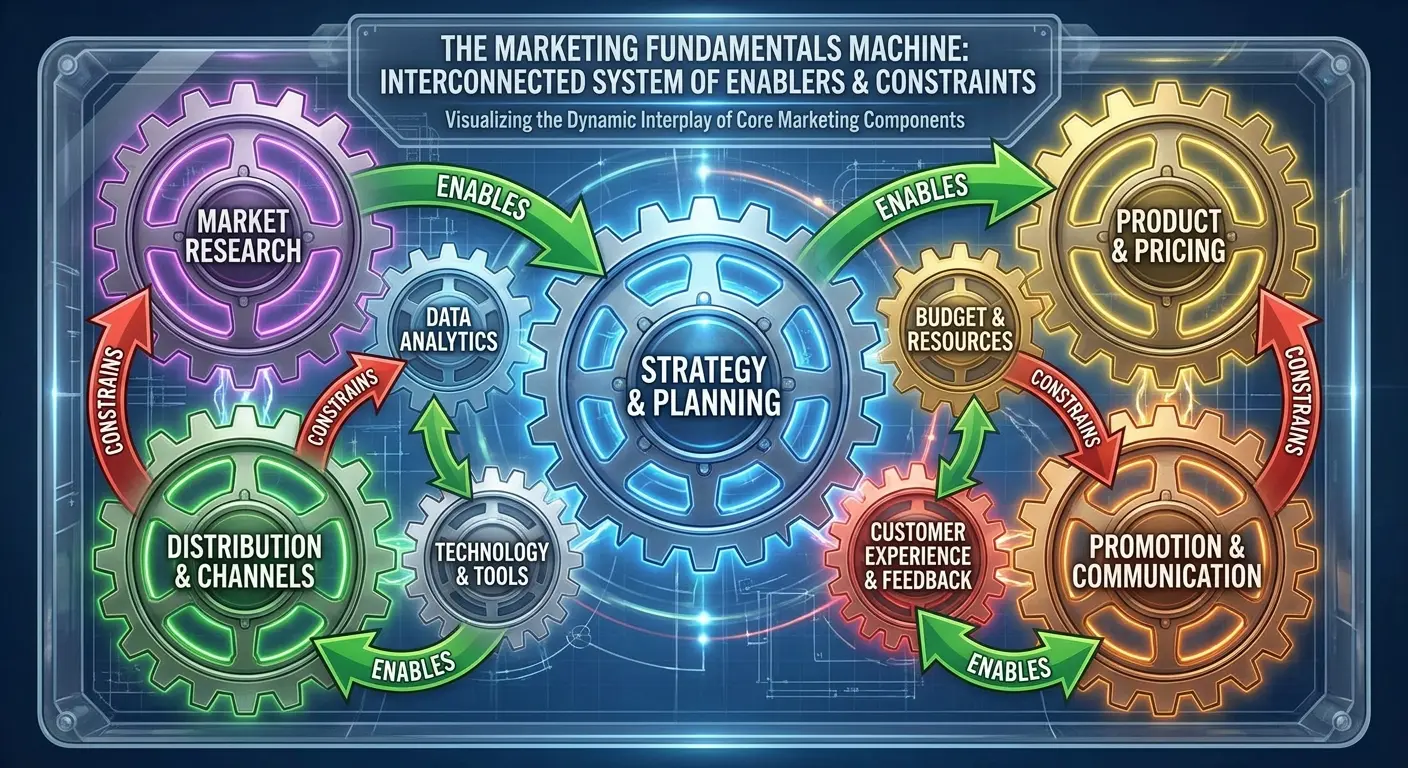
The goal isn’t to eliminate constraints. The goal is to align them so they reinforce rather than conflict. When your positioning naturally leads to segmentation that your product genuinely serves, priced at a level that reflects real value, promoted through channels where your message resonates, you’ve created alignment. Each constraint supports the others instead of fighting them.
Understanding constraints helps you make better decisions. If you know that choosing enterprise positioning constrains you to longer sales cycles and higher implementation complexity, you can build your entire system around that reality. If you pretend those constraints don’t exist, you’ll keep trying to force quick sales and simple implementations that your positioning makes impossible.
|
Marketing Fundamental |
Creates Constraint On |
Requires Input From |
Integration Point |
|---|---|---|---|
|
Positioning |
Segmentation, messaging, channel selection, pricing perception |
Product capabilities, competitive landscape, customer insights |
Must reflect actual deliverable value |
|
Segmentation |
Positioning credibility, channel reach, content specificity |
Customer data, market research, sales feedback |
Must align with product-market fit |
|
Messaging |
Channel selection, content formats, sales conversations |
Positioning, segmentation, customer language |
Must translate across all touchpoints |
|
Channel Strategy |
Message complexity, creative formats, audience reach |
Buyer behavior data, budget constraints, team capabilities |
Must support natural conversion paths |
|
Pricing |
Value perception, competitive positioning, customer expectations |
Product capabilities, market positioning, segment willingness to pay |
Must align with promised and delivered value |
Building Feedback Loops
Systems-based thinking requires feedback loops that surface misalignments before they compound. You need mechanisms to detect when your positioning isn’t attracting the right prospects, when your messaging isn’t converting qualified leads, when your product isn’t delivering on marketing promises, when your customer experience isn’t creating advocates.
These feedback loops can’t just be quarterly reviews. They need to be embedded in your operations so misalignments surface quickly. Your sales team should have a structured way to report when leads don’t match positioning. Your customer success team should flag when onboarding reveals expectation gaps. Your product team should track when feature requests suggest positioning problems. These signals tell you where your fundamentals are drifting apart.
Without feedback loops, misalignments compound silently until they create visible crises. By then, you’re dealing with major dysfunction instead of minor corrections. The goal is to catch disconnects early when they’re cheap to fix rather than late when they require system-wide rebuilding.
Stop optimizing in silos. 30 blogs, 30 days.
The Diagnostic Framework: Identifying Where Your Fundamentals Disconnect
Diagnosing fundamental misalignment requires looking at gaps between adjacent components. You’re not evaluating whether each fundamental is well-executed in isolation. You’re evaluating whether each fundamental logically connects to and supports the next one in your marketing system.
This shift in perspective is crucial. Most marketing audits ask “is our positioning clear?” or “is our messaging compelling?” Those are valid questions, but they miss the more important question: does our positioning naturally lead to our target segments, and does our messaging authentically reflect our positioning? The quality of individual marketing fundamentals matters less than the quality of connections between them.
The Positioning-to-Segmentation Audit
Does your positioning naturally appeal to the segments you’re targeting? This seems obvious, but mismatches are incredibly common. You might position as an enterprise solution while targeting mid-market companies. You might emphasize innovation while targeting risk-averse buyers. You might promise simplicity while serving customers who value customization.
Here’s the fastest test: Show your positioning to people who match your target segments without any additional context. Do they immediately see themselves in it? Do they recognize the problems you’re solving as their problems? Do they believe you can deliver what you’re promising? If the answer to any of these is no, you have a positioning-segmentation disconnect.
The disconnect usually stems from developing positioning and segmentation separately. Your positioning came from competitive analysis and differentiation exercises. Your segmentation came from market size analysis and addressable opportunity calculations. Neither process considered whether they actually fit together.
The Segmentation-to-Messaging Audit
Does your messaging address the specific needs, objections, and decision criteria of your target segments? Generic messaging that could apply to anyone usually means you haven’t actually connected segmentation to message development.
Pull your core marketing messages and remove any company-specific references. Could a competitor use the exact same words? If yes, your messaging isn’t actually informed by your segmentation. You’re writing generic category messages rather than segment-specific value propositions. This disconnect means you’re competing on generic attributes rather than leveraging your understanding of specific segment needs.
Strong segmentation-to-messaging alignment shows up in language specificity. You’re using terms your segments use, addressing objections they raise, and proving value with evidence they find credible. Weak alignment shows up in vague benefit statements that sound good but don’t actually connect to how your segments think about their problems.
I did this exercise with a client once. They were convinced their messaging was highly targeted. We pulled their homepage copy, removed the company name, and showed it to their competitor. The competitor thought it was their own messaging. That’s when reality hit.
The Messaging-to-Channel Audit
Can your core messages be effectively delivered in your chosen channels? Some messages require long-form explanation. Others work in short-form social. Some need visual demonstration. Others work in audio formats. If your messaging requires nuance that your channels can’t support, you have a disconnect.
This often manifests as messaging that gets oversimplified in execution. Your full value proposition is rich and differentiated, but by the time it’s compressed into ad copy or social posts, it becomes generic. The disconnect isn’t that your team can’t write good short copy. The disconnect is that your messaging was developed without considering channel constraints.
You’ll know you have this problem when your team constantly struggles to “fit” messages into channel formats, or when they complain that channels “don’t do justice” to your positioning. That’s a symptom of messaging-channel misalignment, not a channel limitation.
The Channel-to-Conversion Audit
Do your channels naturally lead to your desired conversion actions? If you’re driving awareness through channels that don’t support direct response, but your conversion strategy requires immediate action, you have a disconnect. If you’re investing in channels that build long-term relationships, but measuring success on short-term conversions, you have a disconnect.
This audit reveals whether your channel strategy and your conversion strategy were developed independently. Channels have natural conversion patterns. Social media drives engagement and community. Search drives intent-based action. Email drives relationship development. When you choose channels for reach without considering their natural conversion behaviors, you create friction in your funnel, which is why marketing case studies often reveal channel-conversion mismatches as the primary performance bottleneck.
The fix isn’t to force channels to behave differently. The fix is to align your conversion expectations with channel realities, or choose different channels that naturally support your conversion model.
Fundamental Alignment Diagnostic Checklist
Positioning-Segmentation Alignment:
– [ ] Target segments immediately recognize themselves in positioning
– [ ] Positioning addresses segment-specific pain points, not generic category problems
– [ ] Competitive alternatives mentioned by segments align with our positioning
– [ ] Segments have budget/authority to buy what positioning promises
– [ ] Product capabilities match what positioning implies for these segments
Segmentation-Messaging Alignment:
– [ ] Core messages use language specific segments actually use
– [ ] Messages address objections that specific segments raise
– [ ] Value propositions reflect priorities that specific segments rank highest
– [ ] Proof points match evidence types that specific segments find credible
– [ ] Messages cannot be used interchangeably by competitors
Messaging-Channel Alignment:
– [ ] Core messages can be effectively communicated within channel format constraints
– [ ] Message complexity matches channel audience attention patterns
– [ ] Visual/audio requirements of messages match channel capabilities
– [ ] Message calls-to-action align with natural channel behaviors
– [ ] Message tone fits channel norms without compromising brand voice
Channel-Conversion Alignment:
– [ ] Channels reach audiences at the right stage for desired conversion
– [ ] Channel user behavior naturally leads toward conversion action
– [ ] Conversion friction matches channel context and user expectations
– [ ] Attribution models account for channel’s actual role in journey
– [ ] Channel investment aligns with conversion contribution, not just reach
Repositioning Your Team’s Relationship with Marketing Fundamentals
Understanding systems thinking doesn’t automatically change how your team operates. Most marketers have spent years being rewarded for tactical execution. They’ve been hired, promoted, and praised based on their ability to execute specific fundamentals well. Shifting to systems thinking requires changing how you evaluate work, how you structure projects, and how you define success.
This is where it gets real. You can understand everything in this guide intellectually, but if your team still gets evaluated on individual tactical performance rather than system contribution, nothing changes. The incentive structures need to match the systems approach you’re trying to build.
Rewiring Project Scoping
Traditional project scoping focuses on deliverables. You need a positioning document, so you scope a positioning project. You need a content strategy, so you scope a content project. This approach guarantees siloed execution because each project is defined by its outputs rather than its integration points.
Systems-based scoping starts with the integration points. Before you scope a positioning project, you identify what segmentation data it requires, what messaging it needs to enable, what product capabilities it must reflect, and what sales methodology it needs to support. The project scope includes not just creating positioning, but ensuring it connects to these adjacent systems.
This means projects take longer and involve more stakeholders. That feels inefficient until you realize how much time you currently waste on rework when disconnected deliverables don’t actually fit together. Front-loading the integration work prevents back-end dysfunction.
Changing How You Evaluate Marketing Work
Most marketing evaluation focuses on execution quality within each fundamental. Is the positioning clear? Is the messaging compelling? Is the campaign well-executed? These are valid questions, but they miss the more important question: does this work integrate with and reinforce our other marketing fundamentals?
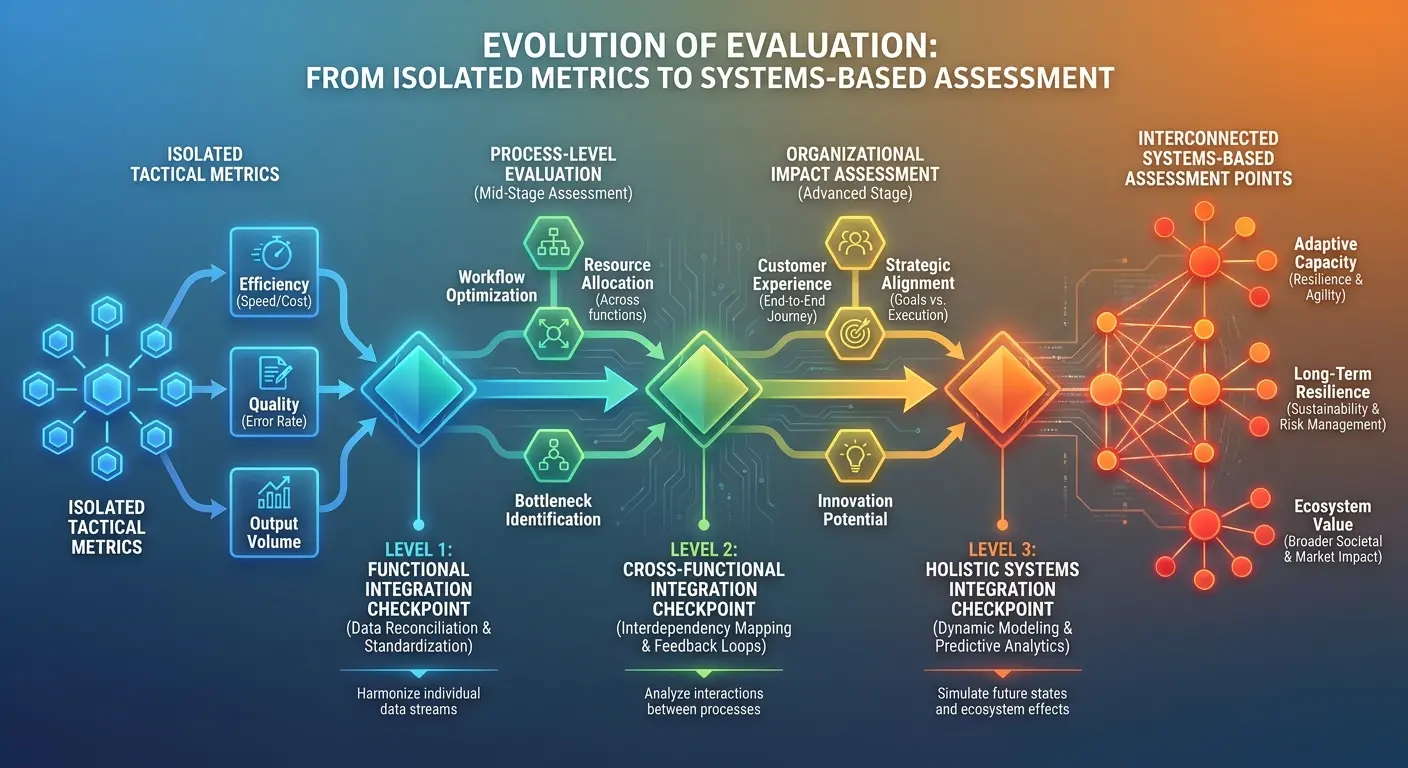
You need evaluation criteria that explicitly assess integration. Does this positioning naturally lead to our target segments? Does this messaging reflect our actual positioning? Does this campaign drive conversions that our sales team can handle? Does this content support our actual customer journey? When integration becomes an explicit evaluation criterion, teams start designing for it rather than treating it as an afterthought.
I’ve seen teams transform their output quality simply by adding integration questions to their review process. When you know your positioning will be evaluated based on how well it connects to segmentation, not just how differentiated it sounds, you approach the work differently from the start.
Building Cross-Functional Visibility
Systems thinking requires seeing beyond your functional area. Your content team needs to understand how sales conversations actually unfold. Your demand gen team needs to know what product capabilities are coming. Your product marketing team needs to hear what customer success is dealing with. Without this visibility, even well-intentioned teams will create disconnects because they’re optimizing for their local context without seeing the broader system.
This doesn’t mean everyone needs to be in every meeting. It means creating structured information sharing that surfaces the dependencies and constraints each team needs to know. Your content team doesn’t need to attend product roadmap meetings, but they need a clear view of what’s launching when so they can align content development with actual capabilities. Your demand gen team doesn’t need to sit in sales training, but they need to understand what objections sales is hearing and what proof points actually close deals.
A marketing team at a fintech company I worked with operated in functional silos. Content marketing created thought leadership about industry trends. Demand generation ran campaigns targeting CFOs at mid-market companies. Product marketing developed messaging around technical capabilities. Each team executed well within their domain, but pipeline quality remained poor.
They implemented a weekly 30-minute cross-functional sync where each team shared one critical insight from their work. Content learned that CFOs cared less about industry trends and more about implementation timelines. Demand gen discovered that their target CFOs rarely made buying decisions without their finance operations teams. Product marketing found out that technical capabilities meant nothing without proof of ROI within 90 days.
Within six weeks of sharing this visibility, all three teams had adjusted their approach. Pipeline quality improved by 67% without changing budget allocation.
That’s the power of visibility. You don’t need more budget or better tools. You need to know what actually matters.
Not sure where to start? Trial the system first.
When to Rebuild vs. Refine Your Marketing System
Not every misalignment requires tearing everything down. Some disconnects can be fixed through refinement. Others are so foundational that incremental fixes just create more complexity. The decision between rebuilding and refining depends on where the misalignment sits in your marketing architecture and how deeply other systems have built on top of it.
Getting this decision wrong is expensive either way. Rebuild when you should refine, and you waste resources solving problems that don’t exist. Refine when you should rebuild, and you extend dysfunction while throwing good money after bad.
Here’s the truth: most of the time, you need to rebuild. I know that’s not what you want to hear. Refinement sounds cheaper, faster, easier. But in 80% of cases I’ve seen, companies waste 6-12 months “refining” before admitting they needed to rebuild from the start.
Signals That Refinement Will Work
Refinement works when your core architecture is sound but execution has drifted. Your positioning is fundamentally right, but your messaging has gotten stale or generic. Your segmentation is accurate, but your targeting has expanded too broadly. Your channel strategy makes sense, but your creative has become inconsistent.

These problems show up as performance degradation over time rather than fundamental dysfunction. Your conversion rates are declining, not absent. Your customer satisfaction is slipping, not collapsing. Your sales cycles are lengthening, not stalling completely. You can trace the decline to specific execution gaps rather than structural mismatches.
Refinement also works when you have strong foundational alignment but need to adapt to market changes. Your competitor launched a new feature, so you need to adjust messaging. Your target segment’s priorities shifted, so you need to update positioning emphasis. Your primary channel’s algorithm changed, so you need to modify creative approach. The core system still works; it just needs tuning.
Signals That Rebuilding Is Necessary
Rebuilding becomes necessary when your fundamentals conflict at an architectural level. Your positioning targets segments your product doesn’t actually serve well. Your messaging promises outcomes your delivery model can’t support. Your pricing implies value that your features don’t justify. Your channel strategy reaches people who will never convert given your actual offering.
These problems manifest as persistent dysfunction that doesn’t improve despite tactical optimization. You’ve tried multiple messaging approaches and none convert well. You’ve tested dozens of audience segments and none show strong fit. You’ve experimented with various channels and none deliver acceptable ROI. The common thread isn’t execution quality. It’s fundamental mismatch between what you’re offering and who you’re offering it to.
Even the best marketing fundamentals course can’t fix structural problems that require architectural rebuilding, which is why B2B marketing automation case studies often show that technology alone can’t overcome fundamental misalignment. You need to fix the architecture before automation can amplify results.
Calculating the True Cost of Each Approach
Refinement feels cheaper because the immediate investment is lower. You’re tweaking existing assets rather than creating new ones. You’re adjusting campaigns rather than rebuilding strategy. But if refinement can’t fix architectural problems, you’re just extending the period of suboptimal performance while spending money on tactics that can’t work.
Rebuilding requires significant upfront investment. You’re stopping to fix the foundation while your competitors keep moving. You’re asking your team to execute on current strategy while simultaneously developing new strategy. You’re managing the transition period where some systems are updated and others aren’t yet.
But if rebuilding is necessary, delaying it just increases the eventual cost while continuing to waste resources on fundamentally misaligned tactics. I’ve seen companies spend two years trying to refine their way out of architectural problems, burning through millions in ineffective marketing spend, before finally accepting that rebuilding was always the answer.
The calculation isn’t just about direct costs. It’s about opportunity cost. What revenue are you leaving on the table every quarter you operate with misaligned fundamentals? What market position are you ceding to competitors who have their architecture right? What team morale are you sacrificing by asking people to execute tactics that can’t succeed?
The Transition Period Strategy
Whether you rebuild or refine, you need a transition strategy. You can’t flip a switch and have all your fundamentals align overnight. Your content library reflects old positioning. Your sales team is trained on old methodology. Your customer base has expectations based on old promises. The transition period is where many organizations fail because they don’t manage the gap between old and new.

Successful transitions require explicit sequencing. Which fundamental changes first? What dependencies does that create? When do adjacent systems need to update? How do you handle the period where some touchpoints reflect new fundamentals and others still reflect old ones? Without clear sequencing, you create confusion that’s worse than the original misalignment.
I typically recommend starting with positioning and segmentation since they constrain everything downstream. Once those align, you update messaging to reflect new positioning. Then you adjust channel strategy to support new messaging. Then you rebuild content and campaigns within the new framework. Each step builds on the previous one rather than trying to change everything simultaneously.
The transition period also requires clear communication. Your sales team needs to understand why positioning is changing and what it means for their conversations. Your customers need context for why messaging is evolving. Your internal stakeholders need visibility into the plan so they don’t panic when they see inconsistency during the transition.
How The Marketing Agency Approaches Fundamental Realignment
Most agencies will audit your tactics and recommend execution improvements. We audit your architecture and identify where your fundamentals disconnect. When you’re dealing with persistent underperformance despite strong tactical execution, the problem usually isn’t that you need better ads or smarter targeting. The problem is that your fundamentals are working against each other instead of reinforcing each other.
We map your entire marketing system to surface the specific disconnection points, then help you decide whether you need refinement or reconstruction. Sometimes that means telling clients their positioning is fundamentally wrong for their target market. Sometimes it means showing them that their channel strategy can’t support their messaging approach.
We focus on the architecture because that’s where real performance improvements come from, not from optimizing tactics within a broken system, which is why our approach to digital transformation starts with fundamental alignment before technology implementation. Understanding marketing basics means recognizing that execution without alignment creates dysfunction.
Final Thoughts
Marketing fundamentals haven’t changed much in decades. Positioning, segmentation, messaging, channel strategy. These concepts are well-established and thoroughly documented. What has changed is the complexity of executing them within interconnected systems where every decision creates cascading effects.
The tactical approach to fundamentals made sense when marketing was simpler and channels were more discrete. You could develop positioning without worrying too much about how it constrained your channel options because you had limited channels anyway. You could create messaging without obsessing over integration because your touchpoints were fewer and easier to control.
That world is gone. Your positioning now needs to work across dozens of channels with different format requirements and audience behaviors. Your messaging needs to remain consistent while adapting to contexts ranging from six-second video ads to hour-long podcasts. Your segmentation needs to be precise enough to drive personalization but broad enough to achieve scale.
This complexity is exactly why systems thinking matters more now than ever. You can’t brute-force your way to success by just executing harder on tactics. You need fundamentals that align and reinforce each other, creating momentum rather than friction. You need architecture that makes tactical execution easier rather than fighting it at every turn.
Once you fix architectural misalignments, tactical execution becomes dramatically more effective. Your ads perform better because they’re reaching people your positioning naturally appeals to. Your content converts better because it’s addressing needs your product actually solves. Your sales cycles shorten because prospects arrive with expectations your delivery can meet. You’re not working harder. You’re working within a system that’s designed to succeed rather than fighting one that’s designed to struggle, similar to how advanced analytics reveals patterns that tactical metrics miss.
Start with the diagnostic framework. Map where your fundamentals disconnect. Decide whether you need refinement or rebuilding. Then do the hard work of aligning your architecture before you invest another dollar in tactical optimization. The returns compound faster than you expect once your system is working with itself instead of against itself.
No marketing fundamentals course can replace the value of getting your architecture right. It’s the difference between optimizing a broken system and building one that naturally amplifies every dollar you invest, which is why understanding marketing ROI calculation becomes more meaningful when your fundamentals align. When your positioning attracts the right segments, your messaging converts qualified prospects, your channels support natural conversion paths, and your product delivers on promises, you’re not just improving efficiency. You’re creating a marketing system that generates compounding returns rather than compounding dysfunction.
The question isn’t whether your team knows what are the fundamentals of marketing. The question is whether those fundamentals connect into a system that actually works. Most marketing dysfunction isn’t an execution problem. It’s an architecture problem. Fix the architecture, and execution becomes exponentially more effective.
Look, I know this sounds like a lot. And yeah, it’s uncomfortable to admit that maybe your entire marketing foundation needs rebuilding. But here’s what I’ve seen over and over: teams that face this reality head-on, that stop optimizing broken systems and start building aligned ones, they don’t just improve performance. They transform it.
You’ve got the diagnostic tools now. You know what to look for. The hard part isn’t understanding the problem anymore. The hard part is having the courage to fix it properly instead of taking the easy path of endless refinement.
Your call.
Systems beat tactics. Start the trial.