



14 Engagement Activities That Survived Our Budget Cut
There's a whiteboard in our kitchen with CULTURE COMMITTEE, TUES 3PM written on it in dry-erase marker. It's been there since March. Nobody has met since May, and at some point someone drew a small sad face next to the word TUES, which is either commentary or boredom.
We're a marketing agency. We spend our working hours figuring out why people click, subscribe, buy and stay, and we still let a culture program die of neglect on a wall we walk past 40 times a week. Keep that in mind while you read the rest of this.
Here's the argument. An engagement program is an internal campaign, and it fails the way a weak campaign fails: nobody defined the audience, nobody recorded a baseline, nobody followed up after launch week. The single most useful idea in this article is the one that normally gets buried at position 19 of a listicle, so I'm putting it at the top instead. Build your calendar backwards from your pulse survey results, not forwards from a list of public holidays. Find your two weakest drivers. Pick things that aim at those two. The rest is decoration.
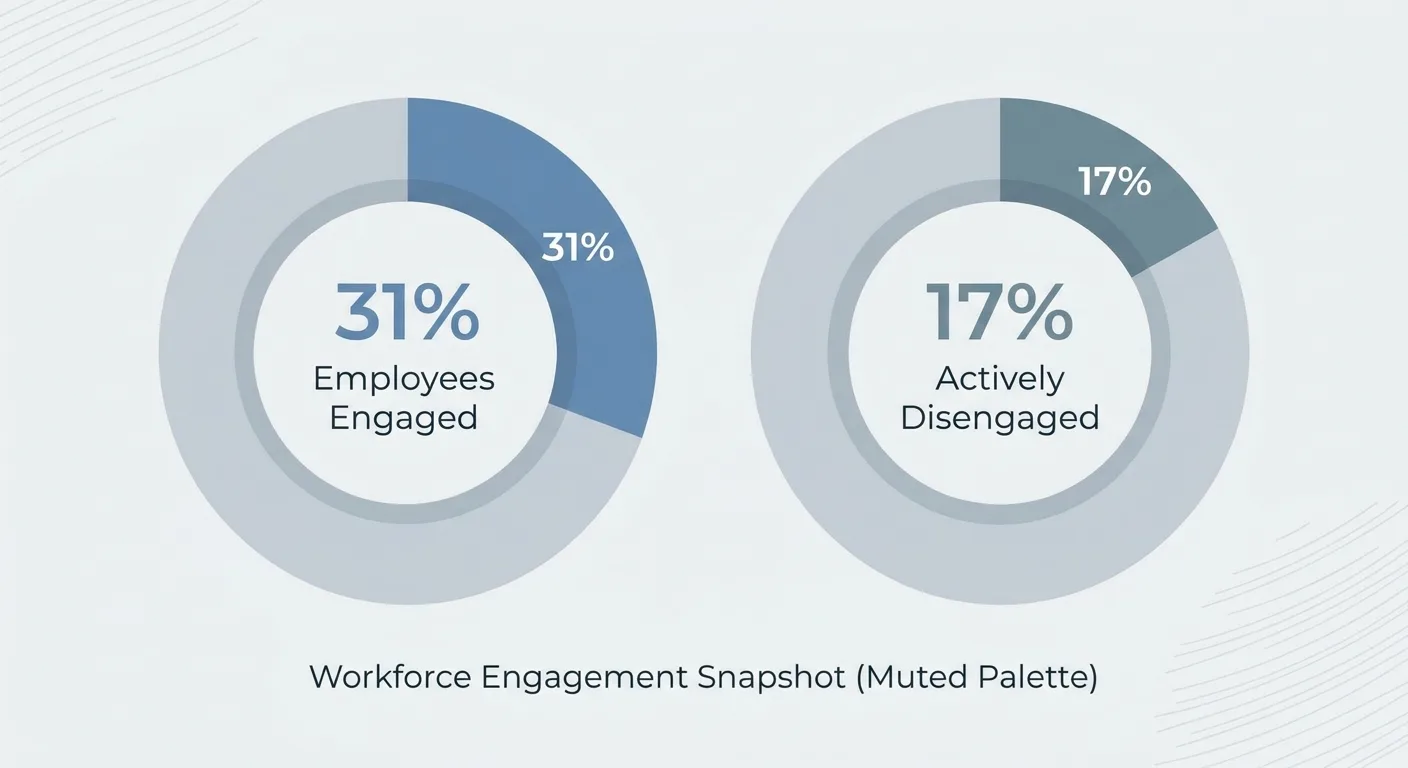
The scale of the problem is well documented. Only 31% of U.S. employees were engaged in 2024, the lowest reading in a decade, with 17% actively disengaged, according to Gallup's annual employee engagement update. So roughly half your people are coasting and one in six is working against you. A packed events calendar will not touch that.
What follows is 14 things, ranked by how much they cost you in money and in political capital. An earlier version of this list had 19. We killed five, and I'll get to which ones.
TL;DR
- Run it like a campaign: audience, baseline, measurement. The best employee engagement activities get chosen backwards from your two weakest pulse survey drivers, not forwards from a list of public holidays, which is also the only way an employee engagement activities calendar stops being decoration.
- Ask them first. Company employee engagement activities that staff asked for outperform corporate employee engagement activities booked by a committee, and any list of employee engagement activities examples online, this one included, is an inventory rather than a plan.
- Segment internally by tenure, location and role. Employee engagement activities in companies with mixed shift patterns cannot run one plan across a sales floor and an engineering team, and employee engagement activities in it companies in particular have to respect focus time, which is why async formats beat scheduled calls there. Employee engagement activities for employees in their first 90 days should look nothing like the activities employee engagement veterans keep getting handed.
- Cheap and weekly does more work than big and annual. Our six standing activities for employee engagement are a 15-minute Friday wins roundup, a peer-picked lunch rotation, employee-led skill swaps, a recognition channel with rules, walking one-on-ones and theme days anchored to something real. Those are the employee engagement activities at work you can start on Monday with no budget and no vendor.
- Fun employee engagement activities in office settings only land when the reason is obvious: a launch, a client win, a first anniversary. Employee engagement fun activities in office calendars fail when someone just needed to fill a Q3 gap, and funny employee engagement activities are not the goal either, because nobody needs a mandatory joke hour. The fun activities for employee engagement that last are small, repeatable and genuinely optional, and the same rule covers fall employee engagement activities and Mother's Day employee engagement activities, where an early finish beats a group card. Keep mothers day employee engagement activities opt-in and quietly messaged; the day carries complicated weight for some people.
- Build every format twice. Fun employee engagement activities in-office need an async twin, because employee engagement activities in-office should never be the only route in for the people who are not in the building.
- Remote employee engagement activities are not office events dragged onto a video call. The virtual employee engagement activities that hold up here are async standups with a non-work prompt, open virtual coworking rooms and a 45-minute curated game hour with a rotating host. Plenty of free virtual employee engagement activities already run in a browser, so a zero budget is not an excuse, and the fun employee engagement activities virtual teams rejoin are short, optional and never mandatory.
- Rotate the times or you have told half your staff exactly where they rank. Employee engagement activities for remote employees in other time zones need a recording or an open thread, employee engagement activities for remote workers on odd schedules need a two-day window rather than a single call, and virtual employee engagement activities for a remote workforce should be planned around coverage instead of head office hours. Anything social you run for remote staff needs a version they can join at 11pm in their own time zone.
- The expensive items need real budget and an executive who owns the outcome: a distributed offsite, a three-day build week, cross-department shadowing and peer-nominated awards with $750 behind them. These are the team building activities for employee engagement worth funding, and shadowing is the highest-return item in our team building employee engagement activities column. Skip the employee engagement team building activities that exist only to fill a day, since team building activities employee engagement leads book under pressure are the first thing cancelled and the last thing missed.
- For about two years we measured attendance, which told us close to nothing, and it took an embarrassing amount of time to work out that the number we actually needed was how many people came back a second and third time. That one column changed which activities we kept and which ones we quietly stopped booking. Track participation by segment, voluntary versus mandated attendance, eNPS, internal referrals and regretted attrition, with a baseline recorded first. Downloading an employee engagement activities pdf template is not a program; the activities employee engagement owners keep are the ones still moving a number two quarters later.
- Start with three, not fourteen: shadowing, the Friday roundup, onboarding buddies. Treat the rest of these employee engagement activities ideas as a shortlist to test, and remember that most employee engagement ideas activities roundups know nothing about your shift patterns. Our ideas for employee engagement activities that died are listed too, because a killed escape room is a useful example of employee engagement activities that read better on paper than in a room.
Why This Dies in Month Two
Someone gets handed "culture" as a side project on top of a full job. They google it, land on a listicle (Zendesk's guide to engagement ideas is usually in the top three), book an escape room and a pizza Friday, and by week six attendance is down to the same four people who show up to everything.
It's rarely for lack of effort. The gap is that nobody said who the thing was for, or which behaviour it was meant to shift, and running a single plan across a sales floor and an engineering team burns budget and goodwill in the same afternoon.
Any list you find online, including this one, is an inventory. It knows nothing about your shift patterns, your tenure mix, or which two departments are currently not speaking to each other.
And then there's the part that never makes the deck. No catered lunch offsets a manager who hoards information, expectations nobody wrote down, or salaries sitting under market. Fix pay and managers first. Then come back here. The fundamentals live in a separate piece we wrote on what drives employee engagement, which is drier than this one and more important.
The Segmentation Question Nobody Asks Internally
Would you send one email to your entire customer list, same copy, no targeting? Of course you wouldn't. Yet most internal announcements go to every person on staff in identical form, at the same time, with the same expectation of enthusiasm.
Splitting your internal audience by tenure, location and role changes what you plan and what shows up in the attendance count. Someone three weeks in wants low-stakes introductions. Someone six years in wants influence over a decision that matters to them. It's the same discipline behind the segmented automation work we build for clients, just pointed inward, where nobody bothers.
| Internal segment | What they usually need | What tends to work | What kills participation |
|---|---|---|---|
| First 90 days | Orientation, safe introductions, permission to ask basic questions | Onboarding buddies, skill swaps, small-group lunches | Large all-hands socials where they know nobody |
| One to three years | Development signals, visibility with leadership | Cross-department shadowing, peer-nominated awards, build weeks | Recognition that only ever names senior staff |
| Four years and up | Autonomy, influence, a new problem to chew on | Employee-led sessions, staff-chosen volunteer days, owning the calendar | Being handed the thing they built three years ago |
| Fully remote | Informal contact, less isolation | Async prompts, virtual coworking, narrow-topic channels | Optional calls scheduled in head office hours |
The row we get wrong most often is the last two. We keep handing our longest-serving people the format they helped invent in 2021, then reading their silence as apathy.
The Cheap Weekly Stuff
Six things that cost almost nothing and run on repetition. No vendor, no approval chain, no two-week planning cycle. What makes them work is that they happen every week whether or not anybody feels like it.
Assign an owner or it dies inside six weeks, usually during the first properly busy stretch. Ours sit as recurring tasks in ClickUp, which we have complained about at length (we wrote up the alternatives we looked at after one of those complaints), though any tool with a repeating task does the job. Continuity should never depend on someone remembering on a Friday afternoon.
1. The 15-Minute Friday Wins Roundup
Close the week with a short standing session where anyone can share one thing that went right. 15 minutes, hard stop, no slides. The cap is deliberate; a 40-minute version turns into a status meeting inside a month and then people start finding conflicts.
Priya, our ops lead, ran it for 11 weeks before anyone else volunteered to host, which I mention because the first two months of any ritual are carried by exactly one stubborn person. We average nine attendees out of 14. Around week seven, people started referencing each other's work without being prompted. Support heard what marketing shipped. Finance found out why the previous fortnight had been chaos for delivery. Of everything on this list that costs nothing, it moved how visible people felt the fastest, and our eNPS went from 11 to 24 over the two quarters we were running it alongside the recognition channel below. I can't cleanly separate which one did what.
2. Peer-Picked Lunch Rotation
When a manager picks the lunch spot, the social moment turns into a soft obligation and everyone can feel it, so hand the rotation to the team: one person a week, $60, no requirement to justify the pick, no theme, no form to fill in. It is cheap, nearly impossible to get wrong, and it builds relationships between desks that would otherwise never interact. Our June order history is roughly 60% burritos.

3. Employee-Led Skill Swaps
Nadia, who buys our media, ran a 30-minute session on pivot tablesthat I still think about a year later, and two people on the client services team now build their own reports because of it.
The Figma one flopped. Three people came, two were on mute, and the host emailed me afterwards to ask if she'd done something wrong. She hadn't. We'd scheduled it against a pitch deadline.
There's a hiring benefit nobody expects. Watch who volunteers, who prepares properly, who handles a question they don't know the answer to. That's your next round of team leads, identified without running a single assessment.
4. A Recognition Channel With Actual Rules
Shout-out channels die of vagueness. "Great job this week Sam!" registers as nothing, and after 30 of those the channel is wallpaper.
Give it a format: what happened, who did it, what changed as a result. Three sentences, maximum. The recipient has to be able to tell which behaviour earned the note. Keep a physical board in the office too, updated weekly, so the people who don't live in Slack still see it. Most companies already have this channel. Most are running it at a fraction of what it could do.
5. Walking One-on-Ones
Get out of the meeting room. That's the whole idea.
Don't use it for performance reviews or anything you need to document. Nobody wants to be told they missed target while crossing a parking lot.
6. Theme Days Anchored to Something Real
Random dress-up days feel forced. They are forced. Somebody needed a Q3 activity and the calendar had a gap.
Attach the day to something that happened instead: a launch, a client win, someone's first anniversary, the end of a migration that nearly broke two people. Participation climbs when the reason is obvious, and the photos stop looking staged.
The seasonal version follows the same rule: specific works, generic gets deleted. A harvest potluck where people bring family recipes gets real turnout. An email about the changing seasons does not. And on Mother's Day, an early finish for parents and caregivers, or a small budget for something they'd choose themselves, beats a group card by a mile. Keep that one opt-in and keep the messaging quiet rather than company-wide. The day carries complicated weight for some people, and we found that out the hard way in 2022 after a well-meant all-staff email that I still wince about.

How We Killed One Without Drama
We ran a Monday morning "what's blocking you" call for four months. Attendance went from 12 to 5 to 3. The rule we now use is unglamorous: two consecutive weeks where fewer than five people show up and it goes.
Announce the ending, thank whoever carried it, say what replaces it. When I killed the Monday call, two people messaged privately to say thank you, which told me everything about how long it had been dead. Nothing damages your credibility faster than a calendar full of things that technically still exist while everyone pretends not to notice.
Now the Distance Problem
Remote engagement has a difficulty in-person doesn't. Participation takes deliberate effort, and every optional call competes with the focused work someone went remote to protect in the first place.
Most of the virtual activities we've seen collapse were in-person events dragged onto a video platform with no redesign. Standing around with drinks works in a room. It does not work on a grid of faces where one person can speak at a time.
7. Async Standups With a Non-Work Prompt
Add one rotating personal question to the written daily standup. What you're listening to. What you're reading. The last thing that made you laugh out loud.
10 seconds to answer, and it puts back a layer of informal texture that distributed teams otherwise lose entirely. More friendships have started in our standup thread over bad podcasts than in any scheduled social call. It fits inside work people are already doing, which is the only reason it survived.
8. Open Virtual Coworking Rooms
A persistent video room. Cameras optional, mics muted, no agenda, no host. People drop in and work quietly next to each other.
One of our developers described it as "weirdly comforting, like a library," and we've been using his line to sell it internally ever since. Companion mode in Google Meet makes low-pressure presence easier to sustain, since nobody feels obliged to perform for a camera.
Honest caveat: I still can't tell whether this works or whether the four people who love it are just four people who love it. It costs nothing to leave open, so it stays.

9. A Curated Game Hour, Not a Marathon
Online trivia, collaborative puzzles and drawing games hold at about 45 minutes. Past that the chat goes quiet and you can watch people start doing email.
Rotate the host so it doesn't become one person's unpaid second job. Keep attendance genuinely optional; mandatory fun breeds resentment fast. For groups over a dozen, split people into breakout rooms so nobody spends the hour muted on the sidelines watching four extroverts enjoy themselves. Plenty of decent browser games cost nothing, which helps if your budget for this is currently zero. Ours was, for most of 2023.
10. Onboarding Buddies for Remote Starters
New remote hires lose all the accidental learning an office hands you free. Nobody overhears why that one client gets handled differently, or which internal system everyone avoids.
Pair every starter with a buddy outside their reporting line for their first 90 days, with three or four check-ins actually scheduled rather than left to goodwill. It's the easiest line item on this list to defend. A few hours of somebody's time against the cost of replacing a hire who left in month five, and we have replaced one of those.
Alongside it: a home office stipend, $400 up front and $150 a year after, plus an open thread where people say what they bought and whether it was worth it. Chairs get recommended, standing desks get quietly criticized, and roughly once a quarter somebody makes an unhinged case for a third monitor.
Time Zones, and the People Who Stop Showing Up
Rotate the times. If a session always lands at 10am Eastern, you've told Vancouver and Lisbon exactly where they rank.
Record anything informational and build an async route into everything social: a thread, a shared board, a prompt that stays open for two days. This is where remote planning quietly falls apart, because the people you've excluded almost never complain. They just stop attending, and you read the number as low interest instead of bad scheduling.

The Expensive Stuff
Everything below needs real budget, lead time and an executive who'll take the hit if it flops. Nominal sponsorship won't carry it; our leadership case study walks through what changes when a senior leader owns the outcome and not just the invoice.
These also demand follow-through. Run a big initiative, then ignore what it surfaces, and you've proven you asked without intending to act. That does more damage than never asking.
For the budget conversation: Gallup's Q12 meta-analysis found that business units in the top quartile for engagement are 23% more profitable and 14% more productive than bottom-quartile units, figures compiled in Zoom's roundup of engagement statistics. Those two numbers are what get a build week approved instead of deferred to next quarter.
11. The Distributed Team Offsite
If you're fully remote, budget to put people in one room once or twice a year. You don't need an agenda. You need people together long enough to get bored, because that's when the side conversations start.
Keep it light on presentations, heavy on unstructured time. Two days of shared meals and half-finished arguments about product direction carries the next six months of async collaboration, and disagreements that had been festering in Slack resolve over lunch in about four minutes. It's the most expensive thing on this list and the one I'd defend line by line.

12. Build Week
Clear the roadmap for three days. No sprint goals, no stakeholder reviews, just people building whatever they've been itching to build, alone or in twos.
One rule: ship at least one output. Our first build week produced four prototypes and we shipped none of them. Nobody signed up for the second one. That isn't a hypothetical risk I'm warning you about, that's us, and it cost about $18,000 in billable time to learn.
13. Cross-Department Shadowing
Sales spends a day sitting with support. Engineering listens to the calls where customers explain what broke. Finance watches how a proposal gets built.
Assumptions between departments dissolve inside a few hours, and you almost always surface two or three process fixes nobody had eyes on because no single team could see the whole path. Highest return of anything here for the cost of a day's scheduling, and also the item that gets cancelled most, since it needs two managers to agree on a Tuesday.

14. Peer-Nominated Awards With Real Money Behind Them
Recognition needs weight to register. Quarterly peer nominations, a selection process people can see and follow, and a reward big enough that winning it changes somebody's month. Ours is $750.
A certificate with no budget behind it sends one message: appreciation was a line item nobody funded. That's worse than running nothing, because now you've formalized the distance between what you say and what you'll pay for.
What We Cut
Escape rooms. We did two. Both times the same three people solved everything and the rest stood in a corner reading a fake diary. Personality-type workshops, which produced a week of people explaining themselves with a four-letter code and then nothing. Desk birthday cakes, which somehow always fell to one person in accounts. A kudos bot, uninstalled after six weeks. And staff-chosen volunteer days, which I'm still unresolved on: the theory is right, employee-picked causes read as trust while company-picked ones read as PR, but the first year someone nominated a cause half the team was uncomfortable supporting and we had no process for that conversation. We'd rather leave it off than fake an answer.
How to Tell If Any of This Is Working
We'd never run a paid campaign this blind. Somehow culture spend gets a pass, measured by a headcount at the door and a vibe.
Track a small set: participation by segment, voluntary versus mandated attendance, eNPS movement, internal referral volume, regretted attrition. Record the baseline before you launch, then check quarterly. Some of it will underperform, and knowing which lets you shift money toward what's earning its place instead of renewing everything by default. It's the same reporting discipline we describe in our guide to performance analytics dashboards, applied to something that never usually gets it.
One we tracked and dropped: Slack message volume in social channels. It went up during our worst quarter, when three people were job-hunting and two were bored, and we spent a fortnight congratulating ourselves on a number that meant the opposite of what we thought.
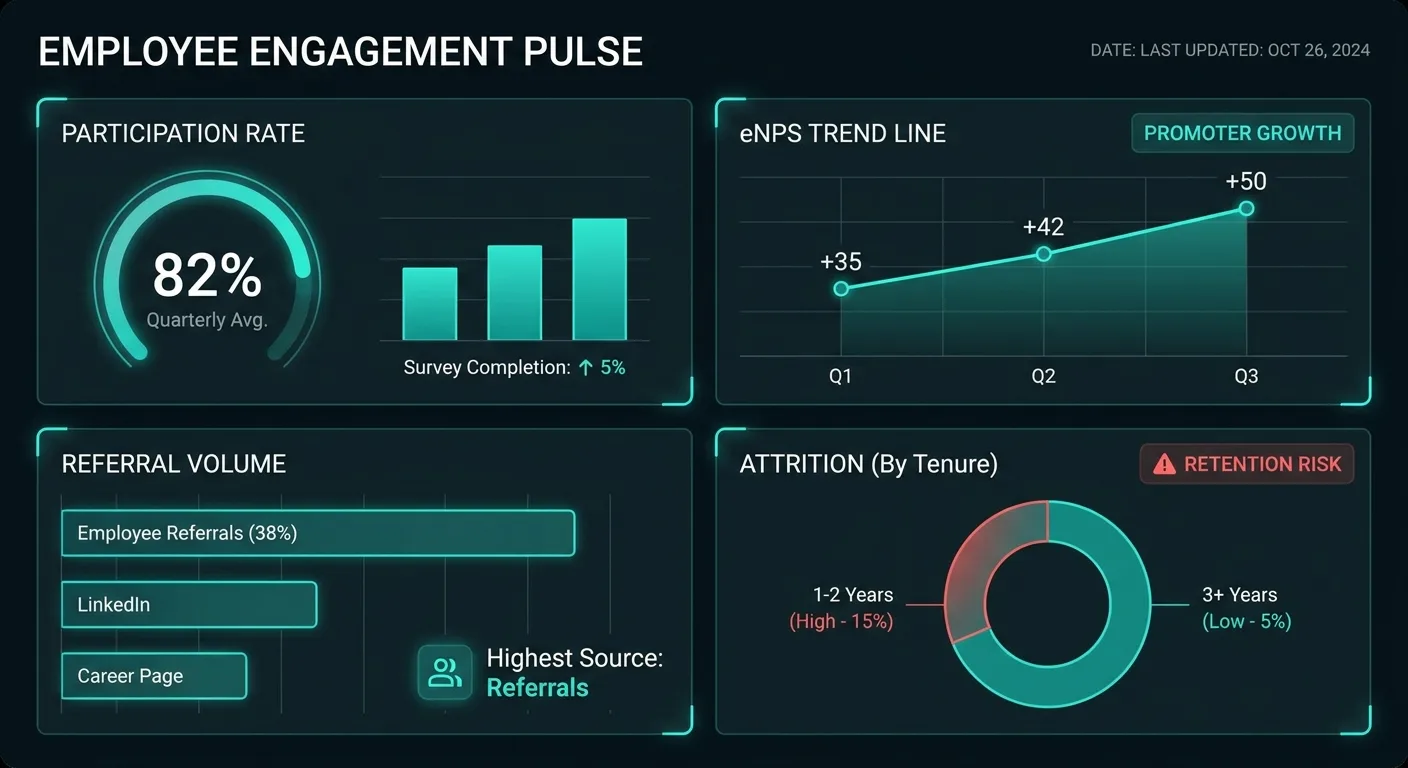
| Indicator | What it tells you | Review cadence |
|---|---|---|
| Participation rate by segment | Whether the activity fits the audience it was built for | Monthly |
| Voluntary vs. mandated attendance | Real appetite, separated from obligation | Per activity |
| Repeat attendance | Whether anyone came back after the first time | Monthly |
| eNPS movement | Directional sentiment across the whole workforce | Quarterly |
| Internal referral volume | Whether people will recommend you with their own reputation attached | Quarterly |
| Regretted attrition | Whether any of this is holding the people you can least afford to lose | Quarterly and annually |
Pulse Surveys People Answer Honestly
Five to seven questions, the same questions every time so you can see movement, and a promise of anonymity your tooling can actually keep. Quarterly suits most teams; monthly if you're mid-restructure and need the signal faster.
Response rates collapse for one predictable reason: leadership goes quiet after collecting the answers. Two rounds of that and people stop bothering, correctly. Share the results, the uncomfortable ones included, and name what you're changing. We moved to Tally after Typeform's anonymity settings confused half the team into thinking their names were attached; if you're choosing, we wrote up the options.
Then build the calendar off those results. Two weakest drivers, whatever they turn out to be (recognition, career clarity, manager support, workload), and every activity in the next four quarters written down against the gap it's meant to close. Review each quarter. Cut whatever isn't moving the number, however good it looked when you planned it.
The Part Where We Sell You Something
Plenty of companies build strong internal programs and then can't prove any of it happened. Careers pages sit unoptimized for years. Search your own employer brand and Glassdoor outranks your site.
We do the measurement side: baselines, dashboards, the boring half. If you want another pair of eyes on what last year's engagement spend actually did, book a call and bring your last two pulse surveys. Twenty minutes will tell you whether there's anything in there.

Start With Three, Not Fourteen
If I could only keep three of these, it's the shadowing, the Friday roundup and the onboarding buddies. Everything else is negotiable.
Pick three from the cheap list and run them for eight weeks. A ritual that survives two months without reminders tells you more about your team than any offsite will. Add the expensive things after that.
And ask your people what they want before you plan a single thing, then act on enough of the answers that they keep telling you the truth.