

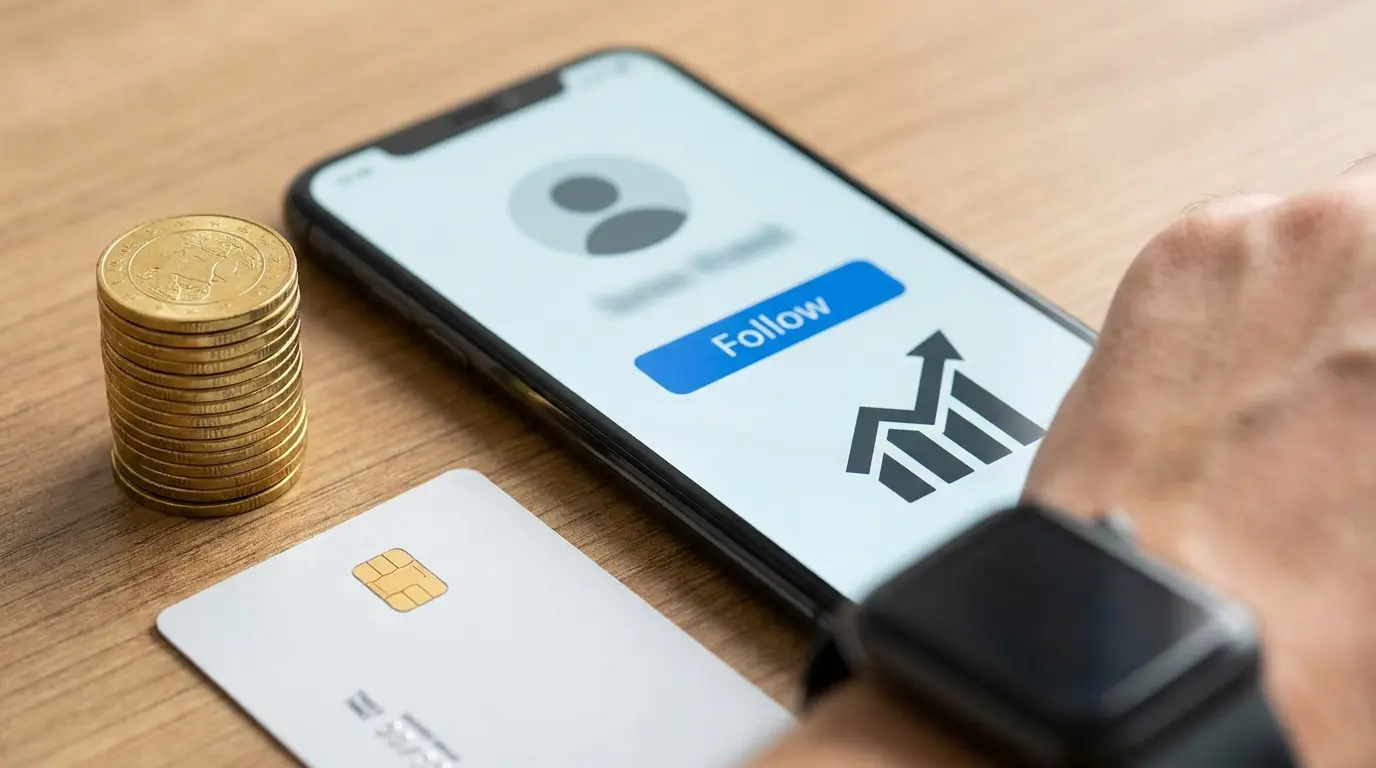
I was on a call last month with a creator who’d bought 8,000 TikTok followers three weeks earlier. She was near tears. “My videos are getting LESS views now,” she said. “How is that even possible?”
I pulled up her analytics and knew immediately what happened. Her engagement rate had cratered from 4.1% to 0.6% overnight. The algorithm saw 8,000 people who supposedly wanted her content and watched exactly none of it. So it stopped showing her videos to anyone.
This is the part nobody talks about when they’re selling you followers, or when you’re at 2am seriously considering buying them because you’re tired of posting into the void.
Everyone argues about whether you SHOULD buy followers. Ethics, authenticity, all that. Fine. But what actually happens AFTER you buy them? What do you wake up to the next day? What shows up in your analytics? How does the algorithm respond? What happens when a brand wants to work with you?
That’s what this is about. Not whether you should do it (that’s your call), but what happens if you do. Because that’s where people get blindsided.
TL;DR
Bottom line: buying followers tanks your engagement rate worse than having no followers at all, the algorithm tests you harder and usually decides your content sucks, brands can spot it in about 30 seconds, and fixing it takes 6-12 months of grinding organic content. It’s not a shortcut. It’s a detour through hell. Here’s the map.
The Immediate Aftermath: What Your Analytics Actually Show
The transaction completes. Your follower count jumps from 847 to 5,847 overnight. You refresh your profile and feel that brief dopamine hit of seeing a bigger number.
Then you make the mistake of opening your analytics.
Every other metric stayed exactly the same.
Your average views per video? Still hovering around 200. Your engagement rate? It just dropped from 3.2% to 0.5% in a single day. Profile visits might tick up slightly (curiosity from your existing audience wondering what happened), but video shares, saves, and comments remain flat.
This is the first 24-72 hours after buying TikTok followers, and the disconnect between follower count and other performance indicators becomes impossible to miss. That gap matters more than the number itself because it signals to both the platform and potential collaborators that something doesn’t add up.
The Engagement Rate Collapse
Let’s talk about the math that’s about to screw you.
Engagement rate equals total engagement divided by follower count. Simple enough.
So let’s say you had 847 followers and your videos got around 27 likes each. That’s a 3.2% engagement rate. Not amazing, but not terrible. Brands will talk to you at 3%.
Now you buy 5,000 followers. Your next video still gets 27 likes because the bought followers don’t do anything. But now you have 5,847 followers.
27 divided by 5,847 equals 0.46%
You just paid money to make your engagement rate look 7x worse.
And here’s the thing: you can’t just “get more likes” to fix it. To get back to that 3.2% rate, you’d need 187 likes per video. You were getting 27. You’d need to 7x your engagement overnight just to break even.
This matters because brands evaluate engagement rate before follower count when considering partnerships. TikTok’s algorithm uses engagement velocity to determine content distribution. Your existing organic followers see the number jump and may question your authenticity. Future organic growth becomes harder when your baseline metrics look weak.
| Follower Count | Likes Per Video | Engagement Rate | Likes Needed for 3% Rate |
|---|---|---|---|
| 847 (organic) | 27 | 3.2% | 25 |
| 5,847 (after purchase) | 27 | 0.46% | 175 |
| 5,847 (after purchase) | 50 | 0.86% | 175 |
| 5,847 (after purchase) | 100 | 1.71% | 175 |
| 10,000 (continued growth) | 100 | 1.0% | 300 |
Follower Quality Indicators That Immediately Shift
Your follower demographics change overnight in ways that show up in analytics. Purchased followers typically come from specific geographic regions (often not your target market), show zero gender/age diversity patterns, and have account creation dates clustered around similar timeframes.
You’ll notice geographic distribution that doesn’t match your content language or cultural references. Follower accounts with no profile pictures, generic usernames, or minimal account activity. Zero overlap between your new followers and your existing audience’s networks. No increase in profile visits from followers’ feeds or discovery pages.
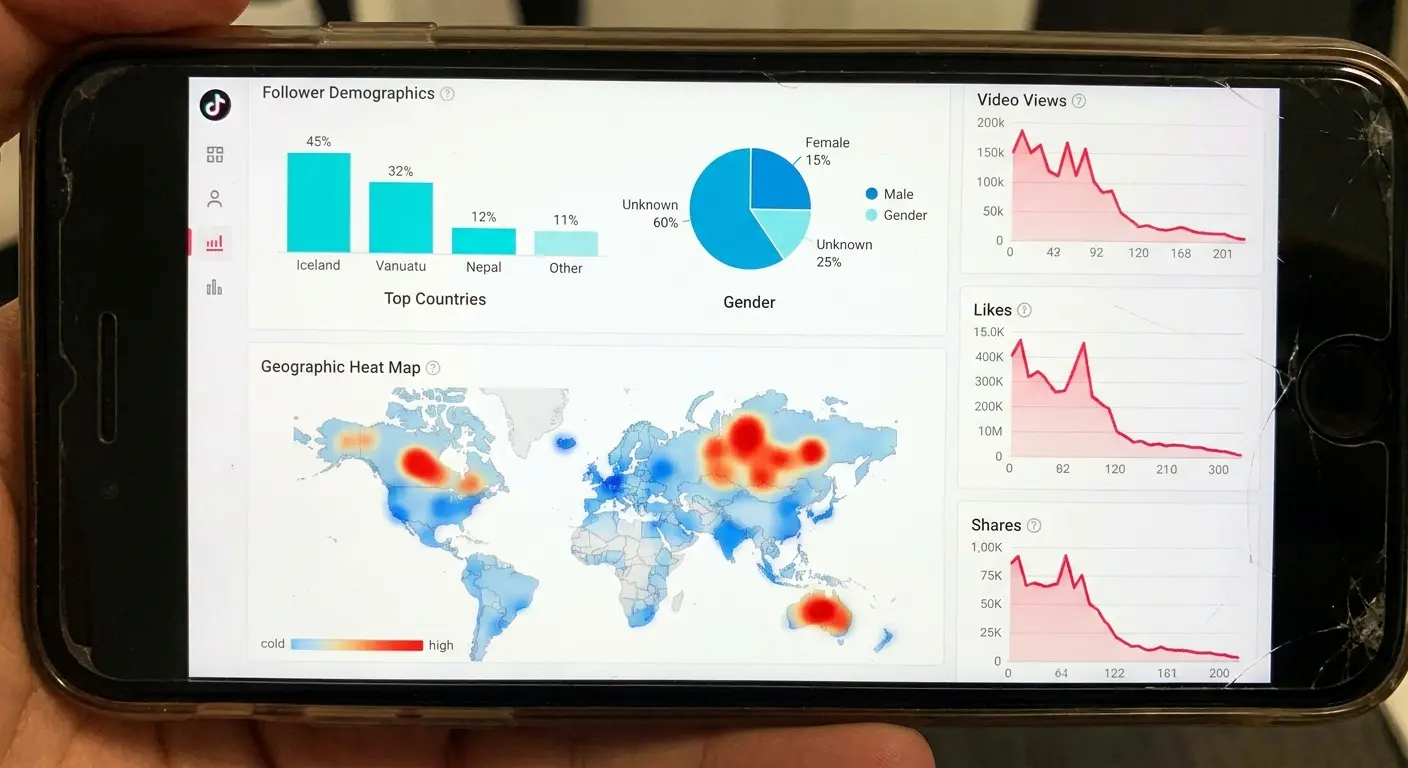
I worked with a fitness creator (let’s call her Maya) who bought 3,000 followers after seeing a competitor hit 10k. Within 48 hours, her analytics showed 67% of her new followers were located in Mumbai and Jakarta. She teaches HIIT classes in Austin. In English. To people who complain about Texas heat. The geographic mismatch was so obvious that when she posted her next video about training in 95-degree weather, literally zero of those 2,000+ accounts watched it. Her engagement came entirely from her original 1,200 followers while the purchased accounts showed zero watch time.
These patterns create a data signature that’s visible to anyone with access to your analytics, which includes potential brand partners who request backend access during vetting processes. The immediate aftermath isn’t just about numbers changing. It’s about creating a permanent record of inconsistency that follows your account through every future interaction.
The Algorithm’s Response to Sudden Follower Spikes
Here’s what people get wrong: TikTok doesn’t immediately penalize follower spikes. That’s not how this works.
What it DOES do is test you. Hard.
When your follower count jumps significantly, the algorithm pushes your next few videos to a larger initial test audience. This sounds good until you realize what’s being measured: how your new followers respond compared to your organic audience.
The Testing Window and What It Measures
Your next 5-10 videos enter a heightened evaluation period. The algorithm serves your content to a sample of your new followers, your existing organic followers, and a broader For You Page test audience.
It’s measuring response rate differential. If your organic followers engage at 4% but your new followers engage at 0.02%, the algorithm interprets this as audience mismatch. Your content isn’t resonating with the people who chose to follow you (even though they didn’t choose anything).
This creates a feedback loop. The algorithm assumes your content isn’t relevant to your stated audience, leading to decreased distribution even to your organic followers who were engaging before.
Content Distribution Patterns After Purchase
You might expect more followers to mean more views.
Yeah, no.
Your videos get pushed to your follower feed first (standard protocol). But when 85% of that follower base doesn’t watch, doesn’t engage, and scrolls past immediately, the algorithm receives a clear signal: this content isn’t valuable even to people who supposedly want to see it.
| Distribution Stage | Pre-Purchase Performance | Post-Purchase Performance | Impact |
|---|---|---|---|
| Initial follower feed push | 847 followers, 340 views (40% view rate) | 5,847 followers, 420 views (7% view rate) | Algorithm interprets as poor content-audience fit |
| For You Page test batch | 1,500 impressions, 180 views (12% CTR) | 800 impressions, 72 views (9% CTR) | Reduced test audience size due to poor follower response |
| Expanded FYP distribution | Triggered after 25% engagement | Rarely triggered, engagement threshold not met | Content stops at initial test phase |
| Total reach potential | 2,000-3,500 views | 500-900 views | 60-75% reduction in distribution |
The result? Your content gets deprioritized for For You Page distribution, which is where TikTok growth actually happens. You’ve traded potential viral reach for a follower number that works against you.
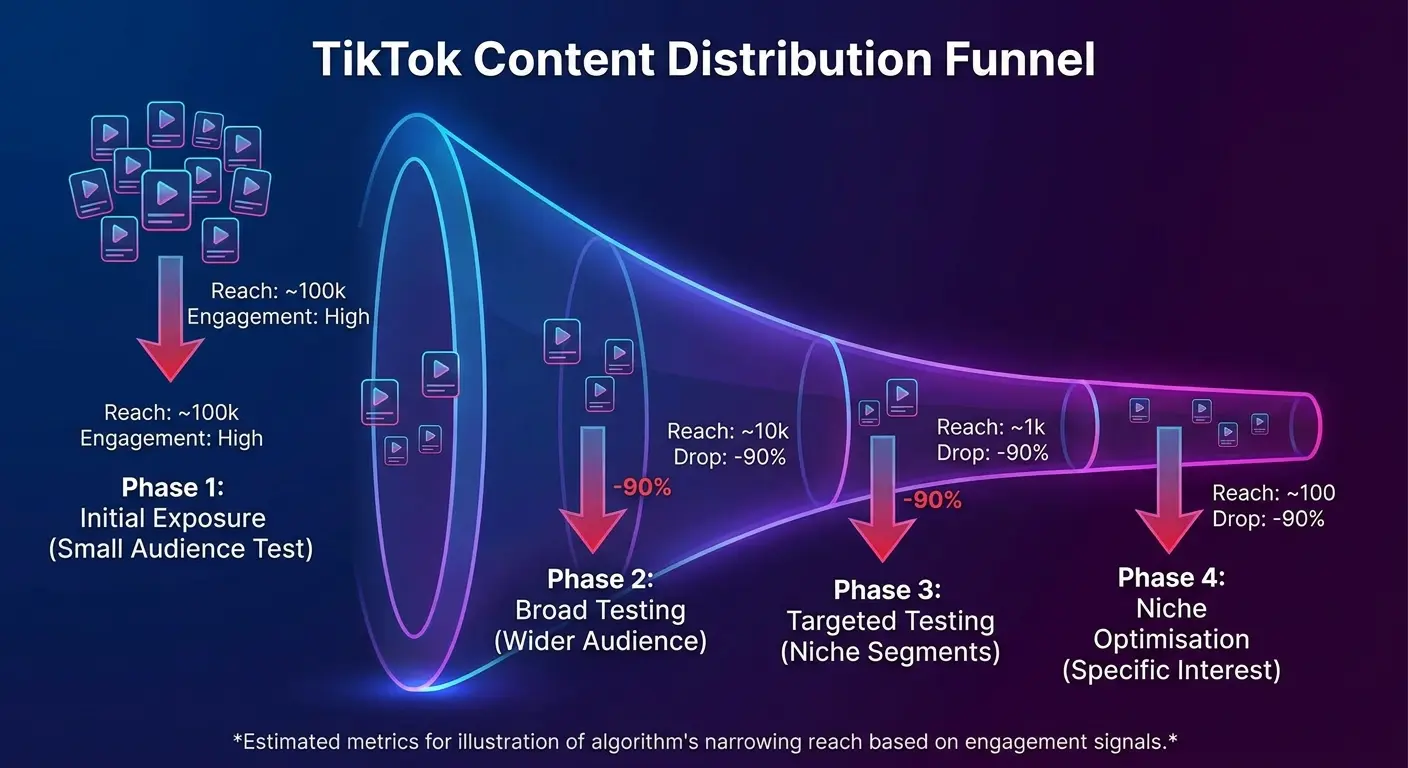
The algorithm isn’t punishing you for buying TikTok followers. It’s responding to the engagement data those followers create. Every inactive account signals to the platform that your content isn’t connecting with your audience, which triggers distribution restrictions that compound over time.
Content Strategy Adjustments When Your Audience Isn’t Real
You can’t create content for 5,000 people who don’t exist as real audience members. But you also can’t ignore them because they’re affecting every metric that matters.
So now you’re stuck creating content for ghosts. Fun, right?
The strategy shift required is counterintuitive: you need to create content that performs well enough with your organic audience to offset the dead weight of purchased followers while simultaneously trying to attract new organic followers who can dilute the inactive percentage.
The Dual-Purpose Content Framework
Every video you post now needs to accomplish two things.
First, it must resonate strongly enough with your actual target audience (your organic followers and potential new organic followers) to generate above-average engagement that compensates for the inactive accounts.
Second, it needs to be discoverable through search and hashtag strategies that bypass the For You Page algorithm, which is now working against you.
This means prioritizing content with strong hook retention in the first 1.5 seconds. Using search-optimized captions that answer specific questions your target audience is asking. Focusing on shareability rather than just likes (shares carry more algorithmic weight). Creating content that drives profile visits, which can lead to organic follows that improve your ratio.
You’re trying to outgrow your purchased follower base through aggressive organic growth, which is harder than just growing organically from the start.
Post-Purchase Content Checklist (Use Before Publishing Each Video):
- Hook delivers value proposition in first 1.5 seconds
- Caption includes 2-3 search-optimized keywords your target audience would use
- Content answers a specific question or solves a clear problem
- Video includes a natural share trigger (surprising information, useful tip, relatable moment)
- At least one element designed to drive profile visits (teasing related content, establishing authority)
- Hashtag mix includes 2 niche-specific tags, 1 medium-competition tag, 1 search-focused tag
- Content aligns with your last 5 videos to establish topical consistency for algorithm
- Call-to-action focuses on saves or shares rather than just likes
Engagement Bait That Works Post-Purchase
You need engagement, desperately. But obvious engagement bait (comment this, tag someone, etc.) typically underperforms unless it’s genuinely valuable.
What works better: controversial takes that spark genuine discussion in comments. Tutorial content with a missing step that prompts questions. Series content that creates return viewership and sustained engagement over multiple posts. Stitch and duet-friendly content that encourages participation.
The goal is generating enough real engagement to mask the inactive follower problem while you work on the longer-term fix.
When buying followers on TikTok, you create a content strategy problem that extends far beyond the initial purchase. You’re now optimizing for an audience that doesn’t exist while trying to build one that does, all while fighting against metrics that make both goals harder to achieve.
Converting Purchased Followers Into Actual Engagement
Can you turn a purchased follower into a real one? Sometimes, but the success rate is low enough that it shouldn’t be your primary strategy.
Purchased followers fall into three categories: bot accounts with zero potential for conversion (60-70% of most purchased follower packages), inactive real accounts that haven’t been used in months (20-30%), and real accounts that follow back as part of follow-for-follow schemes (10-20%).
Only that third category has any conversion potential, and even then, they’re not your target audience.
Reactivation Tactics With Minimal Success Rates
If you’re determined to try activating purchased followers, you’re working with severe limitations. These accounts didn’t follow you because they wanted your content. They followed because they were paid to, programmed to, or following a reciprocal follow pattern.
Your only option is creating content so good that it breaks through their disinterest. Extremely high production value that stands out in a feed. Trend-jacking at the earliest possible moment when a trend is emerging. Controversy or hot takes that generate curiosity clicks. Giveaways or contests (though this often attracts more of the wrong audience).
Realistically, you’ll convert less than 2% of purchased followers into any form of meaningful engagement. That’s not a strategy. That’s damage control.
Why Conversion Efforts Usually Backfire
Time and energy spent trying to activate purchased followers is time not spent attracting organic followers who want your content. You’re optimizing for the wrong audience.
Worse, content designed to appeal to a broad, generic audience (which is what purchased followers represent) often alienates your core organic audience who followed you for specific reasons.
I watched a food blogger absolutely tank her account trying to
I watched a food blogger absolutely tank her account trying to fix this. She’d built this beautiful little following around authentic Italian recipes (her nonna’s techniques, regional dishes, the whole thing). Then she bought 4,000 followers because she wanted to hit that 5k threshold for some brand deal.
Those followers didn’t care about regional Italian cooking. They weren’t there for ANY reason, really. They were bots and inactive accounts.
So what did she do? She panicked and started making generic food hacks. “How to peel garlic faster!” “This one weird trick for chopping onions!” Stuff she thought would appeal to… I don’t know, everyone?
Her original 900 followers (the ones who actually loved her content) started leaving. And the bought followers? Still didn’t engage. She lost both audiences by trying to please neither.
The Hybrid Approach: Mixing Bought and Organic Growth
Some creators use purchased followers as a psychological trigger for organic growth, banking on social proof to make their profile more attractive to real potential followers. This can work, but only under very specific conditions.
The theory: people are more likely to follow an account with 10,000 followers than one with 400, even if the content quality is identical. The purchased followers create perceived credibility that converts organic visitors at a higher rate.
The Ratio Management Strategy
If you’re using purchased followers as part of a broader strategy (rather than a standalone tactic), you need to manage the ratio between purchased and organic followers carefully.
The goal is keeping purchased followers below 30% of your total audience at any given time. This means purchasing smaller batches (500-1,000) rather than large quantities. Spacing purchases weeks or months apart. Aggressively pursuing organic growth between purchases to dilute the inactive percentage. Monitoring engagement rate and adjusting if it drops below industry benchmarks for your niche.
You’re trying to maintain the appearance of legitimacy while using purchased followers as a temporary boost. This requires constant attention and course correction.
Timing Purchases Around Organic Growth Spikes
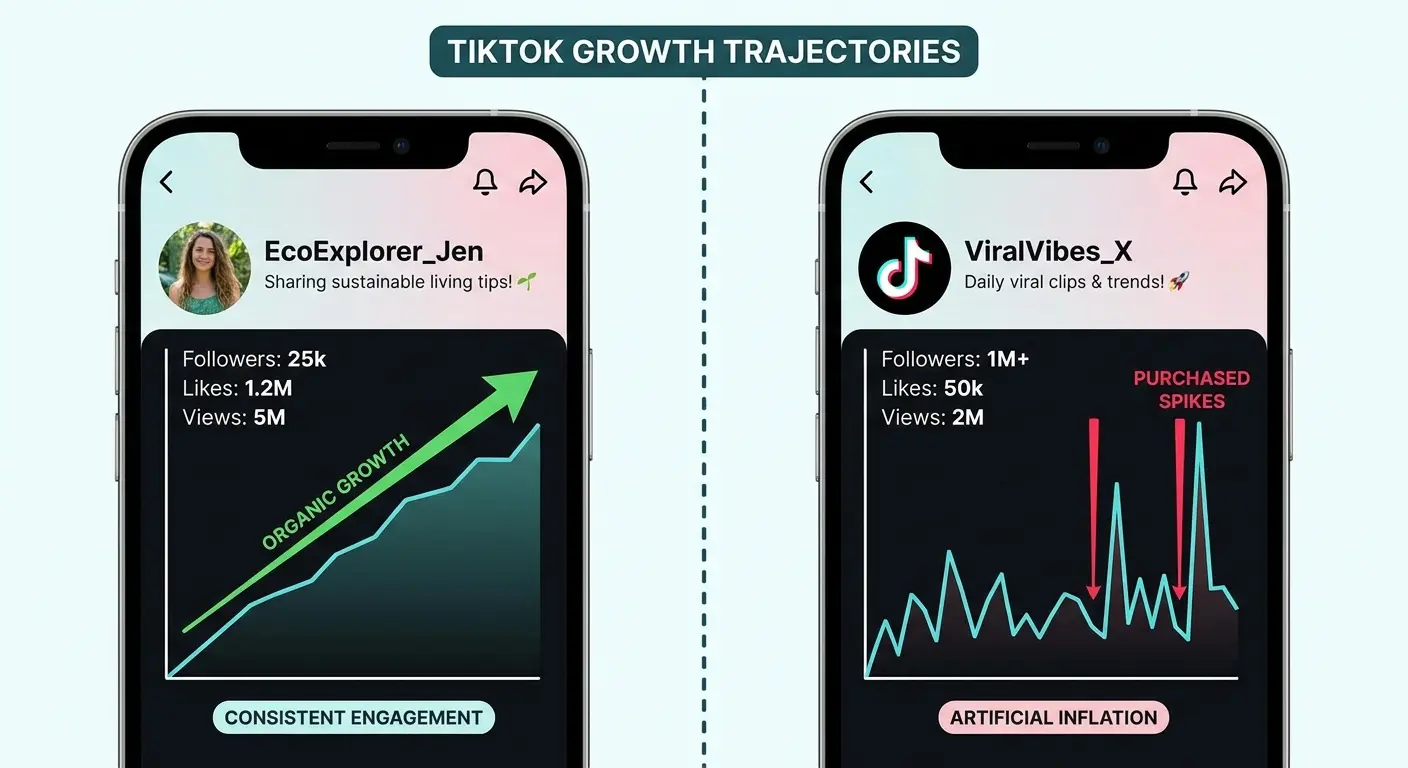
The least detectable time to buy TikTok followers is during or immediately after an organic growth spike. If you have a video go semi-viral and gain 800 organic followers in a day, adding 400-500 purchased followers in that same window creates less of a data signature.
The spike looks like an extension of organic growth rather than an anomaly. Your engagement rate doesn’t collapse as dramatically because you’re also gaining real followers who will engage.
This approach requires patience and opportunistic timing. You can’t force organic spikes, which means you might wait weeks or months for the right moment to add purchased followers without creating obvious red flags.
Hybrid Strategy Risk Assessment Template:
Current Account Status:
- Total followers: _______
- Organic followers (estimated): _______
- Purchased followers: _______
- Current engagement rate: _______%
- Industry benchmark engagement rate for your niche: _______%
Pre-Purchase Evaluation:
- Current engagement rate is within 0.5% of industry benchmark
- Last 10 videos averaged within 20% of each other in views (consistency check)
- No active shadow ban symptoms (views haven’t dropped >40% in last 14 days)
- Organic growth in last 30 days: _______ followers
- Planned purchase amount: _______ (should be <30% of current total)
Post-Purchase Monitoring (Track for 14 days):
- Day 3 engagement rate: _______%
- Day 7 engagement rate: _______%
- Day 14 engagement rate: _______%
- Average views compared to pre-purchase baseline: _______% change
- New organic followers gained: _______
Decision Point:
If engagement rate drops >1% or views drop >25%, pause all future purchases and focus exclusively on organic growth for 60 days.
Platform Detection Methods You’re Up Against
TikTok doesn’t publicly disclose exactly how it detects purchased followers (that would make circumvention easier), but patterns emerge from enforcement actions and platform behavior.
The platform is looking for anomalies in both your account behavior and your followers’ behavior. It’s a two-sided detection system.
Follower Account Quality Signals
TikTok evaluates the accounts following you for signs of inauthenticity.
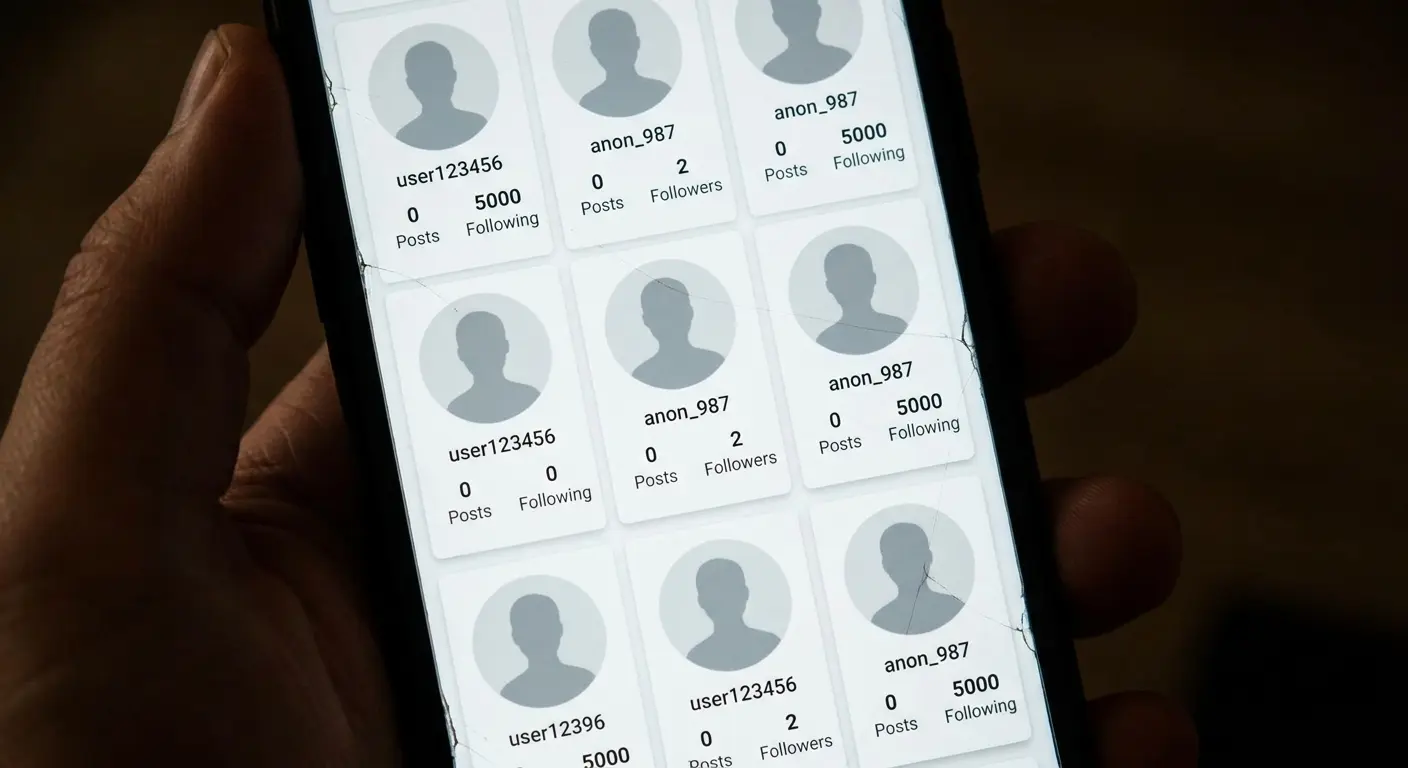
Account age and activity history (new accounts with zero content are red flags). Following/follower ratios (accounts following 10,000+ with 12 followers are obvious). Engagement patterns (accounts that never like, comment, or watch videos fully). Geographic clustering (500 new followers all from the same city in 24 hours). Device and IP data (multiple accounts created from the same device or network).
When a significant percentage of your followers exhibit these characteristics, your account gets flagged for review. This doesn’t always result in immediate action, but it affects how the algorithm treats your content distribution.
Your Account Behavior Patterns
TikTok also watches your account for behaviors that correlate with purchased followers.
Sudden follower spikes with no corresponding viral content. Engagement rate drops that align with follower increases. Follower demographics that don’t match your content language, location, or topic. Posting frequency changes (some people buy TikTok followers then post more, thinking they have an audience now).
The platform uses machine learning models trained on thousands of accounts that were confirmed to have purchased followers. Your account data gets compared against these patterns. Close matches trigger anything from algorithmic suppression to account warnings to permanent bans.
The Shadow Ban Reality
Shadow banning (reduced content distribution without notification) is TikTok’s most common response to suspected purchased followers. Your content simply stops appearing on For You Pages. Your videos only reach your follower feed, and since most of those followers are inactive, your views collapse.
You’ll notice views dropping to 10-20% of previous averages. Zero new organic followers despite posting consistently. Engagement coming only from your existing organic followers. Content not appearing in hashtag feeds or search results.
Shadow bans can last days, weeks, or become permanent depending on ongoing behavior. There’s no official appeal process because TikTok doesn’t officially acknowledge shadow banning exists.
Long-Term Account Health Indicators to Monitor
Follower count is a vanity metric. Your account health is determined by engagement consistency, content distribution reach, and audience quality signals that play out over time.
Monitoring these indicators helps you understand whether your account is trending toward recovery or continued suppression.
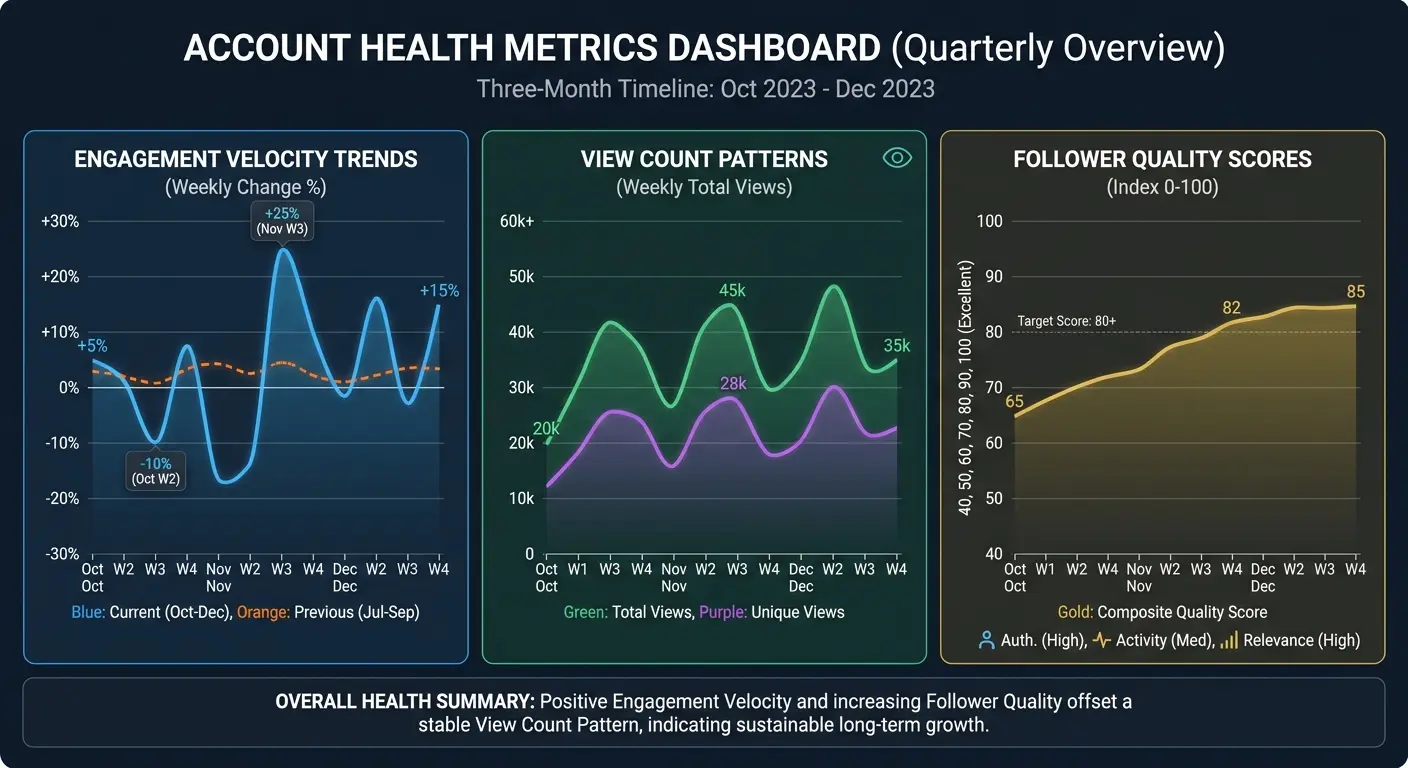
Engagement Velocity Trends
Engagement velocity measures how quickly your content generates engagement after posting. Healthy accounts see most engagement in the first 1-3 hours after posting. Suppressed accounts see slow, trickling engagement that extends over days.
Track time to first 100 views. Percentage of total engagement that happens in the first hour. Whether engagement is accelerating (good) or decelerating (bad) with each post. Engagement coming from For You Page vs. follower feed (FYP engagement indicates healthy distribution).
If your engagement velocity is slowing over weeks, the algorithm is deprioritizing your content. This often happens after buying TikTok followers because your engagement rate can’t support your follower count.
Follower Quality Score Proxies
TikTok doesn’t give you a follower quality score, but you can approximate it by tracking percentage of followers who have posted content in the last 30 days. Average follower count of your followers (extremely low suggests bot networks). Follower retention rate (how many new followers still follow you 30 days later). Profile visit to follow conversion rate (low rates suggest purchased followers aren’t converting visitors).
Improving these proxy metrics means your audience is becoming more real over time, even if your total follower count includes purchased accounts. You’re diluting the problem through organic growth.
Content Distribution Consistency
Healthy accounts see relatively consistent view counts across multiple posts (with expected variation based on content quality and topic). Suppressed accounts see wildly inconsistent distribution, with some videos getting 50 views and others getting 5,000 with no clear pattern.
This inconsistency signals algorithmic confusion. The platform can’t figure out who your audience is because your follower base doesn’t match your content engagement patterns. It’s testing different distribution strategies with each post, leading to unpredictable results.
Consistency returns as your organic follower base grows and engagement patterns stabilize, but this can take months of sustained effort.
What Brands and Collaborators Actually See When They Vet You
Let me tell you what happens when a brand actually wants to work with you.
First, they don’t just look at your follower count and send you a contract. Those days are over. Brands lost too much money on influencers with fake audiences.
Now? They run your account through tools. These tools are specifically designed to catch bought followers.
Third-Party Audit Tools Brands Use
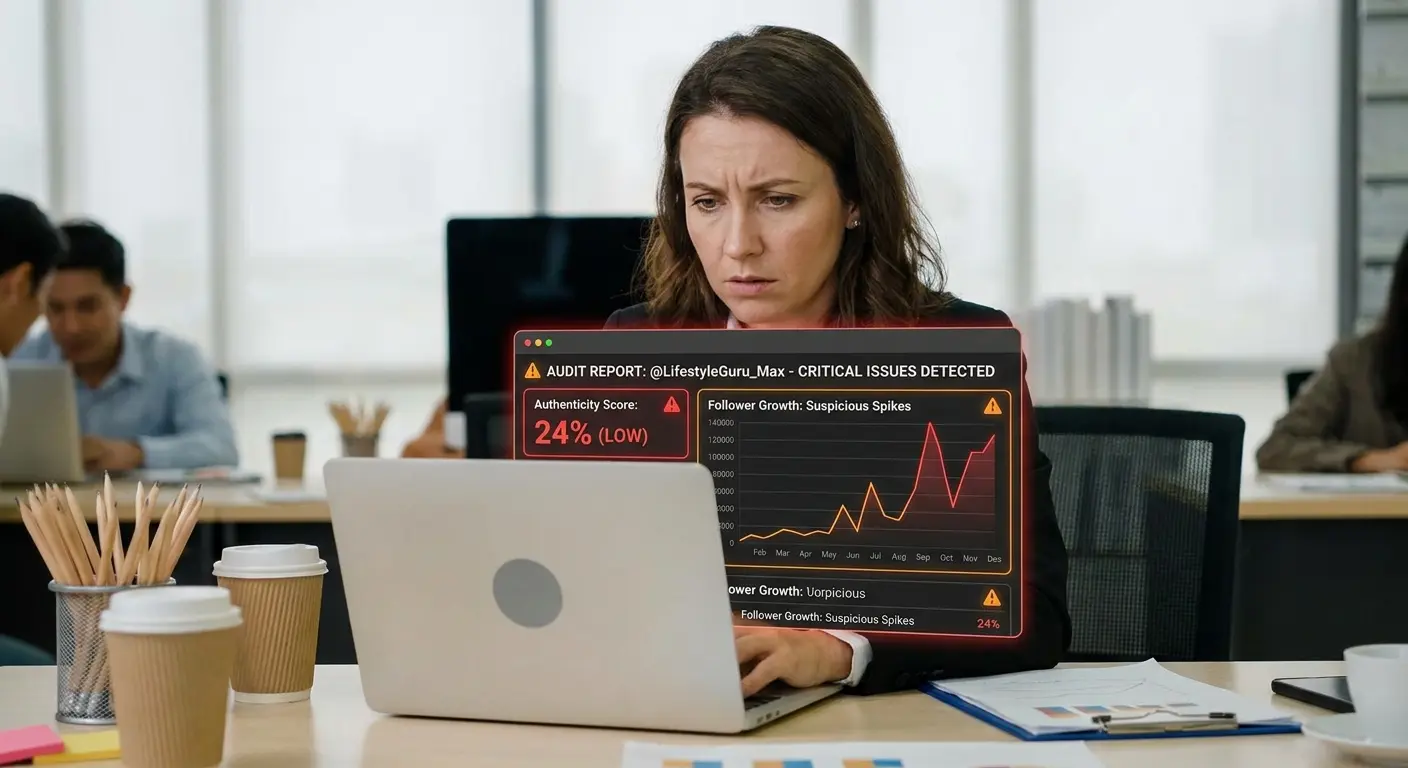
Most brands use influencer marketing platforms that automatically scan your account for authenticity signals. Tools like HypeAuditor, Modash, and AspireIQ analyze follower growth patterns over time (sudden spikes get flagged). Engagement rate compared to follower count benchmarks. Comment quality and authenticity (generic comments like “nice!” from accounts with zero followers). Follower account quality scores based on activity levels. Audience demographics and whether they match your content niche.
These tools generate an authenticity score, typically 0-100. Scores below 70 often disqualify you from consideration regardless of your follower count. Purchased followers tank this score because the tools are specifically designed to detect them.
Backend Analytics Requests
Serious brand partnerships require analytics access. You’ll be asked to share screenshots or grant temporary access to your TikTok analytics dashboard, which reveals traffic sources (follower feed vs. For You Page vs. search). Audience territories and top geographic locations. Follower activity times and patterns. Video completion rates and average watch time. Follower growth charts with daily breakdowns.
A brand manager who knows what to look for can spot purchased followers in seconds. They’re looking for the same patterns TikTok’s algorithm flags: sudden growth without corresponding viral content, engagement rates that don’t match follower counts, and audience demographics that make no sense for your content.
The Questions That Expose Purchased Followers
During partnership discussions, brands ask seemingly casual questions designed to reveal authenticity.
“Which of your recent videos drove the most follower growth?”
If you can’t point to specific content that explains your follower count, that’s a red flag. Organic growth ties directly to content performance. Purchased growth doesn’t.
“What’s your audience demographic breakdown?”
If you stumble or provide vague answers because you don’t know who your purchased followers are, brands notice.
“What’s your typical engagement rate, and how has it changed as you’ve grown?”
The correct answer for organic growth is “relatively stable” or “improving slightly.” If your engagement rate dropped as your followers increased, you’ve just admitted to having low-quality followers.
Comment Section Quality Assessment
Brands read your comment sections. They’re looking for genuine conversations, questions about your content, and community interaction. What they find on accounts with purchased followers:
Generic comments (“Great content!”, “Love this!”, fire emojis with no context). Comments from accounts with usernames like “user8374629”. Zero substantive discussion or questions. Comment-to-like ratios that seem off (1,000 likes but 3 comments).
Real audiences generate real conversations. Purchased followers generate silence or obvious bot comments. Brands know the difference.
Recovery Strategies When Things Go Sideways
So you bought followers. Your engagement tanked. Your content isn’t getting distributed. Brands aren’t interested. You need a recovery plan, and you need to understand that recovery takes longer than the initial damage.
The good news: recovery is possible. The bad news: it requires months of consistent effort with no shortcuts.
The Gradual Organic Outgrowth Strategy
You can’t remove purchased followers without deleting your account and starting over (which is sometimes the right move, but we’ll get to that). What you can do is grow your organic follower base until purchased followers become a small enough percentage that they stop dragging down your metrics.
This requires posting consistently (daily or near-daily) to maximize organic growth opportunities. Focusing on content formats with proven engagement in your niche. Using TikTok SEO to drive discovery outside the For You Page algorithm. Engaging authentically with other creators to build community visibility. Using trending sounds and hashtags strategically without sacrificing content quality.
Your goal is adding 100-200 organic followers per week until they outnumber your purchased followers 3:1 or higher. At that ratio, your engagement rate starts recovering and the algorithmic suppression begins lifting.
Timeline: 6-12 months depending on your niche and content quality.
A tech reviewer I know purchased 6,000 followers in March, dropping his engagement rate from 4.1% to 0.7%. He committed to posting one in-depth review daily, focusing on searchable content like “iPhone 15 Pro battery test” and “best budget gaming laptop 2024.” By consistently answering specific tech questions, he gained 180-220 organic followers weekly through search traffic. By October (7 months later), his follower count reached 14,300, with approximately 8,300 organic followers. His engagement rate recovered to 2.8%, and brands started reaching out again because his comment sections showed genuine tech discussions rather than bot activity.
Content Reset and Niche Clarification
One reason the algorithm struggles with accounts that have purchased followers is audience confusion. Your follower base doesn’t represent a coherent audience, so the algorithm can’t figure out who to show your content to.
You need to clarify your niche through content consistency. Pick one primary content category and stick with it for 30-60 days. Use consistent hashtags that define your niche clearly. Create series content that establishes topical authority. Avoid random viral attempts that confuse your content identity.
This helps the algorithm relearn who your actual audience is by observing who engages with your focused content. Over time, it starts distributing your content to people who match your engaged audience profile rather than your inactive follower base.

Engagement Pod Risks and Why They Usually Backfire
Some creators try to fix their engagement rate by joining engagement pods (groups that agree to like and comment on each other’s content). This seems logical but creates new problems.
TikTok detects coordinated engagement patterns. Pod engagement comes
TikTok detects coordinated engagement patterns. Pod engagement comes from accounts outside your niche, further confusing the algorithm. Pod members often use generic comments that look inauthentic to brands. You’re trading one form of fake engagement for another.
Engagement pods might temporarily boost your engagement rate numbers, but they don’t solve the underlying problem: you don’t have a real audience interested in your content. Brands can spot pod engagement, and the algorithm deprioritizes it.
The Nuclear Option: Starting Fresh
Sometimes the damage is too severe to repair. If you’ve purchased followers multiple times, if your engagement rate is below 0.5%, if you’re shadow banned with no signs of recovery after months, starting a new account might be your best option.
This is the right move when your current account has been flagged or restricted multiple times. Your follower-to-engagement ratio is beyond repair (10,000+ followers with 20 views per video). You’ve lost brand partnerships specifically because of authenticity concerns. You’ve learned enough to grow organically and don’t want the baggage of past mistakes.
Starting fresh means losing your follower count, but if those followers aren’t real or engaged, you’re not losing anything valuable. You’re gaining a clean slate with the algorithm and with potential brand partners.
Transferring Your Audience (The Few Real Ones)
If you decide to start fresh, you can attempt to bring your real followers with you.
Post a video on your old account directing people to your new account. Use other platforms (Instagram, YouTube) to announce the switch if you have presence there. Create a “best of” compilation that showcases why people followed you originally. Pin a comment with your new account handle.
You’ll lose most of your followers in the transition (even real ones don’t always make the jump), but the followers who do transfer are your most engaged audience members. That’s valuable.
The Post-Purchase Content Dilemma
Creating content for an audience that doesn’t exist is demoralizing. You post a video you’re proud of, and it gets 73 views despite your 8,000 followers. You know why, but that doesn’t make it less frustrating.
The psychological impact of buying followers on TikTok often does more damage than the algorithmic consequences. You’ve created a situation where your metrics lie to you, making it nearly impossible to gauge what’s working.
Redefining Success Metrics
You need to stop measuring success by total views or follower count. Those numbers are contaminated. Instead, focus on engagement rate from your last 10 videos (is it trending up or down?). Profile visits per video (indicates content is good enough to drive curiosity). Follower retention rate (what percentage of new followers stick around 30 days later?). Share rate (strongest signal of content value). Comments that demonstrate genuine interest or ask substantive questions.
These metrics tell you whether you’re creating valuable content regardless of your compromised follower count. They’re leading indicators of eventual recovery.
Content Experimentation Without Clear Feedback
Normally, you’d test different content formats and let performance data guide your strategy. But when your metrics are skewed, you can’t trust the data. A video that performs poorly might be great content that your inactive followers dragged down.
You need alternative feedback mechanisms: ask your engaged followers directly (through comments or stories) what they want to see. Monitor which videos drive the most profile visits, even if total views are low. Track saves and shares more than likes (harder to fake, more meaningful). Pay attention to external traffic sources (if people are finding you through search or shares, that’s real interest).
You’re flying blind until your organic audience grows large enough to provide reliable signal through the noise of inactive followers.
Maintaining Motivation Through the Recovery Period
Recovery from purchased followers is a grind. You’re working harder than someone growing organically from zero because you’re fighting against your own metrics.
Staying motivated requires setting process goals rather than outcome goals (post X times per week, not hit X views). Celebrating small wins (a video that gets 50% more engagement than average matters). Connecting with other creators for accountability and community. Remembering that every organic follower you gain dilutes the purchased follower problem.
I’ve worked with creators who’ve successfully recovered from follower purchases, and the common thread is consistency over months, not weeks. The ones who give up do so around week 6-8 when results are still minimal. The ones who succeed push through that wall and see momentum build around month 4-5.
Final Thoughts
Look, I’m not going to tell you whether to buy followers or not. You’re an adult. You can make your own bad decisions.
But if you do it, go in with your eyes open.
You’re not buying an audience. You’re buying a number that makes every other number worse. Your engagement rate tanks. The algorithm tests you harder and usually decides your content isn’t worth showing to anyone. Brands can spot it immediately. And fixing it takes longer than just growing organically from the start.
The followers you buy don’t become your audience. They become your problem.
I’ve seen creators recover from this. It takes 6-12 months of consistent, high-quality content. It takes ignoring your follower count and focusing on engagement rate. It takes posting into the void while your metrics lie to you about what’s working.
Some people make it through. Most don’t.
The ones who do always say the same thing: “I should have just put that money into making better content.”
So maybe start there instead.