12 AdEspresso Alternatives We Tested With Client Budgets in 2026
AdEspresso Alternatives compared by features, pricing, strengths, drawbacks, and best use case.

I timed it once, out of spite. Fifty-one seconds for a client dashboard to render, mid-morning, fibre connection, fresh browser profile, nothing else open. Then I went and looked up AdEspresso on G2 and found it sitting at 3.6/5 across 74 reviews (as of October 2026), where the complaints were almost word for word my own: glitches, slow loads, an interface that hasn’t meaningfully changed since about 2020.
The timing matters, because the cost of running a sluggish tool has gone up. Facebook’s average cost per click across all industries climbed roughly 11% year over year to $1.72 in 2026, up from $1.55 the year before, driven partly by AI bidding and wider Advantage+ adoption. Every hour you spend waiting on a dashboard is now measurably more expensive than it was.
Short answer
The best AdEspresso alternatives in 2026 are Foreplay for creative research and Bïrch (Revealbot) for automation rules. Madgicx suits Meta accounts spending above roughly $15k/month, Servo and Wevion replicate AdEspresso’s simplicity, Adzooma covers the free-tier case, and HubSpot Marketing Hub is the pick when you need ad spend tied to closed revenue.
So we spent most of this year pushing live client budget through every replacement we could get a login for. Some tools earned a permanent spot. One of them paused a working ad set on a Saturday night, and nobody caught it until Monday.
Short version, before the tables and the rankings: most ex-AdEspresso users should be running Foreplay for creative research and Bïrch for automation rules, and nothing else on this page. The other ten exist because your situation might not be the common one. Choosing a tool fixes a workflow problem, and plenty of teams shopping for adespresso alternatives are wrestling with a strategy problem dressed up as a workflow problem.
Some context on why AdEspresso went sideways, because it wasn’t laziness. Hootsuite bought it in 2017 and the roadmap narrowed almost immediately after. iOS 14.5 wrecked split-test reliability on small audiences, which was the entire product thesis. Then Meta folded most of the simplification value into Advantage+, and AdEspresso was left charging a subscription for convenience the platform now hands out free.
Contents
- Quick verdicts
- Comparison table
- How we scored these
- The twelve, ranked
- Four we almost ranked, and seven we dropped
- FAQ
- Final thoughts
TL;DR: Quick Verdicts
Most of these tools solve one bottleneck properly instead of five badly. Find the line that describes your pain and start there.
- Don’t want to run it yourself? The Marketing Agency manages paid search and paid social end to end. PPC from $750/month.
- Creative bottleneck? Foreplay or GetHookd for research, AdCreative.ai for production. If you only buy one thing off this page, buy Foreplay.
- Rules and pacing? Bïrch for precision. Madgicx if you want the machine making calls for you on Meta.
- Want AdEspresso’s simplicity with more under the hood? Servo or Wevion.
- Tight budget? Adzooma’s free tier. Wevion’s €0 plan also exists and never expires, though I’d want a longer track record before running anything serious on it.
- Need revenue truth instead of platform metrics? MyDataNinja if you’re scrappy, HubSpot if you have the budget and a CRM already.
- Agency volume? Smartly.io or Bïrch, both built for many accounts and seats.
One piece of advice that isn’t a shortcut: hook your new tool up to attribution you trust before you switch on a single automation rule. Automation that reads bad data is worse than no automation.
Comparison Table
| # | Option | Standout Capability | Skip If | Platform Coverage | Starting Price |
|---|---|---|---|---|---|
| 1 | The Marketing Agency | Managed creative testing cadence with attribution you can defend | You want to swipe a card and start today | Meta, Google, Microsoft, LinkedIn, Amazon (managed) | PPC from $750/month |
| 2 | Foreplay | AI Brief Generator plus Spyder competitor tracking | You already have a creative strategist with a system | Meta, TikTok, LinkedIn | From $49/month |
| 3 | Revealbot (Bïrch) | Nested AND/OR rules, metric-vs-metric logic, 15-minute checks | You don’t already know Ads Manager cold | Meta, Google, Snapchat, TikTok | From $99/month |
| 4 | Madgicx | 24/7 budget optimization with computer-vision creative analysis | Your account spends under about $15k/month | Meta, plus cross-channel reporting | From $32/month |
| 5 | GetHookd | 65M+ indexed Meta ads with longest-running creative signals | You need campaign management in the same tool | Meta | Free trial, then tiered |
| 6 | AdCreative.ai | Bulk AI design output with pre-launch scoring | You have no designer to clean up output | Social and display formats | From $39/month |
| 7 | Adzooma | Account audits and one-click optimization actions | You need conditional rule logic | Google, Microsoft, Meta | Free tier, paid plans above |
| 8 | Smartly.io | Dynamic creative personalization wired into media execution | You spend under six figures a month | Cross-channel enterprise | Custom, quote-based |
| 9 | MyDataNinja | NJID URL tracking with a built-in CRM | You want the tool to also make changes | Google, Meta, Microsoft, TikTok | Trial, then tiered |
| 10 | Servo | Four-step AI campaign build with Autopilot autonomy modes | You’re an experienced buyer who hates guardrails | Meta only | €49/month flat |
| 11 | Wevion | Approval-first rule engine plus Wavo AI copilot | You need deep conditional automation | Meta | €0 free, Starter €99 |
| 12 | HubSpot Marketing Hub | Ad spend tied to CRM records and closed revenue | Your monthly ad budget is smaller than the licence | Google, Facebook, LinkedIn | From $900/month |
Servo and Wevion price in euros; everything else is USD.
How We Scored These
Two completely different product categories get blended together in most comparison posts, which is why so many buyers end up with the wrong tool. Campaign management software automates rules, bids, pacing, and bulk actions. Creative intelligence software tells you which hooks convert, when fatigue sets in, and what your competitors are scaling. AdEspresso tried to straddle both and excelled at neither. That’s most of the reason people are shopping.
So work out which bottleneck costs you more money before you look at a single pricing page.
Methodology at a glance
- Tools evaluated
- 23 assessed, 12 ranked, 4 honourable mentions, 7 dropped from the previous edition.
- Testing period
- Live client ad budgets across 2026, verified October 2026.
- Scoring dimensions
- Ease of use, automation depth, platform coverage, collaboration, support quality, integrations, pricing.
- Not tested live
- Smartly.io (entry #8), demo and third-party reviews only.
Two of our criteria are worth stating on their own. Ease of use measured against how often you’ll actually open the thing, because a powerful dashboard you avoid is a dead subscription. And support quality when something breaks at 6pm on a Friday, which is not hypothetical; that’s how we found out one vendor’s “24/7 support” means a chatbot until Monday.
Creative intelligence carried extra weight this year for a reason we could see in the accounts. On Meta prospecting in 2026, performance starts declining above a weekly frequency of 2.5 and drops off sharply past 4.0, so the window between a creative working and a creative bleeding money is narrower than most reporting cadences catch. A tool that tells you what to test next is doing more for your CPA than a tool that reshuffles budget between tired ads.
The rest we scored on automation depth (conditional logic, not just timers, since Meta’s documentation puts learning-phase exit at roughly 50 optimisation events per ad set per week, and a schedule won’t get you there), platform coverage across Meta, Google, TikTok, Snapchat, and Microsoft, seat limits and multi-account handling, integrations and attribution sources, and pricing modelled twelve months forward instead of month one. Free tiers we cover in prose where they exist, because adespresso alternatives free of charge are rare and almost always shallow.
One admission, because it changes how you should read entry #8: we never got Smartly.io onto a live account. We couldn’t get past their qualification call at our spend level. That entry is built on a demo and other people’s reviews, and you should weigh it accordingly.
1. The Marketing Agency
Yes, we ranked ourselves first. Skip to #2 if that’s disqualifying; I’d probably skip it too.
Here’s the argument anyway, because it’s the same one we make to clients on discovery calls. Software doesn’t do the work. If nobody on your team has six or eight hours a week to rebuild audiences, write new hooks, and audit where the conversions are actually coming from, then a better dashboard just gives you a nicer view of the same neglected account. The most useful alternatives to adespresso, for a lot of teams, are people.
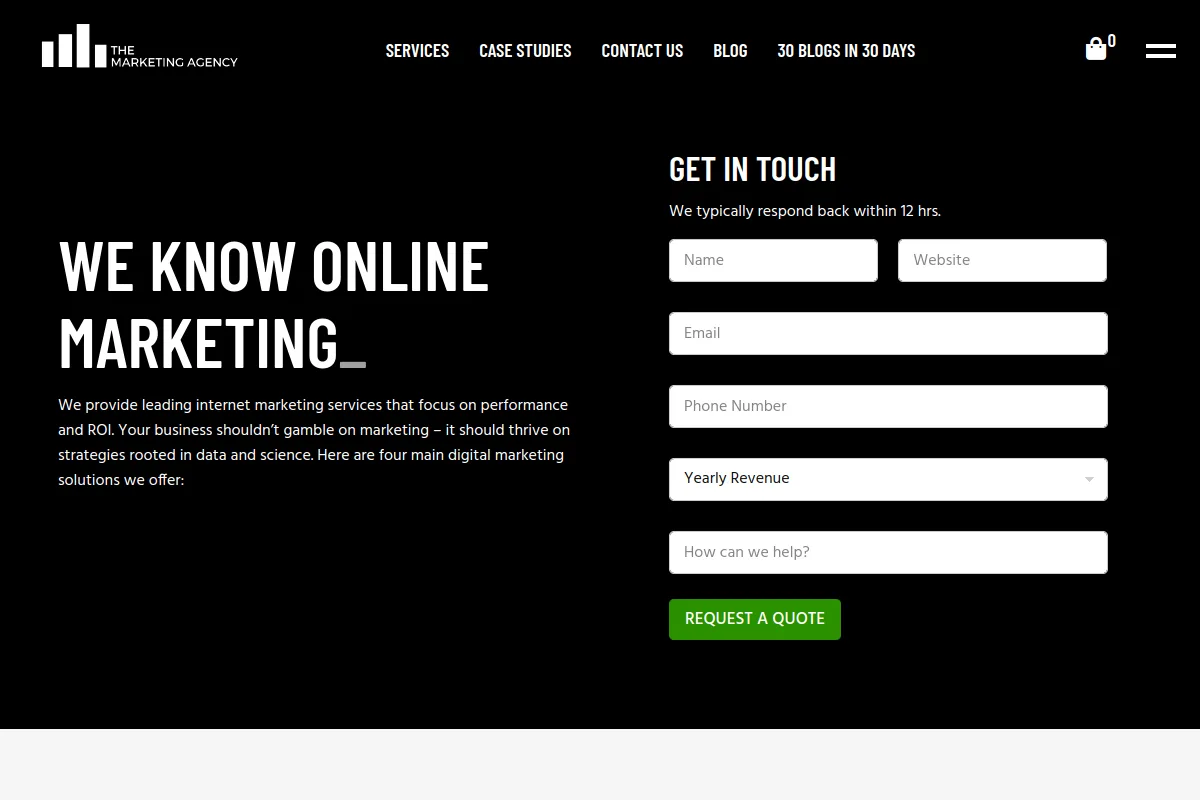
What’s included: campaign audits, keyword research, ad optimization, paid search and paid social management, conversion optimization, and a dedicated Facebook Ads service covering the ground AdEspresso used to occupy. Marketing automation, lead nurture, and user segmentation sit alongside it, with SEO and GEO/AIO available when paid needs organic support.
Pros: the process is a competitive teardown first, then an audience and keyword gap analysis, then a creative audit against what’s already running in your category. Budget follows the 80/20 rule, so it lands where revenue moves. Regular regroups plus ad hoc check-ins mean you know what’s working and where every dollar went. We work across ecommerce, SaaS, B2B, education, health and wellness, legal, and local.
Cons: you can’t swipe a card and start. There’s a strategy call, then a discovery period, and nothing goes live until we’ve both agreed on what we’re measuring. Engagements run on a three-month minimum because the first month is largely diagnostic, and if your total ad budget is under roughly $2,000/month, management fees eat too much of it to be worth either of our time. If you want something running by Thursday, this isn’t it.
Criteria: ease 5, automation 4, coverage 5, collaboration 5, support 5, integrations 5, pricing 3.
Client testimonials: clients describe founder Moe Kaloub as “strategic, detail oriented, results-driven” and “the go-to-person who knows what to do to drive results,” with repeated mentions of data-driven planning. These are first-party testimonials published on themarketingagency.ca, not third-party review-site scores, and you should read them as exactly that.
Pricing: PPC from $2,000 to $15,000/month depending on scope. SEO from $1,500 to $12,000/month. Email marketing from $3,000/month. Details here.
2. Foreplay
Best Known for Creative Intelligence
Our screenshot folder used to be a graveyard. Four hundred and something saved ads, no tags, no notes, no way to find the one you half-remembered from March. Foreplay turned it into a working creative strategy system, and it answered the one question AdEspresso never could: what should we test next?
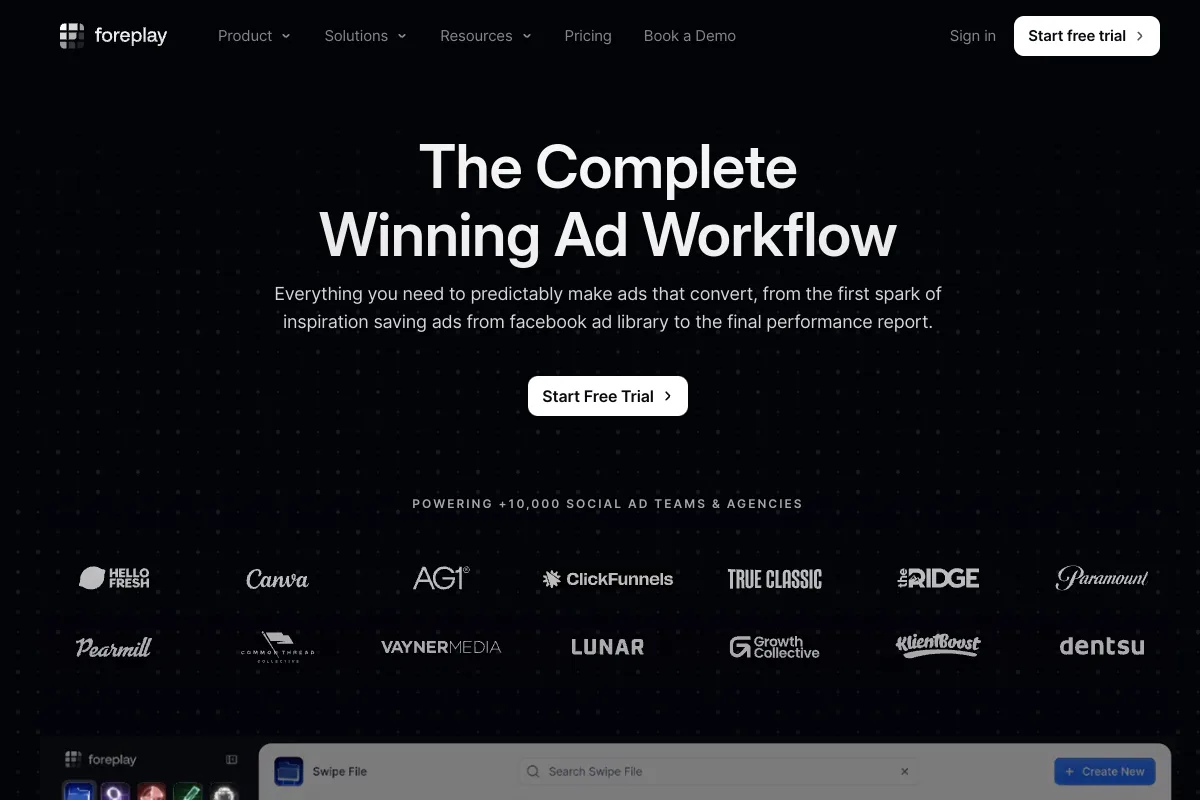
Features: the two that matter are the AI Brief Generator and Spyder, which tracks a named competitor’s active ads and tells you which ones have been running longest. Everything else, the Chrome extension, Discovery browsing, shared team boards across Meta, TikTok, and LinkedIn, is convenience you’ll appreciate later.
Pros: the briefs it generates are better than the ones we write. That stung. And Spyder caught something we’d have missed entirely on a home goods account: a competitor running the same UGC hook in nine variations with only the first two seconds recut, everything after the hook identical. We stole the structure, not the footage, and that format is still the best performer in that account seven weeks later.
Cons: shuffling ads between folders is fiddly enough that I stopped bothering and just tagged everything instead. The filtering occasionally serves dog food ads in the middle of SaaS research.
Criteria: ease 5, automation 5, coverage 4, collaboration 5, support 5, integrations 4, pricing 4.
Reviews: creative strategists rate it highly across Reddit and paid-social communities, but I can’t point you at an aggregate score I’ve verified, so treat that as anecdote. What I can tell you is that it’s the only subscription on this list nobody on our team has asked to cancel.
Pricing: from $49/month at foreplay.co.
3. Revealbot (Bïrch)
The Learning Curve From Hell
Bïrch won’t replace Ads Manager, and it isn’t trying to. What it does is make Meta’s native rules dramatically more capable, and by “dramatically” I mean the difference between “pause anything over $40 CPA” and the kind of logic below.
Here’s a rule we actually run on an ecommerce account, because this is the level of detail that separates Bïrch from everything else on the page. Every fifteen minutes, it checks each active ad set against three conditions joined by AND: spend today above 60% of the daily budget, ROAS over the last three days below 1.4, and ROAS over the last three days below the ad set’s own 14-day average by more than 30%. That last condition is the one native Meta rules can’t express, because it compares a metric to another metric rather than to a fixed number. If all three fire, the ad set gets a 25% budget cut, not a pause, and a Slack message lands in our buying channel with the ad set name and the three values that triggered it. If it fires twice in 48 hours, a second rule pauses it. We built that after a client’s best ad set got paused on a fixed CPA threshold during a Boxing Day traffic spike, which is a mistake you only make once.
The catch: budget two weeks before it earns its keep. Our media buyer, Dana, had it working in four days. It took me closer to three weeks, mostly because I kept building rules that contradicted each other and then wondering why nothing was spending. It also assumes your creative already deserves optimization. Rules can’t fix a bad hook.
Criteria: ease 3, automation 5, coverage 5, collaboration 4, support 4, integrations 4, pricing 4.
Reviews: 4.6/5 from 70 reviews on Capterra as of October 2026. Reviewers keep coming back to two things: the flexibility of the conditions and the history log that shows you exactly what the tool did and why. VP of Growth Oleg Popov, quoted on Bïrch’s own site, says: “Bïrch allows us to build complicated scenarios that just wouldn’t be available to us with other tools.” Vendor-hosted quote, so discount it accordingly, but it matches our experience.
Our full Revealbot review walks through more rule examples on live budgets. Read it before you start the trial; you’ll waste less of the fourteen days.
Pricing: $99/month for up to $10k monthly spend, $249 to $30k, $499 to $75k, with unlimited accounts and seats. Fourteen-day trial, no card required. Checked October 2026, and Bïrch has repriced more than once, so confirm before you budget.
4. Madgicx
Best Known for AI Meta Optimization
Ex-AdEspresso users ask about this one more than anything else on the list, partly because Madgicx markets itself as the direct upgrade path.
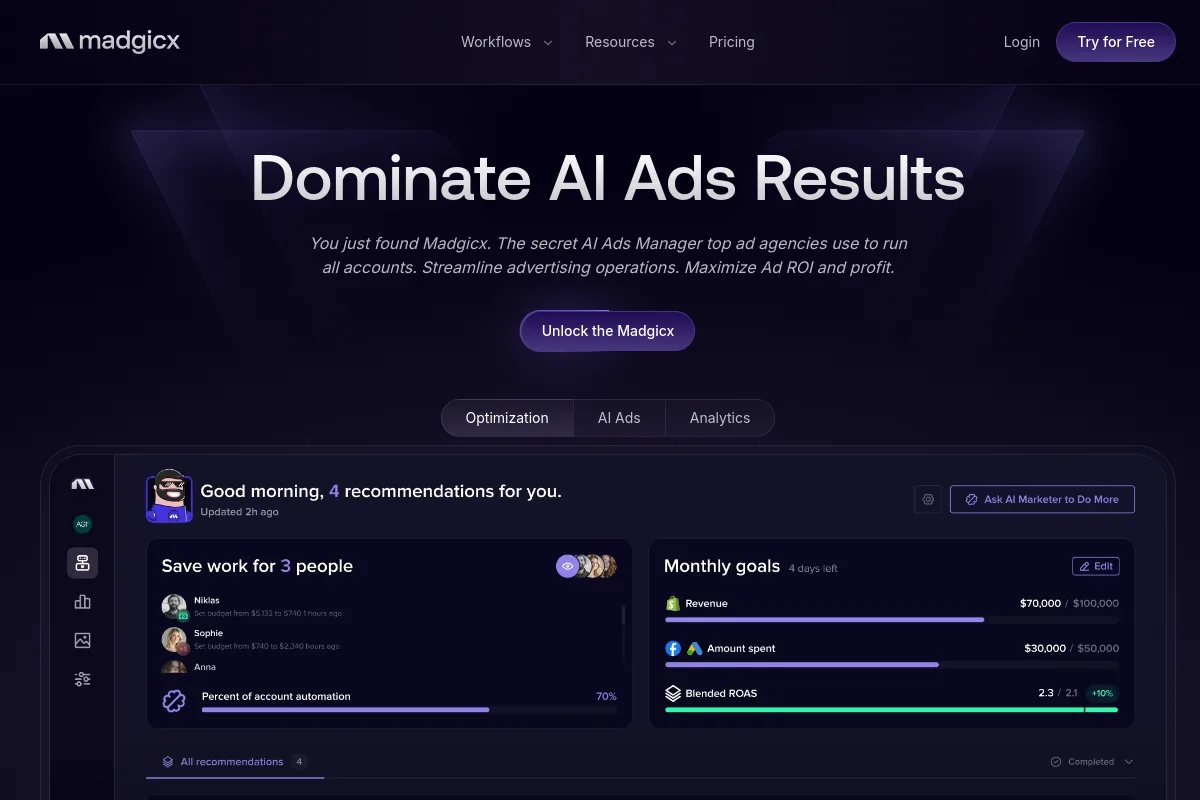
AdEspresso never shipped anything close to this. Its best automation was a scheduled rule; Madgicx is re-weighting budget between ad sets while you sleep, running computer-vision analysis on your creative to tell you which visual elements correlate with your winners, and building AI audiences with exclusions layered in. It also feeds attribution data back into Ads Manager, which matters more than it sounds like it should.
Pros: the funnel segmentation explains conversions at scale. When ROAS drops, you can usually see whether it’s a cold-audience problem or a creative-fatigue problem inside about ten minutes, which used to take us an afternoon of exports.
Cons: the interface is a wall of numbers. Set aside two or three real sessions before the recommendations start clicking, and expect to ignore half of them at first.
Dana still thinks Madgicx is worth the onboarding tax on any Meta account. I don’t, for accounts under about $15k/month, where the AI doesn’t have enough conversion volume to make decisions I’d trust. We’ve argued about it enough that we now split accounts between us and compare notes quarterly. Neither of us has convinced the other.
Criteria: ease 3, automation 5, coverage 3, collaboration 5, support 4, integrations 5, pricing 5.
Reviews: 4.6/5 on G2 as of October 2026. One verified reviewer who switched from AdEspresso called it “better and cheaper than AdEspresso,” and that’s the general shape of the switcher reviews there.
Pricing: from $32/month on spend tiers, $45/month at $2,500 spend with unlimited seats, seven-day trial. madgicx.com.
5. GetHookd
I wrote this off in week two. Dana kept using it, and she was right.
My objection was that it overlaps with Foreplay, which it does. What changed my mind is the longevity signal in Brand Spy: it surfaces the creatives a competitor has been paying to run the longest. Engagement counts are noise. Nobody keeps funding a loser for eleven weeks.
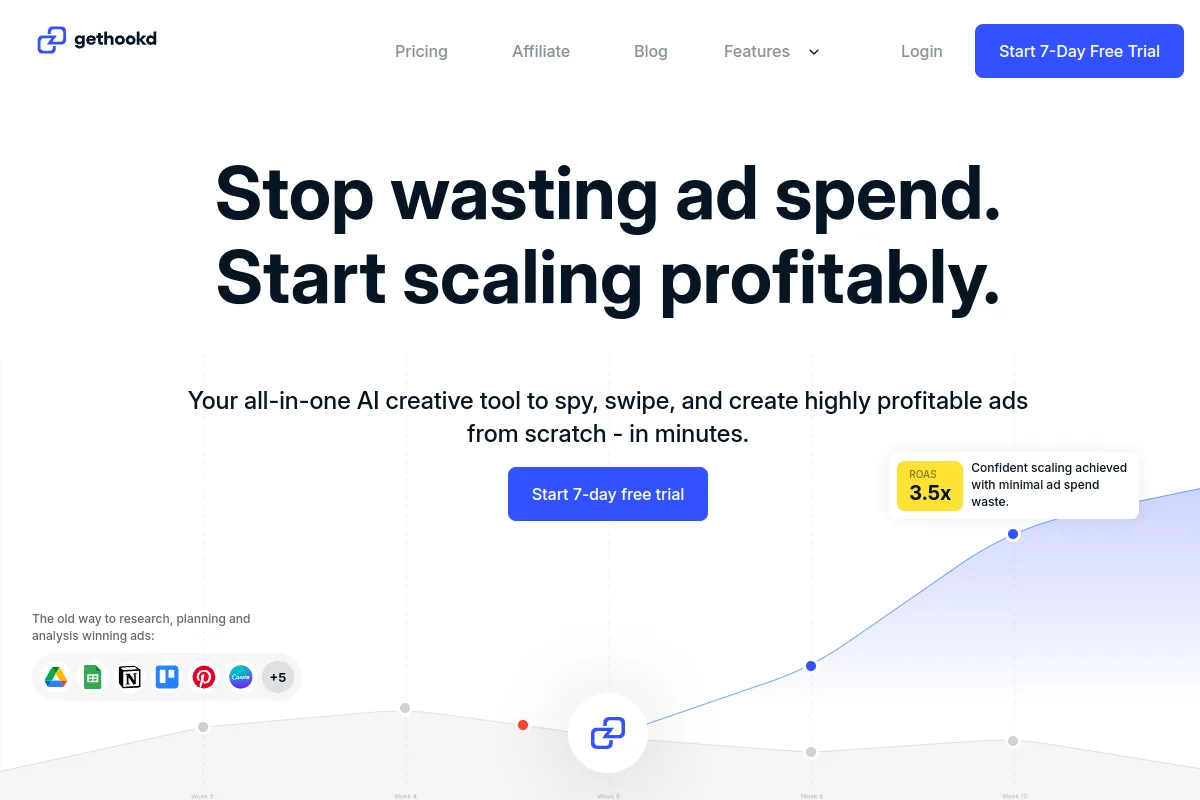
Features: 65M+ indexed Meta ads according to GetHookd’s own site as of October 2026, which I’ve no way to independently verify beyond noting that everything we searched for was in there. Brand Spy with longevity signals, Canva-ready templates, persistent swipe boards, timestamped ad transcription (useful, underrated), AI script generation, clone ads, and a creative analyzer that scores what you upload.
Pros: research and production sit in the same tab. That sounds minor until you’ve spent a month with research in one tool and execution in another and watched the good ideas evaporate in the gap.
Cons: zero campaign management. You’ll still need Ads Manager or an automation layer underneath it.
Criteria: ease 4, automation 4, coverage 3, collaboration 4, support 4, integrations 3, pricing 4.
Reviews: 4.8/5 on G2 and 4.5/5 on Trustpilot as of October 2026. Library depth draws most of the praise on both.
Pricing: free trial, then tiered plans at gethookd.ai.
6. AdCreative.ai
Creative velocity stops being your constraint about ten minutes after you start using this. You brief it, it produces, and a scoring layer filters the weakest output before anything reaches an ad account.
Output speed outpaces how fast we can write briefs, which reorganised our week in a way I didn’t expect. The scoring beats shipping everything blind and sorting it out from the CPA data three days later.
Reviews skew positive on speed and negative on polish, and having used it, both camps are right. If you have a designer who can clean up output, it’s excellent. If you don’t, you’ll ship worse creative faster. Quality also swings hard by industry: apparel and DTC look good, B2B software looks like B2B software from 2019.
Ease 5, automation 4, coverage 4, collaboration 4, support 3, integrations 4, pricing 4. From $39/month at adcreative.ai.
7. Adzooma
The Free Tier That Doesn’t Suck
Free plans usually disappoint. This one doesn’t, and it matters if you’re stretched across search and social with no tooling budget approved.
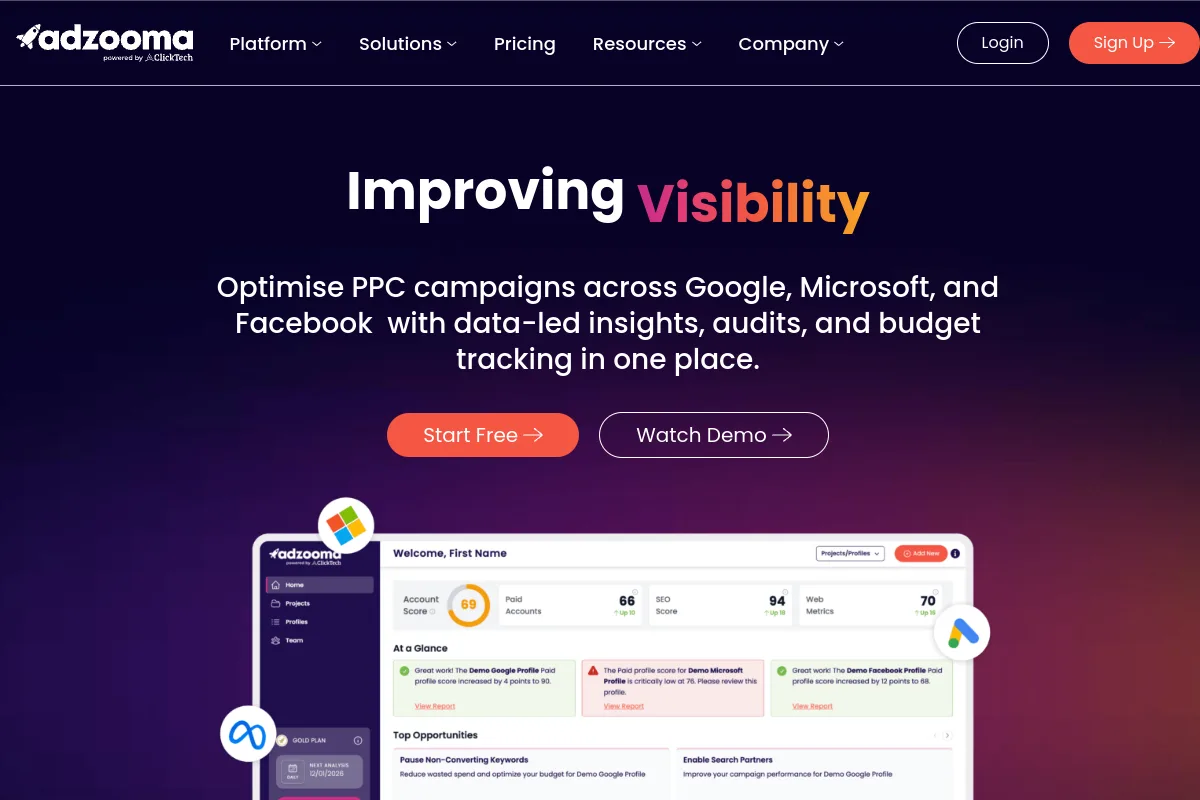
The audit is the reason to bother: it looks at structure, budgets, bids, and targeting across Google, Microsoft, and Meta, then hands you a list of optimization opportunities you can action with a click. Add cross-platform reporting and budget alerts and you’ve got three platforms in one dashboard, which kills the tab-switching that eats lean teams alive.
The suggestions are basic next to a real rule engine. Nothing here is conditional; it’s pattern-matching against best practice. And I don’t have a good answer for why the paid tiers exist. The free plan does most of the work and the upgrades felt thin enough that we never renewed one.
Ease 4, automation 3, coverage 5, collaboration 3, support 3, integrations 4, pricing 5.
4.4/5 on G2 as of October 2026. Reviewers love the price and question the optimization depth, which is a fair summary of the product.
Free tier at adzooma.com, paid plans above it.
8. Smartly.io
Best Known for Enterprise Creative Automation
Large teams bleed money in the handoff between creative and media buying. Smartly.io removes that handoff by keeping both functions in one system, which is a genuinely good idea if you have enough people for the handoff to exist.
Caveat, and it’s a big one: as noted up top, we never ran this on a live account. Their qualification call ended politely and nothing came of it. So the following is a demo impression plus published reviews, not testing.
Features: dynamic creative personalization at scale, cross-channel launching, unified creative and media analytics, automated budget shifts.
Pros: creative and media buying finally work off one place where the numbers agree, instead of trading files and arguing about which export is current.
Cons: enterprise pricing and enterprise setup. Reviewers consistently say you’ll need a quarter and a project owner to implement it properly. Small teams pay for capacity they’ll never touch.
Criteria: ease 3, automation 5, coverage 5, collaboration 5, support 4, integrations 5, pricing 3. Scored on a demo. Discount all seven.
Pricing is quote-based at smartly.io.
9. MyDataNinja
Finally, Real ROI Tracking
CTR looks fantastic right up until nobody buys anything. MyDataNinja follows the click all the way to revenue, so you’re optimizing against money instead of the metrics the platforms flatter themselves with.
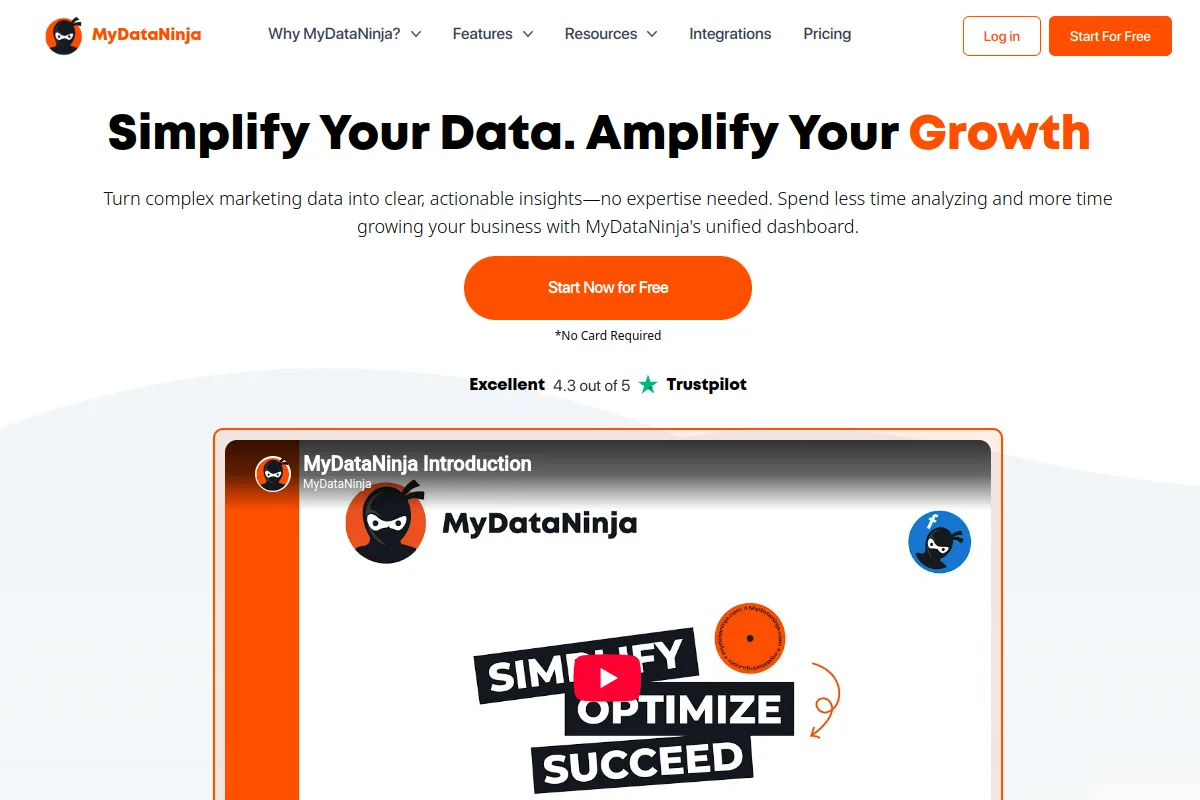
Features: the important ones are NJID URL tracking and the built-in CRM with role management, which together mean you can hand a client a login that shows their pipeline without exposing your other accounts. Beyond that: a unified Google, Meta, Microsoft, and TikTok dashboard, WordPress, WooCommerce, and Shopify plugins, profit reporting with saved filters, creative reporting, Facebook Leads sync, and API conversions.
Pros: multi-account pricing stays sane as you add logins, which is not true of most of this category.
Cons: the automation is shallow. Use it to find out what happened. Use something else to change what happens next.
Criteria: ease 4, automation 3, coverage 5, collaboration 5, support 5, integrations 5, pricing 5.
I can’t point you at a verified aggregate review score for this one, so I’m not going to pretend otherwise. What I can say from our own use: the tracking held up against Shopify’s own numbers within a few percent, and a support question got a human reply the same day.
Pricing: trial available, then tiered plans at mydataninja.com.
10. Servo
Four steps: describe the business, review the AI-built strategy, adjust pre-filled settings, publish. If you’ve never bought media before, that’s a workflow replacement, not a friendlier coat of paint on Ads Manager.
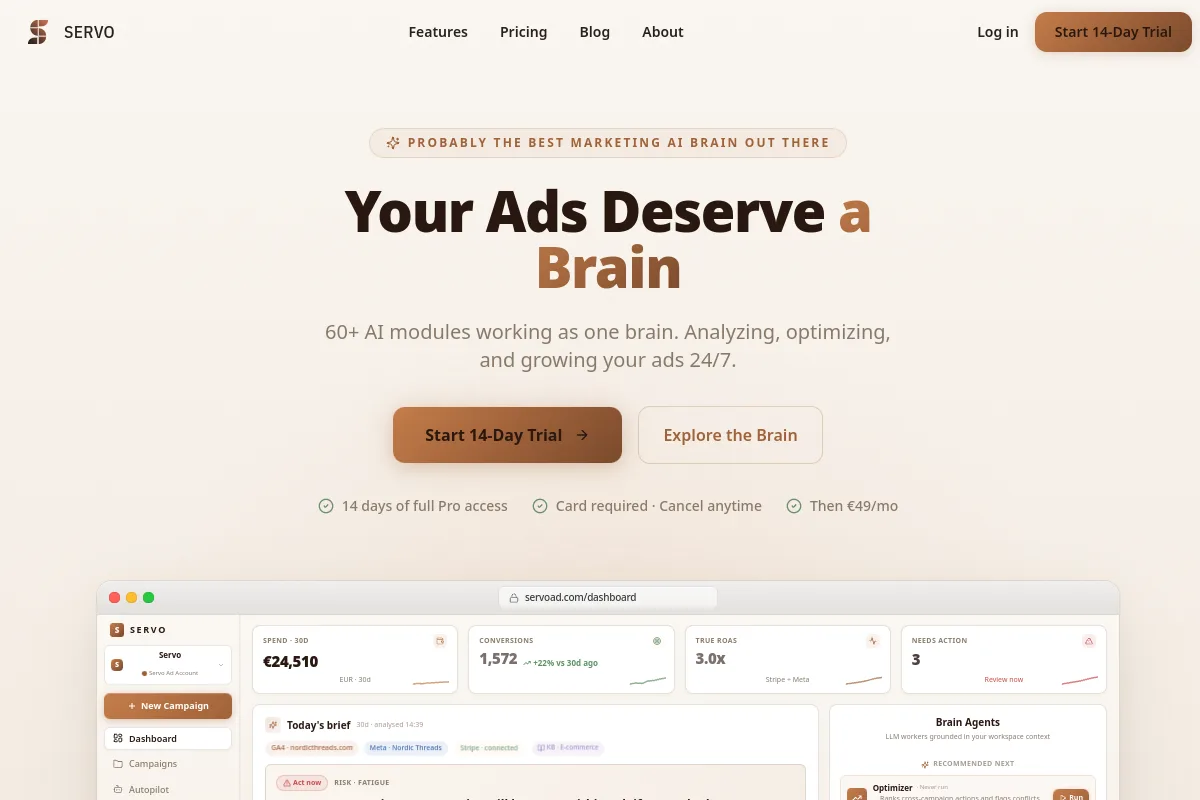
Features: plain-language strategy generation, pre-filled objectives and audiences, 12-dimension analytics, a seven-pillar AI CreativeAudit, Autopilot with four autonomy modes, and one-click publishing through the Meta Marketing API.
Pros: the price doesn’t move when your spend does, which is rarer than it should be. And the creative audit flagged two washed-out product images on a home services account before launch instead of after we’d spent $400 finding out the hard way, which is roughly what the same lesson cost us on a different account in April.
Cons: Meta only. The guardrails will frustrate anyone who already knows what they’re doing, and there’s no G2 listing yet because the product is too new to have one.
Criteria: ease 5, automation 4, coverage 2, collaboration 3, support 4, integrations 3, pricing 5.
Take those numbers with salt. We ran Servo on one small account for two months, which isn’t a sample, it’s an anecdote with a spreadsheet attached. Trial it against a budget you can afford to lose before it touches anything important.
Pricing: €49/month flat at servoad.com.
11. Wevion
Best Known for Single-Screen Management
Launch controls and analytics live on one screen, and the free plan never expires. Wevion keeps what made AdEspresso approachable and adds most of what it was missing.
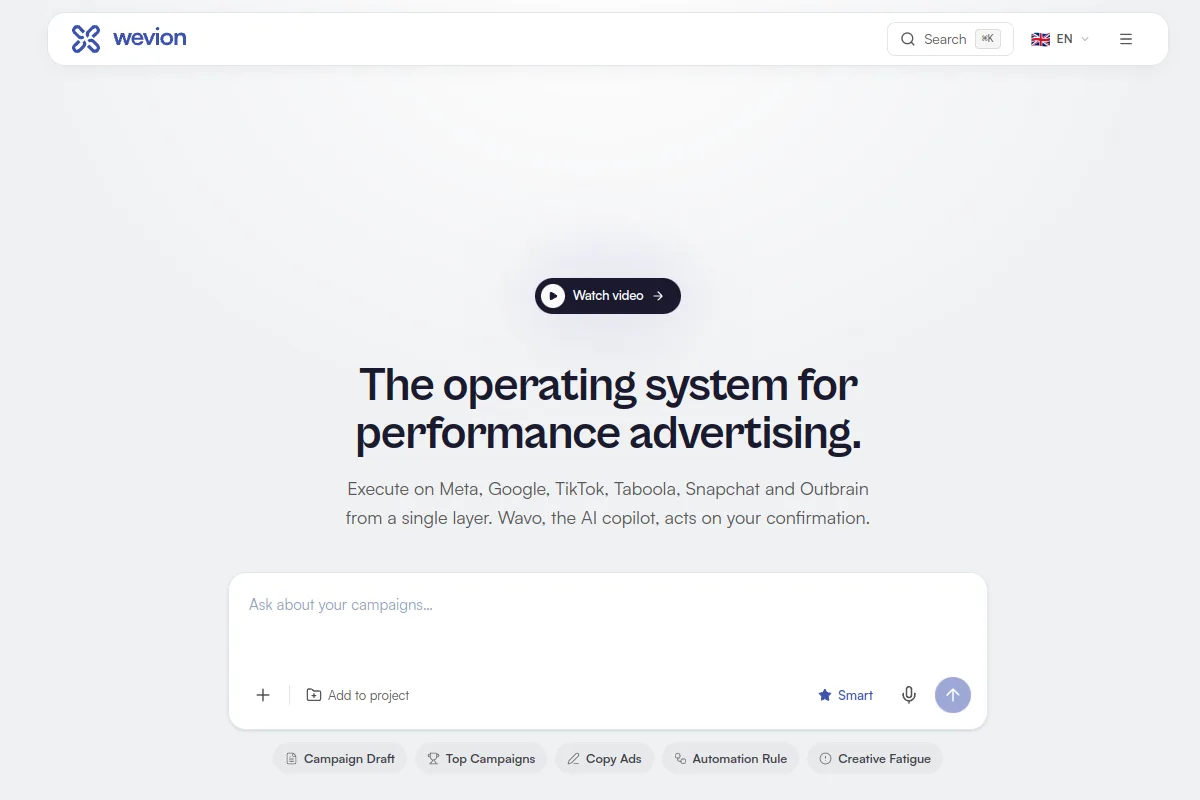
Features: Meta API campaign management, analytics syncing every 15 minutes, an approval-first rule engine, the Wavo AI copilot, a bulk launcher, product catalogs, a creative hub, profitability analytics, multi-account audiences, and Telegram alerts.
Pros: costs are completely independent of spend, so the twelve-month model doesn’t get ugly. The approval-first rules suit teams who aren’t ready to hand over the keys.
Cons: shorter track record than almost everything else here, and the rule depth isn’t in the same conversation as Bïrch. One of our SaaS clients looked at the approval queue and said it felt like a permission slip. He turned it off inside a week and went back to doing it manually, which tells you the feature is a matter of temperament rather than capability.
Criteria: ease 5, automation 4, coverage 4, collaboration 4, support 4, integrations 4, pricing 5.
Reviews: early users praise the clarity and the predictable pricing. That’s from vendor-site testimonials and our own trial, so there’s no independent score to hang a decision on yet.
Pricing: €0 free, Starter €99/month. Higher tiers run to €1,499/month (€14,390 annually, which is the advertised 20% off, and the maths checks out) plus custom enterprise. wevion.ai.
12. HubSpot Marketing Hub
Start with the objection, because it’s the whole decision: $900/month for the tiers that include meaningful ad management. If your monthly ad budget is smaller than the licence fee, stop reading this entry.
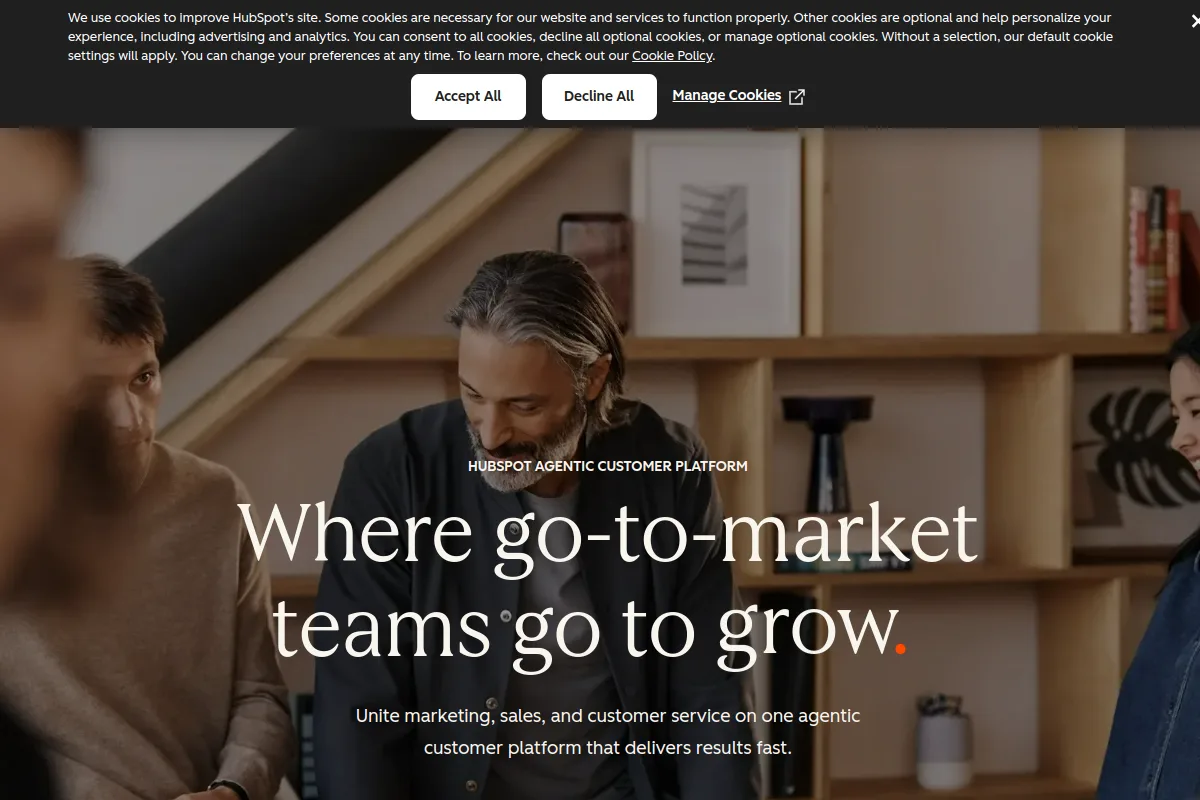
For everyone else, nothing else on this list connects the click to the invoice this completely. Google, Facebook, and LinkedIn ad management tie to CRM records, and attribution reads from your own first-party data instead of platform-reported numbers. That changes what you’re willing to argue for in a budget meeting, because you’re citing closed deals rather than a pixel’s opinion of them. Automation, nurture workflows, landing pages, forms, and Sales and Service Hub integration come along with it.
The trade-off: ad management here is a feature bolted onto a CRM, and it shows. You will not build a Bïrch-grade rule inside HubSpot. What you’ll get is pipeline visibility nobody in the room can wave away.
Criteria: ease 4, automation 4, coverage 4, collaboration 5, support 4, integrations 5, pricing 2.
Reviews: 4.3/5 across 305 reviews on OMR Reviews as of October 2026. Cost is the recurring complaint, every time.
Pricing: from $900/month at hubspot.com.
Four We Almost Ranked
None of these four are for everyone. Each one solves exactly one problem, and if it isn’t your problem, skip it.
Extuitive scores and forecasts creative performance before launch, using your historical data alongside consumer intelligence to project expected CTR and ROAS across large creative batches. Good fit for Shopify brands running continuous acquisition, where you’re producing enough creative that pre-filtering saves real money. extuitive.com.
AdStellar pairs AI creative generation with Meta campaign tooling from $49/month. Worth a look if production volume is your constraint and you’d rather have one subscription than two. No G2 listing yet, so trial it. adstellar.io.
AdsCook is Meta automation for small advertisers who want rules and bulk edits without enterprise complexity. Gentle learning curve, low price, and a scope that’s noticeably shallower than Bïrch or Madgicx. adscook.com.
Metadata.io is built around qualified-lead conversion events and multi-month sales cycles, which is exactly where general-purpose Meta tools misread performance data and start optimising toward cheap junk leads. The specialist pick for B2B. metadata.io.
Seven We Dropped Since The Last Version Of This Guide
Anyone who read the earlier edition of this list of adespresso alternatives will notice some names missing. Here’s where they went:
- OTTO Google Ads was our “complete AI automation” pick. It’s Google-only, and this guide’s centre of gravity has moved to Meta workflows where AdEspresso users actually feel the gap. Still a reasonable tool; wrong list.
- PostNext was a notable mention for organic-plus-paid scheduling. We haven’t run it in over a year and I won’t rank something I can’t speak to currently.
- WordStream Advisor was folded into LocaliQ’s product line, which makes it hard to buy as a standalone the way we originally recommended it.
- Marin Software now sits at an enterprise price point that puts it out of reach for the reader this page is written for.
- Skai (formerly Kenshoo) is retail-media-first these days. Excellent if you’re buying Amazon and Walmart at scale, which is a different article.
- LocaliQ stays useful for local service businesses, but our own experience with the 90-day optimization ramp was slow enough that we stopped recommending it to clients who needed leads this quarter.
- Traffic Booster dropped off on support. Two tickets from a client account went four and six days without a reply, and after the second one we stopped putting clients in front of it.
FAQ
What’s the best AdEspresso alternative for small businesses?
Servo at €49/month flat, or Wevion’s free tier if you’d rather test before paying. Adzooma if you’re also running Google or Microsoft Ads. And if the real constraint is hours rather than software, managed PPC from $750/month often costs less than a subscription plus the time to operate it properly.
Which alternative has the strongest automation?
Bïrch. Not much debate about it.
Nested conditions, AND/OR operators, metric-to-metric comparisons, custom metrics, and 15-minute check intervals across Meta, Google, Snapchat, and TikTok. Nothing else on this page expresses logic that precisely. Madgicx automates more aggressively on your behalf, which is a different thing and a matter of how much control you want to keep.
Are there any adespresso alternatives free to use?
Two, properly. Adzooma’s free tier covers Google, Microsoft, and Meta, and Wevion runs a permanent €0 plan. Both are fine starting points and neither is a destination once you’re spending real money, because the free tiers stop exactly where the useful automation starts.
How does the adespresso vs madgicx comparison break down?
Madgicx brings 24/7 budget optimization, AI creative analysis, AI audiences, funnel segmentation, and better tracking from $32/month, against AdEspresso’s $69/month entry point (as listed on AdEspresso’s pricing page in October 2026, though verify it yourself, they’ve changed it before). The trade-off is patience: for most accounts under $10k/month, Madgicx wins on price and loses on onboarding. Budget a fortnight before it earns its keep. Above that spend level it isn’t close, and I’d move.
Still deciding whether to leave at all? Our AdEspresso review covers where the split-testing engine still holds up and where iOS 14.5 broke it for good.
What’s the most cost-effective alternative for agencies?
Bïrch, on the maths. Unlimited accounts and unlimited seats at every tier means the per-client cost keeps falling as you add clients, and $99/month across eight accounts is a rounding error. MyDataNinja is the cheap answer if your bottleneck is client reporting rather than optimization, since role-based CRM access lets each client see their own numbers and nothing else. Smartly.io is the answer at genuine enterprise volume, with the caveat that we couldn’t get it onto a live account to check.
Which alternative works best for eCommerce businesses?
Madgicx, for anything spending north of $15k/month on Meta, because catalogue-scale accounts generate the conversion volume its models need. Pair it with Foreplay for creative research and you’ve replaced everything AdEspresso did plus most of what it didn’t. Below that spend, Bïrch plus GetHookd costs less and keeps you in control of the decisions. If your problem is that Shopify’s numbers and Meta’s numbers disagree by 40%, none of the above will help; go get MyDataNinja or a proper server-side setup first.
How do I migrate without losing campaign history?
Every tool here connects through the official Meta Marketing API, so your performance history lives in the ad account and travels with you automatically. Three things we learned the hard way, in order of how much they cost us:
- Export AdEspresso’s internal split-test archive before you cancel, because that data does not transfer and you cannot get it back.
- Rebuild your naming conventions in the new platform first, because half of these tools filter and report on ad-set names, and inconsistent naming will quietly break your rules six weeks later.
- Set every new automation rule to notify-only for the first two weeks, then read what it would have done before you let it do anything. That last one is the difference between a smooth migration and a paused winner on a Saturday night.
Our PPC optimization guide works as a checklist for what to re-verify once the switch is done.
Final Thoughts
Five things I’d tell a friend after this year:
- Pick your category before your product. Rules and creative research fix different problems, and buying the wrong category is how people end up back on this page in six months.
- Flat pricing wins as spend climbs. Spend-based tiers only feel cheap in month one.
- Automation is only as trustworthy as the attribution feeding it. Bad ROAS data will confidently pause your best campaigns and feel great about it.
- Free tiers earn a trial. They don’t earn a five-year commitment.
- Read the seat limits and support terms while you’re calm, because you will not be calm the first time something breaks at 6pm on a Friday.
Obvious sales pitch incoming, and you can stop reading here. But it’s the same answer we give clients, so:
We run paid search and paid social as a managed program, and our Facebook Ads service covers the ground AdEspresso used to for our clients. Ecommerce, SaaS, B2B, education, health and wellness, legal, and local, with PPC engagements starting at $750/month.
If you’d rather own an outcome than another login, get in touch and we’ll map the fastest path forward for your account.
Related reading: 14 Engagement Activities, for in-office, remote, and hybrid teams, plus how to tell whether any of them worked.