Blog Writing on Any Topic Without Burning Out: The Sustainability Framework Nobody Talks About
A Blog On Any Topic explained with features, pricing, practical guidance, and key considerations.

A blog on any topic becomes sustainable when you replace motivation-dependent methods with systematic frameworks that function regardless of creative energy levels. Most blogging advice creates burnout by treating content production as isolated work instead of building infrastructure around topic selection, production workflows, automated distribution, and diagnostic measurement that adapts to your actual capacity.
Last Tuesday, I watched someone’s content calendar die in real-time. They’d published three times a week for eleven weeks, posted increasingly frantic apologies on social media, then silence. The blog still sits there, frozen mid-March, another casualty of advice that sounded great but wasn’t actually sustainable.
You’ve heard the advice a thousand times: write consistently, show up for your audience, keep producing content. What nobody tells you is how to maintain that pace without sacrificing quality or your sanity. Here’s what most blogging advice gets wrong: it treats content creation as an isolated task instead of building actual infrastructure around topic selection, production workflows, distribution, and measurement.
Most guidance treats blog creation as separate from your broader communication strategy. That’s the first mistake. When you approach blog writing on any topic as disconnected from everything else, you create the exact friction that leads to burnout and abandoned editorial calendars. Compare measured results under conditions relevant to your needs. Related information The problem isn’t the medium. It’s how people approach it.
Whether you need to produce content for your business or maintain consistent output across diverse subjects, what actually works removes your dependence on inspiration and replaces it with reliable systems.

Table of Contents
- Why Most Blogging Frameworks Collapse After Three Months
- Building a Topic Selection System That Scales With You
- The Production Model That Replaces Inspiration
- Distribution Strategies That Don’t Require Daily Platform Presence
- Measuring What Actually Matters for Sustainability
- Final Thoughts
TL;DR
- Traditional blogging advice focuses on output frequency rather than sustainable systems, creating predictable burnout cycles
- Topic selection should be systematic, not reactive to trends or inspiration-dependent
- Production efficiency comes from repeatable processes, not motivation or creative breakthroughs
- Distribution can be decoupled from constant social media presence through strategic automation
- The right metrics tell you when to scale, pivot, or pause without guilt or guesswork
- Sustainability in blogging requires acknowledging your actual capacity and building around it
Why Most Blogging Frameworks Collapse After Three Months
Three months. That’s when it happens.
Standard blogging advice emphasizes consistency over capacity, creating inevitable failure points. Nobody asks whether that weekly or daily schedule is maintainable alongside other responsibilities.
The “write your passion” directive sounds empowering but ignores content production realities. What feels exciting in week one becomes grinding by week eight, leaving you staring at your keyboard by month three wondering why you started. Initial enthusiasm fails to carry the workload.
Systems sustain what passion can’t.
This addresses structural capacity, not motivation. If you’ve experienced this cycle, the failure was methodological, not personal. Creators who succeed at starting a successful blog have built infrastructure that functions when inspiration doesn’t.
Our number is very similar to what Orbit Media found in their blogger statistics survey: the average writer spent 3 hours and 28 minutes creating an article. We asked this question to see how similar the two populations were when comparing the two studies. Verified source Related information The problem isn’t production speed. It’s the sustainability of the entire system supporting that production.
I’ve built topic banks that I never touched and editorial calendars that mocked me from my project management tool. The difference between those failures and what actually worked came down to honest assessment of what I could maintain, not what sounded impressive.
Building a Topic Selection System That Scales With You
You know that feeling when you sit down to write and have no idea what to cover? That’s not writer’s block. That’s a topic system problem.
Topic generation and topic selection demand distinct mental modes. Generation expands possibilities through exploration, while selection applies analytical strategy. Trying to do both at once leads to decision paralysis.
Build a living topic bank organized by reader intent categories, not your interests. The process of systematic topic generation starts with understanding how to write a blog on any topic by focusing on what your reader needs to accomplish, not what you want to say. Use search data, customer questions, and sales objections as primary inputs rather than waiting for inspiration or chasing trends.
Develop templates defining evergreen versus time-sensitive content ratios for your industry and capacity. Set decision criteria preventing scope creep. Define clear boundaries for each topic before committing to write it.
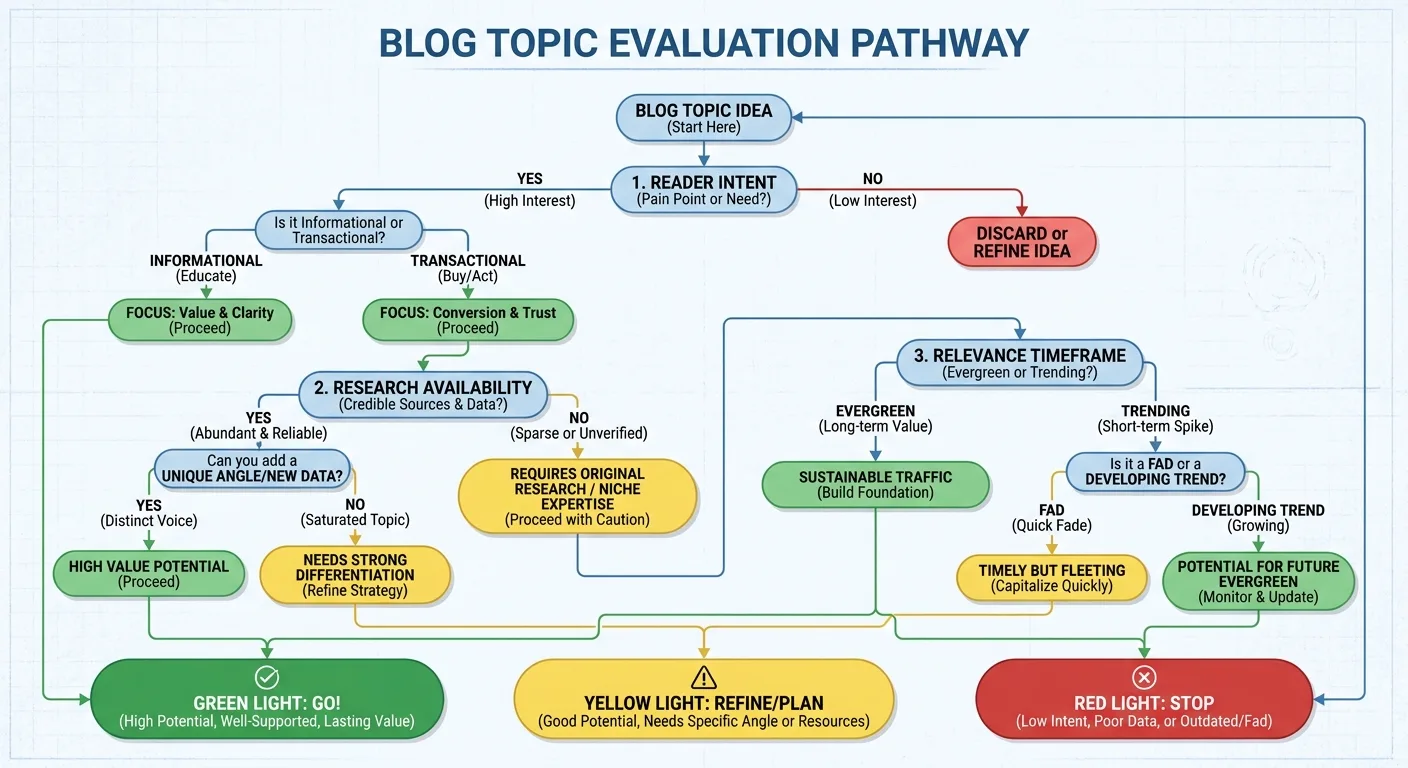
Topic Evaluation Checklist
- Does this enable the reader to do something they couldn’t do before?
- Can I address this topic thoroughly within my target word count?
- Do I have access to the research and examples needed?
- Does this serve a reader intent category I’m targeting?
- Evaluate the available evidence in the context of your own needs.
- Does this topic avoid competing directly with content I’ve already published?
Evaluate the available evidence in the context of your own needs.
Readers don’t care how much you know until you’ve helped them solve something specific.
The Distinction Between Topic Inventory and Editorial Calendar
Topic inventory vs. editorial calendar. Understanding this difference changed everything for me.
Your inventory represents possibility space, while your calendar represents commitment. An inventory can hold 50, 100, or 200 potential topics without pressure because none are promises yet.
Maintaining this buffer removes the anxiety of deciding what to write next under deadline pressure. Your calendar should reflect actual production capacity, not aspirational output. If you can realistically complete two posts monthly, schedule two. Build in backup topics for when planned pieces encounter problems.
| Aspect | Topic Inventory | Editorial Calendar |
|---|---|---|
| Purpose | Capture all potential writing opportunities | Commit to specific publication dates |
| Size | 50+ topics across multiple categories | 3-6 months of scheduled content |
| Flexibility | Constantly expanding, no obligation | Firm commitments with built-in buffer |
| Review Frequency | Weekly additions from ongoing research | Quarterly strategic reviews |
| Mental Load | Low-pressure collection | Accountable execution |
| Decision Point | Is this worth exploring? | Can I deliver this by deadline? |
Quarterly calendar reviews prevent drift from audience needs. What seemed important in January might be irrelevant by April. This separation between exploration and execution allows the approach to scale with your changing capacity and circumstances.
(Side note: I once had 200 topics in my bank and still felt like I had nothing to write about. The problem wasn’t the list, it was decision paralysis. That’s why the selection criteria matter more than the list size.)
Audience Intelligence Collection That Feeds Your Topic System
Here’s where your best topics actually hide.
Track customer support tickets and sales call transcripts for recurring questions. Prospect and user inquiries during purchase decisions or product implementation reveal precise content opportunities. Instead of guessing at audience needs, you document verified knowledge gaps.
Use forum participation and community monitoring on platforms including Reddit, Quora, and industry-specific sites. Track search console queries that bring traffic but lack dedicated content. This traffic signals existing demand you address incompletely, creating opportunities for focused content.
Review competitor content gaps using SEO tools and survey your existing audience directly with open-ended questions. Set up Google Alerts for industry terminology and emerging discussions. Aim for systematic accumulation rather than sporadic inspiration hunting. Each intelligence source compounds into a topic inventory that grows faster than your writing capacity.

Evaluate the available evidence in the context of your own needs. Not “collaboration tools” generally, specifically Slack. That one observation became their highest-traffic post that quarter, directly sourced from demonstrated user need rather than assumed interest.
The Production Model That Replaces Inspiration
I used to try writing a complete post in one sitting. Research, outline, draft, edit, all in one marathon session.
This is a terrible idea.
Separate research, outlining, drafting, and editing into distinct sessions. Each phase demands different mental resources and fits different calendar slots. Segmented workflows enable meaningful progress in shorter bursts.
Research phase: gather all sources, examples, and data points. Outline phase: structure your argument and identify gaps. Drafting phase: rapid first-pass completion. Editing phase: polish for clarity, flow, and accuracy.
Template structures for common post types reduce decision fatigue. Understanding effective blog post structure means recognizing predictable patterns for post types like how-tos, eliminating architectural reinvention. Batch similar tasks across multiple posts for efficiency. Research three topics together. Outline five posts back-to-back. Grouping like activities slashes context-switching overhead.
Evaluate the available evidence in the context of your own needs. Related information
When you learn to produce content through reliable production methods, the topic itself matters less than your process. The same approach adapts whether you’re writing technical documentation or thought leadership. You can create a blog on any topic with consistent quality when the process, not the inspiration, drives production.
Research Collection That Prevents Drafting Paralysis
Look, I know pre-research sounds boring. Do it anyway.
A completed research phase delivers all supporting material before drafting begins. Create a reference document containing sources, quotes, statistics, and examples mapped to your outline sections. Include URLs, publication dates, and relevant excerpts while flagging conflicting information or unresolved questions.
This document becomes your drafting reference. Writing transforms from open-ended exploration into assembly work, connecting pre-gathered evidence with your analysis. You eliminate mid-draft research tangents that kill momentum and balloon timelines.
Evaluate potential savings using evidence relevant to your own costs and circumstances. Related information It’s how that time is structured across distinct production phases.
The staring-at-blank-page problem happens when you try to research and write simultaneously. Separate these tasks and the blank page becomes a construction project with all materials ready, not an intimidating void.
Outline Architecture That Does the Heavy Thinking First
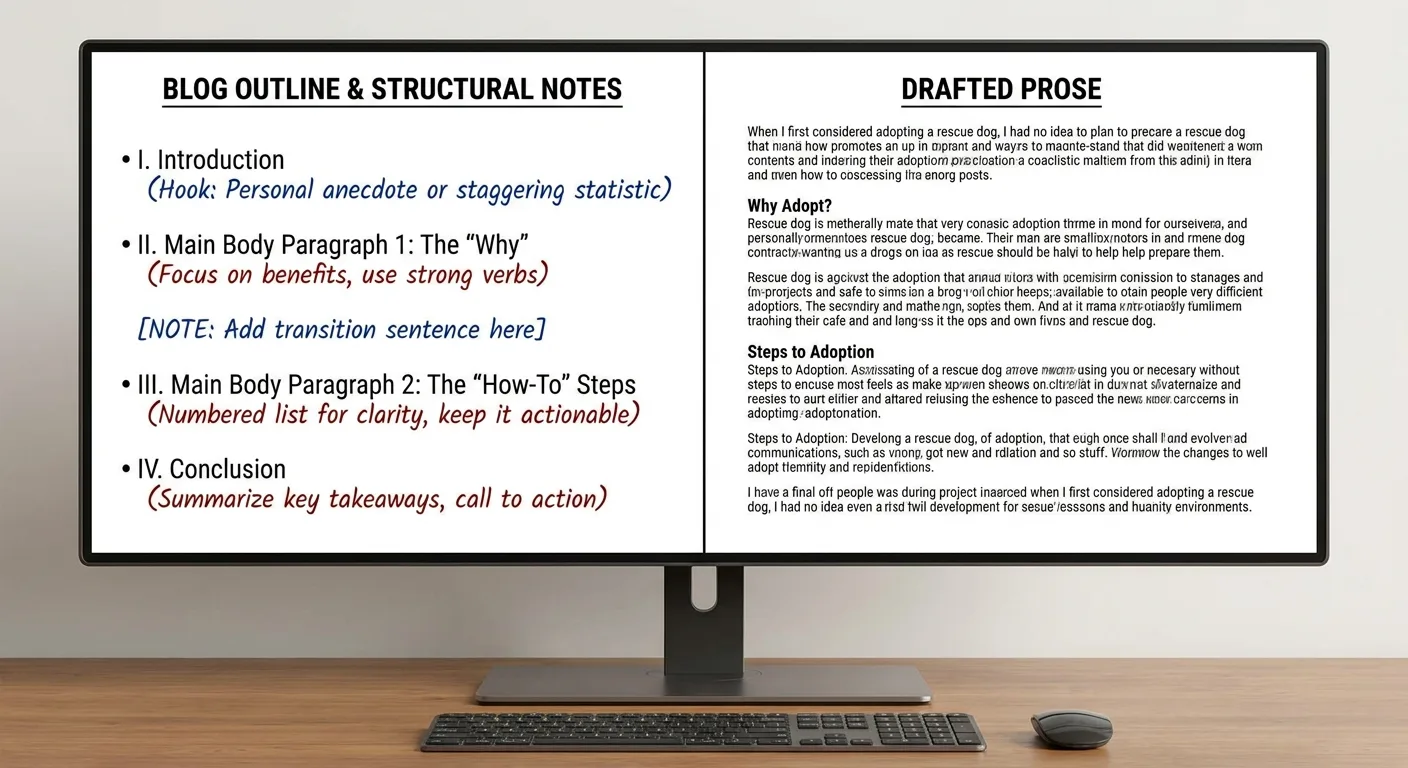
Your outline should resolve all structural and logical questions before you write a single sentence of actual prose.
Include argument flow, transition logic, and evidence placement. Identify exactly where examples, data, and expert perspective appear. Note any areas needing additional research or clarification. A complete outline means drafting becomes adding connective tissue and voice. Test logical progression before committing to full prose, since restructuring an outline takes far less effort than rewriting finished sections.
The outline solves what you’re saying; drafting solves how to say it clearly. Keeping these concerns separate prevents the paralysis of optimizing both at once.
Evaluate the available evidence in the context of your own needs.
This sounds obvious, but somehow everyone, including me, forgets it.
Drafting Without Editing: The Speed Layer
Your first draft is garbage. Mine is too. Everyone’s is.
Stop trying to make it perfect.
First draft goal is completion, not quality. Disable your internal editor during initial writing sessions. Follow your outline and maintain forward momentum, marking areas needing revision with brackets or comments rather than stopping to fix them.
Accept imperfect phrasing and keep moving. Speed matters because it produces a complete artifact you can improve. Perfectionism during drafting kills momentum and extends timelines. Most writers drastically overestimate what a first draft needs to accomplish.
Nobody sees your first draft except you. Its only job is turning ideas into document form so you have material to refine. The gap between acceptable and excellent is smaller than the gap between nothing and acceptable, so cross that first gap as quickly as possible.
Editing as Separate Skilled Work
This is where you save the piece or watch it stay mediocre.
Edit in multiple focused passes, each targeting different elements. Begin with structural logic and argument flow. Move to clarity and readability at sentence level. Then address accuracy, source verification, and factual claims. Conclude with formatting, links, and technical elements.
Separate passes prevent the cognitive overload of fixing everything simultaneously. Schedule editing for a different time than drafting when possible, since creation requires a different mindset than refinement.
Reading aloud catches awkward phrasing that silent reading misses. Your ear detects rhythm problems and unclear constructions that your eye skips over. This technique costs nothing and dramatically improves final quality.
| Pass | Focus | What to Fix | What to Ignore |
|---|---|---|---|
| Structure | Does the argument flow logically? | Section order, transition gaps, missing evidence | Sentence-level clarity, formatting |
| Clarity | Can a reader understand this easily? | Complex sentences, jargon, unclear references | Fact-checking, link placement |
| Accuracy | Are all claims supportable and correct? | Statistics, sources, factual assertions | Style preferences, formatting |
| Technical | Is everything formatted and linked properly? | Links, formatting, images, meta elements | Content changes |
Distribution Strategies That Don’t Require Daily Platform Presence
Most distribution advice is wrong because it assumes you want to be on social media every day.
You don’t.
Your email list remains the most reliable distribution channel you control. Platform algorithms shift constantly, and social media access can vanish with policy updates. Email addresses stay yours as long as subscribers consent.
Automation tools can schedule and distribute content across platforms without requiring your daily attention. Strategic partnerships and guest posting multiply reach without additional content creation. SEO investment pays compounding returns over time. Properly optimized content from two years ago still drives traffic today.
Repurposing single pieces into multiple formats extends distribution lifecycle. One comprehensive piece becomes a week of social snippets, an email newsletter, a slide deck, and a video script. Focus on owned channels over rented platforms. Batch distribution tasks rather than maintaining daily posting requirements.
Related information Compare measured results under conditions relevant to your needs.
Email Distribution as Primary Channel
Email is the only channel you actually own. Everything else can vanish tomorrow.
Platforms alter algorithms or restrict access without warning. Messages in the inbox typically outperform social media because they bypass algorithmic filtering.
Direct inbox access builds stronger connections than feed-based discovery. Segmentation enables targeted distribution by reader interests and behavior. Automated welcome sequences introduce your archive to new subscribers without manual work.
Regular cadence builds anticipation without requiring daily interaction. Email drives traffic back to your owned property where you control the complete experience, including conversion paths and monetization. This makes email the foundation of sustainable distribution, not an afterthought.

A B2B consulting firm I worked with publishes one comprehensive blog post every two weeks. Their email list receives each post the day it publishes, segmented by industry focus. New subscribers enter a 12-email sequence introducing their best evergreen content regardless of when they join. Evaluate the available evidence in the context of your own needs.
SEO as Long-Term Distribution Infrastructure
Properly optimized content continues attracting readers months and years after publication.
Keyword research during topic selection ensures posts address real search demand rather than imagined interest. Technical improvements to site speed, mobile experience, or structure benefit all content simultaneously.
Internal linking between posts builds topical authority, and regular content publication signals active site to search engines. Backlinks from other sites increase domain authority over time, creating compounding returns on early effort.
Search traffic remains independent of platform algorithm shifts or social media presence. It delivers baseline visitors even when you pause active promotion. This autonomy makes SEO the stability foundation supporting other distribution tactics.
Honestly, you can ignore most distribution advice if you get email right. Everything else is secondary.
When Distribution Complexity Requires Specialized Support
SEO, email automation, and multi-channel distribution require specialized technical expertise developed over years. Many creators excel at production yet struggle with distribution infrastructure. The time needed to master these platforms might produce better returns if invested in content creation instead.
The Marketing Agency focuses specifically on data-driven distribution strategies across SEO, SEM, and email. Performance and ROI measurement removes guesswork from what’s working. Professional support allows you to focus on sustainable content production while experts handle visibility and technical optimization.
This becomes particularly valuable when you’ve built a content library but aren’t seeing proportional traffic growth. Quality content poorly distributed generates less value than average content with expert distribution.
If your content quality exceeds your traffic numbers, that’s usually a distribution problem, not a content problem. Book a strategy call with The Marketing Agency to identify distribution gaps and optimization opportunities.
Measuring What Actually Matters for Sustainability
You’re probably tracking the wrong things.
Most creators track metrics that don’t inform sustainability decisions. Traffic numbers feel important but tell you nothing about whether you can maintain your production pace. Growth and sustainability metrics both matter, but only sustainability metrics predict whether you can maintain effort.
Sustainability metrics include production consistency, time-per-post trends, topic bank depth, and email subscriber retention. Growth metrics cover traffic, conversions, backlinks, and ranking improvements. Declining production metrics render growth irrelevant since you’ll stop before compound returns materialize.
Track how long each production phase takes to identify bottlenecks and which topics generate engagement. The goal is diagnostic information that guides decisions, not performance theater that generates anxiety.
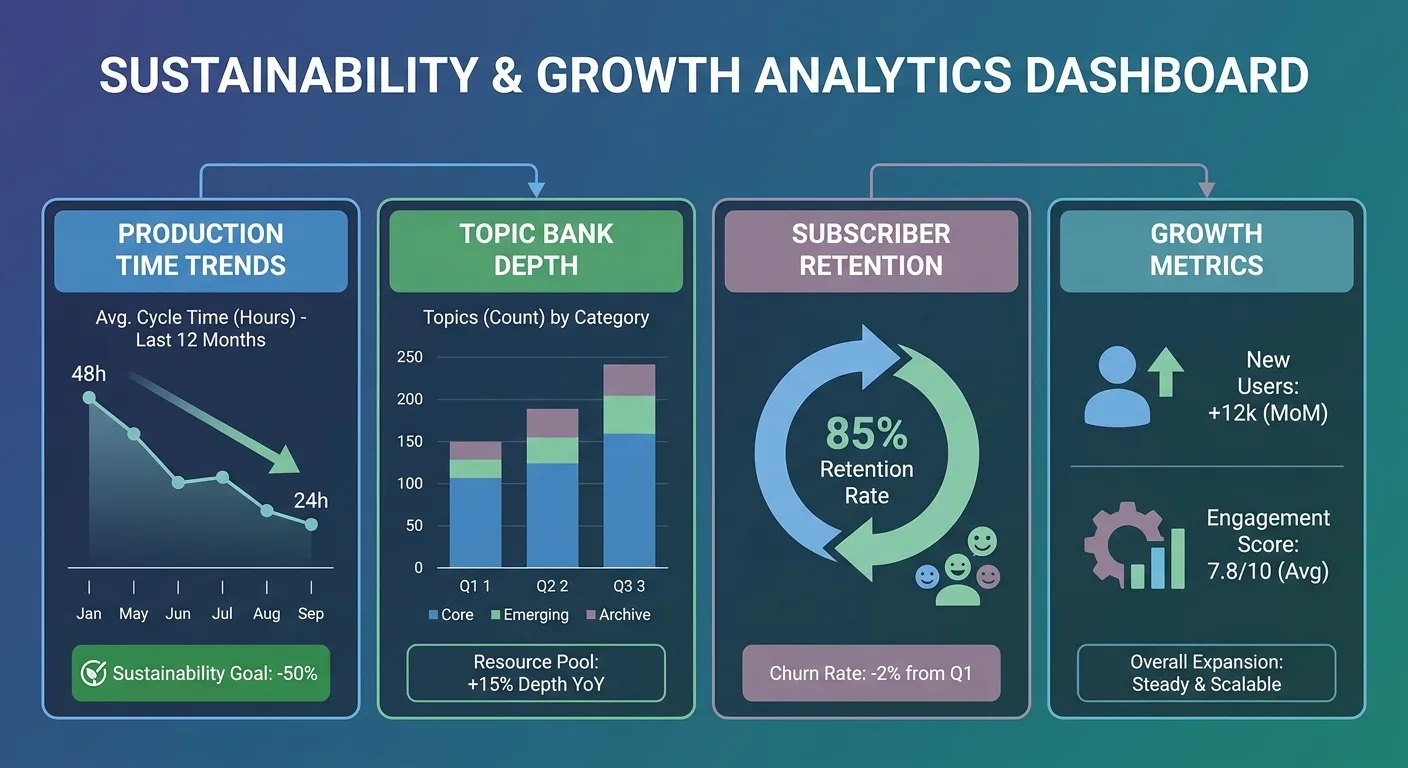
Industry analysis from Detailed.com’s 2026 ranking of top blogs shows that high-performing blogs maintain consistent publication schedules and focus on owned distribution channels rather than chasing viral social content, demonstrating that reliable systems beat sporadic heroics.
Production Efficiency Metrics That Reveal Bottlenecks
Time per post shows where you’re spending energy, both in total and by production phase.
Research-to-outline ratio indicates topic clarity before drafting. Draft completion rate measures how often you finish what you start. Outline-to-publish timeline reveals revision burden.
Topic bank replenishment rate shows whether you’re ahead of demand or constantly scrambling. These metrics inform process improvements, not content quality. They reveal where your system is working and where it’s creating friction.
When your time-per-post starts creeping up, that’s not perfectionism. That’s burnout approaching.
Declining efficiency signals approaching burnout before you feel it consciously, while improving metrics indicate sustainable systems taking hold. Focus on trends across multiple posts rather than individual outliers.
Monthly Production Review Checklist
- Calculate average time per post for the month
- Compare to previous month to identify trend
- Review research phase duration; is it increasing?
- Check draft completion rate; how many outlined posts got finished?
- Assess topic bank depth; do you have 4+ months of potential topics?
- Note any posts that took significantly longer and why
- Identify one specific bottleneck to address next month
- Celebrate improvements from previous process changes
Audience Metrics That Inform Content Direction
Time on page indicates engagement depth rather than click appeal, while scroll depth shows where readers disengage. Return visitor rate measures whether content builds relationship beyond single interactions.
Email click-through rates reveal sustained interest topics, comments indicate exploration needs, traffic source diversity reduces platform dependency, and conversion metrics show which content advances business goals.
Watch trends over time, not individual post performance. Any single piece can be an outlier. Patterns across dozens of posts reveal what resonates with your audience versus what you hoped would resonate.
Using Data to Make Sustainability Decisions
Declining production efficiency signals need for process adjustment or reduced frequency. Strong performance in specific topic areas indicates where to concentrate effort. Weak engagement patterns suggest topic-audience mismatch needing correction.
Increasing time investment per post may indicate scope creep in topic selection. Stable or improving metrics support your current approach. Data removes guilt from capacity decisions around posting less, narrowing focus, or changing format.
Measurement should inform iteration, not create pressure to match arbitrary benchmarks. Your metrics exist to serve your sustainable practice, not judge your worthiness as a creator. Use them as diagnostic tools, not performance reviews.

Frequently Asked Questions
How often should I publish if I want blogging to be sustainable long-term?
Start with a conservative schedule you can maintain without heroics. Increasing frequency later is easier than recovering from burnout. Your realistic cadence depends on your specific situation, including full-time work, family, or other responsibilities. Many successful blogs publish monthly with strong results.
What if I run out of things to write about in my niche?
You probably haven’t. Topic exhaustion usually signals insufficient audience intelligence gathering, not actual material depletion. Your audience continuously generates new questions as they implement previous advice. Each published piece creates downstream questions. Industry changes, new tools, and emerging challenges create fresh angles on existing topics.
The same topic serves different reader segments at different experience levels, with beginners needing different guidance than advanced practitioners. Updating older content counts as valuable publishing. Interviews bring in outside perspectives without requiring your original expertise on every detail.
Genuine exhaustion of a narrow niche signals the need to expand scope or pivot. Most perceived depletion is creative fatigue when you approach content systematically.
How do I maintain quality when I’m trying to publish consistently?
Quality comes from structured processes, not extra time or inspiration. Define minimum standards for research depth, source verification, and clarity. Template structures ensure baseline quality across all posts because you’re not starting from zero each time. Separate editor role from writer role, even if you’re the same person.
Working on several pieces in sequence often enhances consistency since you maintain the same approach throughout. Build in extra time for posts requiring deeper development. Regular above-average work outperforms occasional excellence when building an audience. Dropping standards typically signals system failure rather than time constraints.
Should I write about trending topics even if they don’t fit my content plan?
Probably not. Don’t abandon strategic content for trend coverage unless the trend directly impacts your audience’s immediate challenges. Timely topics work best when you have unique expertise or perspective to add. If you constantly chase trends, you’re not building sustainable topic authority.
Trend coverage should be exception, not foundation. Strategic content builds compounding value. Trend pieces provide temporary visibility spikes but rarely convert to long-term readers. Evaluate the available evidence in the context of your own needs. If not, it’s probably a distraction.
What role does personal experience play in sustainable blogging?
Personal experience works best as supporting evidence, not primary content. Share specific lessons readers can apply instead of general life updates. Experience matters when it illuminates principles others can use. Too much personal focus makes content about you rather than reader needs.
Personal development and lifestyle niches accommodate more personal narrative, while business and technical topics typically need less. Find the right mix by prioritizing “what can the reader apply” over “what do I want to share.”
Your own story creates connection but must supplement rather than substitute useful information. Deploy narrative to demonstrate principles, then provide actionable frameworks.
Final Thoughts
This isn’t inspiring advice, and there’s no hack or secret.
Success comes from treating content as a structured discipline with defined limits, replicable workflows, and honest self-assessment. Motivation alone collapses around the three-month mark when circumstances shift or creative energy wanes.
These techniques work by removing inconsistency: deliberate topic curation, systematic creation, automated publishing, and analytical performance tracking.
You don’t need to publish daily. You don’t need perfect inspiration. You need systems that function when motivation is low and life is complicated. Evaluate the available evidence in the context of your own needs.

Start with one component: build your topic bank this week, separate your research from drafting next week, and test email distribution the week after. Each piece makes the next one easier until you’ve built something that lasts past the three-month mark where most attempts collapse.
This approach lacks the appeal of “follow your passion,” but mundane frameworks endure when tested by real conditions.
The goal is building a sustainable practice aligned with your actual capacity that serves people who benefit from your expertise. Adopt what fits, adapt what doesn’t, and choose longevity over spectacle.
Everything else is negotiable.