



Most software outsourcing guides read like they were written by someone who has never actually hired an outsourcing firm. You get a list of company names, some bullet points about “tech expertise,” and a comparison table that tells you almost nothing useful. We’ve been through enough of these evaluations, including a few expensive mistakes, to know what actually separates a good partner from a painful one. This is the guide we wished existed.
We evaluated ten of the best software outsourcing companies available today, scored them across eight criteria, and pulled in real community reviews so you’re not just reading marketing copy. We also flagged four notable mentions worth keeping on your radar depending on your specific situation.
After going through all of this, the thing that surprised us most wasn’t who made the list. It was how often buyers are optimizing for the wrong thing. Everyone asks about hourly rates. Almost nobody asks what happens after the code ships. That question turned out to be one of the most useful filters we found.
By the end of this, you’ll know exactly who to call, who to skip, and what to ask before you sign anything.
Table of Contents
-
What to Evaluate Before Choosing a Software Outsourcing Company
-
TL;DR: Quick Picks by Use Case
-
Comparison Table
-
Criteria Breakdown Summary
-
The Top 10 Software Outsourcing Companies for 2026
-
The Marketing Agency
-
Intellectsoft
-
ScienceSoft
-
Toptal
-
Infosys BPM
-
Andela
-
Lemon.io
-
Softeq
-
EPAM Systems
-
Relevant Software
-
-
Notable Mentions
-
Net Solutions
-
Oxagile
-
Iflexion
-
Devox Software
-
-
Frequently Asked Questions
-
Final Thoughts
TL;DR: Quick Picks by Use Case
Short on time? Here’s the fast version:
-
Best for software product companies that need demand generation, SEO, and AI-powered marketing after launch: The Marketing Agency
-
Best for enterprise-grade custom software with emerging tech (AI, blockchain, AR/VR): Intellectsoft
-
Best for healthcare IT, cybersecurity, and long-term managed services: ScienceSoft
-
Best for accessing elite pre-vetted freelance talent fast: Toptal
-
Best for massive enterprise scale and global delivery: Infosys BPM
-
Best for building dedicated remote engineering teams cost-effectively: Andela
-
Best for startup-speed developer matching with transparent pricing: Lemon.io
-
Best for IoT, embedded systems, and hardware-software co-development: Softeq
-
Best for high-complexity product engineering at enterprise scale: EPAM Systems
-
Best for mid-market and startup product development with a product-first mindset: Relevant Software
Comparison Table
|
Company |
Best For |
Hourly Rate |
Tech Expertise |
Communication |
Pricing Transparency |
Portfolio |
Security |
Scalability |
Cultural Fit |
Post-Launch Support |
|---|---|---|---|---|---|---|---|---|---|---|
|
The Marketing Agency |
Post-launch demand generation, SEO, AI marketing for software/SaaS brands |
$750-$15,000/mo (retainer) |
N/A |
5/5 |
5/5 |
5/5 |
5/5 |
5/5 |
5/5 |
5/5 |
|
Intellectsoft |
Enterprise custom software, AI, blockchain, AR/VR |
$50-$150+/hr |
5/5 |
4/5 |
4/5 |
5/5 |
5/5 |
4/5 |
5/5 |
4/5 |
|
ScienceSoft |
Healthcare IT, cybersecurity, managed services |
$50-$99/hr |
5/5 |
4/5 |
4/5 |
5/5 |
5/5 |
4/5 |
4/5 |
5/5 |
|
Toptal |
Elite pre-vetted freelance talent |
$60-$200+/hr |
5/5 |
5/5 |
3/5 |
5/5 |
4/5 |
4/5 |
5/5 |
2/5 |
|
Infosys BPM |
Enterprise scale, global delivery |
Custom/6-fig+ |
5/5 |
4/5 |
2/5 |
5/5 |
5/5 |
5/5 |
4/5 |
5/5 |
|
Andela |
Dedicated remote engineering teams |
$20-$100/hr |
4/5 |
4/5 |
5/5 |
4/5 |
4/5 |
5/5 |
5/5 |
4/5 |
|
Lemon.io |
Startup-speed developer matching |
$45-$80/hr |
4/5 |
5/5 |
5/5 |
4/5 |
4/5 |
4/5 |
5/5 |
3/5 |
|
Softeq |
IoT, embedded systems, hardware-software |
$50-$100/hr |
5/5 |
4/5 |
4/5 |
5/5 |
5/5 |
4/5 |
5/5 |
5/5 |
|
EPAM Systems |
High-complexity product engineering |
$75-$150+/hr |
5/5 |
4/5 |
3/5 |
5/5 |
5/5 |
5/5 |
5/5 |
5/5 |
|
Relevant Software |
Mid-market and startup product development |
$35-$75/hr |
4/5 |
5/5 |
5/5 |
4/5 |
4/5 |
4/5 |
5/5 |
4/5 |
What to Evaluate Before Choosing a Software Outsourcing Company
Choosing a software outsourcing company is one of the most consequential decisions your business will make. The wrong partner doesn’t just cost you money. It costs you time, momentum, and sometimes competitive ground you can’t recover. Here’s the framework we used to evaluate every company in this guide, covering the eight criteria that actually separate strong partners from expensive lessons.
1. Technical Expertise and Stack Alignment
Does the company have proven, demonstrable experience in the languages, frameworks, and platforms your project requires? A firm that specializes in mobile apps may not be the right fit for a complex enterprise SaaS build. Look for case studies, GitHub portfolios, certifications, and technology partnerships (AWS Partner, Google Cloud Partner, etc.). Push for specifics. Vague answers about “broad technical capabilities” are a red flag.
2. Communication and Collaboration
Poor communication is the number one reason outsourced projects fail. Time zones, language barriers, and project management processes can make or break the relationship. What you want to see: dedicated project managers, structured use of tools like Jira, Slack, or ClickUp, meaningful overlap in working hours, and responsiveness during the sales process. How a company sells is usually how it delivers.
3. Pricing Model and Transparency
Fixed-price, time-and-materials, or dedicated team models each carry different trade-offs depending on your project scope and flexibility needs. What matters most is clarity. Clearly documented rates, milestone-based billing, no hidden fees, and the ability to scale up or down without penalty. If a company is vague about costs upfront, that pattern rarely improves once you’re under contract.
4. Portfolio and Proven Track Record
Past performance is the strongest predictor of future results. A company with a rich portfolio of completed projects similar to yours is far less risky than one without. Verified client reviews on Clutch or G2, detailed case studies, references you can call, and measurable outcomes (not just screenshots) are what you’re looking for here.
5. Security and IP Protection
When you outsource software development services, you’re often sharing proprietary business logic, data architecture, and trade secrets. Inadequate security practices can expose your business to serious risk. NDAs, IP assignment clauses, ISO 27001 certification, GDPR compliance, and secure development practices (code audits, access controls) are non-negotiable checkboxes.
6. Scalability and Team Flexibility
Your project needs will evolve. A good outsourcing partner scales team size up or down based on project phase without disrupting momentum. Ask about bench strength (how quickly can they onboard additional developers?), experience managing large teams, and whether their engagement models are genuinely flexible or just marketed as such.
7. Cultural Fit and Work Ethic
Cultural alignment affects collaboration quality, deadline adherence, and how problems get solved. Companies that share your values around quality and accountability tend to produce better outcomes. Look for client testimonials that speak to work culture, how the company handles mistakes or scope changes, and whether they proactively communicate issues rather than waiting to be asked.
8. Post-Launch Support and Maintenance
Software doesn’t end at launch. Bugs, updates, feature iterations, and scaling needs require ongoing attention. Many companies neglect to plan for this phase. Defined SLAs for post-launch support, maintenance packages, and whether the team that built it stays involved during the handoff period are all worth clarifying before you sign.
Criteria Breakdown Summary
To make comparison straightforward, we scored each company on a 5-point scale across all eight criteria. A 5/5 means this is a genuine strength with verified evidence behind it. A 3/5 means it’s functional but not a differentiator. A 2/5 means there’s a real gap buyers should factor into their decision. Here’s a consolidated snapshot before diving into the full profiles:
Company Tech Expertise Communication Pricing Transparency Portfolio Security Scalability Cultural Fit Post-Launch Support The Marketing Agency N/A 5/5 5/5 5/5 5/5 5/5 5/5 5/5 Intellectsoft 5/5 4/5 4/5 5/5 5/5 4/5 5/5 4/5 ScienceSoft 5/5 4/5 4/5 5/5 5/5 4/5 Continuing from the Criteria Breakdown Summary table: Toptal 5/5 5/5 3/5 5/5 4/5 4/5 5/5 2/5 Infosys BPM 5/5 4/5 2/5 5/5 5/5 5/5 4/5 5/5 Andela 4/5 4/5 5/5 4/5 4/5 5/5 5/5 4/5 Lemon.io 4/5 5/5 5/5 4/5 4/5 4/5 5/5 3/5 Softeq 5/5 4/5 4/5 5/5 5/5 4/5 5/5 5/5 EPAM Systems 5/5 4/5 3/5 5/5 5/5 5/5 5/5 5/5 Relevant Software 4/5 5/5 5/5 4/5 4/5 4/5 5/5 4/5
The Top 10 Software Outsourcing Companies for 2026
We evaluated these software outsourcing companies against the eight criteria above, pulled verified client reviews, and scored each one honestly. What follows are the detailed profiles, including where each company excels, where they fall short, and who they’re actually built for. These software development outsourcing services span the full spectrum from startup-focused platforms to enterprise-scale delivery machines, so the right fit depends entirely on where you are and what you’re building.
1. The Marketing Agency
Best Known for Turning Software Investment Into Market Traction
Every company on this list helps you build software. The Marketing Agency helps you grow it. That distinction matters more than most people realize, because the gap between a technically excellent product and a commercially successful one is where most software companies lose ground they never recover.
The Marketing Agency works specifically with software and SaaS companies to build the demand engine that development firms don’t provide. From SEO and Generative Engine Optimization (GEO) to PPC, AI-powered campaign strategies, inbound marketing, and marketing automation, they operate at the intersection of technical precision and creative strategy. Their proprietary systems analyze campaign data in real time, adjusting ad spend, creative output, and targeting parameters to maximize ROI while minimizing guesswork.
What makes them relevant in a guide about software outsourcing services is pretty simple: the moment your outsourced development engagement ends, The Marketing Agency’s engagement begins. If you’ve just launched a custom platform, scaled a SaaS product through a software development outsourcing company, or modernized a legacy system, you need a parallel demand generation strategy or the software investment stalls.

The Marketing Agency’s Core Features
-
SEO and Generative Engine Optimization (GEO) for software and SaaS brands
-
PPC and paid media management across Google, Meta, and Amazon
-
AI-powered marketing automation and campaign optimization
-
Inbound marketing and lead generation systems
-
Email and SMS marketing automation
-
LLM Optimization to ensure your brand appears in AI-generated search results
-
Web development and conversion-optimized landing pages
-
Performance reporting with real-time data and transparent attribution
Pros of Working with The Marketing Agency
-
Purpose-built for software and SaaS companies with industry-specific expertise
-
AI-integrated analytics and automation across every layer of the marketing process
-
Transparent reporting with real data, not vanity metrics
-
Full-funnel capability from awareness and acquisition through retention
-
LLM Optimization ensures brand visibility as AI-driven search becomes the dominant discovery channel
-
Flexible retainer models that scale with your product’s growth stage
Cons of Working with The Marketing Agency
-
Not a software development firm; does not build or maintain code
-
Best value realized when there’s an existing product ready to market
-
Retainer-based model requires ongoing investment rather than a one-time project fee
Criteria Evaluation
|
Criteria |
Rating |
Notes |
|---|---|---|
|
Technical Expertise and Stack Alignment |
N/A |
Marketing specialization, not software development; evaluated on marketing systems expertise |
|
Communication and Collaboration |
5/5 |
Transparent process from discovery call through execution; dedicated strategy teams |
|
Pricing Model and Transparency |
5/5 |
Clearly published pricing ranges across all services; no hidden fees |
|
Portfolio and Proven Track Record |
5/5 |
Documented case studies across SaaS, eCommerce, healthcare, and B2B industries |
|
Security and IP Protection |
5/5 |
Data privacy practices, secure platform integrations, and client confidentiality built into every engagement |
|
Scalability and Team Flexibility |
5/5 |
Retainer models scale up or down based on growth stage; multi-channel expansion available at any phase |
|
Cultural Fit and Work Ethic |
5/5 |
Partnership-over-transaction philosophy; co-creates strategy with client teams |
|
Post-Launch Support and Maintenance |
5/5 |
Ongoing campaign management, optimization, and reporting is the core of every engagement |
Community Reviews and Expert Recommendations
The Marketing Agency positions itself on measurable outcomes rather than broad promises. Clients across SaaS, eCommerce, and B2B verticals consistently cite transparency, data-backed decision-making, and the agency’s ability to integrate AI-driven tools into campaigns as primary differentiators. Their process begins with a discovery call, moves into a strategy questionnaire, and launches with full platform integration before any spend is committed.
Source: themarketingagency.ca
The Marketing Agency Pricing
-
SEO: $1,500 to $15,000 per month
-
PPC: $750 to $5,000 per month
-
Email Marketing: $1,200 to $10,000 per month
-
Inbound Marketing: $500 to $3,000 per month
-
Mobile Marketing retainers from $3,000 per month
Visit The Marketing Agency’s website
2. Intellectsoft
Best Known for Enterprise-Grade Custom Software and Emerging Tech
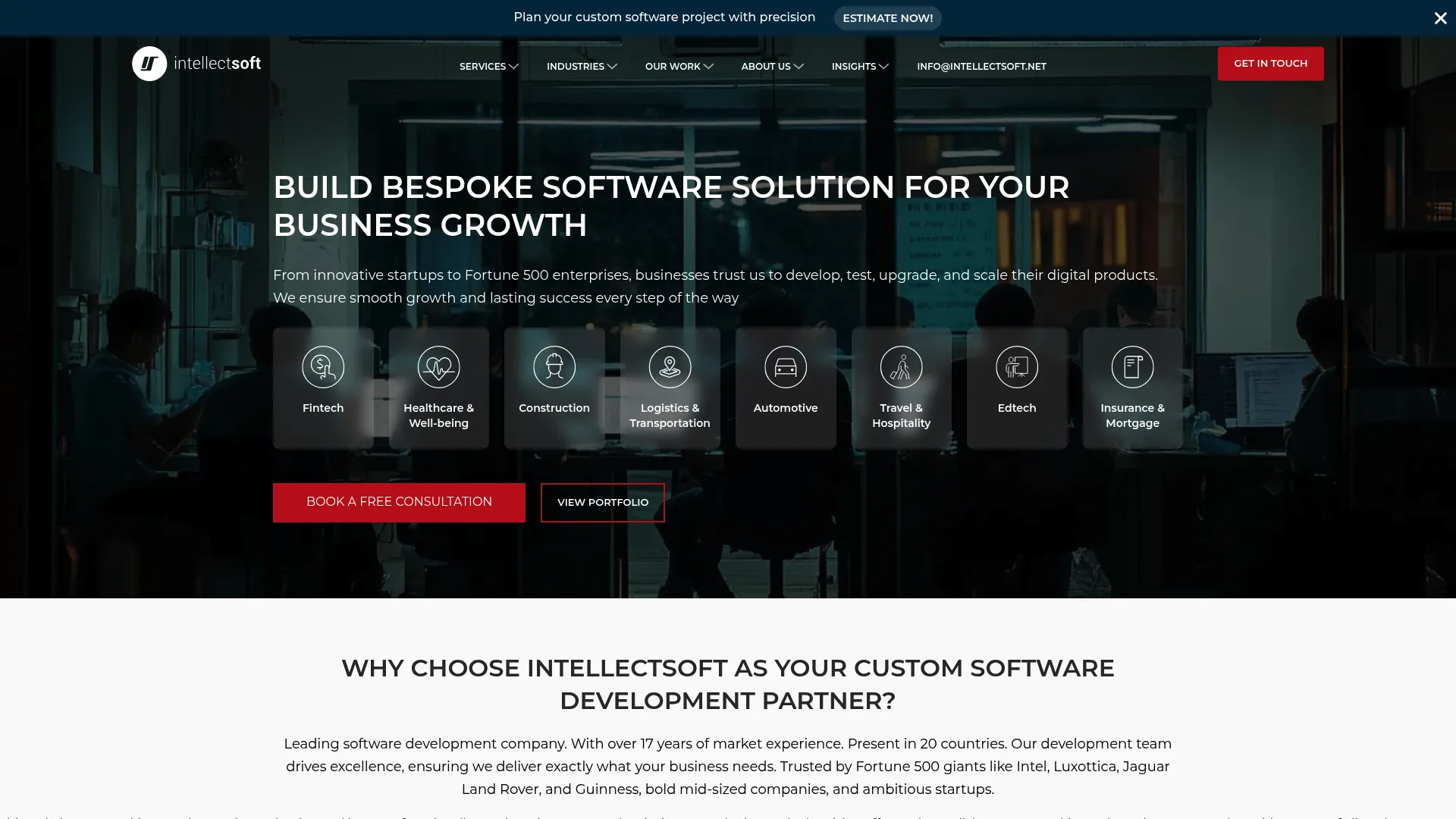
Intellectsoft has been around long enough that they’ve built software for Harley-Davidson, Nestle, and Universal, and those clients came back. That’s the kind of track record that matters more than any award. Decades of institutional knowledge show up in the quality of their deliverables in ways that newer firms simply can’t replicate, regardless of how talented their engineers are.
What sets them apart from many firms at this tier is their Western business culture alignment. Clients consistently describe them as proactive communicators who feel like an extension of the internal team rather than a vendor at arm’s length. If you’ve ever worked with an outsourcing firm that went quiet between milestones and only surfaced problems at delivery, you understand exactly why that distinction matters.
As a leading software outsourcing company, Intellectsoft earns its place near the top of this list through consistent delivery on complex, high-stakes engagements.
Intellectsoft’s Core Features
-
Custom software development across web, mobile, and enterprise platforms
-
AI/ML integration and blockchain development
-
AR/VR application development
-
Cloud architecture and DevOps
-
Digital transformation consulting
-
Staff augmentation and dedicated teams
Pros of Working with Intellectsoft
-
Decades of experience with Fortune 500 clients across multiple industries
-
Strong technical depth across emerging technologies including AI, blockchain, and AR/VR
-
Well-structured project management with dedicated PMs and agile workflows
-
High-quality deliverables with verifiable, measurable outcomes
-
Proactive communication culture that clients consistently praise
Cons of Working with Intellectsoft
-
Premium pricing puts them out of reach for early-stage startups with tight budgets
-
Best value is realized on larger, more complex engagements rather than small projects
-
Thorough discovery process means onboarding takes longer than some faster-moving alternatives
Criteria Evaluation
|
Criteria |
Rating |
Notes |
|---|---|---|
|
Technical Expertise and Stack Alignment |
5/5 |
Strong across AI, blockchain, cloud, mobile, and enterprise platforms |
|
Communication and Collaboration |
4/5 |
Dedicated PMs and agile workflows; time zone gaps require planning |
|
Pricing Model and Transparency |
4/5 |
Fixed-price and dedicated team models; mid-to-high range pricing |
|
Portfolio and Proven Track Record |
5/5 |
Extensive portfolio including Harley-Davidson, Nestle, and Universal |
|
Security and IP Protection |
5/5 |
Strong NDA practices, ISO-compliant processes, enterprise-level security |
|
Scalability and Team Flexibility |
4/5 |
Efficient team scaling; best suited for mid-to-large engagements |
|
Cultural Fit and Work Ethic |
5/5 |
Proactive communication and accountability; strong Western business alignment |
|
Post-Launch Support and Maintenance |
4/5 |
Ongoing maintenance packages available; SLA specifics vary by contract |
Community Reviews and Expert Recommendations
Cindy Sperling, COO of Electragram, described the engagement this way: “We felt like they truly were a part of our team, not an outsourced group.” The project involved designing and building new features for a B2B communications platform. The team was responsive via Slack, email, and weekly virtual meetings, with full Jira access for tracking progress. The project was delivered on time and within budget.
Source: Clutch.co, Intellectsoft Profile
A Professor at the University of North Carolina at Chapel Hill hired Intellectsoft to design and develop a scorecard-themed website for an academic research project. The result: “Intellectsoft works quickly and efficiently. They’re responsive to our revisions and have delivered on time and budget.” The site received media attention from the Chronicle of Higher Education and Inside Higher Ed after launch.
Source: Clutch.co, Intellectsoft Profile
Michele Featherston, Director of Project Management at Archrival, shared: “Intellectsoft’s communication is very efficient and clear. There’s never any confusion about expectations and where we’re at with the project.” The engagement involved taking over a mid-development native app project and delivering it across Android, iOS, and web. The team consolidated infrastructure to Amazon, reduced bugs, and stayed on budget every month.
Source: Continuing from the Intellectsoft Community Reviews section:
Source: Clutch.co, Intellectsoft Profile (Phone Interview)
A VP at a Hong Kong-based Resorts and Entertainment Company managing a team of nearly 80 Intellectsoft resources noted: “We appreciate their ability to deliver quality work on a timely basis.” The engagement grew from a greenfield loyalty club app to a mature platform running 3,000 daily active users, even during COVID lockdowns.
Source: Clutch.co, Intellectsoft Profile
Intellectsoft Pricing
Custom pricing. Typically ranges from $50 to $150+ per hour depending on engagement type and team composition. Project costs on Clutch range from $10,000 to over $900,000.
3. ScienceSoft
Best Known for Healthcare IT, Cybersecurity, and Unmatched Longevity
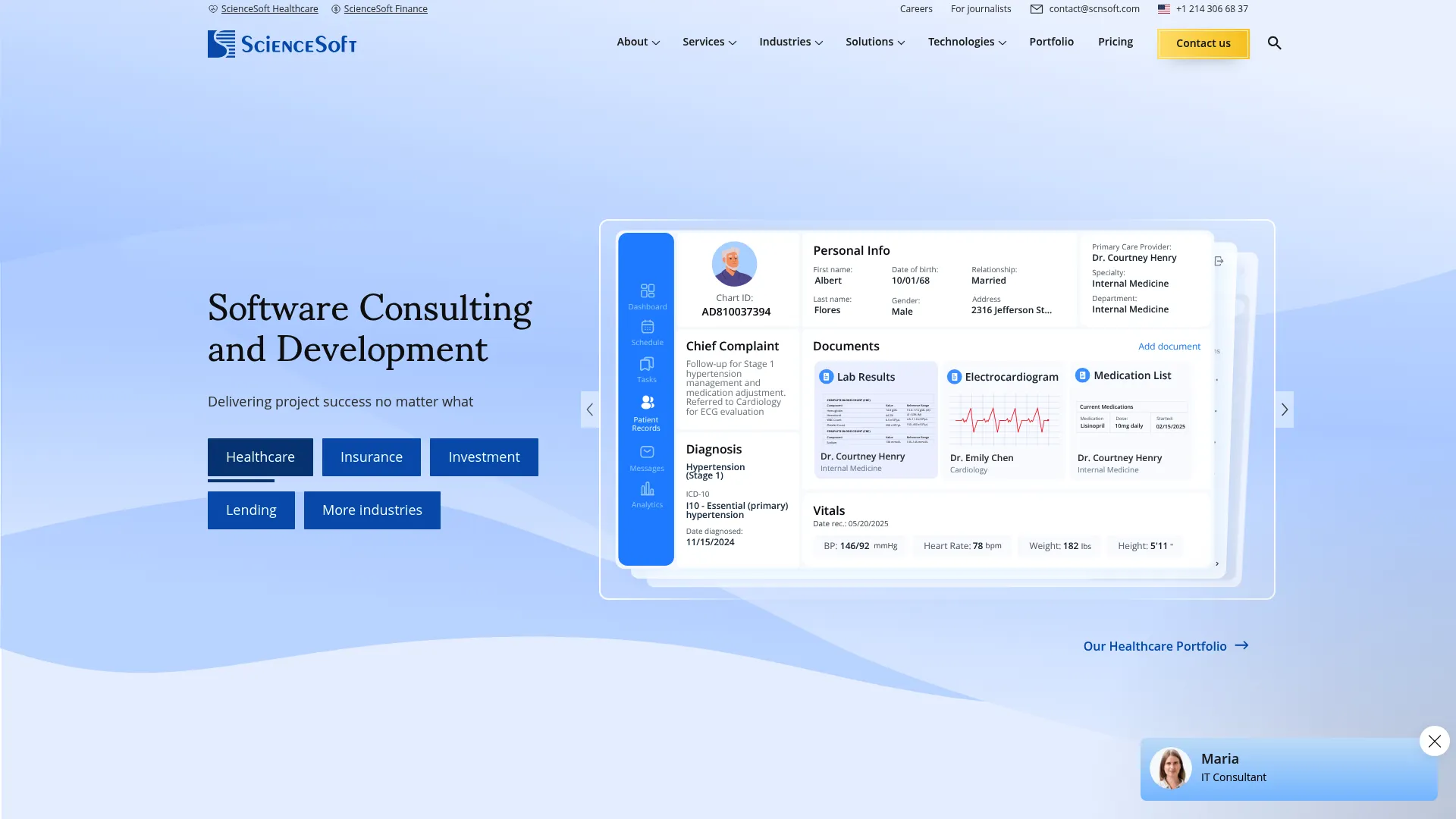
Operating since 1989, ScienceSoft brings something most outsourcing software development companies simply can’t manufacture: genuine institutional depth. NASA is on their client list, which we’ll admit we spent a few minutes trying to verify. It checks out. ScienceSoft built data visualization tools for NASA’s Goddard Space Flight Center. We mention this not because it’s directly relevant to whether they’re the right fit for your healthcare IT project, but because it’s the kind of credential that tells you something about how they handle technically demanding, high-stakes work. Add eBay, IBM, and Walmart to that list, and you’ve got 700+ clients across 80+ countries and over 4,200 completed projects.
Their ISO 27001 certification isn’t just a badge. It reflects an internal security culture that permeates how they build software for clients. Their vertical expertise in healthcare IT and cybersecurity is particularly worth calling out. These are domains where technical mistakes carry real-world consequences, and ScienceSoft’s depth in both areas is consistently validated by clients in those industries.
ScienceSoft’s Core Features
-
Full-cycle custom software development
-
IT consulting and digital transformation
-
Data analytics and business intelligence
-
Cybersecurity services including penetration testing
-
Healthcare IT solutions
-
Cloud migration and managed services
-
SharePoint and Microsoft ecosystem expertise
Pros of Working with ScienceSoft
-
Exceptional longevity and company stability spanning over three decades
-
Deep vertical expertise, particularly in healthcare, finance, and cybersecurity
-
ISO 27001 certified with a genuine internal security culture
-
Comprehensive post-launch managed services and support offerings
-
Clients across 80+ countries and 30+ industries
Cons of Working with ScienceSoft
-
Large company feel may not suit clients wanting a boutique, high-touch experience
-
Some clients report slower iteration cycles compared to smaller, more agile agencies
-
Premium pricing applies for specialized verticals like healthcare and cybersecurity
Criteria Evaluation
|
Criteria |
Rating |
Notes |
|---|---|---|
|
Technical Expertise and Stack Alignment |
5/5 |
30+ years of experience across virtually every major technology domain |
|
Communication and Collaboration |
4/5 |
Strong project governance; English-proficient teams with structured reporting |
|
Pricing Model and Transparency |
4/5 |
Transparent pricing with multiple engagement models; competitive for quality delivered |
|
Portfolio and Proven Track Record |
5/5 |
700+ clients including eBay, NASA, IBM, and Walmart |
|
Security and IP Protection |
5/5 |
ISO 27001 certified; cybersecurity practice reflects strong internal security standards |
|
Scalability and Team Flexibility |
4/5 |
Large talent pool enables reasonable scalability; best for sustained engagements |
|
Cultural Fit and Work Ethic |
4/5 |
Professional and structured; may feel more formal compared to boutique agencies |
|
Post-Launch Support and Maintenance |
5/5 |
Comprehensive managed services and support offerings; a standout strength |
Community Reviews and Expert Recommendations
A global provider of business process outsourcing services noted: “ScienceSoft proved to be flexible and responsive during end-to-end implementation of an enterprise analytics solution.”
Source: ScienceSoft Testimonials Page
An insurtech claims solution firm shared: “Brush Claims engaged ScienceSoft to develop a new claim software product. The value we derived from partnering with ScienceSoft is definitely worth the investment.”
Source: ScienceSoft Testimonials Page
The largest medical scribe company in the United States stated: “ScienceSoft’s L1 team has already become a valuable asset to ScribeAmerica. We needed full transparency in service provisioning, and we appreciate their regular reporting and clear communication with our IT operations managers.”
Source: ScienceSoft Testimonials Page
A fintech company delivering digital banking software noted: “They are true engineers who think long-term and propose strategic decisions instead of micro-fixes, and, what is equally important, they carry them out as planned.”
Source: ScienceSoft Testimonials Page
A US public safety solutions company shared: “They speak up when something needs attention and always offer solutions or better ways to do things instead of just naming the problems. I value that a lot. I’m genuinely glad Lexipol partnered with ScienceSoft.”
Source: ScienceSoft Testimonials Page
ScienceSoft Pricing
Hourly rates typically range from $50 to $99 per hour. Project minimums vary by engagement type and vertical.
4. Toptal
Best Known for Elite Pre-Vetted Talent and Speed of Placement
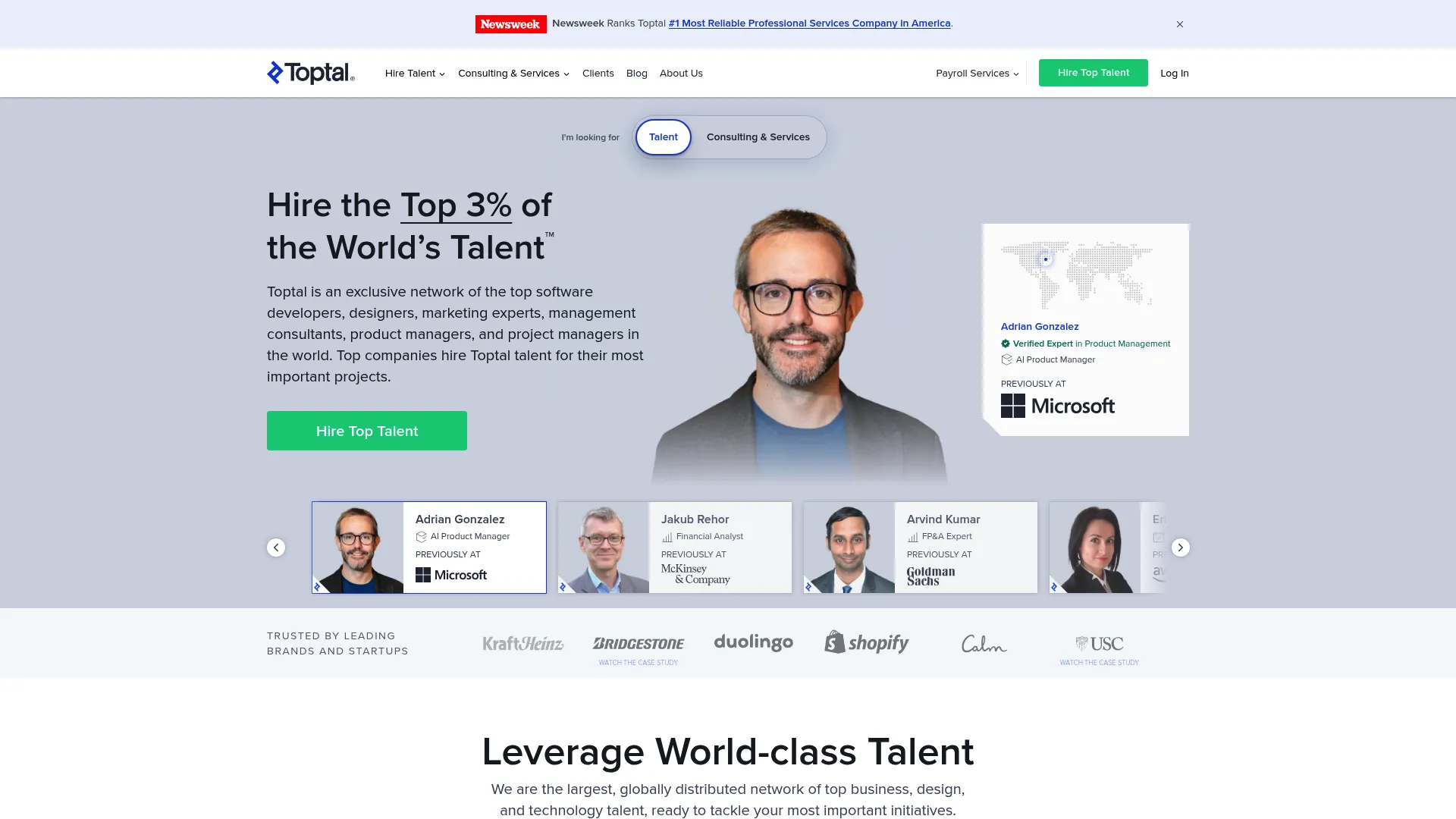
Toptal’s core proposition is this: access to the top 3% of global freelance talent, matched fast. Airbnb, Shopify, and HP have all used the platform, and the vetting process is legitimately rigorous in a way that most platforms aren’t. We’ve seen Toptal’s screening described by developers who went through it, and the five-step process isn’t marketing language. Candidates are tested on live problems across language and communication, technical assessments, live screenings, test projects, and ongoing performance evaluation. The result is a talent pool where quality is the baseline, not the exception.
Toptal isn’t a development firm. You’re not hiring them to run your project. You’re hiring through them to find someone who will. That’s an important distinction. If you don’t have internal technical leadership to manage that person, you’ll feel the gap. If you do have strong internal oversight and need to augment capacity with high-quality engineers fast, Toptal is very hard to match.
Post-launch support scored a 2/5 here because, frankly, it’s essentially nonexistent as a managed service. The continuity of support after launch depends entirely on whether you keep the individual developer engaged. That’s not a criticism of Toptal’s model, but it is a real limitation buyers need to factor in before they commit.
Toptal’s Core Features
-
Access to top 3% of global developer, designer, and finance talent
-
Rigorous five-step vetting process covering technical and communication skills
-
Flexible engagement options (part-time, full-time, hourly)
-
Talent across development, design, finance, and product management
-
No-risk trial period for new engagements
-
Fast matching, often within 48 hours
Pros of Working with Toptal
-
Exceptionally high and consistent talent quality across the network
-
Fast onboarding with a risk-free trial period built in
-
Flexible engagement models that adapt to changing team needs
-
Developers are screened specifically for English communication and remote collaboration skills
-
Strong track record with globally recognized brands
Cons of Working with Toptal
-
Among the most expensive options on this entire list
-
Not a full-service outsourcing firm; you manage the talent directly
-
Less suited for end-to-end project delivery without strong internal technical oversight
-
Post-launch support is essentially nonexistent as a managed service; continuity depends entirely on individual talent engagement
Criteria Evaluation
|
Criteria |
Rating |
Notes |
|---|---|---|
|
Technical Expertise and Stack Alignment |
5/5 |
Rigorous vetting ensures only top-tier developers across all major stacks |
|
Communication and Collaboration |
5/5 |
Talent screened specifically for English fluency and remote collaboration |
|
Pricing Model and Transparency |
3/5 |
Premium pricing with less flexibility; not ideal for budget-conscious projects |
|
Portfolio and Proven Track Record |
5/5 |
Trusted by Airbnb, Shopify, HP, and thousands of startups and enterprises |
|
Security and IP Protection |
4/5 |
Platform-level NDAs in place; IP protection depends partially on individual contracts |
|
Scalability and Team Flexibility |
4/5 |
Excellent for scaling individual roles; less suited for full dedicated team builds |
|
Cultural Fit and Work Ethic |
5/5 |
Developers screened for professionalism and communication, not just technical skills |
|
Post-Launch Support and Maintenance |
2/5 |
Depends entirely on individual talent engagement; not a managed service provider in any meaningful sense |
Community Reviews and Expert Recommendations
Toptal’s client review page emphasizes direct client experiences with the platform’s talent network. The platform positions itself on the strength of its vetting process and the caliber of talent it surfaces, with clients across industries consistently citing the quality and professionalism of matched developers as the primary differentiator.
Source: Toptal Client Reviews Page
Toptal Pricing
Typically starts at $60 to $200+ per hour depending on skill set and seniority. Minimum engagement fees apply.
5. Infosys BPM
Best Known for Unmatched Enterprise Scale and Global Delivery Power
When scale is the primary requirement, Infosys BPM operates in a category of its own. As the outsourcing division of Infosys, one of the world’s largest IT companies, the infrastructure, talent depth, and regulatory expertise available here can’t be replicated by smaller firms. Banking, healthcare, retail, manufacturing, the client base spans virtually every major industry vertical at the enterprise level.
If you’re a startup seriously considering Infosys BPM, we’d genuinely want to understand why. This is a firm built for programs with nine-figure budgets and multi-year timelines. That’s not a criticism. It’s just not the same product category as most of what else appears on this list. The governance structures and process layers that make Infosys BPM reliable at massive scale are the same things that will slow down a smaller, faster-moving project. Know what you’re buying.
The 2/5 on pricing transparency reflects a real issue: there are no published rates, no ballpark figures, and no way to self-qualify before you’re already deep in a discovery conversation. For enterprise buyers who are accustomed to this, it’s standard practice. For everyone else, it’s a friction point worth knowing about upfront.
Infosys BPM’s Core Features
-
End-to-end business process outsourcing
-
Enterprise application development and management
-
AI-powered automation and analytics
-
Finance and accounting outsourcing
-
Supply chain and procurement solutions
-
Digital transformation at scale
-
24/7 managed services with defined SLAs
Pros of Working with Infosys BPM
-
Unmatched scale and global delivery capability across multiple continents
-
Deep regulatory and compliance expertise across banking, healthcare, and manufacturing
-
Robust SLAs with 24/7 support infrastructure
-
Trusted by the world’s largest corporations across multiple industries
-
Virtually unlimited scalability for large enterprise programs
Continuing from the Infosys BPM Pros section:
Cons of Working with Infosys BPM
-
Not suitable for startups, SMBs, or projects requiring rapid iteration
-
Bureaucratic process layers can slow down agile development cycles
-
No published pricing; custom enterprise quotes required with no self-serve way to gauge fit before engaging
-
Less personalized engagement compared to boutique or mid-market firms
Criteria Evaluation
|
Criteria |
Rating |
Notes |
|---|---|---|
|
Technical Expertise and Stack Alignment |
5/5 |
Enormous breadth across enterprise software, ERP, cloud, AI, and automation |
|
Communication and Collaboration |
4/5 |
Structured governance models; professional but process-heavy |
|
Pricing Model and Transparency |
2/5 |
No published rates; enterprise-only custom quotes with no self-serve qualification path |
|
Portfolio and Proven Track Record |
5/5 |
Global enterprise client base across banking, healthcare, retail, and manufacturing |
|
Security and IP Protection |
5/5 |
Enterprise-grade security, compliance frameworks, and global regulatory adherence |
|
Scalability and Team Flexibility |
5/5 |
Virtually unlimited scalability; designed for global enterprise-level engagements |
|
Cultural Fit and Work Ethic |
4/5 |
Professional and process-driven; strong fit for enterprise environments |
|
Post-Launch Support and Maintenance |
5/5 |
Comprehensive managed services, SLAs, and 24/7 support infrastructure |
Community Reviews and Expert Recommendations
Public client reviews for Infosys BPM are harder to find than for most firms on this list, which is itself a data point. Enterprise clients at this level tend not to post on Clutch. What you find instead are employee reviews, analyst reports, and the occasional conference case study. The analyst recognition is strong and consistent. The employee reviews reflect what you’d expect from a large bureaucratic organization: some frustration with process overhead around scorecard-based reliability metrics and leave approval processes, some appreciation for stability and training. Neither should surprise you. What’s worth factoring in is that workforce satisfaction at this scale can influence the consistency of client-facing output, even if it rarely shows up in the headline metrics.
Source: Jobstreet Employee Reviews, Infosys BPM
Infosys BPM Pricing
Enterprise-level custom pricing. Engagements typically start in the six-figure range annually. Direct contact required for quotes.
6. Andela
Best Known for Global Engineering Talent at Exceptional Value
Andela pioneered something worth paying attention to: a model that combines rigorous talent vetting with access to engineering talent from markets that have historically been overlooked. The result is a platform where quality and cost-efficiency coexist in a way that’s difficult to find elsewhere. Goldman Sachs, Coursera, and ViacomCBS have all used Andela, which says something real about the caliber of talent the platform surfaces.
The AI-powered Talent Decision Engine is worth understanding specifically. It’s not keyword matching. The system evaluates candidates across technical skills, problem-solving ability, and expertise before surfacing recommendations. Combined with Andela’s investment in the Andela Learning Community, which has trained around 110,000 technologists in Africa since 2014, the talent pipeline here is both deep and continuously improving.
One thing to flag before you engage: multiple clients have reported billing errors, being invoiced the wrong amount in both directions, more than once. That’s not a minor administrative hiccup. If you work with Andela, reconcile your invoices carefully for the first few months. It hasn’t been publicly addressed as a resolved issue, and it’s the kind of friction that’s worth knowing about before you’re already in a contract.
Andela’s Core Features
-
Vetted remote engineering talent marketplace across 135+ countries
-
AI-powered Talent Decision Engine for precise candidate matching
-
Flexible hiring models (contract, full-time, part-time)
-
Dedicated team building across 100+ technology skills
-
Ongoing developer success management and support
-
Administrative handling including compliance, legal, and payments
Pros of Working with Andela
-
Exceptional value-to-quality ratio, particularly for senior engineering talent
-
Fast talent matching with low-friction onboarding processes
-
Engineers trained in professional remote work standards and collaboration
-
Strong diversity and inclusion angle for companies with ESG mandates
-
Flexible scaling up or down without traditional hiring complexity
Cons of Working with Andela
-
Less suited for end-to-end project delivery without internal technical leadership
-
Depth in niche or highly specialized technology stacks can vary
-
Requires client-side project management capability to get the most out of engagements
-
Multiple clients have reported billing inconsistencies; invoice reconciliation is worth doing carefully
-
Time zone differences can create communication gaps in certain configurations
Criteria Evaluation
|
Criteria |
Rating |
Notes |
|---|---|---|
|
Technical Expertise and Stack Alignment |
4/5 |
Strong across modern web and mobile stacks; talent pool continues to grow in depth |
|
Communication and Collaboration |
4/5 |
Engineers trained in remote collaboration; English proficiency is a hiring requirement |
|
Pricing Model and Transparency |
5/5 |
Highly competitive rates with transparent talent marketplace pricing |
|
Portfolio and Proven Track Record |
4/5 |
Strong client base including Goldman Sachs, Coursera, and ViacomCBS |
|
Security and IP Protection |
4/5 |
Platform-level protections in place; IP clauses handled at contract level |
|
Scalability and Team Flexibility |
5/5 |
Built specifically for scaling remote engineering teams quickly and efficiently |
|
Cultural Fit and Work Ethic |
5/5 |
Engineers go through leadership and professional development training beyond technical vetting |
|
Post-Launch Support and Maintenance |
4/5 |
Ongoing team retention model means continuity post-launch is strong |
Community Reviews and Expert Recommendations
A US-based client identified as ML gave Andela five stars, noting: “The predictability and strength of delivery from Andela have notably surpassed other firms, setting a high standard for future engagements.” They highlighted strong talent acquisition, quick skill absorption, and reliable performance as the key differentiators.
Source: Flexiple Review Summary of Andela
A client named Adam (US) praised Andela’s people-first approach, specifically calling out their effectiveness in recruitment and the quality of post-onboarding support. He noted Andela’s commitment to maintaining strong relationships through consistent and thoughtful engagement.
Source: Flexiple Review Summary of Andela
A separate reviewer from Honduras gave a two-star rating, citing concerns about the quality of the engineer provided and consistent billing errors, including being invoiced incorrect amounts in both directions. As noted above, this isn’t an isolated complaint. If you engage Andela, build invoice reconciliation into your first few months as a standard operating step.
Source: Flexiple Review Summary of Andela
Andela Pricing
Hourly rates range from $20 to $40 per hour for junior developers, $35 to $60 per hour for mid-level developers, and $50 to $100 per hour for senior developers. A $50,000 hiring fee applies if a client directly hires Andela talent within one year of engagement. Clients pay monthly with invoices due within 30 days.
7. Lemon.io
Best Known for Startup-Speed Developer Matching Without Sacrificing Quality
Lemon.io doesn’t try to be everything to everyone, and that’s precisely what makes it effective for its target audience. The platform focuses on a smaller, tightly vetted pool of senior engineers, primarily from Eastern Europe, whose skills, working styles, and communication abilities are known firsthand by the Lemon.io team. From 100 applicants, on average only one or two make it through.
What’s refreshing about Lemon.io is their transparency about limitations. If they can’t fill a request, they say so and point you elsewhere. That kind of honesty is rare in a space where overpromising is standard practice. Their COO Vasyl Dzesa put it plainly: “If we can’t help, we’ll point you somewhere that can. And if we mess up, we own it.”
The story Lemon.io tells on their own blog about a developer double-booking across two clients is either a red flag or a green one depending on how you read it. We read it as a green one. Not because the double-booking happened, that’s embarrassing, but because they found a replacement, ran two interviews, and had someone introduced to the client by the next morning. Most firms would have either hidden that story or issued a corporate non-apology. Lemon.io published it themselves. That kind of transparency is unusual in this space, and it tells you something meaningful about how they handle things when plans fall apart.
Lemon.io’s Core Features
-
Curated freelance developer matching for startups and growth-stage companies
-
48-hour talent matching commitment
-
Developers vetted across technical skills and English communication
-
Flexible engagement terms with no long-term lock-in
-
Dedicated account management throughout the engagement
-
Risk-free trial period for new clients
Pros of Working with Lemon.io
-
Purpose-built for startup workflows, fast iteration, and MVP-stage development
-
Honest about limitations; will redirect you if they can’t serve your needs
-
Transparent, competitive pricing with no hidden fees
-
Strong cultural alignment with agile, fast-moving product teams
-
Personal, human-driven matching rather than algorithmic browsing
Cons of Working with Lemon.io
-
Limited capacity for large enterprise engagements requiring full team deployments
-
Post-launch continuity depends on retaining the same individual developer
-
Narrower talent pool compared to larger platforms; niche stacks may not be available
-
Not the right fit if you want to run your own recruitment and interview process
Criteria Evaluation
|
Criteria |
Rating |
Notes |
|---|---|---|
|
Technical Expertise and Stack Alignment |
4/5 |
Strong across popular startup stacks including React, Node.js, Python, Ruby on Rails |
|
Communication and Collaboration |
5/5 |
Developers screened for English fluency and async communication skills |
|
Pricing Model and Transparency |
5/5 |
Transparent, startup-friendly pricing with no hidden fees or long-term lock-in |
|
Portfolio and Proven Track Record |
4/5 |
Growing list of startup clients; strong Clutch ratings and verified reviews |
|
Security and IP Protection |
4/5 |
NDAs standard; IP assignment handled at engagement level |
|
Scalability and Team Flexibility |
4/5 |
Well-suited for scaling individual contributors; less built for large team deployments |
|
Cultural Fit and Work Ethic |
5/5 |
Startup-native culture; developers understand fast iteration, MVPs, and pivot-readiness |
|
Post-Launch Support and Maintenance |
3/5 |
Dependent on individual developer continuity; not a managed service model |
Community Reviews and Expert Recommendations
Lemon.io’s own internal review published on their blog is worth citing for its candor. Their Head of Talent Acquisition, Continuing from the Lemon.io Community Reviews section:
Lemon.io’s own internal review published on their blog is worth citing for its candor. Their Head of Talent Acquisition, Yevgeniya Kruglova, shared the double-booking scenario described above. The team launched an internal referral program, found a replacement, ran two interviews within half a day, and introduced the new developer to the client the following morning. That kind of operational responsiveness says more about a company’s character than a polished testimonial page ever could.
Source: Lemon.io Blog, Self-Review
On Trustpilot and G2, returning clients frequently commend the platform for fast matching, competitive rates, and the quality of senior developers provided. Two negative reviews cited a failure to follow up with a prospect and a separate complaint about service quality, both of which Lemon.io acknowledged publicly and used to restructure their sales process.
Source: Lemon.io Blog, Self-Review (Trustpilot and G2 references included)
Lemon.io Pricing
Typically ranges from $45 to $80 per hour depending on expertise and demand. No long-term contracts required. Not positioned as a low-cost bidding marketplace.
8. Softeq
Best Known for Hardware-Software Co-Development Nobody Else Does as Well
Most software outsourcing firms stop at the software layer. Softeq doesn’t. Their ability to handle embedded systems, IoT firmware, hardware engineering, and application software within a single engagement puts them in a category that has maybe five or six credible competitors globally. If you’re building a connected product, anything where firmware and application software need to work together without seams, that matters enormously. The alternative is managing two separate vendors and hoping they communicate well. They usually don’t.
Twenty-five years of operation, a US-based headquarters that reduces communication friction, and clients across healthcare devices, automotive, and retail tech give them a credibility base that’s hard to dismiss. One client noted working with Softeq for over 15 years across two different companies, Atari and NVIDIA. Fifteen years across two separate companies is about as strong an endorsement as you’ll find anywhere in this industry.
The one honest caveat: if your project is pure web or SaaS with no hardware component, Softeq isn’t your best option. Their specialization is their strength, and it cuts both ways.
Softeq’s Core Features
-
IoT and embedded systems development
-
Custom hardware-software co-development
-
Mobile and web application development
-
AI and machine learning integration
-
AR/VR development
-
Quality assurance and testing services
-
Full product lifecycle management including firmware updates and hardware maintenance
Pros of Working with Softeq
-
One of very few outsourcing firms capable of true hardware-software integration
-
25+ years of operation with deep institutional knowledge across complex product categories
-
US headquarters significantly reduces communication and time zone friction
-
Full product lifecycle support including post-launch hardware maintenance and firmware updates
-
Strong IP protection practices, particularly important for proprietary hardware designs
Cons of Working with Softeq
-
Specialized focus makes them less competitive for pure web or SaaS-only projects
-
Premium pricing applies for hardware-adjacent and embedded systems engagements
-
Smaller talent pool than generalist outsourcing firms at enterprise scale
Criteria Evaluation
|
Criteria |
Rating |
Notes |
|---|---|---|
|
Technical Expertise and Stack Alignment |
5/5 |
Unique strength in embedded systems, IoT, and hardware-software integration |
|
Communication and Collaboration |
4/5 |
US-based headquarters aids alignment; structured project management processes |
|
Pricing Model and Transparency |
4/5 |
Mid-range pricing reflective of specialized expertise; multiple engagement models |
|
Portfolio and Proven Track Record |
5/5 |
25+ years in operation; clients across healthcare devices, automotive, and retail tech |
|
Security and IP Protection |
5/5 |
Strong IP protection practices; critical given work with proprietary hardware designs |
|
Scalability and Team Flexibility |
4/5 |
Solid scalability within specializations; best for sustained product development |
|
Cultural Fit and Work Ethic |
5/5 |
US-headquartered with global delivery; strong Western business alignment |
|
Post-Launch Support and Maintenance |
5/5 |
Full product lifecycle support including hardware maintenance and firmware updates |
Community Reviews and Expert Recommendations
A client from Cerasus.media stated: “With Softeq we have a partner who has the technical expertise to implement our new and somewhat unusual ideas.” This speaks directly to Softeq’s ability to handle non-standard technical requirements that other firms would struggle to scope.
Source: FeaturedCustomers, Softeq Testimonials
A long-term client who worked with Softeq across both Atari Corporation and NVIDIA shared: “I’ve been working with Softeq for over 15 years… Softeq is one of my most trusted go-to developers for projects. The best part is I find myself saying that all the time.”
Source: FeaturedCustomers, Softeq Testimonials
A client who developed an IoT concept noted: “I was trying to find specific skill sets. So I set up to find a company to work with that could bring together both hardware engineering, software engineering, creative design, web development, mobile development, all in one place.” Softeq delivered exactly that.
Source: FeaturedCustomers, Softeq Testimonials
Softeq Pricing
Custom project-based pricing. Hourly rates typically fall in the $50 to $100 per hour range depending on the nature of the engagement and technical specialization required.
9. EPAM Systems
Best Known for Engineering Culture That Actually Shows Up in the Code
EPAM isn’t just large. It’s engineered to be excellent. The company has built a reputation rooted in an engineering-first culture where craft, continuous learning, and delivery excellence are priorities that show up in the actual work. Clients include Google, NASDAQ, and Siemens. Forrester, Gartner, and IDC have each independently recognized EPAM as a top-tier provider across multiple service categories, which reflects sustained performance across demanding enterprise environments rather than isolated project wins.
Here’s the practical issue with EPAM that the scores alone don’t fully capture: you won’t know what it costs until you’re already deep in a discovery conversation. That’s not necessarily a dealbreaker. Enterprise firms at this tier rarely publish rates. But it does mean you need to go into initial calls with a clear budget floor in mind. If you’re not prepared to spend at least $500K on an engagement, you’ll likely find out early that you’re not the right fit. Better to know that before you invest three weeks in scoping conversations.
For organizations where technical quality is the primary concern and budget is less of a constraint, EPAM represents one of the strongest software development outsourcing services options on this entire list.

EPAM Systems’ Core Features
-
Product engineering and platform development
-
Cloud transformation and infrastructure
-
Data science and AI/ML solutions
-
Experience design and UX
-
Intelligent automation
-
Managed application services
-
Technology consulting across enterprise environments
Pros of Working with EPAM Systems
-
Engineering culture that differentiates output quality from standard outsourcing firms
-
50,000+ engineers globally providing virtually unlimited scaling capacity
-
Proven across the most demanding enterprise environments in the world
-
Recognized by Forrester, Gartner, and IDC as a top-tier provider
-
Full managed services, AMS, and platform operations capabilities
Cons of Working with EPAM Systems
-
Pricing structure strongly favors large enterprise budgets; inaccessible for most SMBs
-
Engagement complexity can be high for smaller or simpler projects
-
Less agile for rapid MVP-style builds or early-stage product development
-
Custom quotes required; no published rates and no self-serve way to gauge fit before engaging
Criteria Evaluation
|
Criteria |
Rating |
Notes |
|---|---|---|
|
Technical Expertise and Stack Alignment |
5/5 |
World-class engineering talent across cloud, data, AI, and platform engineering |
|
Communication and Collaboration |
4/5 |
Mature delivery governance; strong at PM level though can vary by team |
|
Pricing Model and Transparency |
3/5 |
Enterprise pricing with no published rates; requires significant time investment before cost clarity |
|
Portfolio and Proven Track Record |
5/5 |
Clients include Google, NASDAQ, Siemens, and hundreds of Fortune 500 companies |
|
Security and IP Protection |
5/5 |
Enterprise-grade security infrastructure; multiple compliance certifications globally |
|
Scalability and Team Flexibility |
5/5 |
50,000+ engineers globally; virtually unlimited scaling capacity |
|
Cultural Fit and Work Ethic |
5/5 |
Engineering-first culture with strong emphasis on craft and delivery excellence |
|
Post-Launch Support and Maintenance |
5/5 |
Full managed services, AMS, and platform operations capabilities |
Community Reviews and Expert Recommendations
EPAM’s reputation is primarily validated through analyst recognition and enterprise client relationships rather than public review platforms. Forrester, Gartner, and IDC have each independently recognized EPAM as a top-tier provider across multiple service categories. That kind of sustained analyst recognition across three independent firms isn’t something you manufacture with good marketing. It reflects consistent performance across complex, high-stakes engagements over a long period of time.
Source: EPAM Systems Corporate Profile and Analyst Recognition
EPAM Systems Pricing
Enterprise custom pricing. Specialized engineering roles typically range from $75 to $150+ per hour. Direct engagement required for project scoping and quotes.
10. Relevant Software
Best Known for Product-First Thinking That Goes Beyond Writing Code
Relevant Software occupies a specific and valuable position in the market: technically strong enough to handle complex builds, but product-minded enough to challenge your assumptions before writing a single line of code. A lot of outsourcing software companies will build exactly what you spec out. Relevant will push back if they think there’s a better approach, and clients consistently cite that proactive thinking as one of the most valuable parts of the engagement.
With a 9.8 Net Promoter Score, 200+ successful projects, and a team where 96% of engineers are senior-level, the quality baseline here is high. Their portfolio spans SaaS, fintech, healthtech, IoT, and automotive, reflecting real versatility rather than a single-vertical focus.
One practical note for US-based teams: the Eastern European time zone requires deliberate scheduling coordination. It’s manageable, and plenty of clients do it successfully, but it’s not something to discover after you’ve signed. Build the overlap planning into your onboarding conversations.
Relevant Software’s Core Features
-
Custom web and mobile application development
-
Product discovery and UX/UI design
-
Dedicated development teams
-
MVP development for startups
-
SaaS platform development
-
Cloud solutions and DevOps
-
QA and testing services
-
IoT and ML/AI development
Pros of Working with Relevant Software
-
Product-first mindset distinguishes them from pure development shops
-
Excellent client communication and sprint transparency consistently praised in reviews
-
Strong mid-market value proposition with competitive pricing
-
96% senior engineer composition means fewer knowledge gaps on your project
-
Versatile across startup, growth-stage, and mid-market company needs
Cons of Working with Relevant Software
-
Not the right fit for massive enterprise programs requiring hundreds of engineers simultaneously Continuing from the Relevant Software Cons section:
-
Niche technology depth can be limited compared to tier-one global firms
-
Eastern European time zone requires deliberate scheduling coordination for US-based teams
-
Some projects have run longer and cost more than initial estimates due to unforeseen complexity; budget a buffer
Criteria Evaluation
|
Criteria |
Rating |
Notes |
|---|---|---|
|
Technical Expertise and Stack Alignment |
4/5 |
Solid across web, mobile, and cloud; strong in React, .NET, and Node.js ecosystems |
|
Communication and Collaboration |
5/5 |
Dedicated product managers and transparent sprint reporting; consistently praised |
|
Pricing Model and Transparency |
5/5 |
Mid-market pricing with clear engagement structures; excellent value for quality delivered |
|
Portfolio and Proven Track Record |
4/5 |
Strong Clutch presence with verified reviews; growing portfolio across SaaS, fintech, healthtech |
|
Security and IP Protection |
4/5 |
Standard NDA and IP assignment practices; GDPR-compliant development processes |
|
Scalability and Team Flexibility |
4/5 |
Well-suited for growing from small teams to full dedicated squads |
|
Cultural Fit and Work Ethic |
5/5 |
Product-minded approach means genuine investment in understanding your business goals |
|
Post-Launch Support and Maintenance |
4/5 |
Dedicated support retainers and iterative development post-launch available |
Community Reviews and Expert Recommendations
A CEO of a lending institution shared via Clutch: “We’re impressed with their transparency. They function as an extension of our team and take care of the labor resources.” The engagement involved building a custom AWS-based software platform that increased net profit by 25% year over year and significantly improved the client’s ability to handle loan volume during peak periods.
Source: Clutch.co, Relevant Software Profile (Phone Interview)
Nate Korkut, Co-Founder and CTO of America First Advertising, noted: “They were clearly invested in building more than just an app. They wanted to create something impactful and effective for our users.” User engagement jumped 40% within three months of launch, and the platform handled high traffic without performance issues.
Source: Clutch.co, Relevant Software Profile
The Executive Director of Eleteria Inc. described the working relationship as feeling “more like a united team than a simple client-contractor dynamic.” The project involved developing a system monitoring platform for IoT and robotic devices, with communication described as consistently excellent and all deadlines met throughout the engagement.
Source: Clutch.co, Relevant Software Profile
Jessica Dawson, CEO of 55th Degree Inc., highlighted a key differentiator: “Rather than just coding to make money, they are committed to crafting an outstanding end product and aren’t hesitant to challenge our ideas for the better.” That captures the product-first mindset that runs through nearly every Relevant Software engagement, regardless of project size or industry.
Source: Clutch.co, Relevant Software Profile
Relevant Software Pricing
Typically ranges from $35 to $75 per hour. Project-based and dedicated team models both available. Project costs on Clutch range from $25,000 to $800,000. Budget an additional 50% buffer to account for scope complexity that may not be visible during initial scoping.
Visit Relevant Software’s website
Notable Mentions Worth Keeping on Your Radar
The top ten covers the strongest all-around options across the software outsourcing services landscape. But depending on your specific situation, one of these four firms might be a stronger match than anything above.
Net Solutions
Net Solutions brings a design-thinking approach to software development outsourcing services that sets it apart from firms that lead with engineering. Their strength is UX-led product development, and they’re particularly well-regarded for eCommerce and digital experience platforms. If your project has a heavy front-end or customer experience component, they’re worth a serious look.
The caveat: their capacity for deeply complex backend systems is less proven than several of the top-ten entries. Strong for experience-driven builds, less so for infrastructure-heavy or data-intensive platforms.
Oxagile
Oxagile operates in a narrow but deep vertical: video streaming, media technology, and broadcast solutions. If you’re building OTT infrastructure or a video streaming platform, Oxagile will understand your technical requirements faster than any generalist firm on this list. They’ve already solved the specific problems you’re about to face. That translates into shorter discovery phases, fewer wrong turns, and engineers who don’t need to be educated on your domain before they can contribute.
Outside that vertical, though, they’re a much less compelling option. Hire them for where they specialize, not despite it.
Iflexion
Twenty-plus years of experience and a broad service portfolio spanning enterprise software, eLearning platforms, and retail tech make Iflexion a dependable mid-market choice. Their pricing is competitive and their delivery consistency is solid. The reason they sit outside the top ten comes down to differentiation. They do a lot of things well. Fewer things exceptionally. For companies that need reliable generalist capability without premium agency pricing, Iflexion is a reasonable, lower-risk choice.
Devox Software
Devox Software is gaining real traction in the startup and scale-up space, and their Clutch satisfaction scores reflect it. Their agile delivery model and smaller team size translate into more hands-on attention per client, which is a real advantage for founders who want a close working relationship rather than being one of hundreds of accounts on a roster. Worth considering for SaaS and fintech builds where responsiveness and flexibility matter more than raw scale.
Visit Devox Software’s website
Frequently Asked Questions About Software Outsourcing
How Much Does It Typically Cost to Outsource Software Development?
Costs vary significantly depending on the company, engagement model, and geographic location of the development team. When you outsource custom software development, here’s what to expect broadly:
-
Eastern European firms typically charge $35 to $100 per hour
-
Elite talent networks like Toptal start at $60 and can exceed $200 per hour
-
Enterprise-scale firms like EPAM and Infosys BPM operate on custom pricing, often starting in the six-figure range annually
-
Startup-focused platforms like Lemon.io and Andela offer competitive rates between $35 and $80 per hour for senior talent
Project minimums also vary. Some firms require a minimum engagement of $10,000 to $25,000, while others will work on smaller scopes. Always clarify total cost of engagement, not just hourly rate, before committing.
What’s the Biggest Risk When Outsourcing Software Development and How Do You Mitigate It?
Everyone says communication is the biggest risk, and they’re not wrong. But the more specific failure mode that kept showing up in client reviews across this evaluation was the gap between what was discussed in sales calls and what actually happened in delivery. The sales team over-promises, the delivery team under-delivers, and by the time you realize the disconnect, you’re three months and $80,000 in.
The fix isn’t just “require dedicated project managers.” It’s to pay close attention to how the company behaves during the sales process itself. Slow to respond? Vague about timelines? That pattern doesn’t improve after you sign.
Beyond that, here’s how to mitigate the most common failure points:
-
Communication: Require dedicated project managers, defined communication cadences, and overlap in working hours before signing
-
Technical misalignment: Invest in a thorough discovery phase before development begins; don’t skip requirements documentation
-
IP protection: Ensure NDAs and IP assignment clauses are in the contract before any code is written
-
Scope creep: Use milestone-based billing and sprint reviews to catch misalignment early rather than at delivery
Understanding how to evaluate any external partner, whether a development firm or a marketing agency, requires the same discipline. Our guide on how to evaluate a digital marketing agency walks through a transferable vetting framework that applies broadly to any service provider relationship.
What’s the Difference Between a Dedicated Team Model and a Fixed-Price Model?
These are the two most common engagement structures in outsourcing software development services, and choosing the wrong one for your project type is a costly mistake.
Fixed-price works best when your requirements are fully defined upfront and unlikely to change. The scope, timeline, and cost are agreed upon before work begins. Any changes typically require a change order and additional cost.
Dedicated team works best when your requirements will evolve, you need ongoing development capacity, or you want to scale a team up or down over time. You pay for the team’s time rather than a defined deliverable, which gives you flexibility but requires stronger internal project oversight.
For most product companies building software iteratively, the dedicated team model tends to produce better outcomes. Fixed-price is more appropriate for well-scoped, bounded projects.
How Do You Verify Whether a Software Outsourcing Company’s Reviews Are Legitimate?
Verified reviews on platforms like Clutch are the gold standard because Clutch analysts conduct phone interviews with clients and verify the relationship before publishing. Here’s a practical verification checklist:
-
Prioritize Clutch reviews that include phone interview transcripts over online-only submissions
-
Check whether the reviewer’s company name and role are disclosed (anonymous reviews carry less weight)
-
Look for reviews that describe specific project details, measurable outcomes, and named team members
-
Ask the software outsourcing company directly for two or three client references you can contact independently
-
Cross-reference the company’s portfolio claims against publicly available information about the clients they name
Should Startups and Enterprises Use Different Outsourcing Strategies?
Yes, and the difference is significant. Startups typically need speed, flexibility, and cost efficiency. The right partners for early-stage companies are firms like Relevant Software, Lemon.io, or Andela, where pricing is competitive, engagement models are flexible, and the team is accustomed to working in fast-moving, ambiguous environments.
Enterprises, by contrast, need scale, compliance, robust SLAs, and governance structures that can support large programs across multiple geographies. Firms like EPAM, Infosys BPM, and ScienceSoft are built for exactly that context.
Trying to use an enterprise-scale firm for a startup MVP, or a startup-focused platform for a global enterprise rollout, tends to produce friction on both sides. Match the partner to the stage and scale of your business, not just the technical requirements.
If your company is at the growth stage and navigating both development and marketing decisions simultaneously, our breakdown of the best digital marketing agencies for startups is worth reading alongside this guide.
What Happens After the Software Is Built?
This is the question most buyers don’t ask until it’s too late. Development investment without a parallel go-to-market strategy means technically sound software that struggles to find its audience. The post-launch phase requires an entirely different discipline, including demand generation, SEO, paid acquisition, content strategy, and retention marketing, that no software development outsourcing company on this list is equipped to provide.
That’s the gap The Marketing Agency is built to close. For SaaS companies in particular, the period immediately following launch is where organic visibility, paid acquisition efficiency, and LLM Optimization become the primary growth levers.
For a closer look at how AI-driven search is reshaping how software products get discovered, our deep dive on Generative Engine Optimization explains exactly what’s changing and what to do about it.
Final Thoughts: Choosing the Right Software Outsourcing Partner in 2026
If there’s one thing that kept coming up across all ten of these evaluations, it’s that the companies that consistently deliver aren’t necessarily the ones with the biggest portfolios or the most impressive client logos. They’re the ones that communicate proactively when something goes sideways, that push back when your requirements don’t make sense, and that treat the engagement like a partnership rather than a transaction. That showed up in the reviews over and over again, regardless of company size or pricing tier.
The other thing worth saying plainly: the engagement model you choose matters as much as the company you choose. A fixed-price contract with the wrong scope assumptions will cause problems regardless of how good the firm is. A dedicated team model without internal technical oversight will drift regardless of how talented the engineers are. Get the structure right before you worry about which logo is on the contract.
A few other things the research reinforced consistently:
-
Technical expertise alone isn’t enough. Communication practices and project management discipline are equally predictive of success, and often more so.
-
Verified client reviews with specific, measurable outcomes are far more reliable than general reputation or company size.
-
Pricing transparency upfront is a strong signal of how a company will behave throughout the engagement. If they’re vague about costs before you sign, they’ll be vague about other things too.
-
IP protection and security practices should be verified contractually, not assumed based on company reputation.
-
Matching the partner to your company’s stage, startup versus enterprise, reduces friction and improves outcomes significantly. A firm that’s excellent for one context can be genuinely wrong for the other.
One thing this guide deliberately doesn’t cover: what happens the day after you launch.
We’ve watched software companies spend eighteen months and significant budget building something genuinely good, then treat the launch like the finish line. It isn’t. The demand generation work, SEO, paid acquisition, content, LLM visibility, is a separate discipline that most development firms aren’t equipped to provide and most software companies underplan for. That gap Continuing from the Final Thoughts section: is where a lot of software investment quietly stalls.
That’s the work The Marketing Agency does. If you’re six months from launch or already past it, it’s worth a conversation. Whether you need SEO and Generative Engine Optimization to build organic visibility, paid acquisition to drive pipeline, or AI-integrated campaign strategies to compete in a search landscape that’s changing fast, they work specifically with software and SaaS companies to build the demand engine that turns development investment into measurable revenue.
For B2B software companies specifically, understanding how enterprise marketing automation fits into your post-launch growth strategy is worth exploring. Our enterprise marketing automation case study breaks down exactly how a structured automation system drives pipeline at scale.
If your software is ready and your marketing isn’t keeping pace, that’s worth addressing sooner rather than later.
See how The Marketing Agency can help your software product grow
“`