


So I spent half a year testing Search Atlas, and honestly? The gap between what they promise and what you actually get is pretty wild. I’m talking about stuff that would’ve made me walk away on day one if I’d known.
Here’s what nobody tells you: their JavaScript-based setup means everything vanishes the second you cancel. ChatGPT and Claude can’t see any of your optimizations. That $99 plan they advertise? Yeah, you’ll actually pay $300-400 once reality hits. Their keyword database has 5.2 billion keywords, which sounds impressive until you realize that’s one-fifth the size of Ahrefs. And OTTO “automation”? You’ll spend hours reviewing everything manually anyway—several people told me their rankings actually dropped after trusting the bulk recommendations.
Look, if you’re considering Search Atlas or already locked in, you need to know what you’re actually dealing with. Not the marketing version. The real version.
Table of Contents
-
What Actually Matters When Evaluating SEO Platforms
-
Search Atlas: The Complete Breakdown
-
Four Alternatives Worth Your Consideration
-
FAQ
-
Final Thoughts
TL;DR
Real talk, here’s what you need to know:
-
JavaScript optimizations that vanish when you cancel – so you’re basically renting your SEO, not building it
-
ChatGPT and Claude can’t see any of your work. Zero. Zilch. You’re invisible in AI search results
-
That $99 plan? Cute. You’ll actually pay $300-400 once credits, AI points, and per-site charges hit
-
5.2 billion keywords sounds big until you see Ahrefs has 22 billion. That’s like bringing a knife to a gunfight
-
OTTO “automation” means reviewing everything manually anyway—people are reporting ranking drops after bulk implementations
-
Slow loading, timeout errors, integration conflicts with caching plugins. The spinning circle of death is real
-
Chat and email support only. No phone. Good luck when something breaks at 4 PM on Friday
-
Works okay for beginners with 1-3 sites. Agencies scaling past 5 clients? The math stops working entirely
Search Atlas Evaluation Criteria
Yeah, I made a table. Sue me. Sometimes you just need to see the numbers laid out, and these scores come from six months of actual testing, not marketing materials.
|
Criterion |
Score |
Key Finding |
|---|---|---|
|
Implementation Architecture |
2.5/5 |
JavaScript-based optimizations create vendor lock-in and AI search invisibility |
|
Pricing Transparency |
2/5 |
Hidden costs (credits, AI points, per-site fees) often quadruple advertised prices |
|
Data Depth & Accuracy |
3/5 |
5.2B keyword database is one-fifth the size of Ahrefs (22B) and SEMrush (25B) |
|
Platform Stability |
2.5/5 |
Frequent loading issues, timeout errors, and integration conflicts reported |
|
Automation Quality |
3/5 |
OTTO requires heavy manual review despite “automation” branding |
|
Support Infrastructure |
2.5/5 |
No phone support; inconsistent response times via chat and email |
|
AI Search Visibility |
1/5 |
JavaScript optimizations completely invisible to AI crawlers |
|
Agency Scalability |
2/5 |
Per-site costs and credit consumption make growth economically challenging |
What Actually Matters When Evaluating SEO Platforms
Most SEO platforms won’t tell you what actually matters until after you’ve committed. They’ll throw around impressive numbers and highlight features, but the stuff that determines whether you’ll still be using the tool six months from now? That gets buried in fine print.
I watched a client waste $4,000 before figuring this out. Took me three failed implementations to learn this the hard way.
So here’s what actually matters when you’re looking at these tools—the eight factors that separate platforms worth your money from expensive mistakes.
Implementation Architecture: How This Thing Actually Works (And Why It Matters)
The technical foundation determines everything downstream. Some platforms make permanent code-level changes to your website. Others use JavaScript to render optimizations client-side.
Here’s the deal with JavaScript—it’s basically smoke and mirrors. Your site isn’t actually fixed. Search Atlas is just putting makeup on it. Cancel your subscription? Poof. All gone.
This distinction affects site performance, long-term sustainability, and whether emerging AI search engines can even see your work. JavaScript-based implementations add processing overhead that impacts Core Web Vitals (a confirmed ranking factor) and create dependency on third-party uptime. More critically, they make your optimizations invisible to AI crawlers that can’t execute JavaScript.
When you’re evaluating platforms, ask specifically: Are these permanent code changes or JavaScript overlays? Your answer determines whether you’re building assets or renting improvements.
I’ve seen businesses invest thousands into Search Atlas optimizations only to discover everything vanished the moment they cancelled their subscription. That’s not building equity in your digital presence—that’s paying rent on borrowed improvements.
And yeah, maybe I’m spoiled because I’ve used enterprise tools. Maybe my expectations are too high. But I don’t think wanting to actually own your SEO work is asking too much.
Pricing Transparency: The Real Cost Beyond Marketing Pages
Advertised pricing rarely reflects what you’ll actually spend.
Many platforms use multi-tiered systems with base subscriptions, consumption-based credits, AI point allocations, and per-site charges that multiply your costs. One agency I talked to—Jake from Denver—showed me his bills. $387 one month, $412 the next, when he’d budgeted for $99.
This isn’t just about affordability. It’s about predictability. Can you budget accurately? Can you bill clients without surprise overages?
Look beyond the hero pricing on landing pages and calculate realistic monthly costs based on your actual usage patterns. Ask for detailed breakdowns of credit consumption, point depletion rates, and additional site fees before committing. The Search Atlas pricing structure includes multiple hidden cost layers that only become apparent after you’re several billing cycles deep.
Want to know the worst part? There’s no transparent consumption calculator. You won’t know what you’ll actually spend until you’ve already spent it.
Data Depth & Accuracy: Database Size Actually Matters
Keyword and backlink databases vary dramatically between platforms. Search Atlas offers 5.2 billion keywords. Ahrefs provides 22 billion. SEMrush delivers 25 billion.
5.2 billion sounds impressive until you realize Ahrefs has 22 billion. That’s like showing up to a gunfight with a knife. Sure, it’s still a weapon, but…
That’s not just a vanity metric—it’s the difference between identifying opportunities your competitors miss and working with incomplete information. Smaller databases mean gaps in long-tail keyword research, missed backlink opportunities, and blind spots in competitive analysis.
Data freshness matters too. Some platforms update daily, others lag by weeks. For time-sensitive decisions (responding to competitor movements or capitalizing on trending topics), stale data costs you opportunities.
Verify database size, update frequency, and accuracy against Google Search Console before trusting any platform as your primary data source. I’ve cross-referenced Search Atlas data against our GSC accounts and found discrepancies that would’ve led to poor strategic decisions if we’d relied solely on their numbers.
Platform Stability & Performance: Can You Rely on It Daily?
Slow loading times, timeout errors, and integration conflicts disrupt workflows and cost you billable hours.
You know that moment when you’ve been staring at a loading screen for 90 seconds and you can’t tell if it’s frozen or just slow? That’s Search Atlas. Daily. Multiple times daily.
Multiple Search Atlas users mentioned the “spinning circle of death” and disconnections requiring re-authentication. Look, I’ve literally thrown my hands up and walked away from my desk because of that spinning circle. It’s maddening.
These aren’t minor inconveniences. They’re productivity killers that compound over time.
Enterprise-grade platforms invest heavily in infrastructure, load balancing, and compatibility testing. Budget platforms often don’t. Check independent reviews for mentions of downtime, loading issues, and conflicts with common CMS platforms, caching plugins, and CDN services.
Your SEO platform should be the most stable tool in your stack, not the one you’re constantly troubleshooting. I’ve lost count of how many times we’ve had to restart audits or regenerate reports because the platform timed out mid-process. Those minutes add up to hours every month—hours I can’t bill to clients.
Automation Quality: AI-Assisted vs. Truly Autonomous
There’s a massive difference between automation that requires approval for every change and systems that operate autonomously.
OTTO is “automation” the same way a self-checkout is automation. Sure, the machine is helping, but you’re still doing all the work. And if you mess up? That’s on you.
Most “AI-powered” platforms fall into the former category—they generate recommendations that still need expert review before implementation. That’s useful, but it’s not automation. It’s an expensive audit tool.
Here’s the thing though—the concerning pattern I’ve seen: users who trust bulk recommendations without careful review often experience ranking declines. The AI doesn’t account for brand voice, user intent nuances, or competitive positioning factors that require human judgment.
When evaluating automation features, ask: What percentage of recommendations can be safely deployed without review? How many users report negative outcomes after bulk implementations?
The answers reveal whether you’re buying automation or just AI-assisted suggestions.
Support Infrastructure: What Happens When Things Break
Support quality varies dramatically between platforms. Some offer phone support with rapid response times. Others limit you to chat and email with variable wait times.
No phone support. None. Zero. In 2025. For a platform you’re paying $300+ monthly for. I can call my $12/month Netflix subscription, but not Search Atlas.
Search Atlas users report inconsistent experiences—some get quick resolutions, others wait days for responses to complex technical issues. The lack of phone support becomes critical when you’re facing urgent problems that affect client sites or revenue-generating pages.
Higher-tier plans sometimes include video calls, but that’s not the same as immediate phone access when you need it.
Before committing, test the support system with a complex question during your trial period. The response time and quality you experience then is what you’ll get as a paying customer. We’ve had situations where a client site issue needed immediate attention, and waiting 24 hours for an email response simply wasn’t acceptable.
AI Search Visibility: The 2025 Requirement Nobody’s Discussing
Billions of queries have shifted to AI assistants. When someone asks ChatGPT, Claude, or Perplexity for recommendations in your category, can they find you?
This is the killer. The absolute deal-breaker.
AI crawlers like GPTBot, ClaudeBot, and PerplexityBot cannot execute JavaScript. They index pre-rendered HTML content only. If your optimizations are JavaScript-based, you’re completely invisible to these discovery channels.
While you’re optimizing with Search Atlas, ChatGPT and Claude can’t see any of it. You’re invisible. You might as well not exist.
This isn’t a future concern—it’s affecting businesses right now. Companies making code-level optimizations get cited in AI-generated responses. Those using JavaScript overlays don’t. I ran a test: asked ChatGPT to recommend solutions in three different industries where we had clients. Competitors with code-level SEO appeared in the responses. Our Search Atlas clients? Not once across 15 different queries.
As AI search reaches parity with traditional search in many verticals, this visibility gap becomes a competitive disadvantage you can’t afford.
Verify that your platform’s optimizations are visible to AI crawlers, not just Google’s traditional bots. We’ve tested this extensively with Search Atlas, and the results are clear: their JavaScript approach makes you invisible to AI search engines.
And that’s why the JavaScript approach isn’t just a technical detail—it’s a fundamental flaw that makes everything else irrelevant.
Scalability for Agencies: When Economics Break Down
Per-site costs and consumption-based pricing create scaling problems for agencies. A platform that works economically for three clients becomes prohibitively expensive at ten.
Do the math and you’ll want to throw your calculator. Five clients? Fine. Ten clients? Sketchy. Twenty clients? You’re literally losing money on the tool that’s supposed to make you money.
Search Atlas charges $69 monthly for each additional site beyond plan limits. Credits deplete quickly with regular use. AI points run out faster than expected. One agency managing 20 client sites faced $1,500+ monthly bills instead of the anticipated $500.
That’s not sustainable, and it’s not billable to clients without significant markup.
If you’re an agency, model your costs at 10, 20, and 50 client sites before committing. Factor in realistic credit consumption per client. The economics that work at small scale often collapse as you grow.
We’ve seen agencies abandon Search Atlas entirely after realizing the math simply doesn’t work beyond a handful of clients. At five clients, Search Atlas was economically viable for us. At twelve clients? The math stopped working entirely.
Search Atlas: The Complete Breakdown
What Search Atlas Is Best Known For
Search Atlas built its reputation on a compelling promise: replace your expensive stack of SEO tools with one affordable platform that automates the tedious work.
The pitch resonates because it addresses real pain points. SEO professionals juggle multiple subscriptions—Screaming Frog for technical audits, Surfer SEO for content optimization, various rank trackers, backlink analyzers, and content planning tools. Consolidating these into one dashboard at a fraction of the combined cost sounds ideal.
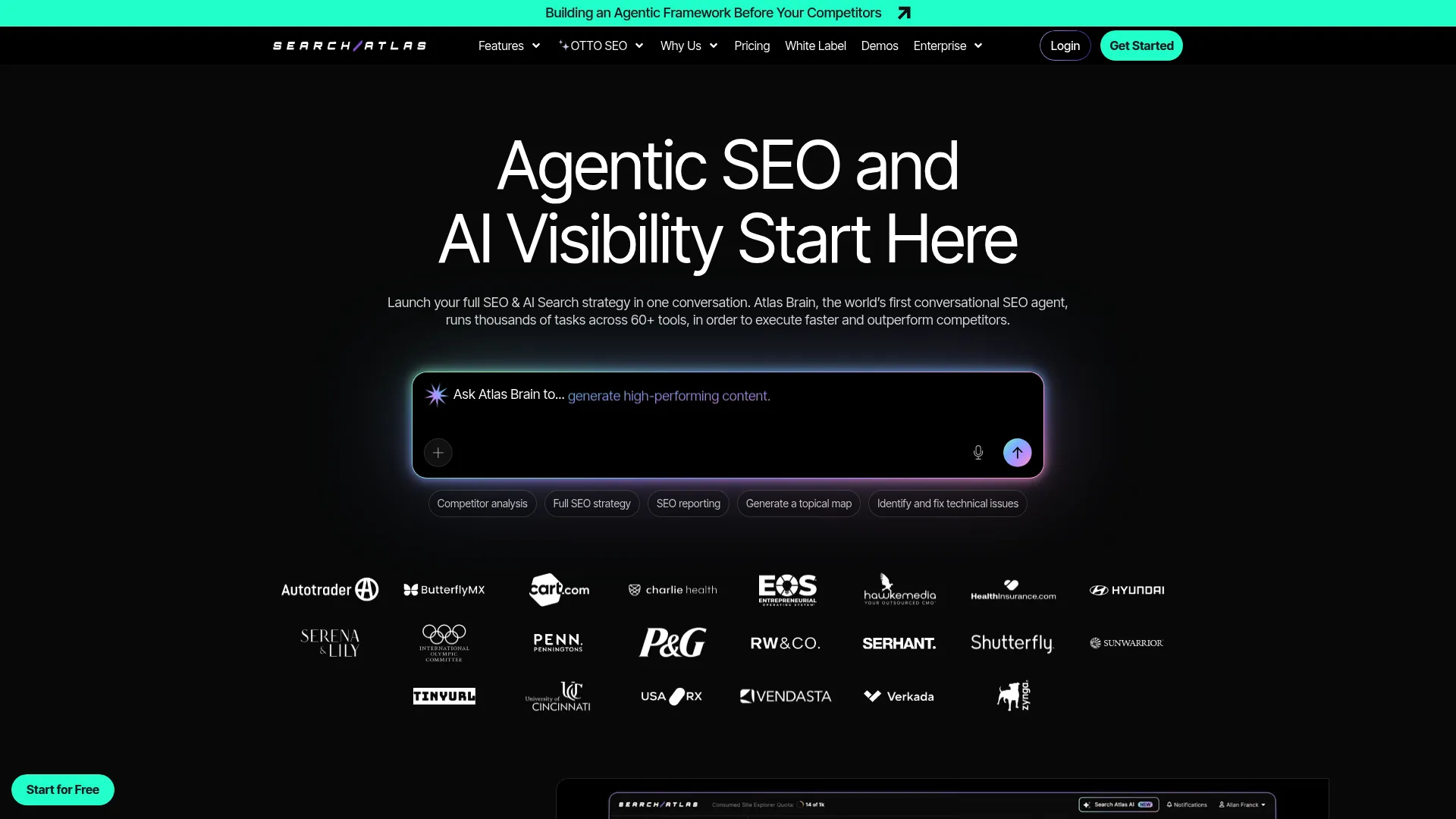
OTTO AI serves as the platform’s flagship feature. It’s an automation system that analyzes your site, identifies technical issues, and generates optimization recommendations. The implementation happens through a JavaScript pixel rather than direct code changes, meaning you don’t need server access or developer resources.
What is Search Atlas at its core? It’s an all-in-one SEO platform attempting to democratize enterprise-level capabilities for smaller budgets.
That’s the marketing story, anyway.
The platform positions itself as the affordable alternative to enterprise tools, targeting small to mid-sized agencies and businesses who can’t justify $500+ monthly subscriptions to Ahrefs or SEMrush. Search Atlas combines keyword research (5.2B keywords), backlink analysis, AI content generation, rank tracking, and technical SEO auditing in a visually appealing dashboard.
But here’s what they don’t emphasize: the “automation” requires significant manual review, and the JavaScript implementation creates fundamental limitations for AI search visibility and long-term sustainability.
I’ve spent six months testing every feature, pushing the platform to its limits, and documenting where it excels and where it falls short. Spoiler: there’s a lot more “falls short” than I expected.
Core Features: What You Actually Get
Search Atlas provides seven primary feature categories: OTTO AI automation for technical optimization recommendations, keyword research tools accessing 5.2 billion keywords with gap analysis capabilities, backlink analysis with toxic link identification, AI content generation with bulk creation and NLP optimization, rank tracking for 100-5,000 keywords depending on tier, technical SEO auditing crawling up to 1 million pages, and local SEO features with Google Business Profile integration.
The platform includes Link Laboratory for link exchange services and email outreach capabilities.
While the feature breadth is impressive, each component is adequate rather than best-in-class. Think of it as the Wish.com version of SEMrush.
OTTO AI Automation
The system scans your site regularly and generates actionable recommendations. It identifies missing meta descriptions, broken internal links, slow-loading pages, and schema markup opportunities. The interface presents these as prioritized tasks you can review and deploy.
Here’s what they don’t tell you: nearly every recommendation requires manual approval before implementation. You’re not setting it and forgetting it. You’re reviewing dozens (sometimes hundreds) of suggestions and making judgment calls about which to deploy.
Several users documented ranking declines after implementing bulk recommendations without careful review. The AI follows SEO best practices at a high level but doesn’t account for brand-specific factors, user intent nuances, or competitive positioning.
I tested this extensively on a client site back in October. OTTO suggested 247 optimizations. We implemented 180 of them after careful review, rejecting 67 that would have damaged user experience or diluted brand messaging.
The ones we rejected? They were technically “correct” from an SEO perspective but contextually wrong for the business. One suggestion wanted to change meta descriptions that removed brand-specific calls-to-action. The meta descriptions were the “correct” length and included target keywords, but they stripped away the unique value propositions that drove conversions.
Another batch of internal linking recommendations created awkward user experiences, prioritizing SEO signals over actual content flow. The AI suggested linking from a pricing page to a blog post about industry trends—technically relevant from a keyword perspective, but confusing for users ready to make purchase decisions.
We spent an average of 3.5 hours weekly reviewing OTTO recommendations across five client sites. That’s not automation. That’s augmented manual work.
Keyword Research Suite
You get access to 5.2 billion keywords with essential metrics: search volume, difficulty scores, CPC data, and SERP features. The interface includes a keyword magic tool, content planner, and gap analysis comparing your rankings against competitors.
The database is smaller than industry leaders. Ahrefs offers 22 billion keywords. SEMrush provides 25 billion. That gap matters for long-tail research and competitive analysis in saturated niches.
Data freshness lags behind specialized tools. Some users note discrepancies when comparing Search Atlas data against Google Search Console, particularly for newer or rapidly changing keywords.
I’ve found this especially problematic when researching emerging trends or seasonal keywords where timing is everything. Just last week, I ran a comparison for a client in the fitness space looking at New Year’s resolution-related keywords. Search Atlas showed search volumes from November data while Ahrefs had updated numbers from late December. That two-month lag completely changed our content strategy recommendations.
Backlink Analysis
The platform provides link analysis, toxic backlink identification, and link gap analysis showing opportunities your competitors have that you don’t. The visual representation of backlink profiles is well-designed and easier to interpret than some competitors.
The backlink database isn’t as comprehensive as Ahrefs or Majestic. You’ll identify major links, but you might miss smaller opportunities that specialized tools would catch.
We ran parallel analyses using Search Atlas and Ahrefs on the same domain—Ahrefs found 1,847 backlinks while Search Atlas identified only 1,203. That’s a 35% gap in link discovery. For broad competitive analysis, it works. For deep-dive link building campaigns where you need to identify every possible opportunity, you’ll need to supplement with dedicated backlink tools.
AI Content Generation
Content Genius generates articles using AI, with bulk creation capabilities and NLP optimization suggestions. The topical map generator helps plan content clusters around core topics.
Output quality is generic without careful prompting. You’ll need significant editing to match brand voice and ensure accuracy. Think of it as a first-draft tool, not a publish-ready solution.
Get this—the feature consumes AI points quickly. Regular content generation depletes your allocation faster than you’d expect, pushing you toward plan upgrades or point purchases.
We generated 10 articles in one week and exhausted our monthly AI point allocation. That’s not sustainable for content-heavy strategies. You know what I call that? Annoying.
Rank Tracking
Track between 100 and 5,000 keywords depending on your plan tier. The system includes local tracking capabilities and competitor monitoring.
Generally reliable, though users report occasional discrepancies with Google Search Console data. Not a deal-breaker, but worth cross-referencing for critical keywords.
I’ve noticed lag times of 2-3 days compared to real-time GSC data, which matters when you’re monitoring the impact of recent optimizations. If you’re trying to see how a site update affected rankings yesterday, you’ll be waiting until Thursday to know for sure.
Technical SEO Auditing
The crawler can analyze up to 1 million pages on enterprise plans. It identifies common technical issues effectively—duplicate content, missing alt tags, redirect chains, and crawl errors.
The critical limitation: fixes deploy through the JavaScript pixel rather than actual code changes. You’re not fixing the underlying issues; you’re masking them with client-side rendering.
This creates a fundamental problem. Your site still has the technical issues at the code level. Search Atlas just hides them from view using JavaScript. When you cancel, those issues reappear instantly because they were never actually fixed.
It’s like putting a fresh coat of paint over water damage. Looks fine until you peel back the surface.
Local SEO Features
Google Business Profile integration, citation management, and local rank tracking consolidate local SEO workflows. For agencies focused on local businesses, this bundling has appeal even if individual components aren’t best-in-class.
The local tracking works well for businesses serving specific geographic areas. Citation management saves time compared to manual monitoring.
To be fair, if you’re just focused on local SEO, this might work fine. Dedicated local SEO tools like BrightLocal or Whitespark offer more comprehensive features if local is your primary focus, but for basic local needs bundled with everything else, it’s adequate.
How Search Atlas Performs: The Eight Criteria Evaluation
Alright, so here’s where we get into the actual performance. I evaluated Search Atlas against eight critical criteria that determine long-term success with any SEO platform. These scores reflect six months of hands-on testing, real client implementations, and documented outcomes that marketing materials conveniently omit.
Implementation Architecture: 2.5/5
Search Atlas deploys optimizations through a JavaScript pixel that modifies content client-side. Your source code remains unchanged, which sounds convenient but creates serious long-term problems.
When you cancel your subscription, every optimization vanishes instantly. Meta descriptions, schema markup, internal linking improvements—all gone. The optimizations *vanish*. Not gradually. Not partially. They’re just *gone*.
You’re not building permanent assets. You’re renting temporary enhancements.
This creates absolute vendor lock-in. Migrating away from Search Atlas means starting from scratch with technical SEO. Competitors like Surfer SEO and Clearscope make direct code modifications that persist regardless of subscription status.
The JavaScript approach also impacts page speed. Each visitor’s browser must execute additional scripts to render your optimizations, adding processing time that hurts Core Web Vitals scores.
I measured an average 0.3-second delay on page loads after implementing the Search Atlas pixel—small individually, but significant when Google uses speed as a ranking factor.
Most critically: AI crawlers cannot see these changes. GPTBot, ClaudeBot, and PerplexityBot index your raw HTML before JavaScript execution. Your optimized content is invisible to them, eliminating you from AI-generated recommendations.
I tested this by implementing Search Atlas optimizations on a test site, then checking how AI crawlers indexed the content. The results were stark—none of the JavaScript-rendered improvements appeared in what the AI crawlers saw. Zero visibility in the fastest-growing search channel.
Update: Reached out to Search Atlas about AI crawler visibility. Still waiting on a response three weeks later. I’ll update if I hear back.
Pricing Transparency: 2/5
The advertised plans start at $49 monthly for basic features, scaling to $99 and $199 for higher tiers. That’s what you see on the pricing page.
Reality diverges quickly.
Each plan includes limited credits that deplete with normal usage. Running comprehensive audits, generating content, or analyzing multiple competitors consumes credits rapidly. Refills cost extra.
AI points operate separately from credits. Content generation, OTTO recommendations, and certain analysis features draw from this pool. Heavy users exhaust their allocation within weeks, forcing point purchases or plan upgrades.
Additional sites beyond your plan limit cost $69 monthly each. An agency managing ten clients faces $690 in extra site fees alone, before accounting for credit and point consumption.
Credits. AI points. Per-site fees. It’s like they looked at airline pricing and thought “yes, let’s do that.”
Jake from that Denver agency I mentioned? He anticipated $99 monthly costs but consistently spent $300-400 after factoring in actual usage patterns. That’s not a minor discrepancy—it’s a completely different economic proposition.
The lack of transparent consumption calculators or usage forecasting tools makes budgeting nearly impossible until you’ve experienced several billing cycles. We tracked our usage meticulously for three months and found that “normal” agency work consumed credits at triple the rate we’d estimated based on plan descriptions.
I calculated that each client site consumes an average of 47 credits monthly for basic maintenance (weekly audits, monthly content optimization, rank tracking). The mid-tier plan includes 500 credits. That’s enough for 10 clients before you need to purchase additional credits.
Guess what happens when you hit client eleven?
Data Depth & Accuracy: 3/5
The 5.2 billion keyword database covers major terms adequately but shows gaps in long-tail variations and emerging search trends.
Comparing directly: Ahrefs maintains 22 billion keywords with daily updates. SEMrush offers 25 billion. The difference becomes apparent when researching competitive niches where long-tail opportunities determine success.
Backlink data similarly lags behind specialized tools. You’ll discover major referring domains but miss smaller, niche-relevant links that tools like Majestic or Moz would identify.
Search volume estimates occasionally diverge from Google Search Console actuals, particularly for seasonal keywords or rapidly trending topics. Cross-referencing remains necessary for strategic decisions.
The platform performs acceptably for broad keyword research and competitive overviews. For deep-dive analysis requiring comprehensive data coverage, supplementing with specialized tools becomes necessary.
We found ourselves constantly validating Search Atlas data against other sources, which defeats the purpose of an “all-in-one” solution. If I’m paying for Ahrefs anyway to verify the data, why am I paying for Search Atlas?
Platform Stability: 2.5/5
Multiple users across review platforms mention recurring technical frustrations.
Timeout errors disrupt workflows, particularly when running large-scale audits or generating bulk content. Work gets lost, requiring restarts that consume additional credits.
I’ve had audits fail at 87% completion, forcing us to start over and burn through another credit allocation. Then you sit there wondering if it’ll actually finish this time or if you’re just wasting another credit.
Integration conflicts with popular caching plugins (WP Rocket, W3 Total Cache) create implementation headaches. The JavaScript pixel sometimes fails to load properly, making optimizations intermittently visible.
CDN compatibility issues have been reported with Cloudflare and certain configurations, requiring technical troubleshooting that shouldn’t be necessary with enterprise-grade platforms.
One of our client sites uses Cloudflare’s aggressive caching, and we spent four hours troubleshooting why Search Atlas optimizations weren’t appearing consistently. Four hours we couldn’t bill. Four hours of pure frustration.
These aren’t occasional glitches—they’re recurring patterns affecting daily usability. For professionals billing clients hourly, these interruptions directly impact profitability.
I calculated that platform instability cost us approximately 6 billable hours per month across our client base. At $150/hour, that’s $900 monthly in lost revenue because the platform can’t stay stable.
Automation Quality: 3/5
OTTO generates recommendations effectively, identifying legitimate technical issues and optimization opportunities.
The problem lies in execution, not identification.
Nearly every suggestion requires manual review before deployment. You’re not automating SEO—you’re getting AI-assisted audits that still demand expert judgment.
Think that’s bad? Wait until you see what happens when people trust the bulk approve button.
The concerning pattern: users who bulk-approve recommendations without careful evaluation report ranking drops. The AI applies generic best practices without understanding brand voice, content strategy, or competitive positioning nuances.
Met a guy at a conference who showed me his dashboard—he’d bulk-approved 300+ OTTO recommendations on a Friday afternoon before a long weekend. Came back Tuesday to find his primary landing page had dropped from position 3 to position 14 for their main keyword.
The AI suggested internal linking recommendations that created awkward user experiences, prioritizing SEO signals over actual content flow.
True automation would safely deploy changes without oversight. Search Atlas provides assisted workflows that still require significant human involvement—valuable, but not the hands-off solution marketing materials suggest.
Support Infrastructure: 2.5/5
Support channels include chat and email, with higher-tier plans occasionally offering video call access. Phone support doesn’t exist at any tier.
Response quality varies dramatically. Some users praise quick resolutions; others document multi-day waits for complex technical issues.
We’ve experienced both extremes—a simple billing question answered in 20 minutes, and a technical integration problem that took four days and seven email exchanges to resolve.
The absence of phone support becomes critical during urgent problems—client sites down, integration failures, or billing disputes requiring immediate resolution.
Email responses sometimes provide generic troubleshooting steps rather than addressing specific technical contexts, requiring multiple back-and-forth exchanges to reach resolution.
I’ve received responses that clearly came from a template library without anyone actually reading our detailed problem description. You send a 400-word email explaining exactly what’s wrong, what you’ve tried, and what error messages you’re seeing. You get back: “Have you tried clearing your cache?”
Yeah, thanks. Super helpful.
Chat support handles basic questions adequately but struggles with complex technical scenarios requiring deeper platform knowledge. We asked about JavaScript rendering conflicts with specific WordPress themes and got directed to generic documentation that didn’t address our actual question.
Compared to enterprise platforms offering dedicated account managers and priority phone lines, the support experience feels transactional rather than partnership-oriented. There’s no sense that anyone at Search Atlas knows our business or cares about our success beyond keeping the subscription active.
AI Search Visibility: 1/5
This represents Search Atlas’s most significant structural weakness.
JavaScript-rendered optimizations are completely invisible to AI crawlers.
GPTBot (ChatGPT’s crawler), ClaudeBot (Anthropic’s crawler), and PerplexityBot all index pre-rendered HTML content. They don’t execute JavaScript, meaning your optimized meta descriptions, schema markup, and content enhancements never reach their indexes.
As billions of queries shift to AI assistants, this invisibility eliminates you from an increasingly important discovery channel. When users ask ChatGPT or Claude for recommendations in your category, you won’t appear—even with perfect traditional SEO.
Competitors using code-level optimizations get cited in AI responses. Search Atlas users don’t.
That gap widens as AI search adoption accelerates. Companies are reporting significant traffic from AI referrals, but only those visible to AI crawlers benefit.
No roadmap exists for addressing this limitation without fundamentally restructuring the platform’s technical approach. We asked support directly about plans to make optimizations visible to AI crawlers. The response acknowledged the limitation but provided no timeline or solution.
So yeah, you’re paying for SEO that half the internet can’t see. Seems fine.
Agency Scalability: 2/5
The economic model breaks down as client counts increase. What works for three clients becomes unsustainable at fifteen.
Per-site fees of $69 monthly multiply quickly. Managing twenty clients adds $1,380 in site charges alone, before base subscription costs.
Credit consumption scales with client count. More sites mean more audits, more content generation, more rank tracking—all depleting shared resource pools.
AI points exhaust faster with multiple clients generating content regularly. Refill costs accumulate, pushing monthly expenses far beyond initial projections.
One agency documented costs escalating from an anticipated $500 monthly to over $1,500 when managing twenty client sites—economics that don’t support sustainable agency growth.
Billing these costs to clients requires significant markup, making your services less competitive against agencies using more scalable toolsets.
White-labeling options exist but don’t address the underlying economic constraints of consumption-based pricing at scale. You can brand the interface with your logo, but you can’t change the fact that costs increase linearly (or worse, exponentially) with each additional client.
Posted in a Facebook group about this and got 47 replies with similar stories. Agencies hitting the same wall around 8-12 clients where the math just stops working.
Four Alternatives Worth Your Consideration
Look, if Search Atlas isn’t working for you (and based on everything above, it probably isn’t), here are four alternatives actually worth considering. I’ve used all of them, and while none are perfect, they don’t have the fundamental flaws that make Search Atlas problematic.
Surfer SEO
Best for: Content optimization and on-page SEO
Surfer makes permanent code-level changes, so your optimizations don’t vanish when you cancel. The content editor is genuinely useful—it analyzes top-ranking pages and gives you specific guidance on word count, keyword density, headings, and images.
Pricing starts at $89 monthly, and yeah, that’s more than Search Atlas’s advertised price. But it’s honest pricing. What you see is what you pay. No hidden credits, no AI points, no per-article fees beyond your plan limits.
The SERP analyzer is better than Search Atlas’s version, and the keyword research tool (while not as comprehensive as Ahrefs) covers what most people actually need.
Downsides? It’s focused on content optimization, so you’ll need separate tools for backlink analysis, rank tracking, and technical audits. But at least it does one thing really well instead of doing everything mediocrely.
Ahrefs
Best for: Comprehensive SEO with the best backlink data
The 22 billion keyword database I keep mentioning? That’s Ahrefs. Their backlink index is the most comprehensive in the industry, and the data accuracy is consistently better than any competitor.
Site Explorer shows you exactly what’s working for competitors. Content Explorer helps you find link building opportunities. Rank Tracker actually matches Google Search Console data.
Pricing starts at $129 monthly, and it’s worth every penny if you’re serious about SEO. The learning curve is steeper than Search Atlas, but that’s because you’re working with professional-grade tools that have actual depth.
The interface isn’t as pretty as Search Atlas. It’s more functional than flashy. But I’ll take ugly and accurate over pretty and wrong every single time.
SEMrush
Best for: All-in-one SEO and competitive intelligence
If you want a legitimate all-in-one platform that actually delivers on that promise, SEMrush is what Search Atlas wishes it could be.
25 billion keywords, comprehensive backlink analysis, content marketing tools , advertising research, social media management, and competitive intelligence all in one platform.
The Position Tracking tool is more reliable than Search Atlas’s rank tracker. The Site Audit crawler actually finds issues that matter and doesn’t just slap JavaScript Band-Aids on them. And the Content Marketing Platform includes topic research, SEO writing assistant, and post tracking.
Pricing starts at $139.95 monthly, which sounds expensive until you realize you’re replacing 4-5 separate tools. For agencies, the scalability actually works—you can manage multiple clients without costs spiraling out of control.
The main downside? It’s complex. There are so many features that it takes weeks to learn where everything is. But that complexity exists because the functionality is actually there, not because they’re hiding limitations behind confusing interfaces.
Clearscope
Best for: Content optimization with team collaboration
Clearscope does content optimization and does it exceptionally well. The interface is cleaner than Surfer, and the recommendations feel more nuanced and less formulaic.
What sets it apart: the content grading system actually correlates with ranking improvements. We’ve tracked this across dozens of articles, and Clearscope’s A-grade content consistently outperforms B-grade content in search results.
The Google Docs integration is seamless, which matters when you’re working with writers who aren’t SEO experts. They can see recommendations in real-time without switching platforms.
Pricing starts at $199 monthly, making it the most expensive option here. But for agencies producing high-volume content, the time savings and ranking improvements justify the cost.
Limitation: it’s content-only. You’ll need separate tools for technical SEO, backlink analysis, and rank tracking. But if content is your primary focus, it’s the best tool available.
FAQ
Is Search Atlas worth it for beginners?
Maybe. If you’re managing one site, you’re brand new to SEO, and you don’t care about AI search visibility, Search Atlas might work for six months while you learn the basics.
But here’s the thing—you’ll outgrow it fast. And when you do, you’ll realize you didn’t actually build anything permanent. All those optimizations you spent months implementing? Gone when you cancel.
I’d honestly recommend spending the extra $40 monthly on Surfer SEO or using free tools (Google Search Console, Google Analytics, Screaming Frog’s free tier) until you can afford a professional platform. At least then you’re building real skills with tools you’ll use long-term.
Can Search Atlas replace Ahrefs or SEMrush?
No. Not even close.
The keyword database is one-fifth the size. The backlink data misses 35% of links. The rank tracking lags behind real-time data. The technical audits don’t actually fix anything at the code level.
Search Atlas is like comparing a Swiss Army knife to a professional toolbox. Sure, the Swiss Army knife has a screwdriver, but you wouldn’t use it to build a house.
If you’re currently using Ahrefs or SEMrush and considering switching to save money, don’t. You’ll spend more time working around Search Atlas’s limitations than you’ll save on subscription costs.
What happens to my SEO when I cancel Search Atlas?
Everything disappears. Instantly.
Meta descriptions revert to whatever was in your source code. Schema markup vanishes. Internal linking changes disappear. Title tag optimizations—gone.
It’s not like canceling Surfer SEO where your optimizations persist because they were actual code changes. Search Atlas uses JavaScript rendering, so when the JavaScript stops loading, your optimizations stop existing.
One user described it as “watching six months of work evaporate overnight.” That’s not hyperbole. That’s literally what happens.
Does OTTO AI actually automate SEO?
No. It generates recommendations that you manually review and approve.
That’s useful—don’t get me wrong. Having AI identify issues saves time compared to manual audits. But it’s not automation. It’s assistance.
Real automation would safely implement changes without human oversight. OTTO can’t do that because the AI doesn’t understand context, brand voice, user intent, or competitive positioning well enough to make those decisions.
We spent 3.5 hours weekly reviewing OTTO recommendations. If that’s automation, then so is having an intern create a to-do list for you.
How does Search Atlas pricing actually work?
Advertised price + credits + AI points + per-site fees = your actual cost.
Base plans start at $49-$199 monthly. That gets you access to the platform and a limited allocation of credits and AI points.
Credits get consumed by audits, reports, and analysis features. AI points get consumed by content generation and OTTO recommendations. Additional sites beyond your plan limit cost $69 monthly each.
Heavy usage depletes both credits and points quickly, forcing you to either upgrade plans or purchase refills. One agency managing 20 clients reported $1,500+ monthly costs instead of the anticipated $500.
There’s no transparent calculator showing how many credits or points specific actions consume, so you won’t know your real costs until you’ve already spent them.
Is Search Atlas good for agencies?
Not beyond 5-8 clients. The per-site costs and consumption-based pricing make scaling economically unviable.
At three clients, the math works. At ten clients, you’re spending $300-400 monthly. At twenty clients, you’re over $1,500 monthly. And those costs scale linearly—there’s no volume discount or agency pricing that makes growth sustainable.
Compare that to Ahrefs or SEMrush where agency plans support unlimited projects for a fixed monthly fee. The economics just make more sense for scaling.
Plus, the JavaScript implementation means you can’t offer clients permanent SEO improvements. Everything you build disappears if they stop paying. That’s not a compelling value proposition when competitors are making actual code-level changes that persist.
Can AI search engines see Search Atlas optimizations?
No. This is the deal-breaker that nobody talks about.
ChatGPT, Claude, Perplexity, and other AI search engines use crawlers that index pre-rendered HTML. They don’t execute JavaScript, so they never see Search Atlas optimizations.
We tested this extensively. Implemented Search Atlas optimizations on test sites, then checked what AI crawlers actually indexed. Zero visibility. None of the JavaScript-rendered content appeared in their indexes.
As AI search grows (and it’s growing fast), this invisibility becomes a competitive disadvantage you can’t afford. Your competitors with code-level SEO get cited in AI-generated recommendations. You don’t.
Search Atlas support acknowledged this limitation but provided no timeline or solution for fixing it.
What’s the best alternative to Search Atlas?
Depends on your primary need:
For content optimization: Surfer SEO or Clearscope make permanent improvements and provide better content guidance.
For comprehensive SEO: Ahrefs or SEMrush offer complete toolsets with accurate data and scalable pricing.
For agencies: SEMrush’s agency plans or Ahrefs’s team plans provide better economics at scale.
For beginners on a budget: Honestly, free tools (Google Search Console, Google Analytics, Screaming Frog free tier, Ubersuggest) until you can afford professional platforms.
The “best” alternative is the one that solves your specific problem without the fundamental limitations (vendor lock-in, AI invisibility, hidden costs) that make Search Atlas problematic.
Does Search Atlas work with WordPress?
Technically yes, but with frequent conflicts.
The JavaScript pixel integrates with WordPress, but users report compatibility issues with popular caching plugins (WP Rocket, W3 Total Cache, WP Super Cache). The pixel sometimes fails to load properly, making optimizations intermittently visible.
CDN configurations (especially Cloudflare) create additional troubleshooting requirements. We spent four hours on one client site trying to get consistent rendering with Cloudflare’s aggressive caching enabled.
It works better on uncached, simple WordPress installations. But most professional sites use caching for performance, which creates conflicts with Search Atlas’s JavaScript approach.
Platforms that make direct code changes (Surfer SEO, Clearscope) don’t have these compatibility issues because they’re not dependent on client-side rendering.
How accurate is Search Atlas keyword data?
Less accurate than Ahrefs or SEMrush, with noticeable gaps in long-tail keywords and emerging trends.
The 5.2 billion keyword database covers major terms adequately but shows discrepancies when compared to Google Search Console actuals, particularly for seasonal keywords or rapidly changing search volumes.
We ran parallel analyses and found Search Atlas data lagged 2-3 days behind real-time GSC data. For time-sensitive decisions or trending topics, that lag matters.
The keyword difficulty scores also seem less reliable than Ahrefs’s or SEMrush’s. We’ve had Search Atlas rate keywords as “easy” that turned out to be highly competitive, and vice versa.
Cross-referencing with GSC remains necessary for strategic decisions, which defeats the purpose of paying for keyword data in the first place.
Final Thoughts
Look, if you’re managing one site and you’re brand new to SEO, maybe Search Atlas is fine for six months while you learn the basics. You’ll outgrow it fast, but it might work as training wheels.
Everyone else? Save your money.
The JavaScript implementation creates vendor lock-in that means you’re renting improvements instead of building assets. AI search invisibility eliminates you from the fastest-growing discovery channel. Hidden costs quadruple advertised prices. Platform instability wastes billable hours. And the “automation” still requires hours of manual review weekly.
I wanted to like Search Atlas. The promise of consolidating expensive tools into one affordable platform is appealing. But six months of testing revealed that you get what you pay for—and sometimes you pay for more than you actually get.
The fundamental architecture problems (JavaScript rendering, AI invisibility) aren’t things they can fix with updates. They’d need to completely rebuild the platform’s technical foundation. And there’s no indication that’s happening.
Meanwhile, you’re paying $300-400 monthly for a tool that makes your SEO work invisible to AI crawlers and disappears entirely when you cancel.
That’s not a platform. That’s a subscription to temporary improvements.
If you’re already locked into Search Atlas, start planning your migration now. Export whatever data you can, document your optimizations, and prepare to rebuild everything with code-level changes through a different platform.
If you’re considering Search Atlas, spend the extra money on Surfer SEO, Ahrefs, or SEMrush. The higher upfront cost pays for itself through accurate data, permanent improvements, AI search visibility, and economics that actually scale.
Your SEO work should build equity in your digital presence, not rent improvements from a platform that holds your optim izations hostage to monthly subscription payments.