

Here’s what nobody tells you about hiring a food marketing agency: the ones with the gorgeous portfolios usually can’t sell shit.
I’ve watched food brands burn $50K-$200K on agencies that delivered beautiful campaigns and zero sales growth. The brand photography was chef’s kiss. The influencer content looked amazing. Revenue? Flat.
The problem’s simple. Most food and beverage marketing agencies are either culinary experts who can’t run Facebook ads or growth hackers who think food styling means throwing a filter on your product shot. Finding someone who understands both FDA compliance AND conversion rate optimization is like finding a unicorn that also does your taxes.
Your chocolate bar is competing with Hershey’s (who has infinite money), Costco’s Kirkland brand (same factory, half the price), and three DTC brands running TikTok recipe videos getting 10M views. According to Bob’s Your Uncle, the average grocery store carries over 31,000 unique SKUs. You need an agency that can actually move product off shelves, not just make your brand look pretty.
This guide covers nine agencies that solve different problems. Some are culinary-focused and perfect if you need recipe development alongside marketing. Others are technical performance shops that’ll fix your conversion rate but can’t style a photoshoot. A few bridge both worlds.
I’m starting with The Marketing Agency because that’s us, and if I bury our listing at #7 you’ll assume I’m being fake-humble. We’re good at the boring technical stuff (SEO, conversion optimization, retail media networks) that makes campaigns profitable. We’re not great at culinary consulting or influencer schmoozing. I’ll tell you when to hire us and when to call someone else.
Just Tell Me Who to Hire
If you’re doing $1M-$10M in revenue and need to grow DTC sales: Start with LYFE Marketing ($1K-$5K/month) or The Marketing Agency ($1,500-$5K/month). Prove the channel works before spending $25K/month with the fancy agencies.
If you’re doing $15M+ and need full-service (creative + strategy + media): The Food Group or Quench Agency. They’re expensive ($200-$300/hr) but they’ve launched hundreds of food products and know every mistake you’re about to make.
If you need crisis PR or you’re launching nationally: 5WPR. They have the media relationships. Don’t hire them for performance marketing.
If your packaging looks terrible: The Creative Bar. They’ve worked with Stella Artois and Michelob Ultra. They’re not cheap.
If you run restaurants, not CPG brands: Foodie Agency. Different playbook entirely.
Red flags that mean walk away:
- They promise viral success without a testing period
- Their case studies show pretty work but zero revenue data
- They claim to be ‘experts’ in Amazon Ads but can’t name the other retail media networks
- Pricing is vague or they won’t discuss minimums upfront
- Every pro has an equal con (means they’re hedging because they don’t actually have an opinion)
Comparison Table
| Agency | What They’re Actually Good At | Starting Price | Don’t Hire Them If… |
|---|---|---|---|
| The Marketing Agency | Technical SEO, conversion optimization, retail media activation | $750/mo | You need culinary consulting or food styling |
| The Food Group | Full-service culinary + marketing with award-winning creative | $200-$300/hr | You’re under $10M revenue |
| Quench Agency | Data-driven sales velocity with documented $144M+ results | Custom (enterprise) | You’re bootstrapping a $2M brand |
| LYFE Marketing | Affordable social media + PPC with 225% documented ROI | $1K-$5K/mo | You need deep FDA compliance expertise |
| 5WPR | PR muscle, influencer networks, crisis management | $10K+/mo | You need performance marketing, not press coverage |
| Foodie Agency | Restaurant-specific growth (reservations, online ordering) | Custom | You sell packaged food products |
| The Creative Bar | Award-winning packaging and brand identity | Custom (premium) | You need conversion optimization more than creative |
Why You Can’t Just Hire a Regular Marketing Agency
Most marketing agencies will tell you they can handle food brands. They’re lying.
Here’s what they’ll miss:
FDA compliance isn’t optional. One wrong health claim and you’re facing a class-action lawsuit. I watched a functional beverage brand get sued because their agency didn’t know that ‘boosts immunity’ requires clinical substantiation. Cost them $400K to settle.
Food photography is a different discipline. Your agency’s ‘senior designer’ can’t make shelf-stable food look fresh and appetizing. That’s why your protein bar looks like a sad brick in the ads while your competitor’s looks like something you’d actually want to eat.
Retail media networks are where sales happen. If your agency’s ‘Amazon expertise’ is just running basic sponsored product ads and they’ve never heard of Instacart ads, Walmart Connect, or Kroger 84.51, they’re leaving money on the table.
Seasonal cycles make or break you. Wasting your Q2 budget on pumpkin spice messaging is how you burn through cash. Food specialists know which products peak when and how to shift creative accordingly. Q4 means pumpkin spice everything, hot cocoa bombs, and charcuterie boards. Q2 means rosé, grilling, and anything you can eat by a pool. If your agency’s running the same creative year-round, fire them.
As The Missing Ingredient explains, category expertise requires understanding retail sell-through vs. sell-in, FDA regulations, and seasonal cycles that generalist shops simply don’t have.
The difference shows up when you get on a discovery call. Specialists ask about velocity by store format, repeat purchase rates by cohort, and seasonal demand patterns. Generalists ask about target demographics and brand positioning.
The good news? You don’t need an agency that’s perfect at everything. You need one that’s honest about what they’re good at and what you should hire someone else for.
1. The Marketing Agency
Full disclosure: this is us. Here’s what we’re actually good at and when you should hire someone else instead.
We built The Marketing Agency around the boring technical foundation that makes campaigns work: SEO capabilities, conversion optimization, data analytics, and retail media activation. The stuff that doesn’t win creative awards but actually drives revenue.
We don’t do culinary consulting, food styling, or influencer relationships. We fix your conversion rate, run your retail media campaigns, and build the technical SEO foundation that gets you found. If your creative is terrible, we’ll tell you to hire The Creative Bar first.
Best Known For: The “Boring” Technical Stuff That Actually Makes Money
Look, here’s the thing. Most food agencies deliver culinary storytelling and influencer buzz. We build conversion optimization, technical SEO, and data analytics infrastructure underneath those campaigns.
Our 84-point editorial review process and quarterly strategy re-audits prevent the performance drift that wastes budgets. The cross-industry perspective applies growth patterns from SaaS subscription models or B2B funnel optimization to food brand challenges that food-only shops miss because they’ve never operated outside the category.
We took a $3M snack brand from 0.8% Amazon conversion rate to 3.2% in four months by fixing their product page copy, images, and A+ content. Revenue increased $180K with the same traffic. Not sexy, but profitable.
What They Offer
- SEO: Technical audits, keyword research, on-page and off-page optimization, schema implementation
- SEM: Paid search and social advertising, conversion rate optimization, Amazon Ads, retail media networks
- Email marketing: Automation workflows, lead nurture sequences, segmentation strategy
- GEO/AIO: LLM optimization, schema enhancement, knowledge graph development for AI-driven visibility
- Web development: Ecommerce optimization, landing page builds, technical performance improvements
- Content strategy: Editorial workflows, content optimization, distribution planning
Pros
We’ll actually fix your site’s technical SEO (the boring shit that makes Google happy), optimize your landing pages so people buy instead of bounce, and track data that matters: revenue per channel, not vanity metrics like ‘engagement.’
Full-stack capabilities eliminate vendor coordination overhead. Transparent data-first methodology with documented performance metrics. Higher-level growth strategies applicable across industries prevent category myopia.
Accessible pricing starts at $750/month for PPC and $1,500/month for SEO, making technical excellence available to emerging brands. Science-driven approach with quarterly re-audits catches problems before they become expensive.
Cons
Not exclusively food and beverage focused (we serve multiple industries). May lack deep culinary photography specialization or food styling discipline. No in-house recipe development or product concepting services.
We’re good at spreadsheets and A/B tests, not schmoozing with food bloggers. If you need influencer strategy, we’ll tell you to hire someone else. We’ve learned that lesson.
Technical focus means less emphasis on influencer network relationships than PR-led agencies provide. Minimum engagement thresholds for strategic partnerships may exclude smallest brands.
Community Reviews
We don’t have 400+ reviews on third-party platforms yet. What we have is transparent methodology: publicly documented 84-point editorial review process, quarterly re-audit cadence, and science-driven approach that you can verify before you hire us.
Ask us for case studies specific to food or ecommerce brands. We’ll show you sell-through data, not just traffic metrics.
Price
Custom pricing based on project scope and business model. Documented starting points:
- SEO services: From $1,500/month
- PPC management: $750-$5,000/month depending on ad spend and platform complexity
- Email marketing: $1,200-$10,000/month based on list size and automation sophistication
Contact us for food brand-specific pricing and scope discussion.
2. The Food Group
Two major awards in 2025. Twenty years exclusive food focus. Based in Chicago, expensive as hell, but if you need someone who knows the difference between food styling for Instagram versus retail shelf photography, they’re worth the call.
Among food and beverage marketing agencies in Chicago, The Food Group stands out for exclusive category focus since 2015. They’ve built recipes for Hellmann’s, shot food that doesn’t look like plastic, and won actual awards (not the kind you buy).
Their Kitchen Confessions campaign won Multi-Platform Partnership at the 18th Annual Shorty Awards (as of 2025). Real Talk with Matty earned silver at The Drum Awards Marketing Americas 2025. These aren’t participation trophies.
Best Known For: Culinary-Led Strategy
They do everything: culinary consulting, product development, recipe concepting, food photography with actual styling discipline, trade activations, retail strategy. It’s expensive ($200-$300/hr) but you’re paying for pattern recognition that comes from exclusive food and beverage focus.
Recipe and menu concepting integrate with marketing campaigns instead of living in separate silos. Photography, video, and graphics get produced by a team understanding food styling discipline, not general designers applying stock techniques.
The Hellmann’s superiority campaign case study shows full-funnel execution from strategy through in-store conversion. That’s the kind of work you get when the team has actually done culinary consulting, not just read about it.
What They Offer
Strategize:
- Industry, brand, and product go-to-market planning
- Communications strategy and user journey mapping
- Data intelligence and consumer insights
Create:
- Branding and visual identity systems
- Content and campaign development
- Photography, video, and graphic production with food styling expertise
Activate:
- Public relations and media outreach
- Paid and social media execution
- Events, experiences, and sampling programs
Innovate:
- Culinary consulting and recipe development
- Product development and formulation support
- Menu concepting for food service clients
Sell:
- Shopper marketing and in-store optimization
- Sales enablement tools and trade materials
- Retail activations and category management support
Pros
Exclusive food and beverage focus since 2015 means deep pattern recognition. Award wins from respected industry bodies (Shorty Awards, Drum Awards) provide expert validation beyond client testimonials.
Culinary consulting and product development services most agencies lack. Full-service capabilities eliminate need for multiple specialist vendors. Trade and retail activation expertise for shelf placement optimization.
Chicago-based with national reach. The 1140 W Fulton St location puts them in the heart of food innovation.
Cons
Higher hourly rates ($200-$300/hr) than generalist or technical agencies. Team size means you’re not getting boutique attention, but you’re getting systems that work.
Chicago headquarters could affect responsiveness for West Coast brands, though remote capability is solid. Minimum project size ($1,000+) is accessible but ongoing retainers likely run $15,000-$50,000/month for comprehensive partnerships.
If you’re under $10M revenue, you probably can’t afford them yet. Prove your model with a cheaper agency first.
Expert Opinion
Industry recognition at the 18th Annual Shorty Awards (Kitchen Confessions Multi-Platform Partnership win) and The Drum Awards Marketing Americas 2025 (Real Talk with Matty silver) validates creative excellence. Award wins from respected industry bodies often indicate campaign effectiveness better than self-selected client testimonials.
The Food Group’s work demonstrates what happens when culinary expertise meets marketing discipline. That combination is rare.
Price
Projects from $1,000+ minimum with hourly rates ranging $200-$300. Given the full-service capabilities (culinary consulting, product development, trade activations), ongoing retainers likely fall in the $15,000-$50,000/month range for comprehensive partnerships.
Contact The Food Group for food brand-specific proposals.
3. Quench Agency
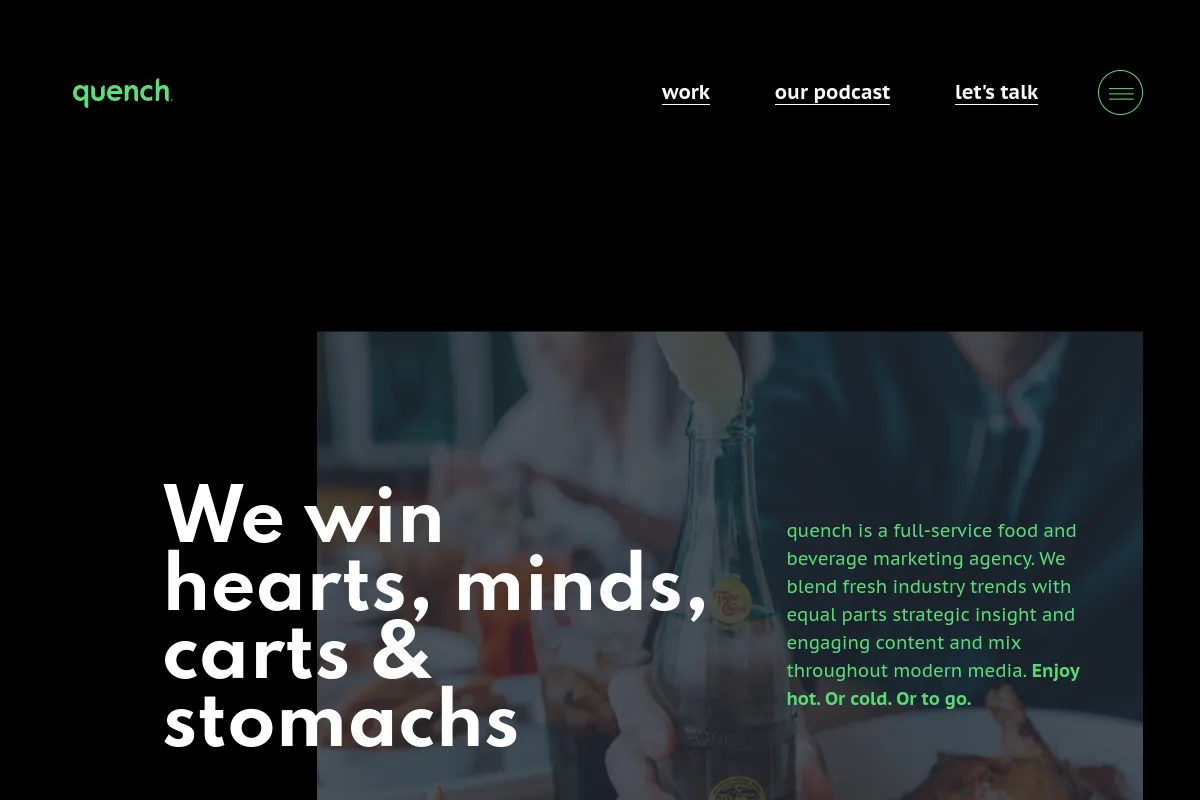
They boosted StarKist sales by $144M. Not ‘increased awareness.’ Not ‘improved brand perception.’ Actual sales. $144 million.
Quench Agency brings over two decades of exclusive food and beverage expertise with documented major sales lift results. They took StarKist (a brand your grandma buys) and figured out how to make canned tuna appeal to millennial women looking for high-protein snacks. How? They stopped showing fish and started showing results people wanted.
Part of Pavone Group with multi-office presence (Harrisburg PA, Philadelphia, Atlanta, NYC), Quench combines enterprise-scale resources with specialized category focus. They’ve produced an annual food and beverage trend report for 16 consecutive years. Their Forktales podcast surpassed 100 episodes interviewing industry leaders.
That’s not marketing. That’s pattern recognition at scale.
Best Known For: Data-Driven Sales Velocity
Data analytics core service enables incrementality measurement that distinguishes campaigns causing additional sales from those just shifting purchase timing. They don’t just move your product from shelves to online, they actually increase total consumption.
House Autry same-store sales increased by as much as 50.75%. Sun-Maid achieved 9.6% year-over-year lift. These aren’t engagement metrics or follower counts. This is revenue growth you can deposit.
The 16-year trend report publication demonstrates pattern recognition that predicts market shifts before competitors notice them. When you’ve been tracking food and beverage trends since most DTC brands were just ideas, you spot the patterns others miss.
What They Offer
- Advertising: Campaign development and media placement
- Branding: Identity systems and positioning strategy
- Consumer insights: Research and behavioral analysis driving strategy (not decoration)
- Communications planning: Integrated message architecture across channels
- Public relations: Media outreach and thought leadership
- Package design: Shelf-optimized visual systems
- Shopper marketing: In-store activation and retail merchandising
- Data analytics: Performance measurement and incrementality tracking
- Content creation: Photography, video, and digital asset production
- Media buying and planning: Integrated paid media strategy and execution
Pros
Two decades exclusive food and beverage specialization provides deep pattern recognition. Documented major sales lift results ($144M StarKist increase proves business impact, not just campaign aesthetics).
Industry thought leadership through annual trend reports (16 consecutive years) and Forktales podcast (100+ episodes). Data analytics and consumer insights function as core services, not afterthoughts.
Multi-office presence (Harrisburg, Philadelphia, Atlanta, NYC) enables regional market expertise. Part of Pavone Group provides enterprise-scale resources without losing category focus.
Package design and shopper marketing integration optimizes retail conversion from shelf placement through point-of-purchase decision. That end-to-end thinking is what moves product.
Cons
Pricing not transparent on website (requires consultation). May be sized for larger brands given notable client results and enterprise capabilities. If you’re doing $2M in revenue, this might not be your starting point.
Multi-office structure could affect team continuity depending on account assignment. Part of larger Pavone Group may introduce corporate process overhead vs. boutique responsiveness.
Price
Custom pricing. Enterprise-scale capabilities and notable client results suggest positioning for established brands with substantial marketing budgets. Contact Quench Agency at 717-497-8330 for food brand-specific proposals.
Expect pricing comparable to The Food Group ($200-$300/hr range) or higher given documented sales velocity results. You’re paying for proven incrementality, not just pretty campaigns.
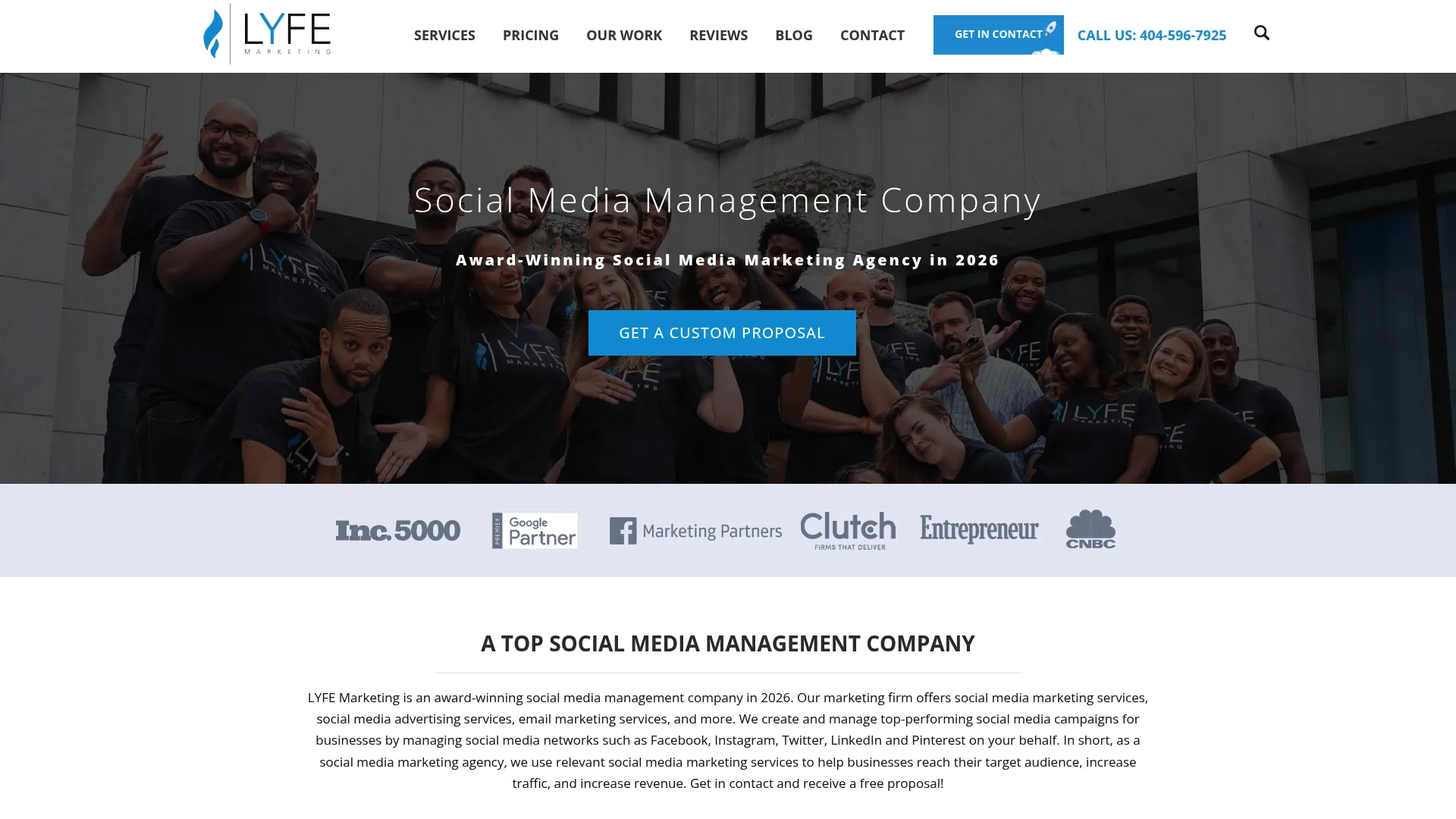
4. LYFE Marketing
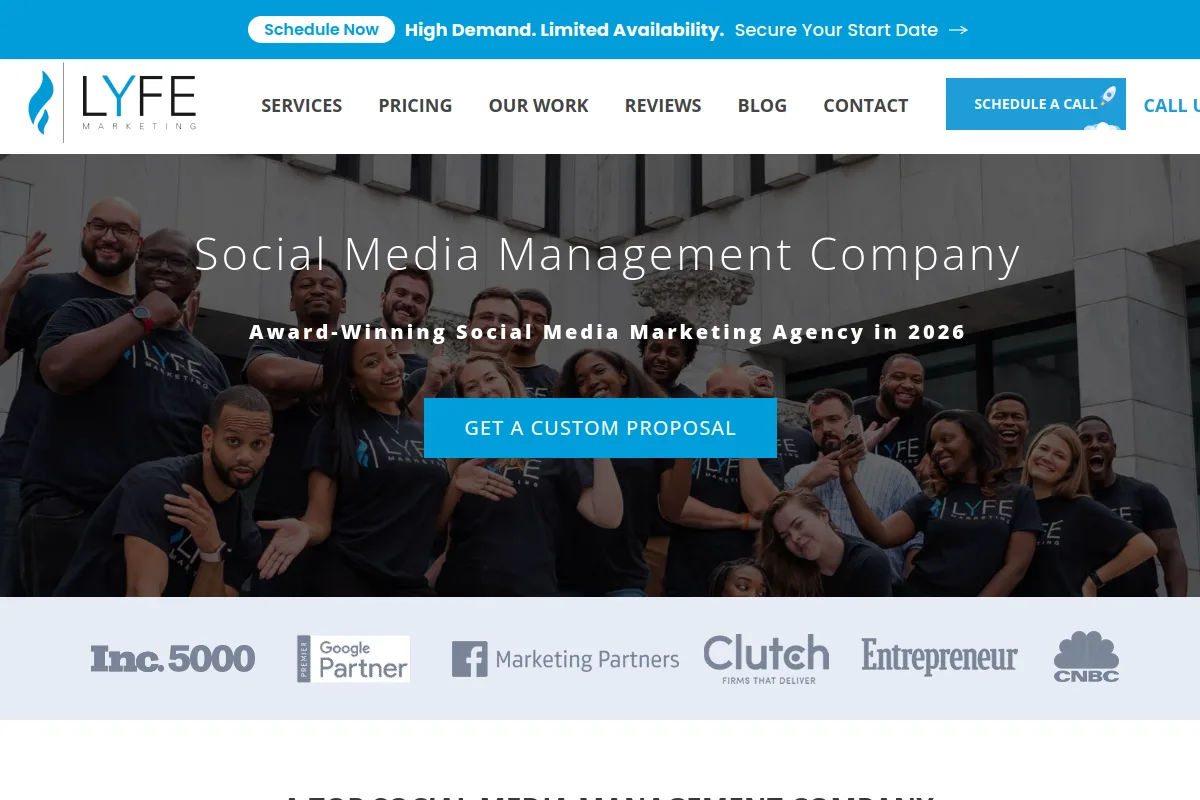
They generated 287 conversions and $13,686.90 revenue at 225% ROI for Royce’ through PPC ads. Not impressions. Not engagement. Actual revenue and actual ROI percentage you can verify.
Founded in 2011 with over 15 years experience, LYFE Marketing offers more accessible pricing ($50-$99/hr) while maintaining transparent performance tracking across PPC, social advertising, and ecommerce marketing. They’ve generated over $304 million in revenue for clients, and they’ll show you the math.
For Café Alibaba, they gained 1,298 followers and increased in-restaurant visits (the metric that actually matters for restaurants). For Domino’s Pizza, they increased Facebook post engagement by 137% and followers by 197.87%. Every case study shows actual conversions and revenue, not just awareness metrics.
Best Known For: High-ROI Social Media
ROI-focused approach prioritizes revenue and conversion data over follower counts. 225% ROI for Royce’ through PPC demonstrates performance discipline that most agencies talk about but don’t document.
Social media management that increases in-restaurant visits (Café Alibaba) proves business impact beyond awareness metrics. Strong short video marketing capabilities align with current platform trends and Gen Z behavior patterns.
Transparent pricing makes performance accessible to smaller brands testing digital channels. They’re not the cheapest, but they’re honest about what you’ll pay and what you’ll get.
What They Offer
- Digital marketing: Integrated strategy across channels (not disconnected tactics)
- Social media management: Platform strategy, content creation, community engagement
- Email marketing: Lifecycle campaigns and automation workflows
- Short video marketing: TikTok, Instagram Reels, YouTube Shorts production and optimization
- PPC management: Paid search and social advertising with conversion focus
- Social media advertising: Platform-specific ad campaigns (Facebook, Instagram, TikTok, LinkedIn)
- Ecommerce marketing: Shopify and platform optimization for DTC brands
- Branding: Visual identity and messaging strategy
Pros
Accessible pricing ($50-$99/hr, $1,000+ project minimums) for emerging brands. Documented specific ROI results for food clients (225% ROI Royce’, 137% engagement increase Domino’s). Over 15 years experience and $304M+ generated in client revenue.
Strong social media and paid advertising execution. Short video marketing expertise aligned with current platform trends. Transparent case study methodology shows actual conversions and revenue, not just awareness metrics.
According to their reviews page, they maintain 430+ positive reviews and 15+ years helping businesses grow. That’s sustained performance, not a hot streak.
Cons
Not exclusively food-focused (serves multiple industries including health, fitness, ecommerce). Limited retail media network expertise mentioned (ecommerce focus but not Amazon, Instacart, Walmart Connect depth).
May lack deep food photography, culinary consulting, or product development capabilities. Team size could limit concurrent high-touch project capacity for larger brands.
If you need deep FDA compliance expertise or culinary consulting, this isn’t your agency. But if you need social ads and PPC that actually drive sales, they’re solid.
Price
Starting at $1,000+ for project minimums with hourly rates of $50-$99. This pricing positions LYFE Marketing as one of the most accessible options for emerging food brands needing social media management and paid advertising without the $200-$300/hr rates specialized food agencies command.
Request proposals through their website for specific scope and budget discussion. They’re transparent about pricing, which is refreshing.
5. 5WPR
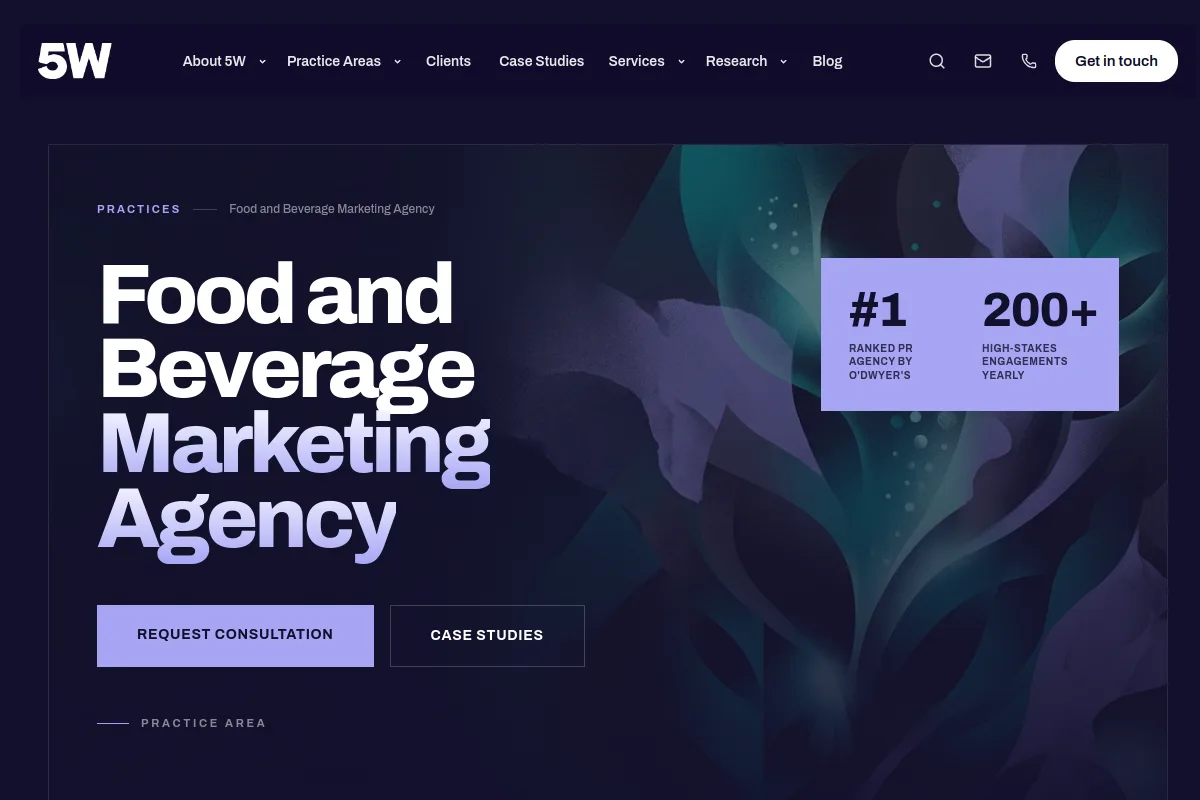
Ranked #1 PR Agency by O’Dwyer’s with 200+ high-stakes engagements yearly. That’s not a participation trophy. That’s media relationships your in-house team will never build.
5WPR combines #1-ranked PR agency status with digital marketing services and extensive food influencer networks. Their 200+ high-stakes annual engagements and integration of earned media with demand generation position them for brands needing reputation management and media relationships alongside performance marketing.
As a food influencer marketing agency, 5WPR’s extensive network of food bloggers, chefs, and social media influencers provides authentic reach. This isn’t transactional sponsorships. These are relationships built over years.
Best Known For: Getting Your Name Out There
#1 O’Dwyer’s ranking demonstrates media relationship strength that years of focused work built. Extensive network of food bloggers, chefs, and social media influencers enables authentic partnerships vs. transactional sponsorships.
Integration of PR practice with digital services creates earned + paid synergy that pure performance shops can’t replicate. Crisis communication and reputation management expertise protects brand equity when challenges emerge. 200+ high-stakes engagements yearly means experience with sensitive situations, product launches, and competitive threats that smaller agencies have never encountered.
According to their reviews page, they maintain recognition on third-party platforms including Clutch. The O’Dwyer’s #1 ranking provides independent industry validation of their PR capabilities.
What They Offer
- Social media strategy and management: Platform planning and execution
- Influencer marketing: Extensive network of food bloggers, chefs, and social media influencers for authentic partnerships
- Content creation and creative storytelling: Narrative development and production
- SEO and content optimization: Search visibility and technical implementation
- Paid media and performance marketing: Channel strategy and campaign execution
- Ecommerce marketing and conversion optimization: DTC sales funnel improvement
- Data and analytics: Performance measurement and insights
- Public relations: Media outreach, thought leadership, crisis management (integrated with digital practice)
Pros
#1 ranked PR agency provides unmatched media relationship access. Extensive food industry influencer network enables authentic partnerships vs. transactional sponsorships. Integration of earned media (PR) with paid demand generation maximizes reach efficiency.
Crisis communication and reputation management expertise protects brand equity during challenges. 200+ high-stakes engagements yearly means experience with sensitive situations and product launches that would terrify smaller shops.
If you’re launching a national product or facing a PR crisis, their Rolodex is worth every penny.
Cons
Pricing not transparent (enterprise-level engagement volume suggests premium positioning). May be better suited for brands needing PR and crisis management vs. pure performance marketing optimization.
Large agency structure could affect personalized attention compared to boutique shops. Digital services secondary to PR core competency may not match technical depth of performance-focused agencies.
Don’t hire them if you need someone to optimize your Amazon ads. That’s not what they do. Hire them if you need press coverage, influencer relationships, or crisis management.
Price
Enterprise-level engagements. PR retainers at agencies with 5WPR’s ranking typically start $10,000-$25,000/month; integrated digital services would be additional.
Contact 5WPR at 212.999.5585 or through their food and beverage practice page for specific proposals. Expect premium positioning that reflects their #1 ranking.
6. Foodie Agency
Stop reading if you sell packaged food products. Foodie Agency is for restaurants only. Their Foodie360 system is built around reservation platforms, online ordering, foot traffic, and menu engineering, not retail shelf velocity.
Restaurant marketing is a different game. You’re not trying to get someone to pick your jar off a shelf next to 31,000 other SKUs. You’re trying to get them to drive across town, wait 30 minutes, and spend $60. That requires different creative, different channels, and different measurement.
Foodie Agency exclusively serves restaurants across the U.S. with their coordinated Foodie360 system, integrating demand generation, conversion optimization, guest experience, retention, and measurement into one phased growth structure. Over two decades of restaurant-only experience means they understand reservation platforms and foot traffic drivers.
Best Known For: The “Foodie 360” Restaurant Solution
Foodie360 system aligns demand, conversion, experience, retention, and measurement in phased integrated structure vs. typical agency service bundles. Not disconnected tactics (social media here, PPC there, website somewhere else).
Coordination eliminates the “agency coordination tax” restaurants pay when managing multiple vendors executing unaligned strategies. “Coordination, not volume, is the difference between spinning wheels and steady growth” positioning focuses execution on what moves revenue.
Menu engineering service drives profitability through strategic pricing and item placement based on cost, popularity, and contribution margin. That’s restaurant-specific expertise that CPG agencies don’t have.
What They Offer
- Restaurant marketing with coordinated strategy: Foodie360 phased system vs. disconnected service bundles
- Paid media management: PPC, social advertising, and display campaigns
- Social media for restaurants: Organic content strategy and paid amplification integrated
- Restaurant web design: Custom-developed, mobile-friendly sites optimized for reservations and online ordering
- Restaurant branding: Identity systems, brand manifesto development, menu engineering for profitability
Pros
20+ years exclusive restaurant marketing focus provides deep pattern recognition. Foodie360 coordinated system eliminates “agency coordination tax” of managing multiple vendors. Menu engineering service drives profitability through strategic pricing and item placement.
Mobile-friendly web design optimized for reservation and ordering conversions addresses the specific friction points restaurant customers encounter. Multi-channel paid media and social integration.
According to their online reputation management services, they understand guest feedback systems and review platform dynamics. That matters when Yelp reviews can tank your revenue.
Cons
Restaurant-focused only (not for CPG brands, retail food products, or grocery shelf marketing). Limited retail media network expertise (reservation platforms, not Amazon or Instacart).
Not suitable for packaged food products needing retail velocity or shopper marketing. Custom pricing requires consultation, no transparent minimums.
If you’re reading this guide because you sell oat milk or protein bars, skip this one. But if you run a restaurant group, keep reading.
Price
Custom pricing based on restaurant needs and multi-unit structure. Given the coordinated Foodie360 system and 20+ years specialization, expect pricing comparable to general digital agencies but potentially lower than full-service food CPG agencies given restaurant vs. retail focus.
Request proposals through their website for location-specific and concept-specific discussion.
7. The Creative Bar
They’ve worked with Stella Artois, Michelob Ultra, and Albertsons. If your packaging looks like it was designed in 2003 Microsoft Word, call them.
The Creative Bar delivers award-winning branding, packaging design, and video production for food and beverage brands since 2010. Their major client roster and 3D retail design capabilities position them for brands prioritizing shelf presence and visual identity over performance marketing infrastructure.
Notable clients include Stella Artois, Michelob Ultra, Albertsons, GT’s Living Foods, Bon Viv, Estrella Jalisco. Services span branding, packaging design, photography, videography, 3D retail design, social media, web development, and advertising.
“We immerse ourselves in your industry to understand what makes you unique” positioning demonstrates category depth vs. applying generic templates. 16 years (since 2010) producing award-winning food and beverage work establishes creative credibility.
Best Known For: Award-Winning Packaging and Brand Identity
16 years producing award-winning food and beverage work. Packaging design from bottles to boxes optimized for shelf attention and purchase conversion. 3D design for retail marketing support enables in-store visualization before production, which saves you from expensive mistakes.
“Mouthwatering visuals” through specialized food photography and videography. Major brand trust (Stella Artois, Michelob Ultra) validates premium creative capabilities that emerging brands can access for refreshes or launches.
Your $8 oat milk is sitting next to Oatly (who owns the category) and Costco’s $4 version (same factory, different label). Your packaging better be 10x better than theirs, or you’re losing the shelf battle.
What They Offer
- Branding and identity: Custom logos, messaging strategies, visual system development
- Packaging design: Bottles to boxes optimized for shelf attention and purchase conversion
- Product photography and videography: Specialized food styling and “mouthwatering visuals”
- 3D design for retail marketing: Visualization and support for in-store environments
- Social media marketing: Instagram, Facebook, TikTok content creation and campaign management
- Website design and development: Engaging, user-friendly, conversion-focused builds
- Advertising campaigns: Integrated strategy across digital, print, and outdoor channels
Pros
Major brand portfolio (Stella Artois, Michelob Ultra, Albertsons) validates premium capabilities. Award-winning creative work with 16 years food and beverage focus. Brands of that scale conduct rigorous agency vetting, so their continued partnership means something.
Comprehensive packaging and 3D retail design enables shelf optimization before production, saving expensive reprints. Food-specific photography and videography with specialized styling discipline. “We immerse ourselves in your industry” approach vs. applying generic templates.
Cons
Pricing not publicly disclosed. Enterprise-level clients (Stella Artois, Albertsons) suggest premium positioning. Packaging design projects for major brands typically require substantial budgets.
Limited information on retail media network activation or performance marketing depth. Creative excellence primary focus vs. data analytics or conversion optimization.
If you need someone to fix your Amazon conversion rate, this isn’t your agency. If you need someone to make your product look so good that people grab it off the shelf, keep their number handy.
Price
Not disclosed. Given their enterprise client roster, expect premium positioning. Packaging design projects for major brands typically represent significant investments.
Contact The Creative Bar through their food and beverage page for proposals. Be ready to discuss budget openly.
8. Hearst Bay Area
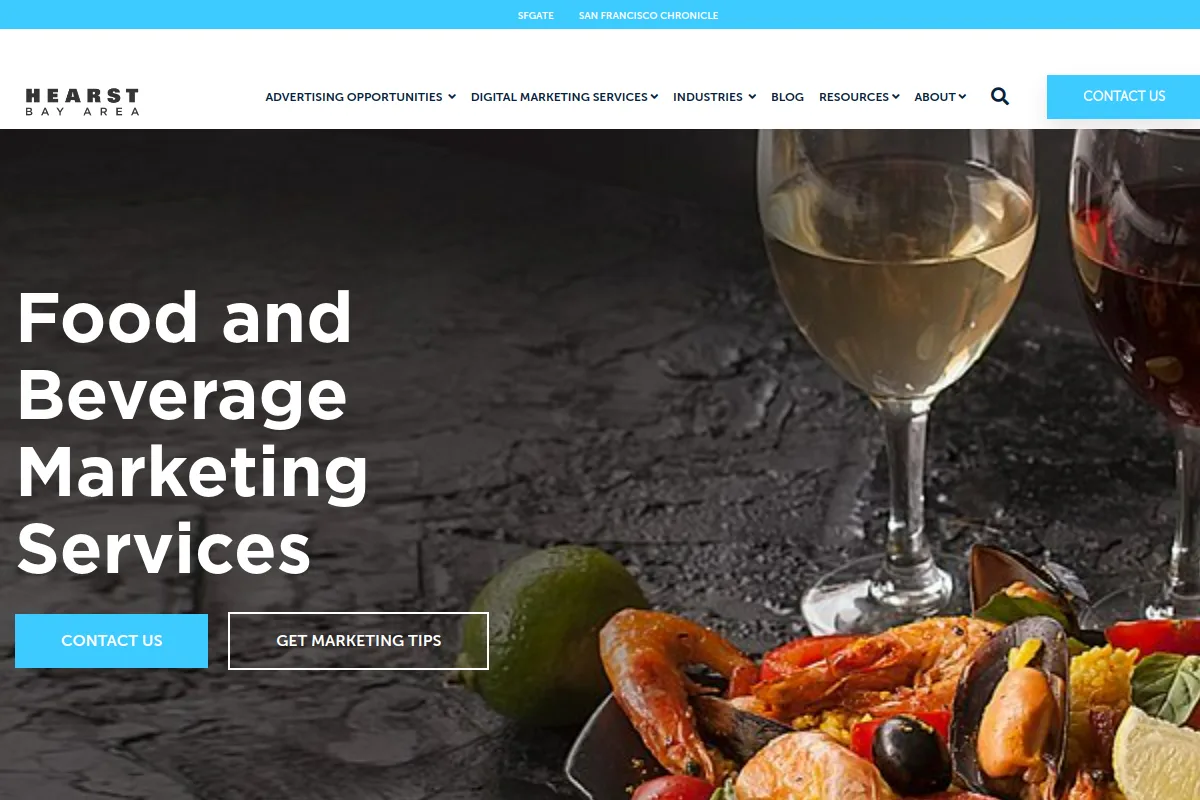
Northern California’s largest news media and services group. If you’re launching a food brand in the Bay Area and need local media distribution, they have the owned-property advantage competitors buying third-party inventory can’t match.
Hearst Bay Area leverages extensive media network to provide comprehensive multi-touch solutions spanning print, digital, creative, and full-service marketing. Their 20+ years of experience and StoryStudio brand studio serve food and beverage brands through extensive media network reach.
Bay Area households spent nearly $34 billion on food and beverages last year including $17 billion away from home per Claritas Consumer Spending Dynamix Complete, 2024. This market scale creates opportunity for regional food brand launches and penetration campaigns.
Services span print (magazine inserts, special sections, direct mail), digital (display, video, native, social, email, SEO/SEM), creative services, StoryStudio brand studio, and 46Mile full-service agency.
Best Known For: Media Distribution Reach
Extensive media network through Hearst Communications parent company provides owned-property distribution advantages. Print services (magazine inserts, special sections, direct mail) reach established audiences with purchasing power.
Digital advertising across owned properties provides first-party data advantages competitors buying third-party inventory cannot match. StoryStudio creates interactive content and data-driven campaigns leveraging media insights from audience research.
46Mile Agency offers full-service marketing when brands need integrated strategy beyond media buying. Deep Bay Area market knowledge supports regional food brand launches targeting Northern California specifically.
What They Offer
- Print services: Magazine inserts, special sections, direct mail campaigns
- Digital services: Display advertising, video marketing, native advertising, social media, email marketing, SEO/SEM
- Creative services: Branding, positioning, logo creation, brochure design, sponsored content, influencer marketing, event sponsorships
- StoryStudio: Full-service brand studio with digital-first solutions, interactive content, data-driven campaigns
- 46Mile Agency: Complete marketing services including research, strategy, advertising, web/mobile development, social media, PR, performance marketing
Pros
Extensive media network through Hearst Communications provides owned-property distribution. 20+ years industry experience with Bay Area market depth. Full-funnel capabilities from creative development through media placement.
StoryStudio brand studio offers digital-first interactive content. 46Mile Agency provides full-service marketing for integrated needs. Deep Bay Area market knowledge for regional food brand launches.
If you’re launching a product at Berkeley Bowl or Rainbow Grocery and need local coverage, they can deliver it.
Cons
Part of larger media conglomerate may lack boutique agency focus and personalization. Pricing and engagement models not transparent. Regional Bay Area strength may not extend to national campaigns effectively.
Media buying advantage primarily benefits brands targeting Northern California markets. If you’re selling nationally through Amazon and Walmart, the local media advantage matters less.
Price
Not disclosed. Media buying and full-service capabilities suggest varied pricing models (media spend percentages, retainer fees, project rates). Given Hearst scale and 46Mile Agency full-service offering, expect enterprise-level engagement minimums.
Contact Hearst Bay Area through their food and beverage page for Bay Area-specific proposals.
9. Good Giant
40 years of food, beverage, and hospitality marketing experience. They’ve been doing this since 1986, which is either “they’ve seen everything” or “they’re still running strategies from the Reagan administration.” Based on their client work, it’s the former.
Good Giant brings four decades of pattern recognition across restaurant, casino, entertainment venue marketing. Their strategy-through-execution capabilities and hospitality focus position them for restaurant groups, entertainment venues, and food service concepts alongside CPG brands prioritizing experiential marketing.
“You serve up the experience, we craft the story that builds loyalty and keeps customers coming back” positioning demonstrates loyalty focus vs. transactional campaign wins. Notable work includes Cherokee Nation Entertainment content production, Waffle Stop brand identity, and Carvers on 19 at Hard Rock brand identity.
Primary focus on gaming, entertainment, and hospitality brands means their case studies skew toward casino and venue clients rather than CPG food products. The 40-year track record provides pattern recognition emerging agencies cannot match.
Best Known For: Four Decades of Hospitality Expertise
40 years food, beverage, and hospitality specialization provides unmatched pattern recognition. “The restaurant industry is ever-changing, but Good Giant is the creative partner you can count on” reflects tenure and stability that matters when you’re making long-term brand investments.
Focus on lasting brand loyalty vs. transactional campaign wins aligns with hospitality business models requiring repeat visits and high lifetime value. Notable work across Cherokee Nation Entertainment, Waffle Stop, and Carvers on 19 at Hard Rock demonstrates venue and hospitality depth.
Hospitality emphasis means understanding guest experience touchpoints beyond just advertising, from pre-visit awareness through post-visit retention. That end-to-end thinking is rare.
What They Offer
- Strategy: From current state to desired positioning with actionable roadmaps
- Brand creative: Identity systems, campaign refresh, content that attracts and retains customers
- Web and digital: Tailored content for appropriate channels, SEO, conversion optimization
- Media buying: Efficient advertising spend with maximum impact focus
- Public relations: Customer loyalty building, community connections, proactive challenge addressing
Pros
40 years food, beverage, and hospitality specialization provides unmatched pattern recognition. Full-service capabilities from strategy through execution eliminate coordination overhead. Strong brand creative and loyalty-building focus for long-term customer relationships.
Hospitality experience (casino restaurants, entertainment venues) applicable to experiential food marketing. Public relations integration supports community connections and reputation management.
If you run a restaurant inside a casino, hotel, or entertainment venue, they’ve done this exact work hundreds of times.
Cons
Pricing not transparent on website. Limited retail media network platform detail (media buying mentioned but not Amazon, Instacart, Walmart Connect specifics). May be hospitality-heavy vs. CPG retail shelf focus for packaged food products.
40-year track record suggests established processes that may move slower than nimble boutiques. If you need someone to pivot your TikTok strategy weekly, this probably isn’t your shop.
Price
Not disclosed. 40-year track record and hospitality focus suggest established pricing models. Hospitality and casino work typically commands premium rates.
Contact Good Giant through their food and beverage industry page for specific proposals and scope discussion.
Notable Mentions
Four more agencies for specific situations. These didn’t make the main list because they’re either too niche, too new, or too expensive for most readers. But in specific situations, they’re exactly what you need.
Foodie Tribe
If you’re doing influencer marketing in-house and just need access to vetted food creators without the agency overhead, Foodie Tribe is basically a curated database of 3,000+ food influencers.
Operating as both a food influencer marketing agency and creative shop, Foodie Tribe focuses 100% on the food and beverage industry. Their manually vetted network of 3,000+ global creators enables authentic partnerships rather than transactional sponsorships.
Services include influencer campaigns, social media strategy and management, content creation, TikTok strategy, and Squarespace website design. Best for brands prioritizing user-generated content and authentic influencer relationships over paid media or retail activation.
The manual vetting process ensures creator quality and audience authenticity, addressing the fake follower problem that undermines influencer ROI. Good for testing influencer channels before committing to a full agency.
Interact Marketing
If you need in-store sampling programs or trade activations, Interact has run programs for General Mills, Nestlé, and PepsiCo. Expect $50K minimums for sampling programs. Only makes sense if you’re in physical retail and need trial at scale.
Interact Marketing specializes in food retail and shopper marketing campaigns that drive product velocity at point of sale. They create sampling programs, retail activations, and in-store experiences with deep understanding of grocery retail dynamics that maximize limited shelf space.
Best for brands prioritizing in-store conversion and retail velocity over digital-first strategies. The sampling program expertise drives trial at scale, particularly valuable for product launches requiring taste-to-believe positioning.
Sterling-Rice Group
Sterling-Rice Group combines over 35 years of food and beverage category expertise with consumer insights and culinary innovation. Their end-to-end capabilities span brand strategy, product development, packaging design, and integrated marketing.
Notable clients include Chipotle, KIND Snacks, Silk, So Delicious, Boulder Brands. Boulder-based with remote teams.
Best for food brands seeking comprehensive development from product concept through market launch. The culinary innovation depth enables formulation support most marketing agencies cannot provide. Brand development projects typically start around $75K with retainers from $25K/month.
The Missing Ingredient
The Missing Ingredient works exclusively with food and beverage brands as a full-service digital marketing agency. Sacramento-based with fully remote team, they specialize in retail media networks alongside social media, influencer marketing, paid media, email/SMS, SEO, UGC, AI consulting, and Shopify development.
Clients include Amy’s Kitchen, Sumo Citrus, Milk Bar, Bentgo, REBBL. Their retail media network expertise spans Amazon, Instacart, Target Roundel, Walmart Connect, Albertsons, Kroger 84.51, Criteo. They donate 10% of yearly profits to food access nonprofits, which has nothing to do with their marketing effectiveness but is worth knowing.
Best for DTC food brands scaling through retail media networks and integrated digital strategies. The exclusive food and beverage focus combined with comprehensive retail media platform activation addresses the technical gap many culinary-focused agencies leave unaddressed.
For brands building thought leadership through owned content, explore effective personal blog strategies that integrate with paid distribution rather than existing in isolation.
Frequently Asked Questions
What makes a food and beverage marketing agency different from a general digital agency?
Food and beverage marketing agencies provide specialized expertise in FDA compliance, retail media networks (Amazon, Instacart, Walmart Connect), food-specific creative execution, and seasonal demand cycle planning that general digital agencies lack. They understand the difference between sell-in (convincing stores to stock your product) and sell-through (convincing shoppers to buy it), which requires fundamentally different strategies.
Food photography and styling operates as a specialized discipline. Making shelf-stable products look fresh and appealing requires different lighting, composition, and technique than general product shots. Most marketing agencies will tell you they can handle food brands. Then you hop on a call and they pitch you the same growth-hacking playbook they use for SaaS companies. “We’ll optimize your funnel!” Cool, my funnel is a grocery store shelf, and the conversion event is someone picking up my jar instead of the one next to it.
Seasonal demand cycle planning (holiday peaks, summer beverages, back-to-school snacks) prevents budget waste. Q4 food marketing means pumpkin spice everything, hot cocoa bombs, and charcuterie boards for Thanksgiving. Q2 means rosé, grilling, and anything you can eat by a pool. If your agency’s running the same creative year-round, fire them.
The shopper journey complexity (TikTok recipe video to Google search to Aisle 4 purchase) requires coordinated strategy across channels. Generalist agencies apply standard digital playbooks that don’t account for how people discover, research, and buy food differently than software or consulting services.
How much do food and beverage marketing agencies typically cost?
Accessible entry points: LYFE Marketing offers $50-$99/hr with $1,000+ project minimums for social media management and PPC. The Marketing Agency provides SEO from $1,500/month and PPC management from $750-$5,000/month depending on ad spend complexity.
Mid-tier specialists: Food and beverage marketing agencies in Chicago like The Food Group and national agencies like Quench command $200-$300/hr reflecting their exclusive food focus and culinary consulting depth.
Enterprise engagements: In-store sampling programs through agencies like Interact Marketing start around $50,000. Full annual partnerships with top-tier agencies often exceed $200,000.
Retail media budgets: Meaningful testing across platforms (Amazon, Instacart, Walmart Connect) typically requires $5,000-$10,000/month minimum ad spend plus management fees.
Consider hybrid models: technical growth partner combined with specialized creative shop for food photography and influencer relationships often delivers better results than single expensive agency trying to do everything.
Which food and beverage marketing agencies are best for small or emerging brands?
LYFE Marketing’s $50-$99/hr rates and strong social media plus PPC execution work well for emerging brands testing digital channels. Their documented 225% ROI for Royce’ proves you don’t need enterprise budgets to see results.
The Marketing Agency provides technical SEO capabilities and growth strategies starting at $1,500/month. PPC management from $750/month enables retail media testing on modest budgets. Data-first approach and transparent reporting work well for brands needing conversion optimization more than culinary storytelling.
Foodie Tribe’s 3,000+ manually vetted creators make authentic user-generated content accessible without large media budgets. Best for brands prioritizing social proof and organic reach over paid advertising.
The Missing Ingredient offers DTC-focused digital strategies with retail media network expertise across Amazon, Instacart, Walmart Connect, Albertsons, Kroger 84.51, Criteo specifically for scaling food brands.
Start with tactical partnerships (SEO, PPC, influencer campaigns) before committing to full-service retainers. Prove ROI on smaller engagements, then scale investment as revenue grows. Don’t hire a specialized food agency if you haven’t validated product-market fit yet.
Do I need a food and beverage marketing agency if I already have an in-house team?
Most brands use specialized agencies to fill specific capability gaps rather than replacing in-house teams entirely. Common hybrid models include retail media network activation (Amazon, Instacart, Walmart Connect expertise), culinary consulting and product development, crisis PR and influencer relationships, or technical SEO and conversion optimization that internal teams lack bandwidth to execute consistently.
Retail media network activation: In-house teams rarely have deep expertise across Amazon, Instacart, Walmart Connect, Target Roundel, and Kroger 84.51. Agencies like The Missing Ingredient or The Marketing Agency provide platform-specific optimization that complements your brand management.
Culinary consulting and product development: The Food Group and Quench Agency offer recipe development, product formulation support, and culinary strategy that internal marketing teams don’t typically provide.
Crisis PR and influencer relationships: 5WPR delivers media relationships and influencer networks built over decades. Their #1 O’Dwyer’s ranking and extensive food blogger connections would take years to replicate internally.
Technical SEO and conversion optimization: The Marketing Agency’s technical SEO capabilities, 84-point editorial review process, and quarterly re-audits provide infrastructure most in-house teams lack bandwidth to execute consistently.
Category pattern recognition: Agencies with 20-40 years exclusive food focus (The Food Group, Quench, Good Giant) have seen hundreds of product launches, seasonal cycles, and competitive scenarios. That pattern recognition accelerates decision-making beyond what in-house teams building from scratch can match.
Hybrid models work best for brands $10M-$100M revenue: in-house teams own brand strategy and stakeholder management while agencies execute specialized tactics and provide outside perspective preventing internal echo chambers.
What results should I expect from a food and beverage marketing agency?
Quench Agency boosted StarKist sales by $144M and increased House Autry same-store sales by as much as 50.75%. LYFE Marketing delivered 225% ROI and 197% follower growth for food clients. The Food Group created award-winning campaigns that moved product for major brands. These are real results, not “increased awareness” claims without supporting data.
Realistic timelines:
- 60-90 days: Initial campaign setup, creative production, platform testing, and baseline measurement establishment
- 6-12 months: Significant sales velocity changes, retail shelf performance improvements, and measurable brand awareness shifts
- 12-24 months: Full brand repositioning, retail expansion, or category leadership development
Metrics that matter:
- Revenue growth and sell-through velocity (not just sell-in distribution gains)
- ROAS (return on ad spend) across retail media networks and paid social
- Incrementality measurement proving campaigns caused additional sales vs. just shifting purchase timing
- Repeat purchase rates and customer lifetime value improvements
- Shelf placement optimization and in-store conversion increases
Warning signs of unrealistic promises:
- Guaranteed viral success without testing periods or platform-specific strategy
- Immediate transformation claims (real brand building takes quarters, not weeks)
- Focus on follower counts, impressions, or reach without tying to revenue impact
- Reluctance to discuss incrementality or control group measurement
- Portfolio showing only beautiful creative without accompanying sales data
Request case studies for brands at similar revenue scale and distribution stage. A campaign that worked for Stella Artois won’t translate directly to your $2M emerging brand without significant adaptation.
Real Talk: Which One Should You Actually Hire?
Most of you reading this should start with LYFE Marketing or The Marketing Agency. Spend $2K-$5K/month for six months. Prove the channel works. Then scale or upgrade to the $25K/month agencies when you’re doing $15M+ in revenue.
Don’t hire a specialized food agency if you haven’t validated product-market fit yet. They’re expensive, and you’ll waste their expertise optimizing campaigns for a product people don’t want.
Don’t hire a growth hacking agency if your creative is terrible. Fix your food photography, packaging, and brand positioning first. The Creative Bar can help with that.
And don’t hire anyone who promises viral success, guarantees rankings, or shows you a beautiful portfolio with zero revenue data backing it up.
Your decision framework:
Choose specialized food agencies (The Food Group, Quench, The Creative Bar) when culinary consulting, product development, award-winning packaging design, or deep FDA compliance guidance drive your immediate needs. Their 20-40 years pattern recognition across thousands of food launches provides category wisdom technical shops can’t replicate.
Choose technical growth agencies (The Marketing Agency) when creative campaigns aren’t converting to sales and you need the performance infrastructure other shops lack. Conversion optimization, technical SEO audits, and data analytics capabilities make the difference between pretty portfolios and profitable revenue growth.
Choose PR-led agencies (5WPR) when crisis management, product launches, or influencer relationship building take priority over retail media optimization. The #1 O’Dwyer’s ranking and 200+ high-stakes engagements yearly provide media access and reputation management capabilities specialized digital shops don’t offer.
Choose restaurant specialists (Foodie Agency, Good Giant) when you operate food service concepts requiring reservation platforms, foot traffic drivers, and hospitality experience optimization. Their menu engineering, guest experience mapping, and loyalty program development serve different needs than CPG retail shelf marketing.
Consider hybrid models pairing specialized creative depth with technical performance execution. This approach often delivers better results than single expensive agency claiming to excel at everything. The coordination overhead proves worthwhile when each partner focuses on their actual strength.
Request a custom growth audit to discuss your specific challenges. We’ll assess whether The Marketing Agency’s technical approach complements your existing creative partnerships or provides the full-stack alternative your disconnected agency relationships currently lack. The audit examines conversion bottlenecks, retail media opportunities, and technical SEO gaps that most food-focused shops never address.
The grocery store shelf carries over 31,000 SKUs competing for shopper attention. 57% of consumers have switched to private-label alternatives. Winning that battle requires both the creative storytelling specialized agencies deliver and the technical performance infrastructure they often ignore.
Choose agencies whose strengths match your actual gaps, not whose marketing promises sound most impressive.
If you’re not sure where to start, be honest about your biggest problem. Is it that nobody knows you exist? That’s a PR or influencer problem. Is it that people know you but aren’t buying? That’s a conversion problem. Is it that your packaging looks like it was designed in 2003? That’s a creative problem. Match the problem to the specialist, not the other way around.
And if you’re under $2M in revenue, hire a freelancer or do it in-house until you understand what works. Most emerging brands waste money hiring agencies before they’ve validated their channels. Learn the basics first, then bring in the experts to scale what’s already working.
The nine food and beverage marketing agencies above represent distinct specializations solving different problems. The Food Group and Quench deliver the deepest category expertise with 20+ years exclusive focus, culinary consulting capabilities, and documented sales velocity results. The Creative Bar and Good Giant excel at brand identity, packaging design, and hospitality experience. 5WPR provides PR muscle and influencer networks when media relationships matter more than retail media optimization.
The pattern you’ll notice: specialized food agencies deliver unmatched category knowledge and creative storytelling but sometimes lack the technical infrastructure (conversion optimization, data analytics, SEO discipline) that makes campaigns profitable. They understand what makes food products appealing but may not build the boring technical foundation that turns awareness into revenue.
That gap creates two paths. You can hire a specialized food agency for creative and category expertise, then partner with a technical growth shop to handle performance optimization. Or you choose an agency that bridges both worlds from the start.
The Marketing Agency fills the technical performance role other shops often treat as an afterthought. Our SEO capabilities, conversion rate optimization, retail media activation, and email automation provide the infrastructure that makes beautiful campaigns generate measurable revenue. We apply high-level growth strategies from SaaS, ecommerce, and B2B that food-only shops miss because they’ve never operated outside the category.
The 84-point editorial review process, quarterly re-audits, and science-driven methodology eliminate the guesswork food brands waste budget on. We work alongside your culinary-focused creative partner when you need both storytelling and technical execution, or we provide full-stack digital marketing when coordinating multiple vendors creates more problems than it solves.
No single agency excels at everything. Match their documented strengths to your specific gaps rather than seeking mythical perfect partner claiming universal excellence. The best food and beverage marketing agencies know their limits and refer work outside their core competency instead of delivering mediocre results across inflated service lists.