
I still have nightmares about a board meeting from a few years ago.
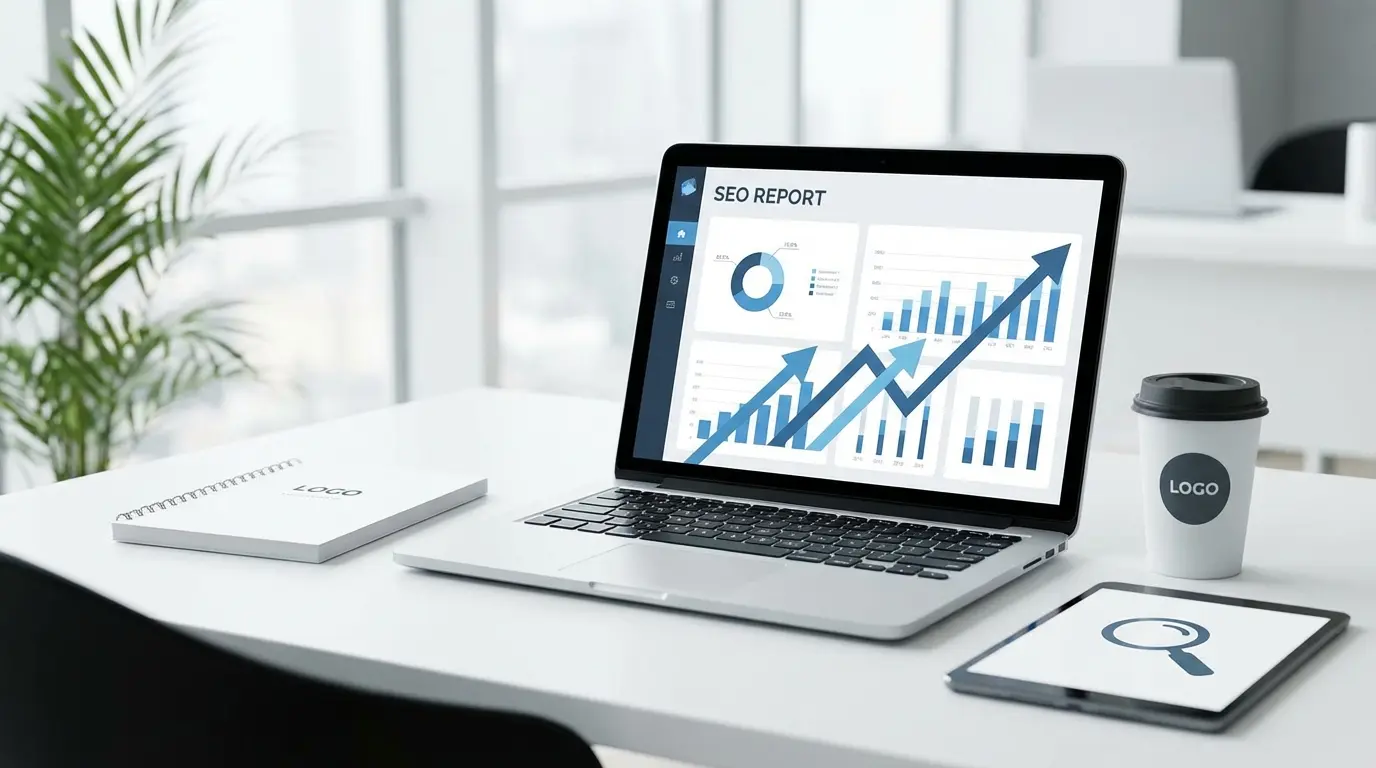
I was staring at a graph showing a beautiful “up and to the right” trend line for website traffic. I felt great. I thought I was about to get a pat on the back. Then, my CFO looked up from his laptop and asked one simple, soul-crushing question:
“Okay, but how many of these people actually booked a demo?”
The room went silent. I didn’t have an answer. We had hired a generalist agency that was amazing at getting eyeballs but terrible at getting wallets. We were ranking for vanity keywords that looked impressive on a spreadsheet but meant absolutely nothing to our bottom line.
That embarrassment was the catalyst for completely rethinking how I vet partners. Finding an agency that understands that SaaS lives and dies by MRR, churn reduction, and qualified pipeline is surprisingly hard. You need partners who speak the language of product-led growth and aren’t scared of the technical mess that usually comes with app subdomains.
This isn’t just a list of names. This is a breakdown of the top 11 agencies for 2026 based on who can actually scale a software company in the age of AI.
The Cheat Sheet (TL;DR)
If you don’t have time to read the deep dive, here is the quick version based on what you might be struggling with right now:
- For AI-First Growth & Tech Fixes: The Marketing Agency
- For Paid + Organic Alignment: Right Left Agency (RLA)
- For Content That Actually Converts: Grow and Convert
- For Enterprise Ghostwriting: First Page Sage
- For a Boutique “Team Extension” Feel: SimpleTiger
- For Digital PR & Authority: MADX Digital
- For Complex Enterprise Sales Cycles: Powered by Search
- For Product-Led Growth (PLG): Skale
- For Fast Sprints: Linkflow
- For World-Class Design Assets: Siege Media
- For Dominating the Whole Search Ecosystem: TripleDart
The Criteria: How We Picked These
Before we jump in, you should know I didn’t just pull these names out of a hat. We evaluated these partners based on the realities of the 2026 landscape. Vanity metrics like “traffic volume” are dead.
- They Get the Lifecycle: Generalist agencies don’t get SaaS. We looked for partners who know the difference between Product-Led Growth (PLG) and Sales-Led motions.
- Show Me the Money: We ignored agencies that only report on rankings. If they can’t talk about SQLs (Sales Qualified Leads) and CAC (Customer Acquisition Cost), they aren’t on this list.
- Technical Chops: SaaS sites are messy. They rely on complex JavaScript frameworks. If an agency can’t read code, they can’t help you.
- AI Readiness: This is the big one for 2026. With SearchGPT and Google’s AI Overviews, the agency needs a strategy for being visible in Large Language Models (LLMs).
1. The Marketing Agency
Best For: AI-First Technical & Revenue Growth
I’m putting The Marketing Agency first, and yes, I’m biased. But there is a specific reason we take the top spot: we address the biggest point of failure in SaaS marketing—the disconnect between your dev team and your marketing team.
Most agencies just write blog posts. The problem is, if your SaaS platform is technically bloated or architected poorly, Google (and now AI bots like ChatGPT) won’t prioritize you. We engineer marketing systems that blend technical web development with “LLM Optimization.”
The Good Stuff
We use a scientific approach centered around the 80/20 rule. We don’t just churn out content; we fix the code bloat that kills SEO and structure your data so AI agents can read it. It’s a mix of heavy technical lifting and high-level strategy.
The Catch
This isn’t a “churn and burn” content mill. If you just want 10 cheap blog posts a month without fixing the underlying system, we probably aren’t the right fit. Our approach requires deep dives and strategy work.
Pricing: Custom/Retainer (Typically $1.5k – $15k+ depending on scope).
Check out The Marketing Agency
2. Right Left Agency (RLA)
Best For: Integrated Growth (Paid + SEO)
Right Left Agency (RLA) makes the list because they refuse to treat SEO as a silo. In most companies, the PPC team and the SEO team barely talk to each other. RLA forces them into the same room.
The Good Stuff
They focus on “Unified Reporting.” This is huge for determining your actual Customer Acquisition Cost (CAC). They ensure the story you tell in a Facebook ad matches the blog post the user lands on, which matches the email sequence they get later. It’s a holistic funnel design rather than just “getting traffic.”
The Catch
Their scope is broad. If you are a tiny startup looking only for backlinks or a few articles, RLA’s full-funnel approach might be overkill for your current stage.
3. Grow and Convert
Best For: Content-Led Conversions
These guys challenge the standard agency playbook. Most agencies chase high-volume keywords because it looks good on a monthly report. Grow and Convert explicitly ignores volume and chases “Pain Point SEO”—bottom-of-funnel terms that actually drive conversions.
The Good Stuff
They interview your internal experts to write content. They don’t guess. This results in content that actually sounds like it knows the product. Their reporting is also refreshingly honest—they track leads directly from specific articles.
The Catch
They are content wizards, not technical developers. If your site has massive JavaScript rendering issues, they’ll flag it, but fixing deep code problems isn’t their core business model.
4. First Page Sage
Best For: Thought Leadership & Ghostwriting
If you are selling a complex, expensive B2B product, you need trust more than you need traffic. First Page Sage is the premium option for building that trust through high-level thought leadership.
The Good Stuff
Their ghostwriting is top-tier. You get content that sounds like it was written by your CTO, not a freelance generalist. They are excellent at mapping complex buyer journeys for enterprise clients.
The Catch
It’s expensive. They are a premium/enterprise solution. Also, because they focus on complex quality, this is a long-term play. Don’t expect overnight miracles; expect a compounding asset.
5. SimpleTiger
Best For: Boutique Extension of Team
SimpleTiger has been doing SaaS SEO for over a decade. They keep things tight and focused. They are known for being a “boutique” agency that integrates so well with your team, you forget they are external vendors.
The Good Stuff
They use proprietary AI tools to speed up research, but the strategy is human-led. They are very transparent—no “fluff” metrics. Clients love them because they tend to underpromise and overdeliver.
The Catch
Because they are boutique, they have capacity limits. They aren’t a massive factory, so availability can sometimes be tight.
6. MADX Digital
Best For: Link Building & Digital PR
Based in London, MADX realizes that in the AI era, Authority is everything. If you want ChatGPT to cite you, you need to be a trusted source. MADX focuses heavily on high-quality backlinks and Digital PR to build that authority.
The Good Stuff
They have a strong grasp on “Generative Engine Optimization” (GEO). They understand that building a brand requires getting mentioned in the press and on authoritative sites, not just tweaking meta tags.
The Catch
Real link building takes time. We aren’t talking about buying cheap links (which will get you banned); we are talking about earning them. It takes patience to see the needle move.
7. Powered by Search
Best For: Enterprise/High ACV
Powered by Search is designed for companies with high Annual Contract Values (ACV) and messy buying committees. If you need to convince a CFO, a CTO, and a Marketing Director all at once, these are your guys.
The Good Stuff
They build a “Predictable Growth System.” They are incredibly structured and great at segmenting audiences. They also have a solid framework for AI SEO called “RAISE.”
The Catch
Their processes can feel a bit “heavy” for early-stage startups that need to move fast and break things. They are better suited for scaling companies that already have traction.
8. Skale
Best For: Product-Led Growth (PLG)
Skale positions itself as a performance-driven agency. They focus heavily on “product-led” SEO, meaning they try to drive product signups and SQLs rather than just blog readers.
The Good Stuff
They are excellent at link acquisition and connecting their work to actual pipeline. They act like an extension of your marketing team and are very communicative.
The Catch
They work best when you already have product-market fit. If you are still figuring out what your product is, you might not be ready for the scale they offer.
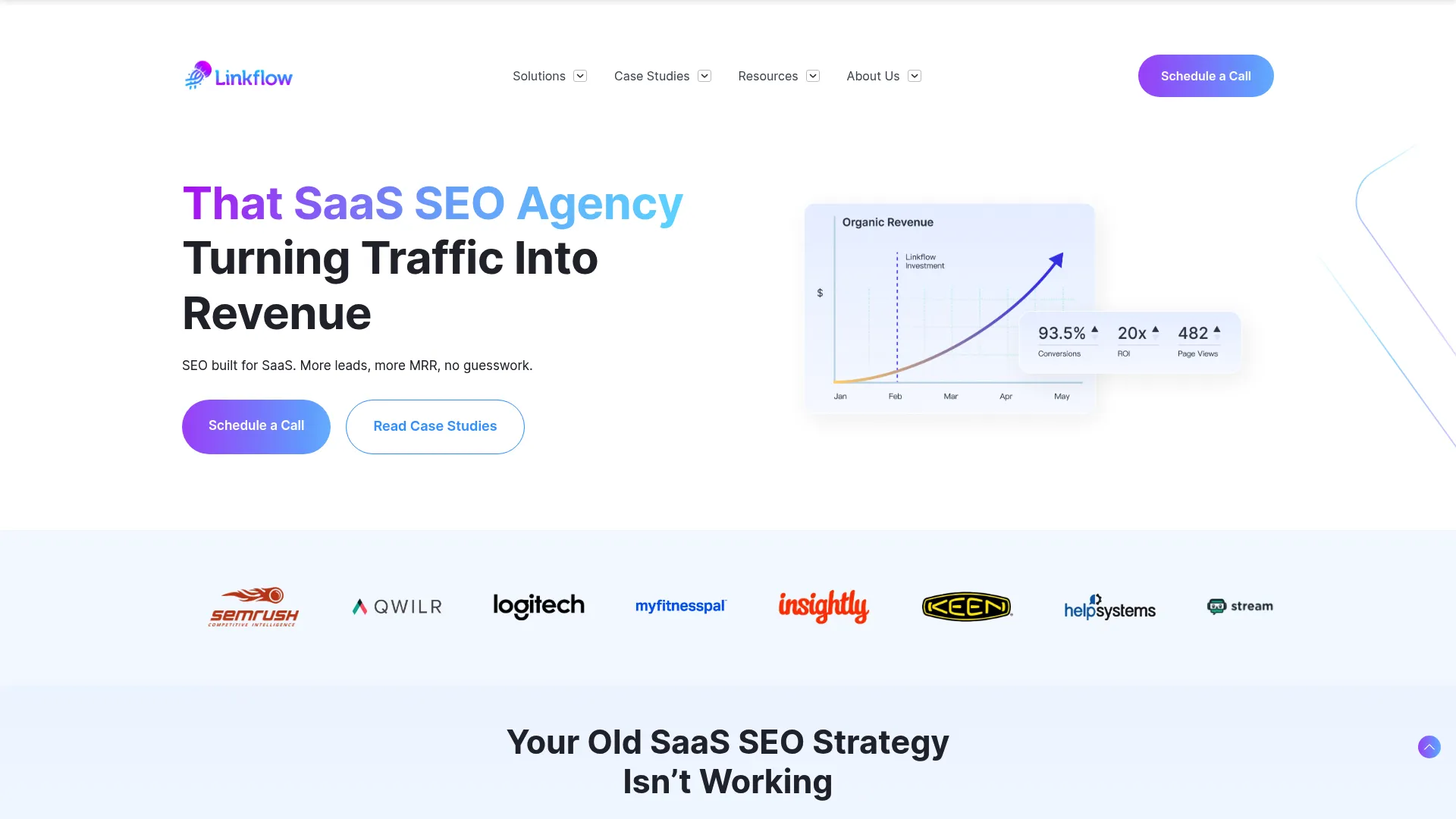
9. Linkflow
Best For: Data-Driven Sprints
Linkflow is great if you hate the “black box” of SEO. They emphasize a data-backed approach and work in sprints (like a dev team) to identify quick wins.
The Good Stuff
Their 6-week discovery sprints are unique. Instead of signing a year-long contract and hoping for the best, you get a rapid assessment and strategy formulation. They also have a strong focus on localized search and LLM optimization.
The Catch
Costs can vary widely depending on how aggressive you want to be with link building campaigns.
10. Siege Media
Best For: Visual Assets & Design
Siege Media is a content powerhouse that specializes in design-heavy, linkable assets. If you want to earn links naturally, you need data studies and infographics that people actually want to share.
The Good Stuff
Their design team is incredible. They produce assets that look expensive (because they are) and attract passive backlinks. They’ve done this for giants like Zapier and Asana.
The Catch
They are production-heavy. You need a budget for creative assets. If you just want text, you’re missing the point of hiring them.
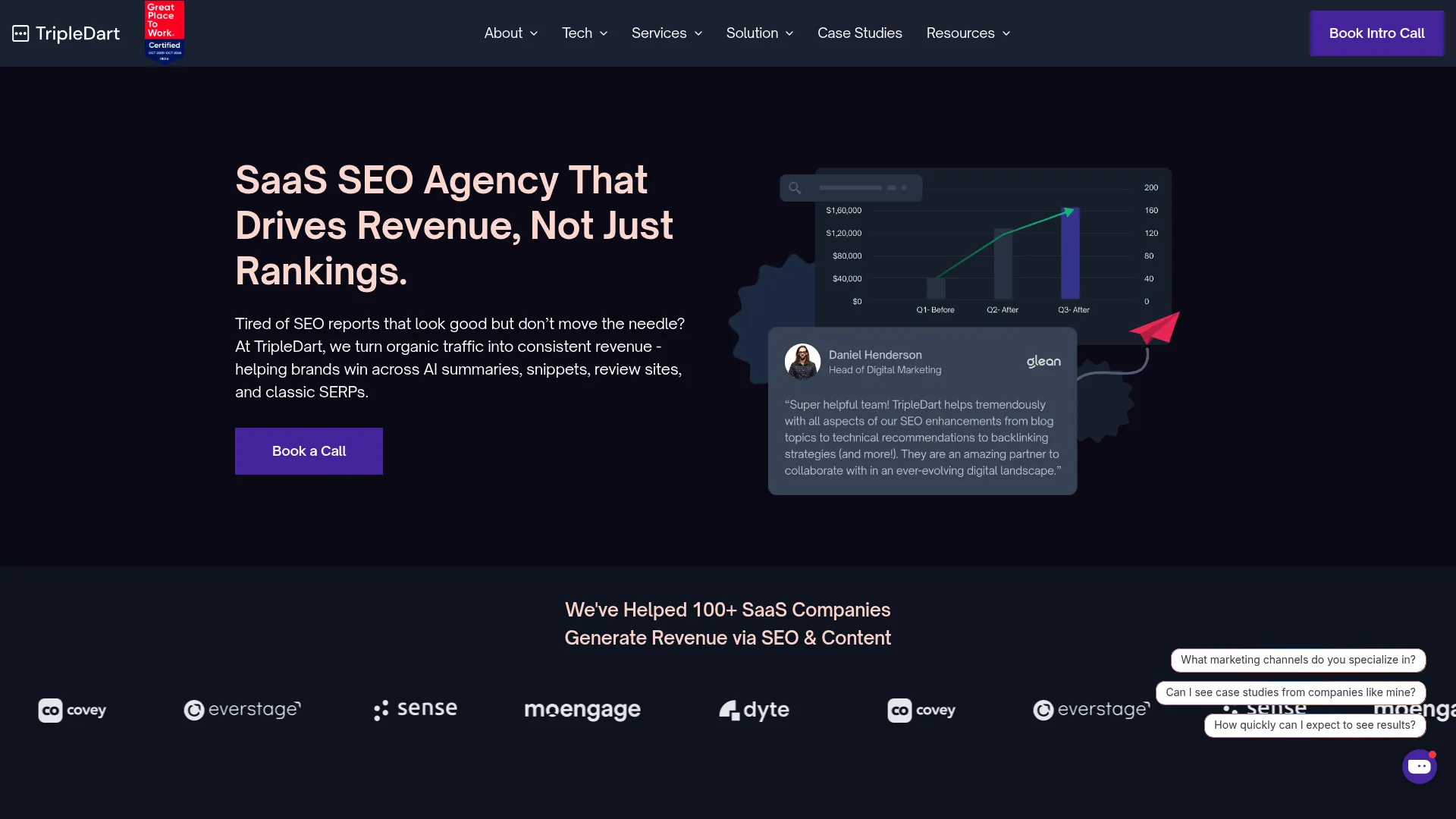
11. TripleDart
Best For: Search Ecosystem Dominance
TripleDart looks at the whole picture—AI summaries, snippets, review sites, and Google. They are known for being highly responsive and basically operating like an in-house performance team.
The Good Stuff
They have a relentless focus on demos and deals. They use “Hub & Spoke” models to build topical authority quickly and are very affordable for the access you get to their collective brainpower.
The Catch
Like any content-heavy strategy, building authority takes patience, especially on a newer domain.
Notable Mentions
Sometimes the top 11 list doesn’t cover every specific niche need. Here are a few others that deserve a look:
- Animalz: Great for deep, high-end editorial content, though they’ve gone through some structural changes recently.
- Breaking B2B: Unique media-first approach (podcasts/video) that gets repurposed into SEO.
- Rock The Rankings: Highly focused on bottom-of-funnel content that sales teams actually use.
- Omniscient Digital: Founded by former HubSpot/Shopify folks. Very high-level strategy.
Real Talk FAQ
How much does this actually cost?
Let’s not beat around the bush. Most agencies on this list will cost between $5,000 and $20,000+ per month. Premium partners like First Page Sage can go higher. If that sounds high, remember: a “cheap” $1,000/month agency usually costs you more in the long run because you’ll eventually have to pay someone else to clean up their mess.
How long until I see money?
SEO is a slow burn. Technical fixes can show results in weeks, but significant revenue impact usually takes 3 to 6 months. If an agency promises you #1 rankings in 30 days, run away. They are lying. For real-world examples of how this plays out, you can review a SaaS SEO case study to see the compounding effect in action.
Generalist vs. Specialist?
Always go with a SaaS specialist. A generalist who works with local bakeries and e-commerce stores won’t understand what “Churn” or “LTV” means. You need someone who knows the B2B buyer journey.
Is AI going to kill SEO?
No, but it is changing it. “Generative Engine Optimization” (GEO) is the new game. Your agency needs to know how to optimize content so that ChatGPT and Claude cite you as the answer. If your agency isn’t talking about AI, they are already obsolete. You can learn more about how this shift works in our guide to Generative Engine Optimization.
Final Thoughts
If you take anything away from this list, let it be these three things:
- Revenue over Traffic: Stop looking at vanity metrics. If the agency can’t calculate ROI, don’t hire them. Calculating your potential return is crucial, so consider using an SEO ROI calculator to ensure the numbers make sense before signing a contract.
- Technical Foundation: Your content is useless if your site is a technical mess that Google can’t crawl.
- AI Readiness: The future is GEO. Ensure your partner has a plan for the AI search landscape.
While the agencies listed above are titans in the space, you might find your needs are a mix of technical dev and marketing strategy. That’s where The Marketing Agency comes in. We combine the technical heavy lifting of web development with high-ROI SEO strategies.
If you’re tired of the disconnect between your code and your content, let’s talk.

 By
By