



There is a stat floating around that consistent branding can boost revenue by 23%. That sounds nice, but it feels pretty abstract until you see the money walking out the door in real life. I once sat across from a medical device founder who had built a genuinely revolutionary cardiac monitoring tool. The tech was life-saving. The compliance data was bulletproof. But their brand identity looked like it was designed in a basement in 1998.
They weren’t losing deals because the product failed. They were losing because hospital procurement teams didn’t trust a company that looked like it might not exist in six months.
Finding a partner to fix this is a headache. You have to balance empathy for patients, clinical authority for doctors, and the absolute minefield of HIPAA and FDA rules. You need an agency that knows a “cool name” is useless if the trademark office rejects it. We took a hard look at the landscape to bring you the top medical marketing agencies and branding specialists for 2026. These are the partners who know the difference between selling sneakers and selling life-saving therapeutics.
Table of Contents
- TL;DR: The Cheat Sheet
- The Criteria: How We Chose
- 1. G & Co.
- 2. The Brand Consultancy
- 3. Addison Whitney
- 4. Brandsymbol
- 5. Brand Institute
- 6. Springboard
- 7. Atomicdust
- 8. BrandingBusiness
- 9. Fello Agency
- 10. Ramotion
- Notable Mentions
- FAQ
- Final Thoughts
TL;DR: The Cheat Sheet
If you don’t have time to read the deep dive and just need to know who fits your specific vertical right now, here is the snapshot. We broke this down so you can quickly spot the agency that fits your immediate problem—whether that’s strict regulatory red tape or needing a slick digital experience.
- Best for Strategy & Diversity: G & Co.
- Best for Mergers & Acquisitions: The Brand Consultancy
- Best for Naming That Don’t Get You Sued: Addison Whitney
- Best for Global Safety & Linguistics: Brandsymbol
- Best for Big Pharma Compliance: Brand Institute
- Best for Patient Experience: Springboard
- Best for Modern Design (No Blue Swooshes): Atomicdust
- Best for B2B Healthcare: BrandingBusiness
- Best for Fixing a Stagnant Brand: Fello Agency
- Best for Digital Startups: Ramotion
Agency Comparison Table
| Agency | Best For | The “Secret Sauce” |
|---|---|---|
| 1. G & Co. | Strategy & Diversity | Brand Intelligence Methodology |
| 2. The Brand Consultancy | Mergers & Acquisitions | Proprietary Research Model |
| 3. Addison Whitney | Verbal Identity & Naming | Regulatory Naming Expertise |
| 4. Brandsymbol | Global Safety & Linguistics | Safety-First Naming & Paralegal Vetting |
| 5. Brand Institute | Pharma Regulatory Compliance | Drug Safety Institute (DSI) |
| 6. Springboard | Patient & Provider Experience | Integrated Communications |
| 7. Atomicdust | Modern Visual Design | Digital-First Brand Experiences |
| 8. BrandingBusiness | B2B Healthcare | Brand Performance Platform™ |
| 9. Fello Agency | Brand Revitalization | Brand Diagnosis & Repositioning |
| 10. Ramotion | Digital Startups & UX | Scalable Design Systems |
The Criteria: How We Chose
Before you sign a retainer, you need to vet these agencies against the harsh realities of the healthcare market. Generalist agencies usually fail here because they underestimate the legal handcuffs. We judged these partners based on five things: regulatory chops, how they use data, if they actually know your sector, scalability, and the human element.
Here is the rubric we used to separate the top healthcare branding agencies from the pack:
- Regulatory & Compliance: Can they navigate HIPAA and the FDA? Specialists know that a creative idea is a liability if it triggers a compliance violation.
- Brand Intelligence: Healthcare decisions run on data. We looked for agencies that interview stakeholders and map patient journeys rather than just guessing what looks pretty.
- Sector Specialization: A hospital system is not a B2B medical device manufacturer. We checked that these agencies have portfolios matching specific verticals like Payers, Providers, MedTech, or Pharma.
- Scalability: If you buy another company next year, will the brand break? The agency must know how to organize sub-brands without creating “brand soup.”
- The Human Experience: Branding isn’t just a logo; it’s an experience. The best agencies align what you say externally with what you do internally.
1. G & Co.
Best Known for Brand Intelligence
The Vibe
Think of G & Co. as the place where creativity meets a spreadsheet. They don’t guess what your audience wants; they dig into the numbers to prove it. They are a solid choice for enterprise health systems and payers that need to justify every marketing dollar to a CFO. As a certified Minority Business Enterprise (MBE), they also bring a necessary perspective on diversity and inclusion, which is massive for building patient trust right now.
Features
- Brand Intelligence Methodology: Using deep insights to drive the strategy.
- Reputation Management: Making sure the public actually likes you.
- Strategic Communications: Handling complex messaging for big orgs.
- Digital Identity: Turning that strategy into a website that works.
Pros
- Data-Driven: Insights over intuition, always.
- MBE Certified: Helps with supplier diversity goals, which is a key metric for many health systems.
- Enterprise Focus: They can handle the messy, complex stuff.
Cons
- Scope Mismatch: Probably too expensive (and overqualified) for a local family practice.
- Slow Burn: Their focus is on large-scale alignment, which might feel slow for a startup that just needs a logo by Friday.
Our Rating
We give G & Co. a 5/5 because they nail the “Brand Intelligence” aspect. They treat healthcare branding as a business science, not just an art project. Their regulatory knowledge is baked in, so you know the work is viable.
What People Are Saying
Clients generally highlight the mix of creativity and logic.
- Pretius (Marketing Specialist): Loved the unified brand presence and noted they “delivered everything on time and responded quickly.”
- GPW Group GmbH (CEO): Highlighted their flexibility during a complex consolidation of multiple entities.
- Source: Clutch & Online Reviews
Price
Custom pricing (Enterprise level).
2. The Brand Consultancy
Best Known for Cleaning Up Messy Mergers
The Vibe
When you are dealing with a massive merger or a complex acquisition, you don’t need a graphic designer; you need a consultant. The Brand Consultancy scores incredibly high on architecture. They specialize in navigating the murky waters of consolidation. Their approach is grounded in statistics, which makes the work defensible to board members who care more about the bottom line than the color palette.
Features
- Proprietary Research Model: A mix of quant and qual data.
- M&A Navigation: Frameworks for unifying fragmented systems.
- Internal Culture: Making sure your staff actually buys into the new brand.
Pros
- Experience: Over 30 years in the game.
- Defensible Strategy: Hard stats make it easier to get the C-suite on board.
- Complex Systems: Perfect for unifying hospital networks (like Children’s National).
Cons
- Pacing: It’s a rigorous process. If you’re in a rush, look elsewhere.
- Visuals Second: Strategy comes first here. If you just want a visual refresh, this is overkill.
Our Rating
They earn a 4.8/5 largely due to their dominance in “Scalability.” If you are a large health system buying up smaller practices, this is who you call to prevent the brand from falling apart.
What People Are Saying
The feedback centers on their ability to handle high-stakes corporate changes. Clients view them as a partner for the CEO, not just the marketing department.
Price
Mid-to-High tier.
Check out The Brand Consultancy
3. Addison Whitney
Best Known for Naming That Passes Legal
The Vibe
Addison Whitney is a heavyweight when it comes to regulatory naming. In healthcare, you can’t just pick a name that sounds cool; it has to pass trademark laws and global regulatory boards. They are the go-to for verbal branding, ensuring that names for biotech and pharma products can actually exist in the market without getting sued or blocked.
Features
- Verbal Branding: Creating names that carry meaning and clear hurdles.
- Visual Identity: Logos and packaging that support the name.
- Brand Strategy: Positioning products in crowded therapeutic areas.
Pros
- Niche Expertise: Unparalleled skill in naming.
- Pharma Focus: They know the biotech lifecycle inside out.
- The Big Boys: Trusted by giants like Microsoft and Aurion Biotech.
Cons
- Scope Limitation: They are primarily focused on the identity/naming phase.
- Execution: You might need another partner for the day-to-day digital marketing later.
Our Rating
We rated them 4.7/5. Their score is driven by their mastery of the “Regulatory” criteria. For a pharma company, a rejected name can cost millions in delays. Addison Whitney is your insurance policy against that.
Price
Premium pricing for specialized naming.
4. Brandsymbol
Best Known for Global Safety
The Vibe
Brandsymbol has a very specific superpower: Global Safety & Linguistics. If you are launching a drug or device globally, you need to know that your name doesn’t mean something offensive in another language or infringe on a trademark in Japan or Germany. They use trademark paralegals and native speakers to vet everything before you get attached to a name.
Features
- Safety-First Naming: Screening candidates against nearly 200 international trademark databases.
- Linguistic Analysis: Native speakers vetting for cultural embarrassing moments.
- Regulatory Division: Dedicated teams for EMA and FDA approvals.
Pros
- Risk Reduction: They guarantee partnership until name approval.
- Vetting: Rigorous trademark vetting is built-in, not an afterthought.
- Global Reach: Ensures your brand travels well across borders.
Cons
- Specialization: Like Addison Whitney, they are highly specialized. You don’t hire them to run your Facebook ads.
Our Rating
They score 4.6/5. They take the guesswork out of the legal side of branding, which is invaluable for risk-averse healthcare orgs.
Price
Custom quotes based on market reach.
5. Brand Institute
Best Known for Big Pharma Compliance
The Vibe
Brand Institute is practically the government standard for pharma naming. If you walk into a pharmacy, odds are you are looking at their work. With a history of developing thousands of FDA-approved brand names, they are unmatched for companies navigating the specific regulatory hurdles of drug naming. They work with the titans (Novartis, Amgen) and integrate legal, linguistic, and marketing expertise to ensure compliance.
Features
- Drug Safety Institute (DSI): A subsidiary dedicated to preventing medication errors through naming.
- Market Research: Extensive surveys with medical pros.
- Regulatory Strategy: Direct experience with FDA and EMA submission processes.
Pros
- Track Record: Massive history of FDA approvals.
- Medical Focus: They have a panel of medical professionals for surveys.
- Global: Offices everywhere.
Cons
- Niche: Extremely focused on pharma naming conventions.
- Applicability: Probably not the right fit for a local hospital system or a service-based brand.
Our Rating
A near-perfect 4.9/5 for Pharma Naming. If you are naming a drug, you go here. If you are rebranding a hospital cafeteria, you go elsewhere.
Price
High-end corporate pricing.
6. Springboard
Best Known for Patient Experience
The Vibe
Springboard is all about the “warm and fuzzy” side of healthcare—in a good way. They excel in storytelling and the patient experience. Having served over 150 healthcare organizations, they focus on aligning brand purpose with messaging across provider systems. They are a strong choice for hospitals that need to humanize their care and stop sounding like institutions.
Features
- Integrated Communications: Aligning internal culture with external marketing.
- Visual Storytelling: Creating emotional connections.
- Destination Medicine: Strategies for attracting patients to specific facilities.
Pros
- Provider Focus: Extensive experience with hospital systems.
- Human Element: Strong focus on the emotional aspect of care.
- Versatility: Good balance of strategy and visual execution.
Cons
- Vertical Limit: More provider-focused than med-tech focused.
Our Rating
Springboard rates 4.5/5. They shine in the “Patient & Provider Experience” category. They understand that a brand is a promise kept by the staff.
Price
Competitive agency rates.
7. Atomicdust
Best Known for Modern Design
The Vibe
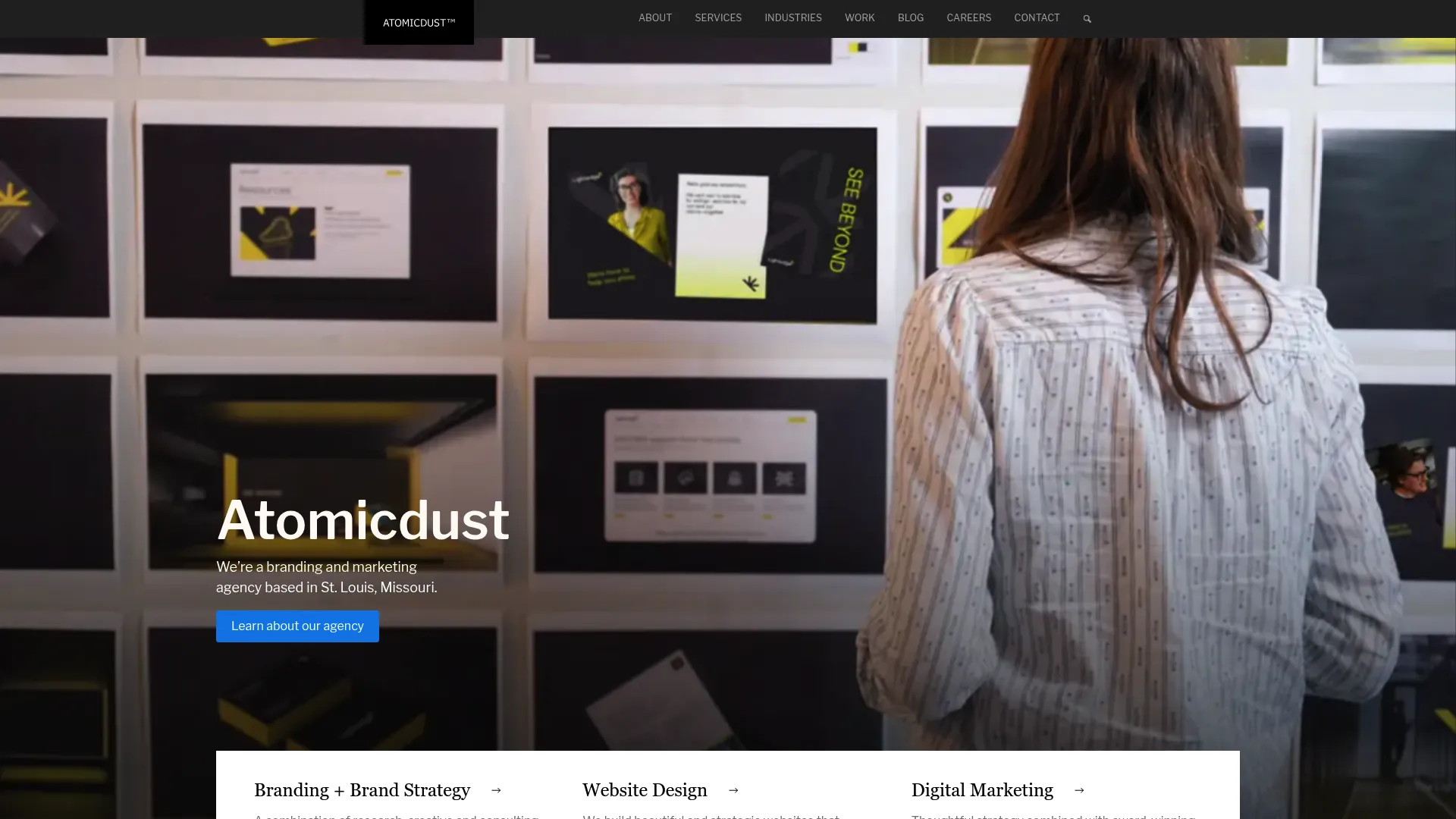
Healthcare branding often suffers from “sea of sameness”—blue logos, sterile fonts, and stock photos of doctors shaking hands. Atomicdust brings a modern aesthetic that disrupts this. They are the choice for companies looking to break the mold, focusing on clarity and confidence. They help medical device companies and wellness brands communicate complex services without looking clinical and cold.
Features
- Brand Strategy: Clarifying the “why” behind the company.
- Web Design: Creating digital-first brand experiences.
- Content Marketing: Telling the brand story through ongoing content.
Pros
- Aesthetics: Strong visual design that looks modern and consumer-friendly.
- Clarity: Great for modernizing legacy brands that feel dusty.
- Digital-First: They build brands meant to live on screens.
Cons
- Regulatory Depth: Might be less suited for massive, highly bureaucratic regulatory naming projects compared to Brand Institute.
Our Rating
Atomicdust gets a 4.4/5. They excel in experience from a visual and UX perspective. They make healthcare brands look approachable, which is half the battle in patient acquisition.
Price
Project-based or retainer models.
8. BrandingBusiness
Best Known for B2B Specialization
The Vibe
If you are selling to hospitals rather than patients, BrandingBusiness is your top choice. They lead in “B2B Sector Specialization.” They utilize proprietary tools to guide medical device firms and hospital networks, focusing heavily on the business-to-business aspect. They offer research-led brand intelligence for clients like AllCare Health.
Features
- Brand Performance Platform™: A tool for measuring brand strength.
- B2B Strategy: Tailored specifically for complex sales cycles.
- Internal Engagement: Ensuring employees understand the B2B brand promise.
Pros
- Specialized: They understand the nuance of B2B healthcare better than consumer agencies.
- Data-Driven: Proprietary tools provide measurable insights.
- Collaborative: Known for deep engagement with client teams.
Cons
- Consumer Reach: Less focus on direct-to-patient advertising.
Our Rating
They score 4.5/5. Their “Sector Specialization” is their strongest asset. B2B healthcare is a different beast, and they have tamed it.
Price
Mid-to-High tier ($200k+ for comprehensive projects).
9. Fello Agency
Best Known for Brand Revitalization
The Vibe
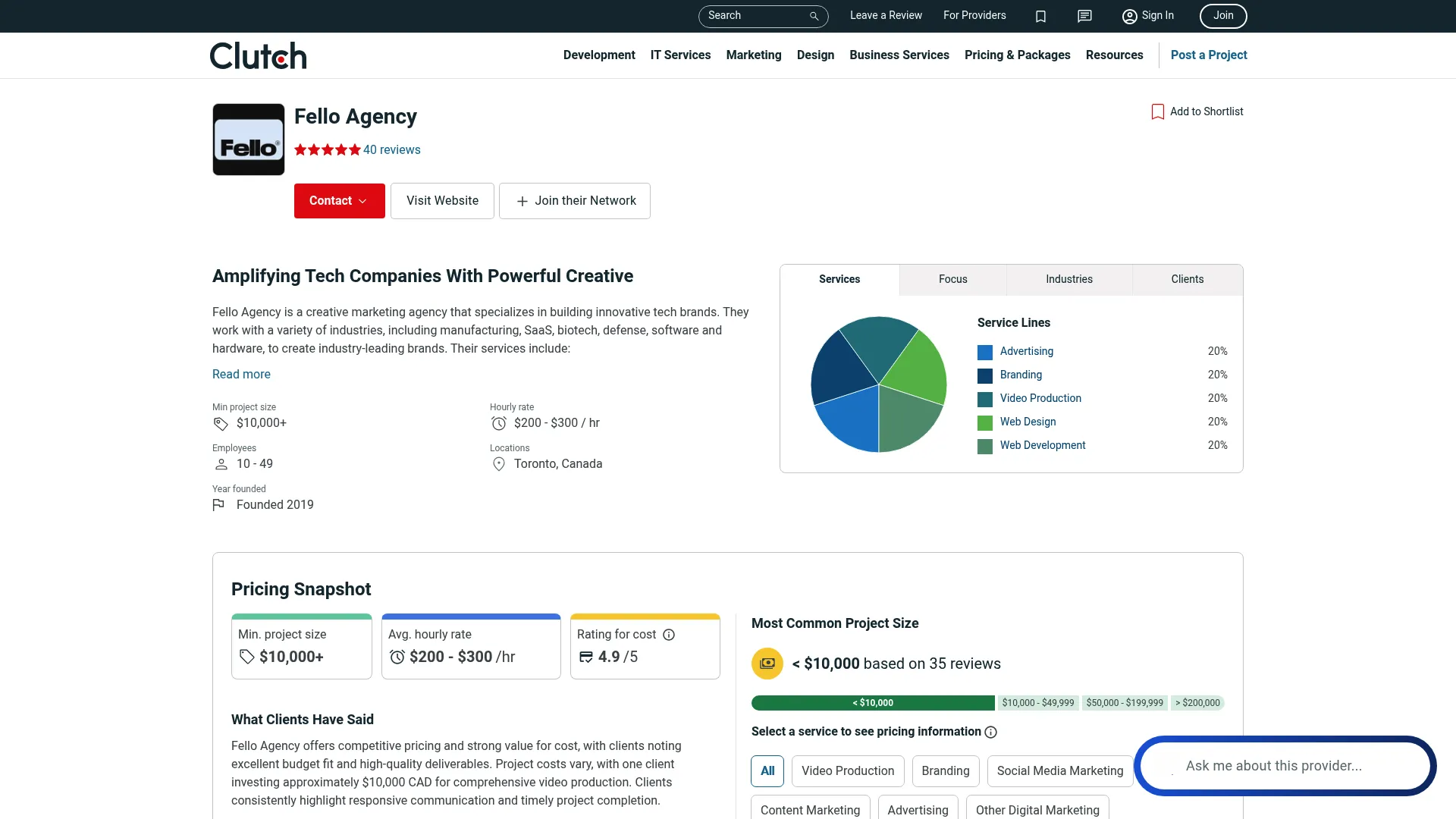
Sometimes a brand isn’t new; it’s just tired. Fello Agency specializes in “Brand Revitalization.” They are great at solving brand stagnation, particularly in the medical device space. They excel at repositioning brands to resonate with both physicians and procurement audiences. They are best known for their proprietary brand diagnosis process—basically a check-up for your marketing.
Features
- Brand Diagnosis: Identifying exactly why a brand is stalling.
- Repositioning: Shifting the market perception of existing products.
- Creative Campaigns: High-impact visuals and messaging.
Pros
- MedTech Focus: Specific understanding of medical devices.
- Procurement Savvy: They understand the audiences that sign the checks.
- Agility: Known for entrepreneurial hustle.
Cons
- Niche: Heavy focus on devices/medtech might not translate to payer/provider needs.
Our Rating
Fello earns a 4.3/5. They are strong in MedTech and smart about market positioning.
Price
Custom project pricing (often accessible for mid-market).
10. Ramotion
Best Known for Digital Startups
The Vibe
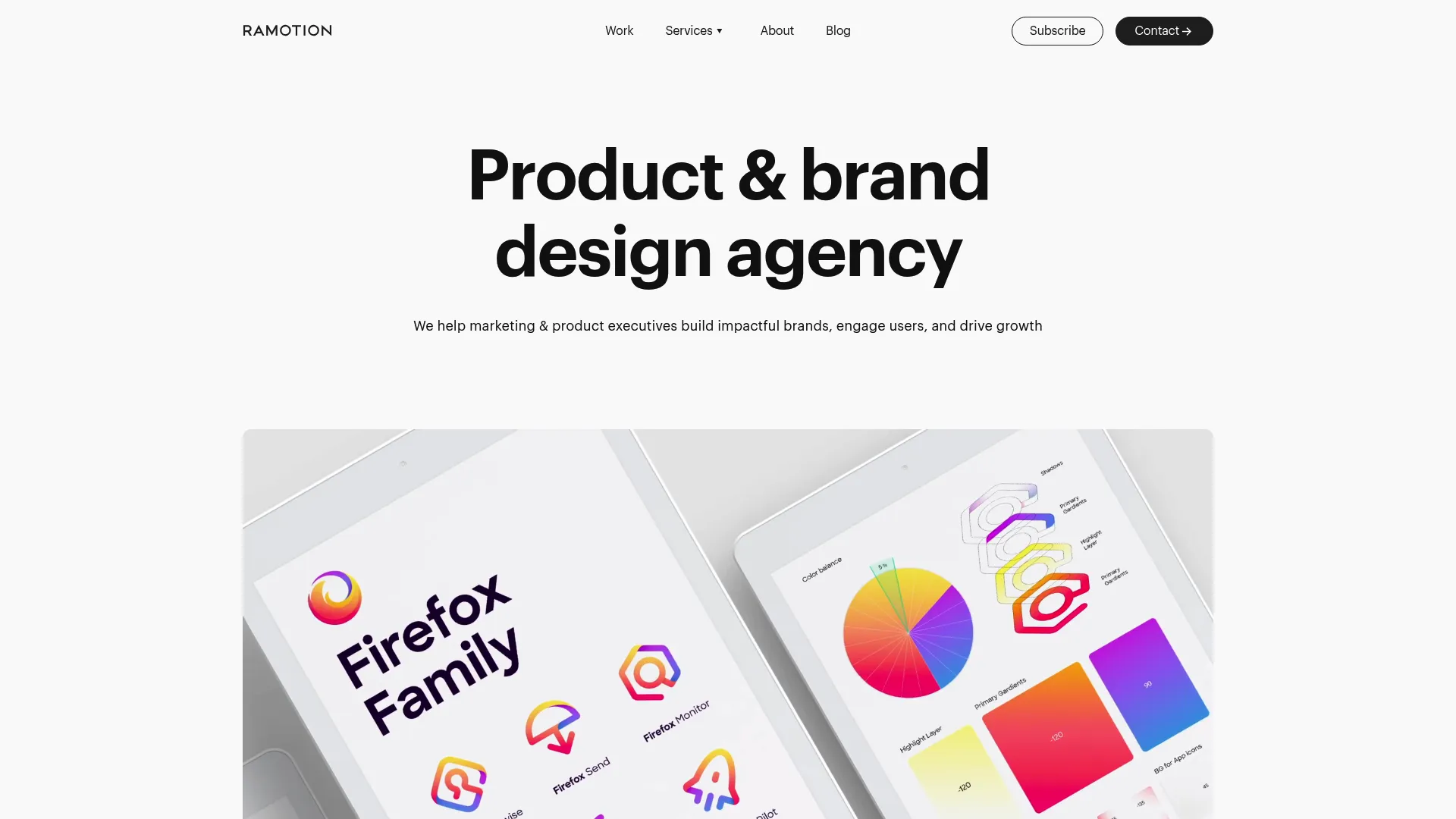
If you are a HealthTech startup, you don’t need a 50-page brand book on letterhead usage; you need a killer app icon and a responsive web presence. Ramotion is the go-to for startups. They apply user-centered design principles to healthcare, making them ideal for health-tech innovators and early-stage companies needing a scalable digital identity.
Features
- UI/UX Design: World-class interface design for apps.
- Visual Identity: Creating brands that look native to the digital space.
- Scalable Systems: Design systems that grow with the product.
Pros
- Startup Ready: Excellent for HealthTech and SaaS.
- Visuals: Stunning, modern aesthetic.
- Extension of Team: Clients often feel they are part of the internal product team.
Cons
- Legal Depth: May lack the deep regulatory legal teams of larger pharma-focused agencies.
Our Rating
Ramotion scores 4.4/5. They dominate “Patient Experience” in the digital realm. For a digital health product, the UX is the brand.
Price
Geared towards funded startups and growth companies.
Notable Mentions
While the agencies above focus heavily on the foundation and identity, these notable mentions offer strong capabilities in executing that brand through integrated marketing and performance. We wanted to highlight four additional agencies that didn’t make the top 10 but offer specific strengths.
- Levo Health: A strong choice if you need your branding to immediately tie into performance marketing and patient engagement centers. Check them out here.
- Quaintise: Best considered for wellness brands and clinics. They blend market strategy with data-backed messaging. Check them out here.
- Healthcare Success: An integrated healthcare advertising agency perfect for those who need a “multidisciplinary” approach. Check them out here.
- Syneos Health Communications: A massive global player ideal for major commercial delivery. They operate at the intersection of health, technology, and creativity on a global scale. Check them out here.
If you are looking for partners that specialize in paid media and advertising to complement your branding efforts, take a look at our guide to the Best Healthcare Advertising Agencies.
Frequently Asked Questions
How is healthcare branding different from general consumer branding?
The stakes are higher. Unlike selling a soft drink, healthcare marketing agencies have to build trust regarding life-altering decisions while navigating strict laws (HIPAA, FDA) on what they can and cannot promise. You can’t just say your product is the “best” without clinical data to back it up.
How much does a healthcare branding agency cost?
It varies wildly. A visual refresh for a startup might cost $20,000–$50,000, while a comprehensive renaming and restructuring for a hospital system or a global pharma launch can easily run into the millions.
How long does a healthcare rebranding project take?
Usually 6 to 12 months. This includes the research phase (talking to stakeholders), strategy development, creative execution, and the slow process of regulatory approval.
When should a healthcare organization rebrand?
Consider it during mergers and acquisitions, when expanding into new service lines, if your current brand has a bad reputation, or if your visual identity just looks old compared to modern competitors.
What is the difference between a branding agency and a marketing agency?
A healthcare branding agency defines who you are—your name, logo, voice, and strategy. A healthcare marketing agency (like us) takes that identity and ensures how you are found—through SEO, website performance, and lead generation.
For a broader look at marketing partners if your primary need is leads rather than logos, check out our list of the Top Healthcare Marketing Agencies.
Final Thoughts: From Identity to Market Performance
Choosing the right partner to define your identity is a big first step. Whether you need the regulatory muscle of Brand Institute, the B2B strategy of BrandingBusiness, or the modern design of Atomicdust, the agencies on this list are the real deal for 2026. Strategy comes first because healthcare is too complex to guess, and compliance matters because getting sued is expensive.
But here is the catch: a brand that is invisible on search engines or broken on mobile devices won’t make you any money. Once you have a compliant name and a compelling visual identity, you need to ensure your target audience actually finds you.
The Marketing Agency specializes in taking established healthcare brands and ensuring they perform digitally. While branding agencies define who you are, we define how you are found. Think of us as the mechanics who make sure the car actually runs.
- Technical Foundation: We ensure that moving to a new domain or CMS doesn’t destroy your existing SEO rankings.
- Healthcare SEO: We specialize in Medical and Dental SEO, ensuring your new brand ranks for the procedures you offer.
- Performance Web Development: We build healthcare websites that are fast, mobile-responsive, and compliant.
If you are investing in a top-tier brand, protect that investment with performance marketing. To estimate the potential return on investment for your digital marketing efforts once your branding is established, use our SEO ROI Calculator.
Contact The Marketing Agency to discuss how we can amplify your healthcare brand’s reach in 2026.