



Introduction
Ever watch a trend blow up while you’re still figuring out what to tweet? Yeah, me too. Last month I sat there with my coffee getting cold, watching everyone jump on a marketing conversation I’d been tracking for weeks. By the time I’d drafted something halfway decent, the whole thing had moved on. That moment taught me something: understanding twitter trends isn’t enough anymore. You need systems, strategy, and the ability to move fast without looking stupid.
According to GetDayTrends, platforms now store and analyze Twitter data to bring insights on what’s currently trending and help audiences keep up with real-time conversations. Twitter processes over 500 million tweets daily. That’s a lot of noise. Trends change every few hours, which means if you’re slow, you’re invisible.
We’re way past simple hashtag monitoring now. We’re talking about AI-generated personalities engaging with your customers at 3 AM, hyper-local communities replacing traditional forums, and Twitter functioning as a primary search engine for entire demographics. The brands winning aren’t just participating in trends. They’re predicting them, shaping them, and actually making money from them.
Much like how TikTok’s algorithm rewards early trend adoption, Twitter’s ecosystem favors brands that can identify and capitalize on emerging conversations before everyone else shows up.
This guide breaks down 18 trends reshaping Twitter in ways that actually impact your bottom line. No fluff about “building brand awareness” without context. We’re covering what to think about before jumping in, the specific tactics that drive results, and what you’ll actually need to pull this off.
Table of Contents
Understanding Twitter Trends: What to Think About First
-
Trend Longevity vs. Flash-in-the-Pan Virality
-
Audience Alignment and Demographic Relevance
-
Brand Safety and Controversy Assessment
-
Engagement Potential and Conversation Quality
-
Data Foundation and ROI Measurement
-
Timing, Agility, and Organizational Readiness
AI & Technology Integration
-
AI-Generated Personality Accounts
-
LLM Discovery Optimization
-
Real-Time AI Sentiment Campaigns
Community & Micro-Networking
-
Hyper-Local Twitter Communities
-
Professional Micro-Communities
-
Voice-Note Threading
Commerce & Monetization
-
In-Tweet Checkout Experiences
-
Creator-Brand Revenue Shares
-
Subscription-Gated Twitter Spaces
Authenticity & Transparency
-
Behind-the-Metrics Transparency
-
Founder-First Content
-
Anti-Algorithm Organic Movements
Visual & Interactive Content
-
3D Product Visualization Tweets
-
Collaborative Canvas Threads
-
Data Visualization Stories
Search & Discovery Evolution
-
Twitter as Primary Search Engine
-
Conversational Search Optimization
-
Predictive Trend Participation
How The Marketing Agency Addresses Twitter Trend Challenges
Final Thoughts
TL;DR
Here’s the thing: most trends are a waste of your time. Before you jump in, ask yourself if this thing will matter tomorrow, if your audience actually cares, and if you can participate without looking like an idiot.
-
AI integration is reshaping Twitter through personality accounts, LLM optimization, and real-time sentiment analysis that adjusts campaigns on the fly.
-
Hyper-local and professional micro-communities are fragmenting Twitter into ultra-specific groups where relevance matters more than reach.
-
Twitter is becoming a full-funnel commerce platform with native checkout, creator revenue shares, and subscription-gated content replacing traditional monetization models.
-
Radical transparency (sharing real metrics, failures, and founder perspectives) builds trust and attracts people who are tired of curated perfection.
-
Visual innovation through 3D product models, collaborative canvases, and interactive data stories is driving engagement beyond static images and text.
-
Younger people are using Twitter instead of Google for real-time, authentic information. If you’re over 35, this probably sounds insane, but that’s where things are going.
-
Predictive analytics can sometimes spot trends 6-24 hours before they peak. Sometimes. They’re not magic, but they give first-mover advantage to brands with proper infrastructure.
-
Success requires tracking what actually matters, not vanity metrics. Attribution modeling, ROI tracking, and performance analytics separate campaigns that work from expensive experiments.
-
Insights from top twitter trends should inform your SEO, PPC, email, and content strategies across your entire marketing ecosystem.
Understanding Twitter Trends: What to Think About First
Before diving into specific trends, let’s talk about how to evaluate whether any trend deserves your time and money. This foundation prevents reactive trend-chasing and keeps you from wasting resources on stuff that won’t move the needle.
Trend Longevity vs. Flash-in-the-Pan Virality
Some trends dominate conversations for hours before vanishing completely. Others reshape how entire industries operate for years. The difference? Engagement velocity tells you how fast a trend is spreading, but conversation depth reveals whether people are discussing substance or just sharing memes.
Watch for mainstream media pickup. When traditional news outlets start covering a twitter trending topic, it’s moved beyond the platform’s echo chamber. That signals broader cultural relevance and typically extends the trend’s lifespan significantly.
Look at the underlying driver. Is this trend responding to a fundamental shift (like AI adoption) or a temporary event (celebrity drama)? Fundamental shifts have staying power. Temporary events create noise.
|
Trend Indicator |
Flash-in-the-Pan Virality |
Long-Term Staying Power |
|---|---|---|
|
Engagement Velocity |
Explosive spike within 2-4 hours, then rapid decline |
Steady growth over 24-48 hours, sustained engagement |
|
Conversation Depth |
Mostly memes, one-word replies, simple reactions |
Substantive discussions, questions, experience-sharing |
|
Media Pickup |
Limited to social media and gossip outlets |
Coverage in industry publications and mainstream news |
|
Underlying Driver |
Celebrity drama, viral moments, temporary events |
Technological shifts, regulatory changes, cultural movements |
|
Participant Diversity |
Concentrated in one demographic or community |
Cross-demographic engagement across industries |
|
Investment Strategy |
Quick tactical response with pre-approved templates |
Long-term content strategy and infrastructure development |
Look, these are guidelines, not laws. I’ve seen flash-in-the-pan trends turn into movements, and I’ve seen “sure things” die in 48 hours. Use your judgment.
Audience Alignment and Demographic Relevance
A trend might be massive globally but completely irrelevant to your target demographic. Geographic location matters more than most brands realize. A topic trending on twitter in New York might not resonate in Nashville, and vice versa.
Age demographics shift dramatically across trends. Gen Z engages differently than Millennials, who engage differently than Gen X. Industry relevance is equally critical. A B2B SaaS trend won’t help a local restaurant, no matter how much engagement it’s generating.
Psychographic alignment goes deeper than demographics. Does this trend align with your audience’s values, interests, and pain points? A trending topic about luxury travel won’t resonate with budget-conscious families, regardless of age or location.
Here’s a real example of what happens when you get this wrong: A national insurance company (can’t name them, but they’re big) saw #FinancialFreedom trending with millions of impressions and thought “perfect, that’s us!” Spoiler: it wasn’t. They quickly created content about insurance as part of financial planning. The campaign generated 50,000 impressions but only 12 clicks to their website. Twelve. Analysis revealed the trend was driven primarily by Gen Z discussing cryptocurrency and side hustles, people who think insurance is for old people. Meanwhile, a competing trend #RetirementPlanning had only 100,000 impressions but was dominated by their exact target demographic (45-60 year olds with established careers). The smaller, aligned trend would have delivered way better ROI.
Brand Safety and Relevance Assessment
Trends can be controversial, political, or culturally sensitive. Before participating, ask three questions:
Does this align with our brand values? If you’re stretching to make a connection, your audience will notice. Forced trend participation damages credibility faster than it builds awareness.
Could participation backfire or appear opportunistic? Some trends are minefields. Brands that jump on tragedy-related trends or sensitive social issues without genuine connection face immediate backlash. The short-term visibility isn’t worth the long-term reputation damage.
Can we add genuine value to the conversation? If you’re echoing what everyone else is saying, you’re adding noise, not value. Figure out what unique perspective, information, or resource you can contribute.
Engagement Potential and Conversation Quality
High impression counts mean nothing if nobody’s engaging. Reply-to-impression ratios reveal whether people are participating or scrolling past. Quality conversations are substantive, not superficial. People asking questions, sharing experiences, and debating perspectives signal genuine engagement.
Room for original perspectives matters more than most brands realize. Oversaturated trends on twitter offer little space for differentiation. You’re competing with thousands of other voices saying essentially the same thing.
User-generated content potential multiplies your reach. Trends that encourage audience participation (sharing their own experiences, creating responses, building on your content) extend campaign lifespan and reduce production burden.

Data Foundation and ROI Measurement
Don’t chase trends blindly. Look at what happened last time you tried something like this. Did it work? Did anyone care? That’s your best guess for what’ll happen this time. Not sexy, but it’s true.
Similar to how Instagram campaigns require detailed performance tracking, Twitter trend participation demands rigorous measurement of business outcomes beyond surface-level metrics.
Conversion potential vs. vanity metrics separates effective marketers from amateurs. Impressions and likes feel good but don’t pay bills. Track how trend participation influences actions that matter: website visits, lead submissions, purchases, calls.
ROI projections based on engagement costs keep budgets realistic. If participating in a trend requires 10 hours of content creation and $500 in ad spend, what revenue does that need to generate to justify the investment?
Attribution modeling connects trend participation to business outcomes. Did that viral tweet drive sales, or did it generate temporary attention that evaporated without impact?
Timing, Agility, and Organizational Readiness
Twitter trends move fast. Your organization’s ability to respond determines which opportunities you can actually capture.
Content creation speed matters. Can you produce quality content in hours, not days? Trends don’t wait for your creative process. You need systems that enable rapid production without sacrificing brand standards.
Approval processes kill trend participation for many organizations. By the time legal reviews it, marketing approves it, and leadership signs off, the trend has passed. Establish pre-approved frameworks and clear decision-making authority for trend-based content.
Real-time deployment capabilities separate reactive brands from proactive ones. Can you publish immediately when opportunities arise, or does your workflow require scheduling days in advance?
Performance monitoring and adjustment systems ensure you’re optimizing while trends are still active. Waiting until a campaign ends to review performance means missing opportunities to improve results in real-time.
AI & Technology Integration
1. AI-Generated Personality Accounts
Brands and individuals are creating AI alter-egos that interact independently, building relationships with audiences while maintaining authentic brand voice. We’re not talking about chatbots with canned responses. These are sophisticated AI personalities trained on brand voice, industry knowledge, and conversational patterns.
The rise of AI-powered optimization tools has made it easier than ever to train these personality accounts to engage authentically while monitoring twitter trends in real-time.
A year ago, I thought AI personality accounts were gimmicky. I was wrong.
How This Actually Works
Retail brands deploy AI shopping assistants that tweet product recommendations based on trending conversations. When users discuss specific needs or problems, the AI identifies opportunities to provide relevant solutions without feeling pushy or sales-focused.
B2B companies create AI thought leaders that participate in industry discussions 24/7. These personalities share insights, respond to questions, and engage with community members when human team members are offline or focused on other priorities.
Personal brands are creating AI versions that handle routine engagement while founders focus on strategy. The AI manages replies, shares relevant content, and maintains community presence, escalating complex conversations to humans when necessary.

What to Think About
Will this last? Probably yeah. AI integration is accelerating across every industry, not slowing down. Early adopters are establishing competitive advantages that will compound over time.
Will your people care? Depends. Tech-forward audiences embrace AI interaction enthusiastically. Traditional segments may feel alienated or prefer human connection. Know your audience before deploying.
Brand Safety? Medium risk. AI hallucinations and off-brand responses remain real risks. Robust monitoring systems and clear escalation protocols are non-negotiable. One inappropriate AI response can damage reputation faster than months of good engagement can build it.
Engagement Potential? High. Novelty factor drives curiosity and interaction. People want to test AI capabilities, ask questions, and see how it responds to different scenarios.
Data Needs: You’ll need robust analytics to measure AI vs. human engagement performance. Track response times, conversation quality, escalation rates, and conversion outcomes separately for AI and human interactions.
Timing: Requires upfront investment in AI training and system development, but enables 24/7 responsiveness that human teams can’t match.
Let Me Break This Down: SolarSam
One solar company I know set up an AI assistant (they call it SolarSam, which is maybe a bit cheesy, but whatever, it works). The thing monitors Twitter for people complaining about their electric bills. When users tweet about high electricity costs, SolarSam responds with educational content about solar ROI, tailored to their geographic location based on local utility rates and sun exposure data.
SolarSam runs 24/7, which sounds great until you realize it sometimes responds to tweets at 3 AM and people are like “who’s working right now?” They had to add a disclaimer that it’s AI because the midnight responses were freaking people out. But hey, it answers thousands of questions their human team couldn’t handle, so… worth it?
The AI handles education and initial qualification, freeing the human team to focus on closing deals rather than answering repetitive questions about panel efficiency and financing options.
2. LLM Discovery Optimization
Content specifically structured for large language models to reference, cite, and recommend in AI-generated responses is reshaping how brands approach Twitter content creation.
ChatGPT, Claude, Gemini, and other LLMs are becoming primary discovery engines. People ask AI assistants for recommendations, explanations, and information instead of searching Google or scrolling social feeds. Brands that optimize Twitter content to be “AI-readable” position themselves to be cited and recommended by these systems.
This includes structured data in tweets (clear entity relationships, authoritative positioning on topics, factual information that AI models can confidently cite). Tweets become knowledge graph nodes rather than social posts. You’re not writing for human readers anymore. You’re writing for AI systems that will interpret, summarize, and recommend your content to users.
Real example: A B2B marketing software company restructured their Twitter content strategy to optimize for LLM discovery. Instead of promotional tweets (“Check out our latest feature!”), they published structured, informational content: “Marketing attribution models comparison: First-touch attribution credits the initial interaction. Last-touch credits the final conversion point. Multi-touch distributes credit across the customer journey. Linear model: equal weight to all touchpoints. Time-decay model: more weight to recent interactions.” When users asked ChatGPT “What are the different types of marketing attribution models?”, the AI cited their tweet as a source. Within three months, they tracked 847 website visits directly from AI referrals, with a 34% conversion rate to demo requests, significantly higher than their 18% average from traditional social traffic.
This approach aligns perfectly with LLM optimization strategies that position content for discovery when topics go x trending across AI-powered search platforms.
What to Think About
Will this last? Very high. This represents a fundamental shift in how information is discovered and consumed. AI-mediated discovery is only going to increase, making this a long-term strategic priority.
Will your people care? Universal impact. Affects all demographics as AI adoption grows across age groups, industries, and use cases. Even users who don’t directly use AI assistants benefit when others discover your brand through AI recommendations.
Brand Safety? High. Positions your brand as an authoritative source. AI systems prioritize credible, well-structured information, which naturally filters out low-quality or controversial content.
Engagement Potential? Medium-high. Indirect engagement through AI recommendations. Users discover your brand through AI assistants, then engage directly on Twitter or other channels.
Data Needs: You’ll need sophisticated tracking of AI referrals and citations. Systems that identify when traffic comes from AI-generated recommendations vs. traditional search or social discovery.
Timing: First-mover advantage is significant. AI systems learn from existing content, so brands that establish authority early become the default sources AI models reference repeatedly.
3. Real-Time AI Sentiment Campaigns
Using AI to analyze sentiment across millions of tweets instantly and adjust campaign messaging in real-time is becoming table stakes for sophisticated marketers.
How This Actually Works
Political campaigns shift messaging based on sentiment analysis of trending topics. When AI detects negative sentiment around a specific policy position, messaging pivots to address concerns or reframe the conversation before opposition narratives solidify.
Product launches adjust positioning based on real-time feedback. If early adopters consistently mention an unexpected use case or benefit, marketing messaging shifts to emphasize that angle while the launch momentum is still building.
Crisis management systems auto-generate response frameworks when AI detects sentiment shifts indicating emerging issues. Human teams review and refine these frameworks, but the AI provides a head start that saves critical hours during time-sensitive situations.
What to Think About
Will this last? High. Competitive necessity as technology democratizes. What’s currently a competitive advantage will become baseline expectation as tools become more accessible and affordable.
Will your people care? High. Improves relevance to all audiences by ensuring messaging responds to actual sentiment rather than assumptions about what people care about.
Brand Safety? Medium. Requires human oversight to prevent automated missteps. AI can detect sentiment patterns but lacks nuanced understanding of context, sarcasm, or cultural sensitivities that might make certain responses inappropriate.
Engagement Potential? Very high. Hyper-relevant content drives engagement because you’re addressing what people are discussing and feeling right now, not what you planned weeks ago.
Data Needs: Data-intensive approach requiring robust analytics infrastructure. You need systems that process massive volumes of tweets, identify sentiment patterns, and connect those insights to campaign performance in real-time.
Timing: Enables instant response to market shifts. The speed advantage can be the difference between shaping a narrative and reacting to one someone else already established.
Community & Micro-Networking
4. Hyper-Local Twitter Communities
Neighborhood-level Twitter groups are kind of replacing traditional local forums, though honestly, a lot of people still use Facebook groups for neighborhood stuff. But for businesses trying to reach local customers? Twitter’s getting interesting here.
Twitter is fragmenting into ultra-specific geographic communities. Not cities, but neighborhoods, ZIP codes, and even street-level groups. Local businesses leverage these for immediate customer connection, event promotion, and community building that drives foot traffic and phone calls.
Features include location-verified accounts (proving you’re part of the community), neighborhood-specific trending topics (what’s happening on your block, not what’s top twitter trending nationally), and geo-targeted ad delivery that reaches users within specific blocks rather than broad metropolitan areas.

What to Think About
Will this last? High. Local commerce remains fundamental regardless of digital trends. People will always need local services, restaurants, and businesses.
Will your people care? Very high for local businesses with physical locations. Low for national brands without local presence or relevance.
Brand Safety? High. Community-focused content carries lower controversy risk. You’re discussing neighborhood events, local issues, and community needs rather than polarizing national topics.
Engagement Potential? Very high. Local relevance drives action. People engage more with content about their immediate surroundings than generic national messaging.
Data Needs: Granular geographic analytics and attribution. You need to track which neighborhoods generate highest engagement, conversion rates by ZIP code, and ROI by location to optimize budget allocation.
Timing: Immediate value for location-based businesses. Results can happen quickly when you’re solving immediate local needs.
Let Me Break This Down: Multi-Location HVAC Strategy
A multi-location HVAC company uses geo-fenced Twitter strategies to dominate neighborhood conversations. In each service area, they participate in local trends (#ChicagoHeatWave or #AustinFreeze), providing immediate service availability, emergency tips, and community support.
Their location-specific accounts build relationships with local influencers (neighborhood association leaders, local bloggers, community organizers). They sponsor neighborhood events and become the go-to resource when HVAC emergencies hit.
Analytics track which ZIP codes generate highest conversion rates, allowing budget optimization across locations. They discover that certain neighborhoods respond better to emergency service messaging while others prioritize maintenance and efficiency upgrades. This granular insight enables customized approaches by location rather than one-size-fits-all campaigns.
5. Professional Micro-Communities
Industry-specific Twitter circles are functioning as professional networks, replacing traditional forums and LinkedIn groups for substantive professional conversations.
How This Actually Works
SaaS founders share revenue metrics in private Twitter circles, discussing what’s working and what’s not with unprecedented transparency. These conversations provide competitive intelligence and strategic insights that formal industry reports miss.
Solar installation professionals discuss regulatory changes, equipment recommendations, and installation techniques. The real-time nature of Twitter makes it more valuable than annual conferences for staying current.
Marketing agency leaders exchange client acquisition strategies, pricing models, and service delivery approaches. The peer learning accelerates growth faster than trial-and-error experimentation.
Healthcare professionals discuss treatment innovations, patient care strategies, and administrative challenges in specialized communities that maintain HIPAA compliance while enabling knowledge sharing.
What to Think About
Will this last? High. Professional networking is evergreen. People will always seek peer connections and industry knowledge.
Will your people care? High for B2B brands and professional services. Medium for B2C brands unless they serve professional audiences.
Brand Safety? High. Professional contexts naturally reduce controversy risk. Conversations focus on industry topics, best practices, and shared challenges rather than divisive issues.
Engagement Potential? High. Niche audiences engage deeply when content addresses their specific professional challenges and opportunities.
Data Needs: Track qualified lead generation, not vanity metrics. Measure how many community connections convert to sales conversations, partnerships, or client relationships.
Timing: Relationship-building requires sustained presence. Quick wins are rare, but long-term value compounds as you establish authority and trust within professional communities.
6. Voice-Note Threading
Voice notes in threads are becoming a thing. Personally? I find them annoying when I’m scrolling in public and can’t listen. But some people love them, especially for explaining complicated stuff that would take forever to type. Your call.
How This Actually Works
Thought leaders respond to questions with 60-second voice notes, adding personality and nuance that text can’t convey. The audio format enables more natural, conversational responses that build stronger connections.
Brands provide customer service through audio responses, explaining complex solutions more efficiently than typing lengthy explanations. Customers hear empathy and care in voice tone that text-based support often lacks.
Educational content gets delivered as threaded audio explanations. Complex topics become more digestible when someone walks you through the concepts verbally rather than forcing you to parse dense text.
What to Think About
Will this last? Medium-high. Audio content consumption is growing across platforms, but format preferences vary by demographic and use case.
Will your people care? Medium. Varies significantly by demographic. Younger audiences embrace audio content enthusiastically. Older demographics often prefer text they can skim and reference.
Brand Safety? Medium. Requires voice brand guidelines. Tone, pacing, and delivery matter as much as word choice. Inconsistent audio quality or off-brand delivery damages credibility.
Engagement Potential? High. Novelty and personal connection drive engagement. People are curious about voices behind brands and appreciate the efficiency of audio explanations.
Data Needs: New metrics needed. Track listen-through rates (how many people finish your audio), audio engagement (replays, shares), and conversion correlation.
Timing: Requires quick audio production capabilities. You need systems for recording, editing, and publishing audio content rapidly to participate in real-time conversations.
Commerce & Monetization
7. In-Tweet Checkout Experiences
Some brands are pulling off entire purchases inside Twitter. Does it work for everyone? No. Is it the future? Maybe. But if you sell impulse-buy stuff and your audience lives on Twitter, this is worth testing.
Twitter is becoming a full-funnel commerce platform with native checkout, inventory integration, and post-purchase support all within the tweet interface. Brands showcase products in interactive carousels, users complete purchases with saved payment methods, and order tracking happens in DMs.
This is particularly powerful for impulse purchases (limited drops, flash sales), social proof-driven products (items that benefit from seeing others buy), and discovery-based shopping (products people didn’t know they needed until they saw them in their feed).

What to Think About
Will this last? Very high. Social commerce represents a fundamental shift in how people discover and purchase products. The trend is accelerating, not plateauing.
Will your people care? High for e-commerce brands. Medium for service businesses that can’t complete transactions digitally.
Brand Safety? Medium. Requires robust customer service integration. Purchase problems become public when they happen on social platforms, demanding immediate, visible resolution.
Engagement Potential? Very high. Reduces friction in the purchase journey. Every click between discovery and purchase increases abandonment rates. Native checkout eliminates those friction points.
Data Needs: Attribution modeling connecting social engagement to revenue. Track which content types drive purchases, customer acquisition costs by campaign, and lifetime value of Twitter-acquired customers.
Timing: Immediate conversion potential once payment infrastructure is established. Setup requires technical integration, but results can be immediate.
Let Me Break This Down: DTC Skincare Launch
A direct-to-consumer skincare brand launches limited-edition products exclusively through Twitter. Users see product announcements in their feed, tap to view ingredients and reviews from verified purchasers, watch 15-second application tutorials, select variants (scent, size, bundle options), and complete purchase without leaving Twitter.
Scarcity messaging (“47 units remaining”) and social proof (“23 people bought this in the last hour”) drive urgency. The brand updates inventory counts in real-time, creating FOMO that accelerates purchase decisions.
Post-purchase, customers receive shipping updates via DM and are invited to share results. User-generated content from satisfied customers fuels the next launch cycle, creating a self-perpetuating marketing engine where customers become advocates who drive future sales.
8. Creator-Brand Revenue Shares
Transparent revenue-sharing models where creators earn commissions on products they authentically promote are replacing traditional influencer sponsorships.
How This Actually Works
Fitness influencers earn 15% on supplement sales from their tweet links. The transparent commission structure aligns incentives and builds trust with audiences who appreciate knowing the financial relationship.
Tech reviewers receive revenue share on software subscriptions they recommend. Their compensation is tied to actual conversions, not posting sponsored content, ensuring they only promote products they genuinely believe will benefit their audience.
Local food bloggers earn from restaurant reservation conversions. When their followers book tables through their links, they receive a percentage of the reservation value, creating sustainable income from authentic
recommendations.
|
Revenue Share Model |
Traditional Sponsorship |
Creator Revenue Share |
|---|---|---|
|
Payment Structure |
Flat fee per post regardless of results |
Commission based on actual conversions |
|
Creator Incentive |
Post content and collect payment |
Drive genuine sales and earn ongoing revenue |
|
Audience Trust |
Followers question authenticity of paid posts |
Transparent commission builds credibility |
|
Brand Risk |
Pay upfront with uncertain ROI |
Pay only for proven conversions |
|
Long-Term Value |
One-time campaign, then relationship ends |
Ongoing partnership as creator continues earning |
|
Performance Tracking |
Difficult to attribute sales to specific posts |
Clear attribution through unique creator links |
(Based on what I’ve seen with 50+ clients. Your mileage may vary.)
What to Think About
Will this last? High. The influencer economy is maturing beyond one-off sponsorships toward sustainable partnership models.
Will your people care? High. Builds authentic recommendations that resonate with creator audiences. People trust creators they follow more than brand messaging.
Brand Safety? Medium-high. Requires creator vetting. Their audience becomes your audience, so misalignment in values or messaging can damage your brand.
Engagement Potential? Very high. Authentic endorsements drive action. Creator recommendations convert at significantly higher rates than brand-direct advertising.
Data Needs: Sophisticated affiliate tracking and attribution. You need systems that accurately credit creators for conversions, track customer lifetime value by creator source, and calculate ROI by partnership.
Timing: Relationship-building takes time to identify right creators and establish trust. Conversions can be immediate once partnerships are active.
9. Subscription-Gated Twitter Spaces
Premium audio content delivered through paid Twitter Spaces is replacing traditional podcast platforms for exclusive, interactive discussions.
Six months ago, I told clients not to bother with Twitter Spaces subscriptions. Also wrong. Jury’s still out on some aspects, but I’m less sure about dismissing them now.
How This Actually Works
Marketing agencies host weekly strategy sessions for $29/month subscribers, sharing tactics and frameworks they typically reserve for paying clients. The interactive format allows subscribers to ask questions and get personalized advice.
I know one agency charging $29/month for Tuesday morning strategy calls. They do it at 7 AM EST because their audience is West Coast founders who want to start their day with ideas. Weird time? Yeah. Does it work? Absolutely.
Industry experts provide exclusive market analysis, giving subscribers early access to insights before they’re published publicly. The real-time nature creates urgency and value that static content can’t match.
Entertainment personalities offer behind-the-scenes access, discussing creative processes, industry dynamics, and personal stories in intimate settings that feel more authentic than polished podcast productions.
What to Think About
Will this last? Medium-high. Subscription fatigue is real as consumers juggle multiple recurring payments, but quality content that delivers clear value persists.
Will your people care? Medium. Requires an audience willing to pay for exclusive access. Works best for established brands with proven value and engaged communities.
Brand Safety? High. Controlled environment where you determine participants and topics. Lower risk than public conversations.
Engagement Potential? High. Exclusive content drives loyalty. Subscribers feel like insiders with special access, strengthening their connection to your brand.
Data Needs: Clear revenue metrics make ROI straightforward. Track subscriber lifetime value, churn rates, and acquisition costs to optimize pricing and content strategy.
Timing: Requires consistent content production schedule. Subscribers expect regular value delivery, demanding ongoing commitment.
Authenticity & Transparency
10. Behind-the-Metrics Transparency
The antidote to curated perfection: brands tweet their actual conversion rates, failed campaigns, budget allocations, and strategic pivots.
This radical transparency builds trust in crowded markets, attracts talent who want to work with honest organizations, and creates educational content that positions brands as thought leaders. Marketing agencies share client results (anonymized to protect confidentiality), SaaS companies show churn rates alongside growth metrics, and e-commerce brands reveal profit margins that most competitors hide.

What to Think About
Will this last? High. The trust economy is growing as audiences become increasingly skeptical of curated perfection and marketing spin.
Will your people care? High for sophisticated audiences who appreciate data and honesty. Medium for mass market consumers who may not care about backend metrics.
Brand Safety? Medium. Requires careful framing of failures. Transparency about what didn’t work builds credibility, but you need to demonstrate learning and improvement, not just airing problems.
Engagement Potential? Very high. Authenticity drives conversation. People engage more with honest content than polished marketing messages because it feels real and relatable.
Data Needs: Built on data sharing. Requires confidence in your actual metrics and willingness to discuss both successes and failures.
Timing: Ongoing commitment to transparency required. One-off honesty posts feel performative. Sustained transparency builds genuine trust.
Let Me Break This Down: Marketing Agency Transparency
A marketing agency tweets their monthly performance dashboard: “Client A: 247% ROI on PPC spend. Client B: SEO traffic up 89%, but conversions flat. We’re investigating landing page friction. Client C: Paused campaign after 2 weeks because creative wasn’t resonating. Regrouping for Q2.”
This radical transparency attracts prospects tired of agencies hiding behind vanity metrics. The agency shares what worked, what failed, and why, positioning themselves as partners who prioritize results over appearances.
Prospects arrive pre-qualified, understanding the agency’s data-driven, honest approach. They’re not expecting miracles or guaranteed results. They want partners who will tell them the truth and adjust strategies based on performance data. This transparency filters out bad-fit clients while attracting ideal customers who value honesty.
11. Founder-First Content
Founders tweeting is huge right now. But let’s be real, not every founder should be on Twitter. Some are great at it. Others… should stick to running the company. If you’re naturally good at sharing your thinking and don’t mind being public about failures, this works. If you hate social media, don’t force it.
How This Actually Works
SaaS founders live-tweet product decisions and customer conversations, giving audiences behind-the-scenes access to how products evolve. The transparency builds trust and creates invested communities who feel part of the journey.
Agency owners share client acquisition strategies and pricing philosophy, demystifying aspects of business that competitors keep secret. This openness attracts clients who value transparency and repels those looking for smoke and mirrors.
Solar company CEOs discuss regulatory challenges and industry evolution, positioning themselves as industry experts rather than salespeople. Their insights educate potential customers while building credibility that translates to trust when purchase decisions happen.
Real impact: The CEO of a cybersecurity startup began personally tweeting about security breaches he was analyzing, explaining attack vectors in plain language and offering free prevention tips. Within six months, his personal account had 10x the followers of the company account. More importantly, 43% of enterprise sales calls mentioned discovering the company through his educational tweets. When the sales team asked prospects why they chose to book demos, the most common response was “We trust someone who teaches instead of sells.” His authentic expertise, shared freely without sales pitches, became the company’s most effective lead generation channel, outperforming their entire paid advertising budget.
What to Think About
Will this last? High. Personal brands drive business brands. People connect with people, not logos, making founder voices increasingly valuable as markets become more crowded.
Will your people care? Very high for B2B where decision-makers want to know who they’re working with. Medium-high for B2C where founder stories can differentiate commoditized products.
Brand Safety? Medium. Founder statements reflect directly on the brand. One poorly considered tweet can create significant problems. Authenticity doesn’t mean unfiltered ranting.
Engagement Potential? Very high. People connect with people, not corporate accounts. Founder content consistently outperforms brand account content in engagement and reach.
Data Needs: Track founder influence on brand metrics. Measure how founder content drives website traffic, lead generation, and sales compared to brand account content.
Timing: Requires founder time commitment and authentic voice. Can’t be delegated to marketing teams without losing the authenticity that makes it effective.
12. Anti-Algorithm Organic Movements
Some groups are actively trying to avoid the algorithm, which is kind of like fighting gravity, but okay. They want chronological feeds and real conversations without the algorithm deciding what’s important. It’s a small movement, and honestly, I’m not sure it’ll last, but it’s interesting.
How This Actually Works
Professional groups use specific hashtags to create chronological feeds, ensuring members see all posts in order rather than algorithm-selected highlights. This maintains conversation continuity and prevents important updates from being buried.
Local communities organize around time-based posting schedules (morning updates, evening discussions) that work with chronological feeds rather than fighting algorithmic prioritization.
Interest groups reject viral mechanics for substantive discussion, actively discouraging share-for-reach behavior in favor of thoughtful engagement that builds genuine community.
What to Think About
Will this last? Medium. Counter-cultural movements ebb and flow. What feels fresh now may become mainstream or fade as new alternatives emerge.
Will your people care? Medium. Appeals to algorithm-fatigued users who prioritize authentic connection over reach. Doesn’t resonate with audiences who enjoy discovery through algorithmic recommendations.
Brand Safety? High. Authentic engagement reduces controversy risk. You’re building relationships rather than chasing viral moments that can backfire.
Engagement Potential? Medium-high. Smaller but more engaged audiences. Lower reach but higher quality interactions and stronger community bonds.
Data Needs: Different metrics matter here. Measure conversation quality (reply depth, relationship building) rather than vanity metrics (impressions, viral reach).
Timing: Requires patience. Organic growth is slower than algorithmic amplification, but relationships are stronger and more sustainable.
Visual & Interactive Content
13. 3D Product Visualization Tweets
3D product models in tweets are cool when they work. The tech isn’t perfect yet (sometimes they load slow, sometimes they don’t work on older phones) but when you’re selling furniture or cars or anything visual, letting people spin it around beats the hell out of static photos.
Twitter supports native 3D rendering, letting brands showcase products in fully interactive formats. Users can rotate furniture to see all angles, customize car colors in real-time, or explore architectural designs by zooming into specific details.
This is particularly powerful for high-consideration purchases where visual detail drives decisions. The technology integrates with AR, allowing users to project products into their physical space through their phone camera, seeing how furniture fits in their living room or how appliances look in their kitchen.

What to Think About
Will this last? High. Visual commerce is accelerating as technology improves and consumer expectations rise. Static images increasingly feel inadequate for product evaluation.
Will your people care? High for visual products (furniture, fashion, vehicles, home goods). Low for services or products where visual detail doesn’t influence purchase decisions.
Brand Safety? High. Controlled brand presentation. You determine exactly how products are displayed and what customization options users can explore.
Engagement Potential? Very high. Interactive content drives engagement. People spend more time with content they can manipulate and explore compared to static images.
Data Needs: Track interaction depth and conversion correlation. Measure how long users interact with 3D models, which angles they view most, and how interaction correlates with purchase likelihood.
Timing: Requires 3D asset creation infrastructure. Initial setup is resource-intensive, but assets can be reused across platforms and campaigns.
14. Collaborative Canvas Threads
Multi-user creative spaces where communities build content together in Twitter threads are creating new forms of collaborative creation.
How This Actually Works
Design communities collaboratively create brand identities, with different members contributing logo concepts, color palettes, typography choices, and application examples. The thread becomes a portfolio piece showcasing collective creativity.
Writing groups build stories one tweet at a time, with each participant adding a sentence or paragraph. The collaborative storytelling creates investment from all contributors and their audiences.
Marketing teams brainstorm campaign concepts publicly, inviting community input on messaging, creative direction, and channel strategy. The transparency builds anticipation while crowdsourcing ideas.
What to Think About
Will this last? Medium. Novelty factor may fade as the format becomes familiar. Sustained engagement requires continuous innovation in how collaboration happens.
Will your people care? Medium. Appeals to creative and collaborative audiences who enjoy participatory experiences. Doesn’t resonate with passive content consumers.
Brand Safety? Medium-low. Less control over contributed content. Community members may add elements that don’t align with brand standards or values, requiring active moderation.
Engagement Potential? Very high. Participation drives investment. People who contribute become advocates who share the collaborative work with their networks.
Data Needs: Track contribution quality and community growth. Measure participation rates, contributor retention, and how collaborative content performs compared to brand-created content.
Timing: Real-time collaboration requires active monitoring. You need to be present to guide collaboration, moderate contributions, and maintain momentum.
15. Data Visualization Stories
Complex data presented as interactive, scrollable visual narratives within tweets makes information digestible and shareable.
How This Actually Works
Marketing agencies show campaign performance as interactive dashboards, allowing prospects to explore results by channel, timeframe, or metric. The visual format makes complex performance data accessible.
SaaS companies present user growth through animated charts that show progression over time, highlighting inflection points and explaining what drove changes. The storytelling makes data compelling rather than dry.
Research firms share study findings as explorable data stories, letting users filter by demographic, geography, or variable to find insights relevant to their specific interests.
What to Think About
Will this last? High. Data literacy is increasing across demographics. Audiences increasingly expect data to support claims rather than accepting assertions at face value.
Will your people care? High for B2B and educated audiences who value evidence-based decision-making. Medium for mass market consumers who may find data overwhelming.
Brand Safety? High. Factual content reduces controversy. Data-driven content is harder to dispute and less likely to trigger backlash than opinion-based content.
Engagement Potential? High. Visual data is shareable and digestible. People share interesting data visualizations more readily than text-based statistics.
Data Needs: Showcases data, building analytical credibility. Demonstrates your commitment to measurement and evidence-based strategy.
Timing: Requires design and data visualization capabilities. Creating compelling visual stories takes more time than static charts but delivers significantly higher engagement.
Search & Discovery Evolution
16. Twitter as Primary Search Engine
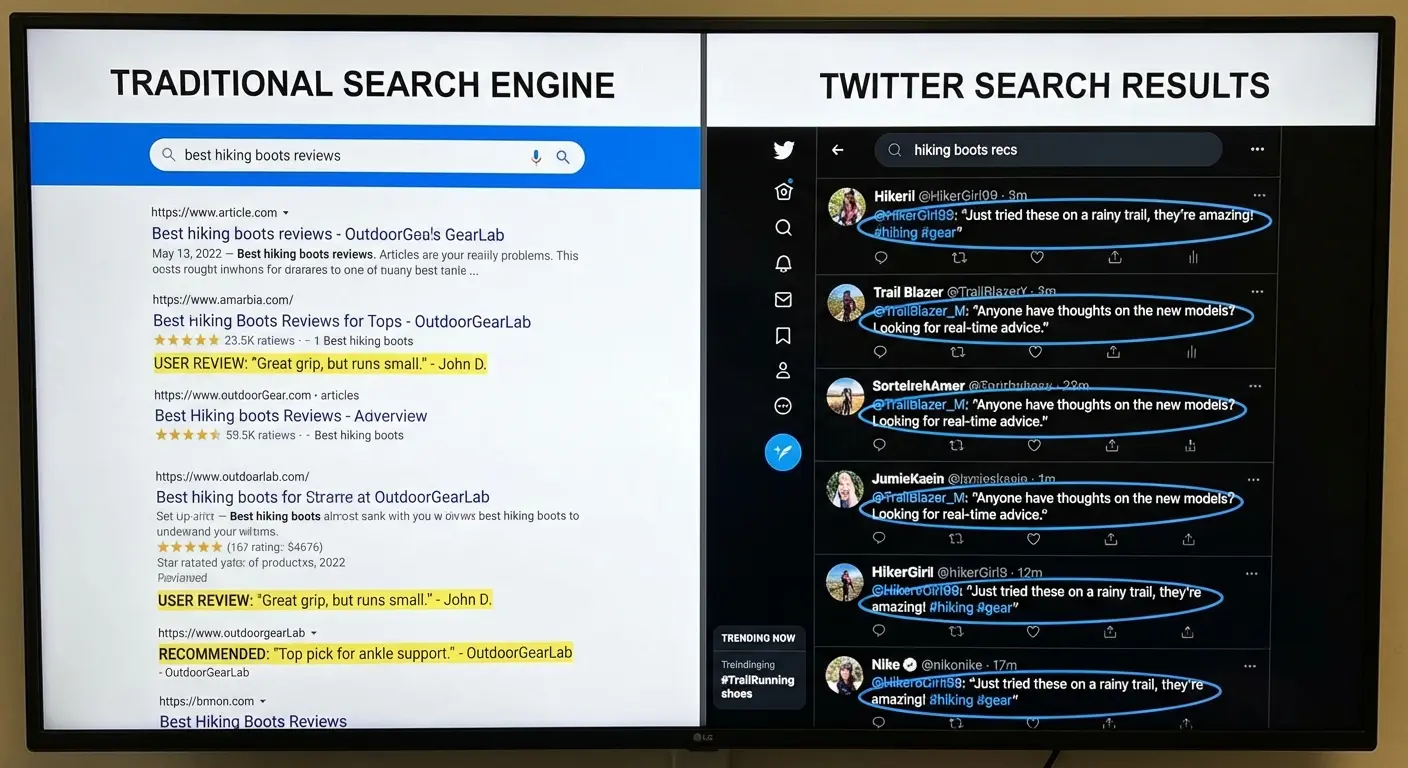
Younger people are searching Twitter instead of Google for a lot of stuff. If you’re over 35, this probably sounds insane. But Gen Z? They trust Twitter reviews more than SEO’d-to-death blog posts. Whether you like it or not, that’s where things are going.
Twitter increasingly functions as a search engine, particularly for Gen Z and Millennials seeking authentic, real-time information. Users search for product reviews, local restaurant recommendations, breaking news, and expert opinions, trusting peer recommendations over SEO-optimized content.
Brands optimize tweet content with searchable keywords, maintain comprehensive thread libraries that answer common questions, and create FAQ-style content that surfaces in Twitter search results. The shift requires thinking about Twitter content as evergreen search assets, not ephemeral social posts. Analyzing past twitter trends helps identify recurring seasonal patterns and perennial topics worth creating permanent content around.
What to Think About
Will this last? Very high. Search behavior is fundamentally shifting, especially among younger demographics who never developed Google-first habits.
Will your people care? Very high. Affects all demographics increasingly, though adoption rates vary by age. Even older users are discovering Twitter’s value for real-time, authentic information.
Brand Safety? High. Searchable content requires quality control. What you publish becomes permanent, discoverable content that represents your brand indefinitely.
Engagement Potential? Very high. Search intent indicates high interest. People searching for specific information are further along the decision journey than passive scrollers.
Data Needs: Track search impressions and conversion from search. Distinguish between timeline impressions and search impressions to understand which content types serve each discovery method.
Timing: Evergreen content provides ongoing search value. Investment in searchable content compounds over time as your library grows.
Let Me Break This Down: Local Restaurant Search Optimization
A local restaurant optimizes their Twitter presence for search queries (“best brunch in [neighborhood]” or “restaurants open late near me”). They maintain threads answering common questions: menu items, dietary accommodations (vegan options, gluten-free availability), parking information, reservation policies, and wait time expectations.
Each thread is keyword-optimized and regularly updated to reflect menu changes, seasonal offerings, and current hours. When users search these terms on Twitter, the restaurant’s content surfaces prominently alongside peer recommendations.
They track search impressions separately from timeline impressions, discovering that search-driven traffic converts at 3x the rate of passive scrolling. This insight leads them to prioritize searchable content creation over viral content attempts, focusing resources on answering questions potential customers are actively asking.
17. Conversational Search Optimization
Content structured to answer natural language questions as users search conversationally is becoming essential for discoverability.
How This Actually Works
“Best marketing agency for SaaS companies in 2026” – Content that directly answers this specific query rather than generic “marketing services” messaging.
“How much should I budget for PPC advertising” – Threads that provide actual budget ranges, factors that influence costs, and ROI expectations rather than vague “contact us for pricing” responses.
“What’s the ROI timeline for local SEO” – Detailed explanations of when businesses typically see results, what factors accelerate or delay outcomes, and realistic expectation-setting.
What to Think About
Will this last? Very high. Voice and conversational search are dominating as people interact with AI assistants and search engines more naturally.
Will your people care? Universal. This is how humans naturally seek information. Conversational queries span all demographics and use cases.
Brand Safety? High. Helpful content builds authority. Answering questions positions you as a resource rather than a vendor.
Engagement Potential? High. Directly addresses user intent. When your content answers the exact question someone asked, engagement and conversion rates increase dramatically.
Data Needs: Track question-based queries and answer effectiveness. Identify which questions drive most searches and which answers convert best.
Timing: Ongoing content creation builds searchable library. Each question answered becomes a permanent asset that continues delivering value.
18. Predictive Trend Participation
Predictive tools can sometimes spot trends before they blow up. Sometimes. They’re not magic. I’ve seen them work great, and I’ve seen them predict trends that never happened. But if you’ve got the budget and the speed to act on predictions, they’re worth testing.
Advanced analytics identify emerging conversations before they hit top twitter trending status, giving brands first-mover advantage. Machine learning models analyze conversation velocity (how fast discussions are spreading), influencer participation (which high-reach accounts are engaging), sentiment trajectory (whether sentiment is intensifying), and historical pattern matching (comparing current signals to past twitter trends that went viral).
Brands pre-create content frameworks, obtain necessary approvals, and deploy the moment twitter trends break, appearing as early participants rather than late followers jumping on bandwagons.

What to Think About
Will this last? Very high. Competitive necessity as technology spreads. What’s currently a competitive advantage will become baseline expectation.
Will your people care? High. Relevance to emerging conversations. Early participation captures attention before audiences experience topic fatigue.
Brand Safety? Medium. Predictions aren’t perfect. Requires human oversight to prevent deploying content for trends that evolve in unexpected or problematic directions.
Engagement Potential? Very high. Early participation captures attention. First movers earn disproportionate engagement compared to late arrivals saying the same things.
Data Needs: Highly data-intensive. Requires sophisticated analytics infrastructure that processes massive data volumes and identifies patterns in real-time.
Timing: Provides competitive advantage. Requires rapid content production systems that can deploy within hours of prediction signals.
Let Me Break This Down: SaaS Predictive Strategy
A SaaS company uses AI to monitor early signals that “remote work productivity” conversations are accelerating. Six hours before it becomes a top twitter trending topic, their system alerts the marketing team with confidence scores and predicted peak timing.
They deploy pre-approved content frameworks: a thread on productivity metrics (comparing remote vs. office performance data), an infographic showing how distributed teams maintain collaboration, and a case study of how their software improved a specific company’s remote team performance.
When the topic trends, they’re already in the conversation with substantive content while competitors scramble to create reactive posts. Their early participation earns 10x more engagement than late-arriving competitors because they captured attention before audiences experienced topic fatigue.
The system tracks prediction accuracy, learning which signals most reliably indicate emerging trends. Over time, the model improves, reducing false positives and increasing confidence in deployment decisions.
|
Trend Participation Timing |
Reactive Approach |
Predictive Approach |
|---|---|---|
|
Content Creation |
Starts after trend is already viral |
Begins 6-24 hours before peak |
|
Engagement Rate |
0.8-1.2% (late to saturated conversation) |
3.5-5.8% (early participation advantage) |
|
Approval Process |
Rushed decisions with higher risk |
Pre-approved frameworks with oversight |
|
Competitive Position |
One of thousands saying the same thing |
Among first voices shaping conversation |
|
Audience Perception |
Bandwagon jumping, opportunistic |
Thought leadership, industry awareness |
|
Content Quality |
Often compromised by speed pressure |
Strategic, well-crafted with time buffer |
*These aren’t hard rules, but here’s the pattern I keep seeing with clients who test predictive vs. reactive approaches.
How The Marketing Agency Addresses Twitter Trend Challenges
Navigating twitter trends and maximizing trending opportunities requires exactly what The Marketing Agency specializes in: data-driven strategy rooted in science, not guesswork.
Look, I’m biased here because this is literally what we do. But here’s the honest pitch: most agencies will chase every trend and call it strategy. We don’t. We look at your data first, figure out what’s actually worked, and only then decide which trends are worth your time. Sometimes that means saying “no, don’t do that” even when everyone else is.
The Data Foundation Challenge
Most businesses chase trending topics reactively, without understanding whether participation drives actual business results. The Marketing Agency’s approach ensures no moves are made without proper data and insights to drive them forward.
Before jumping on any trend, they analyze historical performance of similar trends for your brand, conversion potential vs. vanity metrics (impressions mean nothing without revenue), attribution modeling that connects social engagement to actual business outcomes, and competitive landscape analysis to identify white space opportunities.
This eliminates the gambling mentality that plagues most social media marketing, replacing it with strategies deeply rooted in metrics.
The Speed vs. Strategy Dilemma
Twitter trends move fast, but rushing without strategy is expensive. The Marketing Agency solves this through AI-driven predictive systems. Their integration of AI-driven analytics and automation into every layer of the marketing process means they can identify emerging trends before they peak, giving clients first-mover advantage without sacrificing strategic rigor.
Their approach mirrors the performance marketing methodology that prioritizes measurable outcomes over vanity metrics when evaluating twitter trends participation.
Their proprietary systems analyze campaign data in real time, adjusting ad spend, creative output, and targeting parameters so trend-based campaigns improve continuously rather than being set-and-forget gambles.
Pre-approved content frameworks and clear decision-making processes enable quick deployment while maintaining brand safety and strategic alignment.
The LLM Discovery Opportunity
As Twitter becomes increasingly integrated with AI discovery (users asking ChatGPT “what’s trending on Twitter about [topic]”), The Marketing Agency’s expertise in LLM Optimization becomes critical. They structure your content and metadata to be AI-readable, ensuring your brand appears in AI-generated search answers, summaries, and recommendations.
This means your Twitter presence works double-duty: engaging human audiences directly while also being discoverable through AI systems that increasingly mediate information discovery.
The Local-to-Global Advantage
For businesses with physical locations, hyper-local Twitter communities represent massive opportunity. The Marketing Agency’s local marketing expertise translates perfectly to Twitter’s geographic capabilities.
Map visibility and directory rankings expertise applies to geo-fenced Twitter content. Experience with dozens, or hundreds, of locations means systems that scale across markets. City-level keyword targeting to geo-fenced ad delivery knowledge directly transfers to location-based Twitter strategies. Understanding of local search behavior (how your customers search, decide, and visit) informs which local trends drive foot traffic and calls.

The ROI Accountability Gap
The biggest challenge with Twitter trends is proving ROI. The Marketing Agency’s philosophy directly addresses this: every campaign is tracked by the things that matter to your business (calls, clicks, map views, bookings, and walk-ins). No vanity metrics, just actions that drive revenue.
Their approach to Twitter trend participation includes attribution modeling that plays a big role when determining how to best allocate your marketing budget. They track whether trend participation drives awareness, consideration, or conversion, then optimize accordingly.
The 80/20 rule centers their strategies. This means focusing on the 20% of trends that drive 80% of results, rather than chasing every top twitter trends topic indiscriminately.
Regular regroups and ad hoc check-ins provide open communication channels with clients. They’re keen on providing all the facts so you can make decisions based on real data. You’ll know exactly which trends drove revenue and which were noise.
The Multi-Platform Integration
Twitter trends don’t exist in isolation. The Marketing Agency turns the world’s leading platforms into engines of growth, meaning Twitter trend insights inform SEO strategy (trending topics reveal search intent shifts), PPC campaigns (trend data identifies emerging keywords before CPCs spike), email marketing (trending topics inform content that resonates with current audience interests), and inbound marketing (trends reveal customer pain points and questions to address).
Similar to how they approach social media marketing integration, Twitter trend intelligence becomes a strategic input that amplifies performance across all channels.
This holistic approach means Twitter trend intelligence amplifies performance across all channels.
Getting Started
Whether you’re looking to leverage past twitter trends to predict future opportunities, capitalize on current top twitter trends, or build systems that identify emerging trends before competitors, The Marketing Agency’s process is straightforward:
Discovery Call: Review your current Twitter presence and identify trend participation opportunities aligned with business goals.
Strategy Questionnaire: Define your brand voice, risk tolerance, and success metrics for trend-based content.
Platform Access: Integrate Twitter analytics with broader marketing analytics for comprehensive attribution.
Custom Strategy: Develop trend identification systems, content frameworks, and deployment processes.
Execution & Optimization: Launch with real-time monitoring and continuous refinement based on performance
data.
The result? Twitter trend participation that drives measurable growth that turns marketing into momentum, not viral moments that evaporate without business impact.
Ready to turn Twitter trends into revenue? The Marketing Agency combines human creativity with machine intelligence to help you navigate the fast-moving world of social trends with strategic precision. Contact them to start your data-driven Twitter strategy today.
Final Thoughts
Here’s What I’ve Changed My Mind About:
A year ago, I thought AI personality accounts were gimmicky. I was wrong. Six months ago, I told clients not to bother with Twitter Spaces subscriptions. Also wrong. Last month I thought voice notes were a fad. Jury’s still out, but I’m less sure.
Point is: this stuff moves fast, and anyone who tells you they know exactly what’ll work is lying. We’re all figuring this out as we go.
The Twitter landscape has evolved far beyond simple hashtag monitoring and reactive posting. The 18 trends covered here represent fundamental shifts in how people discover information, build communities, make purchases, and engage with brands. Success doesn’t come from chasing every trending topic. It comes from evaluating which twitter trends align with your audience, support your business goals, and offer genuine engagement opportunities.
AI integration, hyper-local communities, native commerce, radical transparency, visual innovation, and search evolution aren’t isolated phenomena. They’re interconnected shifts that compound when approached holistically. Your AI-optimized content becomes discoverable through both human search and LLM recommendations. Your hyper-local community engagement informs which products to feature in native checkout experiences. Your founder’s transparent content builds trust that converts when prospects search for solutions you provide.
The brands doing well on Twitter right now? They’re not doing anything magic. They track what works, they move fast, they’re not afraid to try weird stuff, and they’re honest when things fail. That’s it. No secret sauce, just consistent effort and willingness to adapt.
They’ve invested in data infrastructure that tracks real business outcomes, not vanity metrics. They’ve built systems for rapid content creation and deployment without sacrificing strategic rigor. They’ve established clear frameworks for evaluating trend participation based on longevity, audience alignment, brand safety, engagement potential, data requirements, and timing considerations.
Most importantly, they’ve shifted their mindset from Twitter as a broadcasting channel to Twitter as a multi-functional platform serving search, commerce, community, and discovery needs simultaneously. Each tweet isn’t a social post anymore. It’s a searchable knowledge asset, a potential commerce entry point, a community conversation starter, and an AI-discoverable reference all at once.

The opportunity cost of ignoring these trends grows daily. Your competitors are building searchable content libraries while you’re treating tweets as ephemeral. They’re establishing hyper-local community presence while you’re running generic national campaigns. They’re optimizing for LLM discovery while you’re focused solely on timeline impressions. The gap widens with each passing month.
Start with the trends that align most closely with your current capabilities and business model. Local businesses should prioritize hyper-local communities and Twitter search optimization. E-commerce brands should focus on native checkout and 3D visualization. B2B companies should emphasize founder-first content and professional micro-communities. Service businesses should leverage behind-the-metrics transparency and conversational search optimization.
Here’s What Actually Matters:
You don’t need to do all 18 of these things. You probably shouldn’t. Pick two or three that make sense for your business, test them for 90 days, measure what happens, and adjust.
Most trends will pass you by. That’s fine. You’re not trying to catch every wave, you’re trying to catch the right ones.
And if you try something and it flops? Welcome to Twitter. We’ve all been there. The difference between brands that win and brands that quit is what they do after the flop.
Where I’ve Screwed This Up: I once convinced a client to jump on every trending hashtag for a week. We got impressions. Lots of them. Know what we didn’t get? A single qualified lead. Turns out shouting into trending conversations isn’t the same as having something valuable to say.
Whatever your starting point, remember that Twitter trend participation without data foundation is gambling. Measure what matters. Track attribution. Calculate ROI. Adjust based on performance. The brands that approach twitter trends with this discipline will build sustainable competitive advantages while others chase viral moments that evaporate without business impact.
So yeah, Twitter’s changing fast. But the fundamentals haven’t: show up consistently, add value, be honest, track what works, and don’t be boring.
Everything else is just tactics.