



Table of Contents
-
The Intelligence Layer
-
LLM Optimization Is Now Table Stakes
-
Answer Engine Optimization Replaces Traditional SERP Strategy
-
Semantic Entity Mapping Over Keyword Density
-
AI-Generated Content Detection and Differentiation
-
Predictive Search Intent Modeling
-
-
The Technical Foundation
-
Core Web Vitals Evolution Beyond Page Speed
-
JavaScript Rendering Optimization for Crawlers
-
Schema Markup as a Ranking Signal (Not Just a Feature)
-
API-First Content Delivery Systems
-
Progressive Web App Integration
-
-
The Human Element
-
Brand Authority Signals Trump Link Volume
-
User-Generated Content as a Ranking Multiplier
-
Behavioral Engagement Metrics Replace Dwell Time
-
Accessibility as a Core Ranking Factor
-
Multi-Format Content Ecosystems
-
-
The Measurement Shift
-
Attribution Modeling for Organic Traffic
-
Conversion Value Optimization Over Traffic Volume
-
Cross-Platform Search Presence Tracking
-
Predictive ROI Forecasting for SEO Investments
-
TL;DR
Too long? Here’s the short version:
-
LLMs are changing search. Your content needs to work for AI, not just humans.
-
Technical stuff matters more than ever. If Google can’t render your site, you don’t exist.
-
Brand authority beats link building now. People need to talk about you, not just link to you.
-
Stop counting traffic. Start counting revenue.
-
Accessibility is a ranking factor. Finally.
-
One format isn’t enough. Create content everywhere your audience hangs out.
Search is changing faster than it has in 20 years. Google processes over 8.5 billion searches daily (that’s 99,000 every second, which is honestly insane), but how those searches get answered? Completely different now.
The era of ten blue links is dying. We’re getting AI-generated summaries, conversational interfaces, and content that lives everywhere except traditional search results. These 19 things aren’t predictions about what might happen. They’re happening right now, affecting your visibility, traffic, and revenue whether you like it or not.
I’ve been doing SEO for over a decade, and I’ve never seen changes this big happen this fast. The businesses adapting to this stuff are capturing market share. The ones clinging to 2019 tactics are watching their organic traffic disappear. We’re seeing this play out across our client portfolio every single week.

The Intelligence Layer
Search engines think differently now. They’re running on LLMs (the same tech behind ChatGPT), and that changes everything about how they read and rank your content.
These five trends aren’t future considerations. They’re active ranking factors affecting your visibility right now. Understanding how AI interprets your content determines whether you appear in traditional search results, AI-generated summaries, or nowhere at all.
Here’s what keeps me up at night: We’ve watched brands disappear from search visibility overnight because their content structure doesn’t align with how LLMs extract and present information. Not penalized. Not filtered. Just… invisible to the systems that matter.
The gap between companies who get this and those who don’t? It’s widening fast.
|
Traditional SEO Focus |
Intelligence Layer Focus |
What This Actually Means |
|---|---|---|
|
Keyword density and placement |
Semantic entity relationships and context |
Your content needs to show topical authority across related concepts, not just repeat the same phrase |
|
Optimizing for click-through |
Optimizing for information extraction |
Structure content so AI can parse and cite it, even if users never click |
|
Single-format content |
Multi-format content ecosystems |
Create text, video, and structured data variants of the same information |
|
Ranking in blue links |
Appearing in AI summaries and voice results |
Focus on clear answers and factual accuracy that AI can confidently quote |
|
Backlink volume |
Brand authority signals across platforms |
Build presence beyond your website where AI systems can verify you’re legit |

1. LLM Optimization Is Now Table Stakes
Here’s the problem: Your content needs to make sense to both humans and AI. And no, they don’t read the same way.
Humans skim. AI parses structure. Humans forgive vague language. AI needs clear entity relationships. You’re writing for two completely different readers now, and if you ignore either one, you’re toast.
Large language models like ChatGPT, Gemini, and Claude have become discovery engines. They summarize, recommend, and answer questions about businesses. If your content isn’t structured for AI readability, you’re invisible to an entire channel of user discovery.
Translation: You need structured data that goes beyond basic schema. You need content with clear entity relationships. You need your brand information appearing consistently across platforms. We’re not talking about keyword stuffing for robots. We’re talking about semantic clarity that helps AI models understand what your business does, who it serves, and why it matters.
The brands winning here treat AI as a legitimate traffic source, not a novelty. For deeper insights on this shift, check out our LLM optimization strategies guide.
The urgency is real. According to recent analysis from Search Engine Journal, every marketing leader is hearing the same question right now: “What’s our AI strategy?” But here’s the thing: moving fast isn’t the point. Understanding where AI visibility will actually create measurable lift for your specific business model? That’s the point.
Ask yourself: Does your product complexity support AI optimization? Is your customer journey simple enough for AI to explain? Is your content actually ready for this, or are you about to waste six months optimizing for a channel that won’t move the needle?
Look, I know this sounds paranoid. But we got this wrong initially. Spent six months building traditional SEO while our competitors built LLM visibility. Expensive lesson.

2. Answer Engine Optimization Replaces Traditional SERP Strategy
When’s the last time you actually clicked through ten blue links?
Users aren’t doing that anymore. They’re getting answers directly in search results, voice assistants, and AI chat interfaces. No click required.
Answer Engine Optimization (AEO) focuses on positioning your content as the source for these direct answers. You structure content that directly addresses questions, provides clear definitions, and offers step-by-step solutions. Think featured snippets, but evolved.
The goal isn’t to rank. It’s to be cited, quoted, and referenced by the systems that deliver answers.
What does this look like in practice? You optimize for information extraction, not clicks. Your content must be easily parsed, factually accurate, and contextually complete. Half-formed thoughts and vague positioning won’t cut it. Learn how to do this right with our answer engine optimization framework.
The numbers back this up. Featured snippets have the highest clickthrough rate at 42.9%. That’s insane. Nearly half of people who see a featured snippet click it. Compare that to position 1 organic results (around 27%), and you see why everyone’s obsessed with snagging that spot.
But here’s the kicker: 60% of searches now end without a click due to AI Overviews. Your content needs to be structured not just to earn clicks, but to be cited as the authoritative source within AI-generated answers themselves.
We’re no longer writing for human readers who’ll click through to our sites. We’re writing for AI systems that’ll extract, summarize, and present our information without sending users to our pages.
So how do you capture value when the answer is delivered without the click? That’s where brand positioning, trust signals, and strategic content structure become critical. The question becomes less about traffic volume and more about brand authority and recognition.
3. Semantic Entity Mapping Over Keyword Density
Search engines moved beyond matching words years ago. Now they understand relationships between concepts.
Semantic entity mapping means identifying the core entities in your content (people, places, products, concepts) and establishing how they connect. Instead of repeating “digital marketing agency” seventeen times, you’re building a web of related entities: SEO, PPC, conversion optimization, attribution modeling, analytics platforms.
Google’s Knowledge Graph operates on entity relationships, not keyword frequency.
Your content needs to demonstrate topical authority by covering the ecosystem around your subject matter. This doesn’t mean writing longer content. It means writing smarter content that establishes clear connections between relevant concepts.
The difference shows up in how search engines categorize and rank your pages for related queries you never explicitly targeted. We’ve seen pages rank for hundreds of related keywords they never mentioned because the entity relationships were properly established.
Here’s an example: If you’re discussing conversion rate optimization in depth, the algorithm understands you’re probably relevant for queries about landing page testing, A/B testing frameworks, and statistical significance… even if those exact phrases don’t appear in your content.
This rewards expertise over narrow keyword targeting. Discover advanced techniques in our knowledge graph optimization guide.

4. AI-Generated Content Detection and Differentiation
Search engines can identify AI-generated content. They’re getting better at it daily.
And yes, I know this is frustrating. You finally figured out how to use AI to speed up content production, and now Google’s penalizing it? Except they’re not. Not exactly. They’re penalizing lazy AI content. There’s a difference.
The question isn’t whether you use AI tools (most of us do). It’s whether your content demonstrates human insight, original research, or unique perspective that only comes from actual experience.
Google’s Helpful Content Guidelines explicitly reward content that shows firsthand expertise and genuine value. You can use AI for research, outlining, and efficiency. But the final output needs human refinement that adds depth machines can’t replicate.
What does that mean? Incorporate proprietary data. Real client outcomes. Specific methodologies. Nuanced perspectives that only come from years of execution.
We use AI extensively in our content production. Every piece goes through multiple rounds of human editing that adds client examples, strategic insights, and perspectives drawn from actual experience. That’s the difference between content that ranks and content that disappears.
People think Google penalizes AI content. They don’t. They penalize thin, generic, unhelpful content, which AI happens to produce at scale when used carelessly. The companies winning combine AI efficiency with human expertise. They don’t choose one over the other.
5. Predictive Search Intent Modeling
We’re moving from reactive content creation to predictive intent modeling.
Advanced analytics platforms now forecast what users will search for based on behavioral patterns, seasonal trends, and emerging topics. You can create content before demand peaks, positioning yourself as the authority when search volume surges.
Predictive modeling analyzes historical data, identifies patterns in query evolution, and suggests content gaps in your current strategy. You’re not guessing what to write next. You’re using data to anticipate user needs before they fully articulate them.
The play: Integrate machine learning tools with your content strategy. The payoff: You capture traffic while competitors are still reacting to trends you predicted weeks earlier.
We’ve used predictive modeling to identify emerging queries in our clients’ industries, creating content months before search volume spiked. When the trend hit mainstream awareness, our content had already built authority and accumulated ranking signals. By the time competitors noticed the opportunity, we’d already won.
This transforms content strategy from reactive to proactive. Instead of watching what ranks and trying to replicate it, you’re forecasting what will matter next and building authority before the competition recognizes the opportunity.
Full transparency: This is cutting-edge stuff. We use it for enterprise clients with massive content operations. If you’re a 5-person company, there are better places to invest your time. But if you’re operating at scale? This is how you stay ahead.
The Technical Foundation
Technical SEO has evolved way beyond fixing broken links and adding meta descriptions.
The technical foundation now determines whether search engines can properly crawl, render, and index your content in the first place. These five technical trends separate functional websites from high-performing search assets.
Here’s the thing: These implementations require developer resources and strategic planning. They’re not optional. Ignoring this stuff means watching your competitors capture traffic you should own, regardless of how good your content is.
I’ve audited sites with exceptional content that received zero organic traffic because the technical implementation prevented search engines from accessing it. Technical excellence is the price of admission now.
6. Core Web Vitals Evolution Beyond Page Speed
Core Web Vitals expanded beyond simple page load times to measure actual user experience quality.
Largest Contentful Paint (LCP), First Input Delay (FID), and Cumulative Layout Shift (CLS) account for how quickly content becomes visible, how fast pages respond to interactions, and whether elements shift unexpectedly during load.
Google’s algorithm updates increasingly penalize sites that provide poor user experiences, even if their content is exceptional. You need to optimize for perceived performance, not just technical speed.
In practice: Prioritize above-the-fold content loading. Minimize JavaScript that blocks rendering. Ensure visual stability as pages load.
Many sites pass basic speed tests but fail on actual user experience metrics. That gap is costing you rankings. We’ve seen sites with sub-second load times still fail Core Web Vitals because elements shifted during load or interactivity was delayed by poorly optimized scripts.
Search engines want to send users to sites that feel fast and responsive, not sites that technically load quickly but feel sluggish. There’s a difference, and the algorithm can tell.

7. JavaScript Rendering Optimization for Crawlers
This one makes me irrationally angry.
Search engine crawlers are getting better at rendering JavaScript, but they’re not perfect. If your site relies heavily on JavaScript frameworks (React, Vue, Angular), you need to ensure crawlers can access and index your content properly.
You build a beautiful React site, spend months on it, and Google sees… nothing. Blank pages. Because crawlers don’t always wait for JavaScript to execute. Cool. Great. Love that for you.
The fix often requires implementing server-side rendering (SSR) or static site generation (SSG) to deliver pre-rendered HTML to crawlers while maintaining dynamic functionality for users.
Many modern websites are essentially invisible to search engines because their content only appears after JavaScript execution. And crawlers don’t always wait for that process to complete.
Test your site with tools that show how crawlers see your content. The gaps you’ll discover are probably costing you traffic you didn’t know existed.
Real example: Last year we audited a project management SaaS tool. They had 200+ help articles, detailed feature comparisons, case studies. Genuinely good content. Zero Google traffic. We checked Google Search Console: 12 pages indexed. Their entire site was built in React with client-side rendering. Google’s crawler saw blank pages with loading spinners. That’s it.
We implemented SSR. Within three weeks they had 2,000+ pages indexed. Traffic went from basically zero to 15,000 monthly visitors in 90 days.
If your development team prioritizes user experience over crawlability, you’re building a beautiful site that search engines can’t see.
8. Schema Markup as a Ranking Signal (Not Just a Feature)
Schema markup graduated from “nice to have” to “direct ranking factor.”
Structured data helps search engines understand your content’s context, relationships, and purpose. Sites with solid schema implementation consistently outrank competitors with similar content quality but poor structured data.
You should implement schema for articles, products, services, FAQs, reviews, events, and organizational information. The goal is giving search engines maximum context about every element on your page.
This isn’t just about rich snippets anymore. It’s about helping search algorithms properly categorize and rank your content.
Many sites implement basic schema but miss opportunities for deeper markup that establishes topical authority and entity relationships. The more context you provide, the better search engines understand where you fit in their index.
Among the trends we’re tracking, schema implementation shows the clearest correlation with ranking improvements. Sites that implement structured data properly see measurable ranking increases within weeks, even without changing their content.
Remember what I said about entity relationships in #3? Schema markup is how you make those relationships explicit to search engines. It’s the technical layer that connects semantic entity mapping to actual algorithmic understanding.

9. API-First Content Delivery Systems
Content management is shifting from monolithic platforms to API-first architectures that separate content storage from presentation.
This approach (often called “headless CMS”) allows you to deliver content across multiple channels (website, mobile apps, voice assistants, third-party platforms) from a single source.
For SEO, this means better performance, easier multi-platform optimization, and flexibility to adapt to new search interfaces as they emerge. You optimize content once and deploy it everywhere, maintaining consistency while tailoring presentation for each channel.
Traditional CMS platforms struggle with modern performance requirements and multi-channel distribution. API-first systems solve both problems while future-proofing your content infrastructure for whatever search interfaces develop next.
We’ve migrated several enterprise clients from WordPress to headless architectures. The performance improvements alone drove 20-30% traffic increases before we changed a single word of content. Just from the infrastructure upgrade. That’s how much technical implementation matters now.
The flexibility to serve content to emerging AI platforms, voice assistants, and future search interfaces makes this one of the most forward-looking approaches you can take.
10. Progressive Web App Integration
Progressive Web Apps (PWAs) combine the best features of websites and native apps: fast loading, offline functionality, push notifications, and app-like interfaces. All without requiring app store downloads.
For SEO, PWAs offer superior performance metrics, better user engagement, and improved mobile experience. They load instantly, work offline or on poor connections, and provide smooth interactions that keep users engaged longer.
Search engines reward these experience improvements with better rankings.
PWAs also reduce bounce rates by ensuring content remains accessible even when connectivity is spotty. The implementation requires technical investment, but the payoff shows up in both user metrics and search visibility.
Sites that feel fast and responsive keep users engaged. And engagement is a ranking signal search engines increasingly prioritize.
We implemented PWA functionality for an e-commerce client. Their mobile bounce rate dropped 34% while time-on-site increased 52%. Those behavioral improvements translated directly into ranking gains across their entire product catalog.
Honestly? PWAs are cool but not urgent for most businesses. If you’re still struggling with basic site speed, fix that first. Don’t get distracted by shiny new tech. But if you’ve got the fundamentals covered and you’re ready to level up? PWAs deliver measurable results.
The Human Element
Technical optimization means nothing if you’re ignoring the human signals that search engines increasingly prioritize.
These five trends center on how real users interact with, trust, and engage with content. Search algorithms are sophisticated enough now to measure genuine user satisfaction, not just technical checkboxes.
The brands winning in search optimize for humans first and algorithms second. Because algorithms are increasingly designed to reward exactly that approach.
We’ve stopped asking “what does Google want?” and started asking “what do users need?” Our rankings have never been better.
11. Brand Authority Signals Trump Link Volume
We’ve entered an era where brand mentions, citations, and authority signals matter more than raw backlink counts.
Search engines evaluate whether your brand is discussed, recommended, and referenced across the web (even when those mentions don’t include links).
Focus on brand building, thought leadership, and becoming a cited source in your industry. You need to appear in industry publications, podcasts, social discussions, and expert roundups.
Establish your brand as an entity that search engines recognize as authoritative within your domain. This shift rewards businesses that invest in genuine authority building over those gaming link schemes.
Quality backlinks still matter. But they’re part of a larger authority picture that includes unlinked mentions, social signals, and brand search volume.
We track brand mention velocity for our clients (how frequently their brand appears in industry contexts, regardless of links). That metric correlates more strongly with ranking improvements than backlink acquisition rate.
Search engines understand that brands people talk about, reference, and trust deserve visibility. It’s that simple.

12. User-Generated Content as a Ranking Multiplier
Search engines recognize that user-generated content (reviews, comments, Q&A, testimonials) signals genuine engagement and value.
Sites with active user participation consistently outrank static sites with similar content quality. This content provides fresh perspectives, long-tail keyword coverage, and social proof that algorithms interpret as quality signals.
Encouraging and moderating user contributions becomes part of your SEO strategy, not just your community management.
You need systems that make contributing easy, incentives that encourage participation, and moderation that maintains quality. The challenge is generating authentic engagement. Forced or fake user content backfires.
Sites that build genuine communities around their content see compounding benefits as user contributions expand topical coverage and demonstrate ongoing relevance.
One of our B2B clients added a community Q&A section to their resource library. Within six months, user-generated questions and answers covered 300+ long-tail keywords they’d never targeted. That section drove a 40% increase in organic traffic.
Hot take: Most businesses shouldn’t focus on this yet. UGC is powerful, but it requires critical mass. If you’re getting 50 visitors a day, you don’t have enough traffic to generate meaningful UGC. Focus on creating your own content first. Build the audience, then give them ways to contribute.
13. Behavioral Engagement Metrics Replace Dwell Time
Search engines moved beyond simple dwell time to measure actual engagement quality.
They track scroll depth, interaction patterns, return visits, and task completion. A user who spends two minutes actively engaging with your content signals more value than someone who leaves a page open for ten minutes while checking email.
Optimize for meaningful engagement: clear navigation, compelling content structure, interactive elements, and clear calls to action that guide users through your site.
You want users actively consuming and interacting with content, not passively present.
Sites that facilitate genuine engagement through intuitive design, valuable information, and clear user journeys see ranking improvements even if traditional metrics like time-on-page remain unchanged.
The algorithm is sophisticated enough now to distinguish between actual engagement and passive presence.
We’ve restructured content to include interactive elements, embedded calculators, and progressive disclosure that encourages active engagement. Those pages outrank longer-form static content that users scroll past without interacting.
This connects back to Core Web Vitals (#6). Search engines are measuring actual user behavior, not just technical metrics. The content needs to invite interaction, not just exist on the page.
14. Accessibility as a Core Ranking Factor
Web accessibility isn’t just ethically important. It’s now a direct ranking factor.
Search engines prioritize sites that work for users with disabilities, recognizing that accessible sites provide better experiences for everyone.
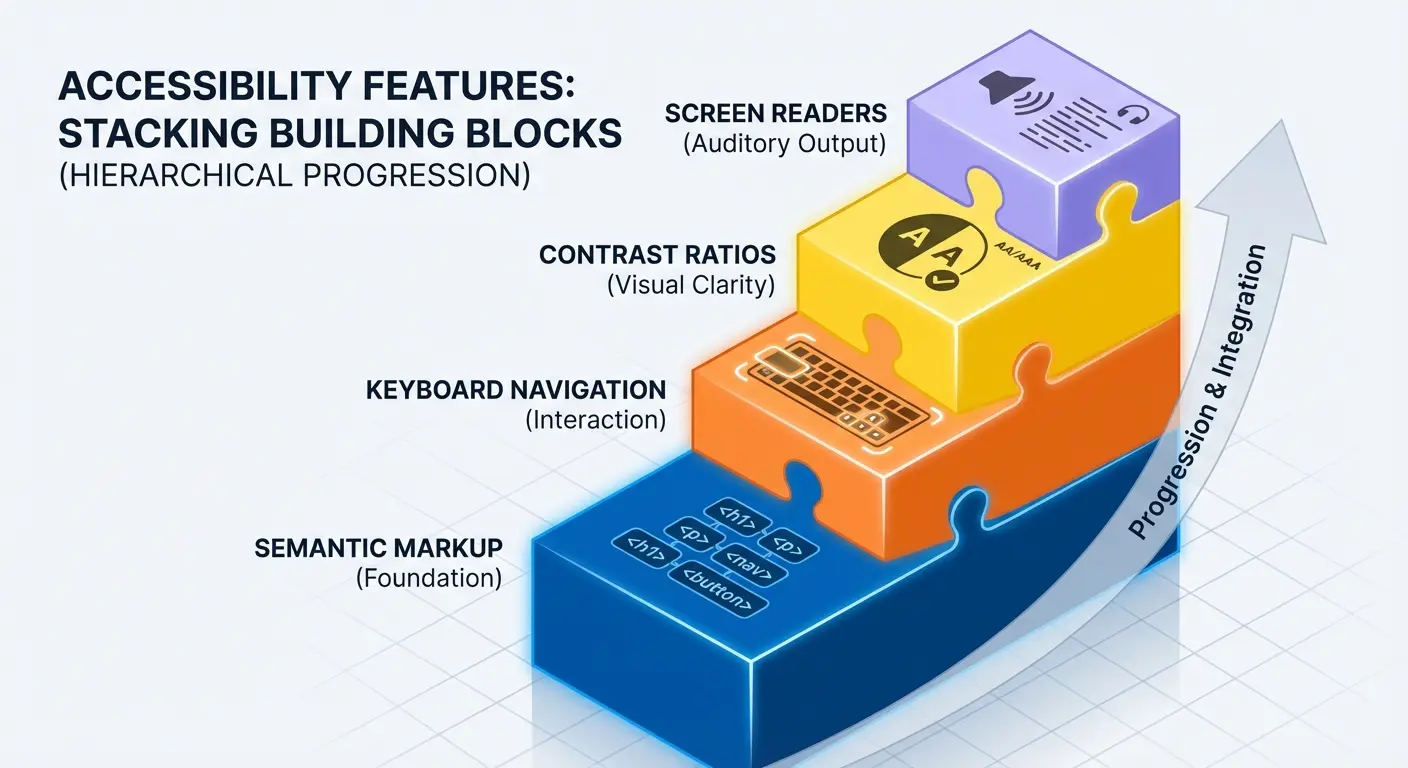
Implement proper heading hierarchy, alt text for images, keyboard navigation, sufficient color contrast, and screen reader compatibility.
Many accessibility improvements also benefit SEO directly: clear heading structures help crawlers understand content hierarchy, descriptive alt text provides keyword context, and clean HTML improves crawlability.
Sites that ignore accessibility face both ranking penalties and potential legal issues. The good news is that accessibility improvements often enhance user experience across the board, benefiting all users while improving search visibility.
This is one area where doing the right thing and optimizing for search perfectly align.
|
Accessibility Feature |
SEO Benefit |
User Experience Impact |
|---|---|---|
|
Proper heading hierarchy (H1-H6) |
Helps crawlers understand content structure and topical relationships |
Improves navigation for screen readers and visual scanning |
|
Descriptive alt text for images |
Provides keyword context and enables image search ranking |
Makes visual content accessible to visually impaired users |
|
Keyboard navigation support |
Indicates clean, crawlable HTML structure |
Enables users with motor disabilities to navigate effectively |
|
Sufficient color contrast ratios |
Signals attention to user experience quality |
Improves readability for users with visual impairments |
|
Semantic HTML markup |
Enhances crawler understanding of content meaning |
Provides context for assistive technologies |
We conducted accessibility audits for three enterprise clients and found that fixing accessibility issues correlated with 15-25% ranking improvements within 90 days. The improvements weren’t dramatic (adding alt text, fixing heading hierarchy, improving color contrast) but the cumulative effect was significant.
15. Multi-Format Content Ecosystems
Users consume content differently depending on context, device, and preference.
Search engines reward sites that offer content in multiple formats: written articles, videos, podcasts, infographics, interactive tools, downloadable resources.
This approach captures traffic from different search interfaces (Google Search, YouTube, Google Images, podcast platforms) while meeting users wherever they are.
A single topic can generate multiple content pieces, each optimized for its format and distribution channel. Video content should be transcribed for text-based search, written content should include visual elements, and complex topics should offer interactive exploration tools.
Sites that build content ecosystems around core topics demonstrate topical authority while capturing traffic from diverse search behaviors.
We create content clusters where a single topic exists as a blog post, video, podcast episode, infographic, and interactive tool (each optimized for its respective search platform). This approach has increased total organic visibility by 200-300% compared to single-format content strategies.
Search engines interpret format diversity as a signal of thorough topical coverage. Multi-format content shows you’re serious about serving users in their preferred format, on their preferred platform.

The Measurement Shift
SEO measurement has evolved beyond tracking rankings and traffic volume.
The metrics that matter now focus on business outcomes, conversion value, and predictive forecasting. These four trends redefine how we measure SEO success and allocate resources.
If you’re still celebrating traffic increases without connecting them to business outcomes, you’re measuring the wrong things.
Here’s what drives me nuts about SEO reporting: Too many people focus on vanity metrics. Rankings that don’t convert. Traffic that bounces. Impressions that mean nothing to the bottom line.
We’ve fired clients who only wanted to see ranking reports. We’re interested in revenue attribution, not vanity metrics.
16. Attribution Modeling for Organic Traffic
Organic traffic rarely converts on first visit.
Users discover your brand through search, return through direct visits, engage via email, and eventually convert through a paid ad. Attribution modeling tracks these multi-touch journeys, assigning appropriate credit to each channel.
For SEO, this means understanding how organic traffic initiates customer journeys even when conversions happen elsewhere.
You need analytics that track users across sessions and devices, connecting initial organic discovery to eventual conversion. This reveals SEO’s true value beyond last-click attribution, which typically undervalues organic’s role in customer acquisition.
Proper attribution modeling justifies SEO investment by showing how organic traffic supports overall marketing performance, even when it doesn’t get conversion credit in simplified reporting.
For practical implementation guidance, review our advanced analytics for strategic growth that connects SEO performance to revenue outcomes.
We implemented multi-touch attribution for a SaaS client and discovered that organic search initiated 67% of customer journeys but only received last-click credit for 23% of conversions. That insight tripled their SEO budget allocation because we could finally prove the channel’s true contribution.

17. Conversion Value Optimization Over Traffic Volume
Driving more traffic means nothing if that traffic doesn’t convert or converts at low value.
Conversion value optimization focuses on attracting users with high purchase intent, strong brand fit, and genuine need for your solutions. This often means targeting lower-volume keywords with higher conversion rates and better customer quality.
You’re optimizing for revenue impact, not vanity metrics.
Connect SEO data with CRM and revenue analytics. Track which keywords and pages drive valuable customers versus tire-kickers. Maximize ROI per visitor, not visitor count.
This shift changes keyword strategy, content focus, and success metrics. You might reduce overall traffic while increasing revenue. And that’s exactly the point.
We deprioritized high-volume informational keywords for a B2B client and focused on lower-volume commercial intent terms. Traffic dropped 18%. Qualified leads increased 94%. Revenue from organic increased 140%.
Quality over quantity wins every time.
18. Cross-Platform Search Presence Tracking
Search happens across Google, YouTube, Amazon, social platforms, voice assistants, and AI chat interfaces.
Tracking SEO performance requires monitoring visibility across all these channels, not just traditional Google Search. Your brand might rank well in Google but be invisible in YouTube search or absent from AI-generated recommendations.
Cross-platform tracking reveals these gaps and opportunities.
You need tools that monitor presence across multiple search interfaces, tracking how users discover your brand regardless of platform. This view shows where to allocate resources for maximum visibility.
Many brands over-invest in traditional search while ignoring emerging channels where their competitors are building dominant positions. Cross-platform monitoring ensures you’re not blindsided by shifts in search behavior.
Explore proven strategies in our generative engine optimization guide to expand your visibility beyond traditional search.
We track 12 different search interfaces for enterprise clients: Google, YouTube, Amazon, ChatGPT, Perplexity, LinkedIn, Reddit, Pinterest, Google Images, Google Maps, voice assistants, and industry-specific platforms. The visibility gaps we discover often represent the biggest growth opportunities.
Search is omnichannel now. Your presence needs to be too.
19. Predictive ROI Forecasting for SEO Investments
SEO has historically been difficult to forecast, but machine learning models now enable predictive ROI forecasting based on historical performance, competitive analysis, and market trends.
You can model expected returns from specific SEO investments before committing resources.
These models analyze keyword difficulty, search volume trends, conversion probability, and customer lifetime value to forecast revenue impact from targeting specific topics or improving specific pages.
SEO transforms from a faith-based investment to a data-driven decision with projected returns. You’re not guessing whether SEO will work. You’re forecasting specific outcomes and adjusting strategy based on predicted performance.
This requires analytics integration and willingness to treat SEO as a measurable investment channel. But it changes how leadership views organic search.
When you can project that investing $X in content for Y topic cluster will generate $Z in revenue over the next 18 months, SEO becomes a strategic growth lever instead of a marketing expense.
We’ve built proprietary systems at The Marketing Agency that integrate these trends into measurable strategies. Look, if you made it this far, you either care about SEO or you’re procrastinating really hard.
If it’s the former and you’re wondering whether your current agency actually understands this stuff (or if you’re doing it in-house and feeling overwhelmed) we should talk. We built our entire analytics stack around tracking what matters. Not rankings. Not traffic. Revenue. Which keywords drive customers who actually stick around. Which content initiates buying journeys even when the conversion happens three weeks later through a different channel.
From keyword intelligence to behavioral insights, our decisions are rooted in measurable performance that ties directly to your bottom line. If that sounds like what you need, let’s talk. If you’re just here for the free knowledge, cool. Bookmark this and come back when things get weird.
Final Thoughts
So what ties all this together?
Search engines finally got smart enough to measure what actually matters: whether users find your content helpful. Not whether you gamed the algorithm.
The good news: If you’re building something genuinely useful, SEO is easier than ever. The bad news: You can’t fake it anymore. No more link schemes. No more keyword stuffing. No more technical shortcuts.
You need real expertise, real technical chops, and real data to prove it’s working. Which is exactly why most companies are struggling with this.
These 19 trends represent a major evolution in how search engines evaluate, rank, and serve content. You can’t fake authority with link schemes anymore. You can’t ignore technical performance and expect rankings. You can’t measure success through traffic volume alone.
The brands that thrive treat SEO as a discipline that touches everything from technical infrastructure to content strategy to user experience. This isn’t about gaming algorithms. It’s about building digital properties that genuinely serve users while meeting the technical and strategic requirements of modern search.
The challenge is execution. Implementing these trends requires expertise across multiple disciplines, advanced analytics, and willingness to measure what matters instead of what’s easy.
But that’s exactly what separates brands that dominate search from those that wonder why their competitors keep winning.
My prediction: Within 18 months, half of these trends will be baseline expectations and we’ll have 10 new ones to worry about. The pace of change isn’t slowing down. If anything, it’s accelerating.
The question isn’t whether you’re ready. The question is whether you’re willing to adapt fast enough to stay competitive.