



Look, I’m going to save you some time: Instagram’s search algorithm doesn’t care about your keywords nearly as much as you think. What it *actually* cares about is what people do after they find you. Did they save your post? Stick around on your profile? Actually click through to your site (or at least send it to someone)? That behavior, not your perfectly optimized caption, is what determines whether you show up in search results next time someone types that query.
Here’s the other thing nobody’s talking about: search completion patterns. You know, those suggestions that pop up when you start typing in Instagram’s search bar? That’s free user research. Those completions show you what people are *actually* searching for versus what you think they’re searching for. The gap between those two things? That’s where your content strategy is probably failing.
And search refinement behavior, how users modify their initial queries when they don’t find what they want, signals content gaps that most brands miss completely. Someone searches “Instagram tips,” finds nothing useful, then refines to “Instagram tips for real estate agents.” That refinement? That’s a content opportunity with way less competition and way higher intent.
Profile authority compounds search visibility through engagement recency, not follower count or verification status. I see accounts with 3,000 followers consistently outranking accounts with 50,000+ for specific queries because they post consistently on one topic and people actually engage with their stuff.
You can reverse-engineer search performance by analyzing your Insights tab’s “not following” traffic sources and cross-referencing with content themes. It’s not perfect, but it’s the best proxy we’ve got since Instagram doesn’t just hand you search analytics.
The most search-optimized content doesn’t look optimized because it prioritizes natural language and user problems over keyword stuffing. If your caption reads like you’re trying to game an algorithm, you’ve already lost.
Why Search Intent Mapping Fails Without User Behavior Context
Let me guess: you’ve been stuffing keywords into your Instagram bio like it’s 2012 Google SEO. Front-loading search terms in every caption. Maybe even optimizing alt text because some guru said it matters.
And people are still bouncing in three seconds.
Here’s why: Instagram doesn’t care if your content has the right words. It cares what people *do* after they find you. Did they save your post? Visit your profile? Actually stick around? Or did they immediately back out and keep searching?
That behavior, not your keywords, is what determines whether you show up in search results.
Instagram’s search algorithm tracks what happens after someone discovers you through search. The engagement rate, the dwell time, the profile visits, the saves. These behavioral signals tell Instagram whether your content satisfied the searcher’s intent. You can rank for “content strategy tips,” but if users immediately back out and refine their search, Instagram learns that your content wasn’t the right match. Over time, your visibility for that query drops.
According to Sprout’s Q2 Pulse Survey, social is the #1 place that Gen Z searches, with users actively using Instagram and other networks as discovery engines for specific content, products, accounts and inspiration rather than passively scrolling. Which honestly tracks. I can’t remember the last time I saw someone under 25 just “scroll” Instagram without looking for something specific. This behavioral shift means search optimization has become critical for discoverability.
I see this constantly with clients who obsess over keyword placement but completely ignore the post-search experience. Their Reels show up in search results, sure. But the engagement rate from search traffic is terrible because the content doesn’t deliver on the implied promise of the query.

So what actually works? Start with the end result and work backward. If someone searches “email marketing templates,” what do they need in the first three seconds to know they’re in the right place? Probably a clear visual of a template, not a talking head explaining why email marketing matters.
Effective instagram search queries optimization starts with understanding these post-search behaviors and structuring your content to satisfy them immediately. This means your first frame, your opening caption line, and your visual hierarchy all need to confirm that the searcher found exactly what they were looking for.
A productivity coach I worked with, let’s call her Melissa, was ranking for “morning routine ideas” but getting minimal engagement from search traffic. When we dug into the behavioral data, we discovered users were bouncing because the first frame of her Reel showed her talking into the camera. Generic intro, zero visual payoff. We restructured the content to lead with a visual checklist of the routine steps in the first three seconds, with her voiceover explaining each step. Within two weeks (maybe closer to 17 days, honestly), the save rate from search traffic jumped something like 340%, and her profile visits from that query doubled. The keyword strategy didn’t change at all. The post-search experience did.
Search intent mapping without behavioral context is just guessing. You need to know what users do after they find you, then optimize backward from that action.
The Difference Between Keyword Matching and Intent Satisfaction
Matching a keyword gets you in the door. Satisfying intent keeps you there.
Instagram’s algorithm tracks engagement velocity after discovery. If someone finds your post through search and immediately saves it, that’s a strong signal. If they watch your Reel for three seconds and swipe away, that’s weak.
Different search queries imply different content needs. Someone searching “quick dinner recipes” wants a Reel. Period. They’re not reading a carousel. They’re in their kitchen, phone propped against the backsplash, trying to figure out what to make. But “Mediterranean diet guide”? That person’s sitting on their couch doing research. They want something they can save and come back to.
You can’t optimize for instagram search queries optimization without understanding the format expectation behind each query type. I’ve tested this across dozens of accounts, and the pattern is pretty clear. Informational queries perform better with carousels. How-to queries convert with Reels. Inspiration-based queries need strong visual aesthetics in static posts.
|
Search Query Type |
User Intent |
Optimal Format |
Key Success Metric |
|---|---|---|---|
|
“How to [action]” |
Immediate implementation |
Reels (step-by-step) |
Watch time + Saves |
|
“[Topic] guide” |
Reference/learning |
Carousel (detailed) |
Saves + Profile visits |
|
“Best [category]” |
Inspiration/comparison |
Static post or carousel |
Shares + Comments |
|
“[Product] review” |
Purchase decision |
Reel (demonstration) |
Link clicks + Saves |
|
“[Topic] tips” |
Quick wins |
Carousel or Reel |
Saves + Shares |

The format you choose signals to both the algorithm and the user whether you understand what they’re looking for.
What Instagram’s Algorithm Actually Looks At (And It’s Not What You Think)
Follower count doesn’t determine search ranking. Engagement recency does.
Understanding how to structure content around Instagram’s algorithmic preferences requires looking beyond surface-level metrics. Instagram prioritizes profiles that consistently publish content on a topic and generate recent engagement around that topic. If you posted about “Instagram growth strategies” six months ago and haven’t touched the subject since, you’re not ranking for that query today. Even if that post performed well initially.
The algorithm looks for signals of ongoing authority. Are you still creating content on this topic? Are people still engaging with it? Is your audience asking questions or sharing your posts related to this subject?
This is why topical clusters matter more than one-off viral posts. You need multiple pieces of content reinforcing the same subject area to build search authority.
One Reel about “productivity hacks” won’t rank you. Ten pieces of content across different formats (Reels, carousels, static posts) over three months will.
Cross-Signal Validation and Topical Consistency
Instagram doesn’t trust single signals. It validates authority through pattern recognition.
Your bio says “digital marketing strategist.” Your last ten posts are about productivity, travel, and personal development. Which topic does Instagram think you’re authoritative on?
None of them. You’ve diluted your signal.
The algorithm looks for consistency across multiple data points: bio keywords, hashtag patterns, caption themes, content format choices, and even the types of accounts engaging with your posts. When these signals align, Instagram gains confidence in your topical authority.

I’ve seen accounts double their search traffic by narrowing their content focus for 90 days. They didn’t change their keyword strategy. They stopped confusing the algorithm with mixed signals.
Here’s what I actually do when auditing an account (you don’t have to follow this exactly, but it’s a solid starting point):
-
Pull up your last 20 posts and group them by topic. Yeah, all 20. This takes like 10 minutes and you’ll immediately see where you’re all over the place.
-
Identify which topics appear 5+ times. These are your authority candidates.
-
Check if your bio keywords align with your most frequent topics. If not, you’ve got a problem.
-
Analyze which topics generate the highest “not following” reach. That’s your search traffic indicator.
-
Review your hashtag patterns. Do they consistently reinforce 2-3 core topics, or are you just throwing spaghetti at the wall?
-
Examine the types of accounts engaging with your content. Do they cluster around specific niches, or is it random?
-
Identify topics that appear less than 3 times. Consider eliminating or consolidating them.
-
Map your content calendar for the next 90 days around your top 3 authority topics.
-
Set a minimum posting frequency. At least once a week per core topic.
-
Schedule monthly reviews to track “not following” traffic by topic.
Audit your last 20 posts. Do they reinforce a clear topical focus, or are you covering too much ground? If someone landed on your profile from search, could they immediately identify what you’re known for?
How Engagement Recency Compounds Search Visibility
Engagement isn’t about volume. Timing matters.
A post from three weeks ago with 500 likes carries less search weight than a post from yesterday with 100 likes. Instagram interprets recent engagement as a signal of current relevance.
This creates a compounding effect for accounts that post consistently on the same topics. Each new post reinforces your authority while generating fresh engagement signals that boost your entire content library’s search visibility.
You can’t post sporadically about a topic and expect to rank for it. The algorithm rewards sustained focus and recent activity.
Here’s a practical approach: identify your three core topics (the subjects you want to be found for in search). Commit to publishing at least one piece of content per week on each topic for 90 days. Track which topics generate the most “not following” profile visits in your Insights (that’s search traffic). Double down on what’s working.
Side note: this is why I laugh when people buy followers. You’re literally just diluting your engagement recency signals. Instagram sees 10,000 followers with 50 likes per post and knows exactly what you did. But I digress.
How to Structure Content Around Search Completion Patterns
Search completion patterns are user research handed to you for free.
Start typing a broad keyword into Instagram’s search bar. Watch what auto-completes. Those suggestions aren’t random. They’re the most common queries users search for.
“Instagram growth” auto-completes to “Instagram growth strategies 2024,” “Instagram growth hacks,” “Instagram growth tips for small business.” Each completion pattern reveals a different user intent and content opportunity.
Most creators ignore these patterns and optimize for what they think people search for. I’ve built entire content strategies around completion patterns and watched search traffic triple within 60 days. Well, closer to 67 days if I’m being honest, and the first month we thought it wasn’t working at all.

The process is simple: identify your core topic, type it into Instagram search, screenshot all completion patterns, then create content specifically addressing each pattern. Don’t force the keyword. Answer the exact question the pattern implies.
When you’re implementing instagram search queries optimization, completion patterns become your roadmap for content creation. They show you exactly what language your audience uses and what specific problems they’re trying to solve. This level of precision transforms generic content into search magnets that capture high-intent traffic.
Identifying High-Intent vs. Informational Completion Patterns
Not all search queries carry equal conversion potential.
Completion patterns reveal where users are in their decision journey. “Email marketing templates” signals someone ready to implement. “What is email marketing” signals someone still learning.
Both are valuable, but they require different content approaches. High-intent patterns deserve content with clear next steps (download this, use this tool, book a call). Informational patterns need educational content that builds trust without pushing too hard.
I prioritize high-intent patterns for clients focused on lead generation. The search volume might be lower, but the conversion rate is significantly higher because you’re reaching people ready to act.
Map your completion patterns across a spectrum from awareness to decision. Create content for each stage, but weight your publishing calendar toward the intent level that aligns with your business goals.
Layering Secondary Keywords Through Related Patterns
One piece of content can rank for multiple queries if you understand semantic relationships.
Instagram’s algorithm recognizes that “content strategy,” “content planning,” and “content calendar” are related concepts. If you naturally incorporate these terms into a single piece of content, you can capture search traffic from all three queries.
The key word? Naturally. Keyword stuffing destroys this strategy. You need to structure your content so these related terms appear in context, solving interconnected problems.
I call this “search clustering.” Instead of creating separate posts for every keyword variation, you create comprehensive content that addresses a topic cluster. One detailed carousel about content strategy can rank for a dozen related search queries if you’ve properly layered secondary keywords throughout.
Review your completion pattern research. Identify thematic clusters where multiple patterns address related aspects of the same problem. Create content that serves as the definitive resource for that entire cluster.
Why People Refining Their Searches Is Your Biggest Opportunity
Users refine searches when your competitors fail them.
Similar to how SEO case studies reveal user search behavior patterns, Instagram query refinements expose critical content gaps. Someone searches “Instagram tips.” The results are too generic. They refine to “Instagram tips for real estate agents.” That refinement represents a content gap.
Most creators compete for the broad query and ignore the refinements. I do the opposite. We identify common refinement patterns and create hyper-specific content that addresses them.
Why? Because refined queries have less competition and higher intent. Someone searching a specific variation has already filtered through generic content and found it lacking. If your content directly addresses their refined query, you’re not another result. You’re the answer they’ve been looking for.
A fitness trainer I worked with was struggling to rank for “workout routines” against major fitness brands. We analyzed refinement patterns and discovered users frequently refined to “workout routines for busy moms under 30 minutes.” She created a carousel series specifically addressing this refined query, including time-stamped routines, equipment alternatives for home use, and modifications for postpartum recovery. Within 45 days (maybe closer to 50, I’d need to check the spreadsheet), she became the top-ranking creator for that refined query. The profile visits from search jumped. I want to say it was around 12x more than her generic “workout routines” content ever generated. The refined query had maybe a tenth of the search volume but converted at 8x the rate because it matched exact user intent.
This approach builds profile authority faster because you’re satisfying high-intent searches that your competitors haven’t even identified yet.
Tracking Refinement Patterns Without Native Tools
Instagram doesn’t hand you refinement data. You have to dig for it.
Start with your DMs. What questions do people ask repeatedly? Those questions often mirror search queries they couldn’t find satisfying answers for. If five people ask “how do I grow on Instagram without Reels,” that’s probably a refined query they searched before reaching out.
Check competitor comments. What are people asking that isn’t being answered in the content? Those gaps represent refinement opportunities.
Manually test search patterns. Type your core keyword, then add modifying terms (industry-specific, problem-specific, solution-specific). Note which combinations auto-complete and which don’t. The ones that don’t auto-complete might represent underserved refinements.
Cross-reference this research with your Insights. Which posts drive the most “not following” profile visits? What refined queries might have led users to that specific content?
Building Search-Optimized Content That Doesn’t Feel Optimized
The best-optimized content doesn’t announce itself.
You know the posts that feel like they were written for robots? Stiff keyword phrases awkwardly jammed into captions. Hashtags that don’t match the content. Bios that read like SEO experiments.
Users bounce. The algorithm notices.
Search optimization works best when it’s invisible. You start with the user’s problem, write content that solves it in your natural voice, then layer in optimization during editing.
Write your caption or script without thinking about keywords. Get the value and message right first. Then review and identify places where you can naturally incorporate search terms without disrupting flow. If a keyword doesn’t fit organically, don’t force it. Find a related variation that sounds more natural.
Instagram’s algorithm is sophisticated enough to understand semantic variations. You don’t need the exact keyword phrase if a natural variation communicates the same concept.
Using Conversational Keywords Over Formal Phrases
People don’t search like robots anymore.
“Instagram marketing strategies” is how marketers think users search. “How do I get more followers on Instagram” is how they actually search.
Voice search and natural language processing have trained users to search conversationally. Instagram’s algorithm has adapted. You should too.

Instead of forcing “content creation tips” into your caption, write “here’s how to create content that converts.” The algorithm understands the semantic relationship. Your audience gets content that doesn’t sound like it was written by a keyword tool.
I’ve tested this across hundreds of posts. Conversational variations consistently generate higher engagement rates from search traffic because users feel like they’re reading content from a human, not a search engine optimization experiment.
Review your keyword list. For each formal phrase, write out how someone would say it in conversation. Use that version in your content.
Where Optimization Actually Matters (and Where It Doesn’t)
Not all optimization opportunities carry equal weight.
Your profile name field (the one that appears under your handle) is the single most powerful search signal on Instagram. It’s searchable, it’s prominent, and most accounts waste it on their actual name or a generic descriptor.
If you’re a marketing strategist named Sarah, putting “Sarah” in that field helps no one find you. “Instagram Growth Strategist” helps thousands of people find you.
Your bio is the second most important field. The first sentence matters most because that’s what appears in search previews.
Captions matter, particularly the first 125 characters (what shows before “more”). Instagram scans this section for topical signals.
Alt text is valuable for accessibility first, search second. Write descriptive alt text that helps visually impaired users, and you’ll naturally include relevant keywords.
Hashtags? Honestly, they’re the least important search signal now. They still have value for discovery, but Instagram’s algorithm prioritizes the signals above them.
When implementing instagram search queries optimization, focus your energy on the profile name field and bio first. These deliver 80% of your search visibility with 20% of the effort.
|
Optimization Element |
Search Impact |
Time Investment |
Priority Ranking |
|---|---|---|---|
|
Profile Name Field |
Very High |
2 minutes |
1st |
|
Bio (first line) |
High |
10 minutes |
2nd |
|
Caption (first 125 chars) |
High |
15 minutes |
3rd |
|
Alt Text |
Medium |
5 minutes |
4th |
|
Full Caption |
Medium |
20 minutes |
5th |
|
Hashtags |
Low-Medium |
5 minutes (that you’re probably wasting) |
6th |
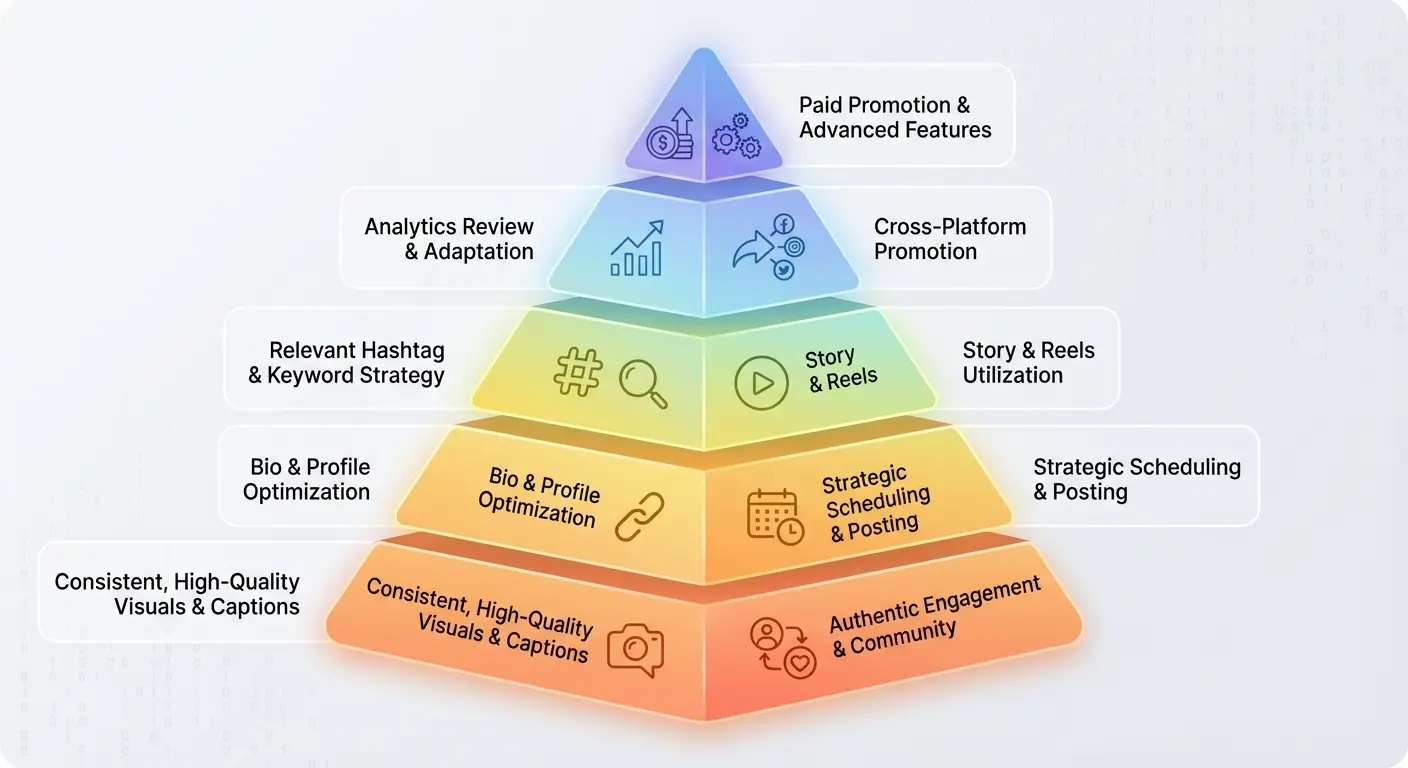
Stop spending 20 minutes researching hashtags and 5 minutes writing your caption. Flip that ratio.
Tracking Search Performance Without Native Analytics
Instagram hides search data. You have to get creative.
In early July 2025, Instagram announced the expansion of Google indexing for professional and creator accounts, making more public posts eligible to be displayed in traditional search engine results. While this development is still in early stages and web content remains the primary engine for consistent search visibility, it represents an evolving relationship between social media and traditional search that creates new avenues for visibility beyond the Instagram app itself.
The “Accounts Reached” metric in your Insights shows how many non-followers saw your content. This is your best proxy for search and discovery traffic (though it includes Explore and hashtag discovery too).
Track this metric weekly for each post. When you see spikes in non-follower reach, cross-reference with the content topic. You’re identifying what generates search visibility.
Profile visits from non-followers is another strong signal. If a post drives significantly more profile visits from people who don’t follow you, they likely found it through search.

I build simple tracking spreadsheets for clients: post date, topic, format, non-follower reach, profile visits from non-followers, and any notable engagement patterns. After 30 posts, patterns emerge. You’ll see which topics consistently drive search traffic.
Creating Content Experiments to Isolate Search Performance
You can’t improve what you don’t measure systematically.
Run controlled experiments by publishing similar content with one variable changed. Post a carousel about “email marketing” with heavy keyword optimization in the caption. Two weeks later, post another carousel on the same topic with conversational language and minimal keyword focus.
Compare non-follower reach, profile visits, and engagement rate. Which approach drove more search traffic?
The key is changing only one variable per experiment. If you change the topic, the format, and the optimization approach simultaneously, you won’t know which factor influenced the results.
I run these experiments constantly for clients. The insights are often counterintuitive. Sometimes less optimization generates more search traffic because the content performs better with your existing audience, which signals quality to the algorithm and boosts overall visibility.
Here’s the framework I use (adapt it however you want):
Experiment Name: [Brief descriptor]
Hypothesis: [What you believe will improve search performance]
Test Duration: [Start date to end date]
Control Post:
-
Topic: _______________
-
Format: _______________
-
Optimization approach: _______________
-
Keywords used: _______________
-
Posted: [Date/Time]
Variable Post:
-
Topic: [Same as control]
-
Format: [Same as control]
-
Changed variable: _______________
-
Keywords used: _______________
-
Posted: [Date/Time]
Metrics to Track (7-day window):
-
Non-follower reach: Control ___ | Variable ___
-
Profile visits (not following): Control ___ | Variable ___
-
Saves: Control ___ | Variable ___
-
Shares: Control ___ | Variable ___
-
Engagement rate: Control ___% | Variable ___%
Winner: _______________
Key Learning: _______________
Next Action: _______________
Document your experiments. After 10-15 tests, you’ll have data-backed insights about what drives search performance for your specific account and audience.
Using Story Stickers to Gather Search Intelligence
Your audience will tell you what they search for if you ask.
Use the question sticker in Stories: “What’s the biggest challenge you’re facing with [your topic]?” The responses often mirror search queries.
Poll stickers work too: “What content would help you more?” with two options representing different search intents. The results tell you which query type your audience prioritizes.
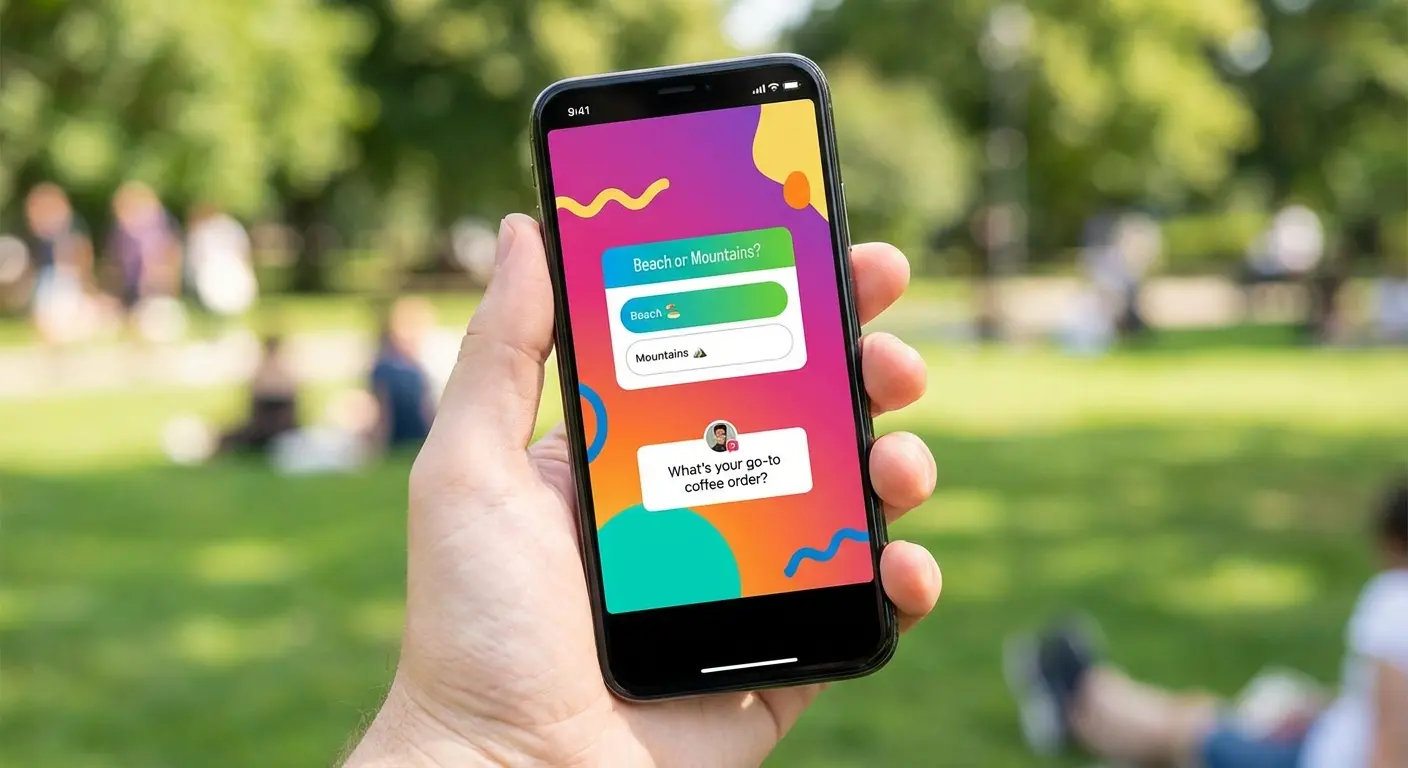
I’ve gathered hundreds of search insights this way. People share their exact pain points, which translate directly into search queries. “I can’t figure out how to schedule Reels” becomes content optimized for “how to schedule Instagram Reels.”
This approach gives you search intelligence while building engagement. You’re not guessing what people search for. You’re asking them.
Compile these responses monthly. Look for patterns in language, specific problems mentioned repeatedly, and gaps in existing content. That’s your search optimization roadmap.
The Search Optimization Reality Check
You’ve read this far. You’re probably thinking “this sounds great but I have zero time to execute any of it.”
I get it.
According to SEO Sherpa’s research, 70% of App Store visitors use search to find apps, demonstrating that search behavior has fundamentally shifted across digital platforms. This behavioral change extends to Instagram, where users are increasingly treating the platform as a search engine rather than just a social feed, making instagram search queries optimization critical for discoverability.
As of July 10, 2025, Instagram’s decision to allow public posts from professional accounts to be indexed by Google represents a strategic realignment that transforms Instagram from a “walled garden” social platform into what industry experts call a “searchable content powerhouse.” This means Instagram content now directly competes with traditional web pages and AI-generated answers in organic search results, making the integration of instagram search queries optimization into broader SEO strategy no longer optional but essential.
Search traffic is improving for some accounts, but not fast enough. Or you’re seeing results on Instagram but your other channels are underperforming. Or you simply don’t have the bandwidth to execute this level of optimization while running your business.
This is the reality for most brands I work with. The strategy is clear. The execution is overwhelming.
If you’re struggling to connect the dots between search visibility and bottom-line results, or if you need a team that can execute this level of optimization consistently while you focus on running your business, we should talk. If you’re finding it challenging to balance Instagram optimization with your broader digital marketing strategy, that’s literally why we built our agency because most business owners know what they should be doing but can’t actually do it while running their company.
Book a strategy call and we’ll audit your current approach, identify specific gaps, and show you exactly how we’d integrate search optimization into a holistic marketing system rooted in data, not guesswork. If that’s not for you, no worries. Take what’s useful here and run with it.
Final Thoughts
Instagram search optimization isn’t a hack. It’s a commitment.
According to The 2026 Content Strategy Report, over a quarter of social users are turning to the network for product discovery, reinforcing that Instagram has evolved far beyond a visual sharing platform into a critical search and discovery engine where purchase decisions begin.
The brands dominating search results aren’t the ones with the biggest budgets or the most followers. They’re the ones who’ve identified specific problems their audience searches for and built topical authority by addressing those problems repeatedly, in multiple formats, over extended periods.
A small business consultant with 3,200 followers consistently outranks accounts with 50,000+ followers for “small business tax deductions” and related queries. Her secret? She’s published 47 pieces of content on tax-related topics over 18 months: carousels breaking down deduction categories, Reels explaining documentation requirements, and static posts with tax deadline reminders. Her smaller audience engages heavily with this content (average save rate around 8%), signaling to Instagram that she’s authoritative on the topic. Meanwhile, larger accounts post sporadically about taxes mixed with dozens of unrelated topics, diluting their topical signals. She generates more qualified leads from search than accounts with 15x her follower count because she understood that search authority compounds through consistent, focused execution.

You don’t need to overhaul your entire content strategy tomorrow. Start with one high-intent search query your audience uses. Create one piece of content that genuinely solves the problem that query implies. Track the non-follower reach and profile visits. Learn from the data. Repeat.
Search visibility compounds. The content you publish this week builds authority that makes next month’s content perform better. The topical consistency you maintain over 90 days creates search momentum that continues growing for months after.
Most creators abandon search optimization after three weeks because they don’t see immediate results. The ones who commit to 90 days of consistent, behavior-focused optimization are the ones who build sustainable search traffic that drives business results long-term.
Your audience is searching. Make sure they find you instead of the ten other people doing what you do.