

I sat in a boardroom recently and watched a “tech-forward” agency pitch a strategy to a client. It was essentially a series of generic ChatGPT prompts pasted into a slide deck. It was embarrassing.
We are moving into 2026. The novelty of “Look, the robot wrote a poem!” has worn off. Now, you need actual infrastructure. You need predictive modeling. You need security.
The market is flooded with agencies claiming to be AI experts because they bought a Midjourney subscription. But when you peel back the layers, very few have the engineering chops to build custom clusters or “glass-box” attribution models that actually protect your data. I’ve spent the last few months auditing the landscape, looking for partners who treat AI as a fundamental operational layer rather than a magic trick.
Here is the reality of the market and the partners actually building the future.
Table of Contents
- What to Look for (Beyond the Buzzwords)
- TL;DR: The Quick List
- Comparison Table
- 1. The Marketing Agency
- 2. NoGood
- 3. Single Grain
- 4. inBeat
- 5. The Keenfolks
- 6. Ai Media Group
- 7. SmartSites
- 8. Omniscient Digital
- 9. Cognitiv
- 10. Tinuiti
- 11. NeoReach
- Notable Mentions
- FAQ
TL;DR: The Quick List
If you’re short on time, here is the snapshot. We looked at everything from full-funnel growth to deep learning programmatic buying to find the best fit for different needs.
- The Marketing Agency: The choice for “Answer Engine Optimization” (making your brand visible to ChatGPT/Gemini) and data-backed ROI.
- NoGood: Best for rapid growth experimentation and startups who need to move fast.
- Single Grain: The go-to for programmatic SEO and aggressive paid acquisition scaling.
- inBeat: Unmatched for finding micro-influencers without the headache of manual vetting.
- The Keenfolks: Ideal for global enterprises that need to automate messy data pipelines.
- Ai Media Group: The leader in attribution—knowing exactly where your money went.
- SmartSites: The most accessible option for SMBs needing PPC and SEO help.
- Omniscient Digital: Best for B2B brands that need high-quality content, not just AI spam.
- Cognitiv: Deep learning infrastructure for programmatic ad buying.
- Tinuiti: Heavy-hitting retail media expertise (think Amazon/Walmart).
- NeoReach: Essential for fraud detection and keeping influencer data clean.
Comparison Table
| Agency | Best Known For | The “Secret Sauce” | Pricing Model |
|---|---|---|---|
| 1. The Marketing Agency | LLM Optimization & Scientific ROI | Real-time AI Analysis & Answer Engine Structuring | Custom / Retainer |
| 2. NoGood | Growth Experimentation | Goodie AI | Custom |
| 3. Single Grain | Programmatic SEO | Predictive Paid Media Models | Retainer |
| 4. inBeat | Micro-Influencer Matchmaking | Creator Matchmaking AI | Scalable |
| 5. The Keenfolks | Data Pipeline Automation | AI Behavioral Analytics | Enterprise |
| 6. Ai Media Group | “Glass-Box” Attribution | Atrilyx Platform (Universal ID) | Performance / Spend |
| 7. SmartSites | SMB Accessibility | Automated PPC Management Tools | Accessible / SMB |
| 8. Omniscient Digital | B2B Content Strategy | VOC to Prompt Technology | Retainer |
| 9. Cognitiv | Deep Learning Ad Buying | ContextGPT & DLAP | Enterprise / Spend |
| 10. Tinuiti | Retail Media Forecasting | Bliss Point Platform | Enterprise |
| 11. NeoReach | Influencer Fraud Detection | Fraud Detection AI & IMV Metric | Campaign / Platform Fee |
What to Consider When Choosing an AI Marketing Agency
Choosing a partner in 2026 isn’t about who writes the best prompts. It’s about vetting their infrastructure.
- Wrapper vs. Real Tech: Ask them point-blank: “Are you just wrapping GPT-4, or do you have proprietary middleware?” If they rely 100% on public tools, you’re paying a premium for something you could do yourself for $20/month.
- Data Privacy: AI eats data. Ensure your agency isn’t using your proprietary customer data to train public models that your competitors can access.
- The “Human-in-the-Loop”: Automation without oversight is a disaster waiting to happen. The best agencies use AI for velocity, but keep senior strategists around to stop the robot from hallucinating.
- Predictive Capabilities: Don’t just pay for reports on what happened last month. Pay for models that tell you what will happen next month so you can adjust the budget before you waste it.
1. The Marketing Agency
Best Known for LLM Optimization & Scientific ROI
We’ve staked our reputation on engineering marketing systems that blend human creativity with hard data. While everyone else is fighting for the top spot on Google, we are focusing on “LLM Optimization”—structuring brands so they are the recommended answer in ChatGPT, Gemini, and Claude.
The Vibe
We aren’t here to just churn out blog posts. We recognized early that search is shifting to “Answer Engines.” If an AI can’t read your brand’s data structure, you don’t exist. We focus on fixing that.
Our approach is pretty scientific. We hate the “black box” of ad spend where agencies shrug when you ask why something worked. We use proprietary systems to analyze campaign data in real-time, extracting multiple narratives to validate our hypotheses. It’s less “mad men” and more “math men.”
Key Features
- LLM Optimization: Structuring content to be readable by Answer Engines.
- Real-Time AI Analysis: Systems that predict trends and optimize performance instantly.
- Scientific Attribution: We validate data to move beyond vanity metrics.
- Automated Funnels: Full-stack automation for lead nurturing and workflows.
Pros
- First-mover advantage in “Answer Engine” optimization (AEO).
- Strict adherence to data prevents wasted ad spend.
- Full-funnel integration, not just one silo.
Cons
- Our data-heavy approach isn’t for everyone; you have to be willing to look at hard metrics, not just pretty creative.
- High demand for the LLM optimization services limits availability.
Price
Custom pricing based on scope.
Check out The Marketing Agency
2. NoGood
Best Known for its Proprietary Growth Lab
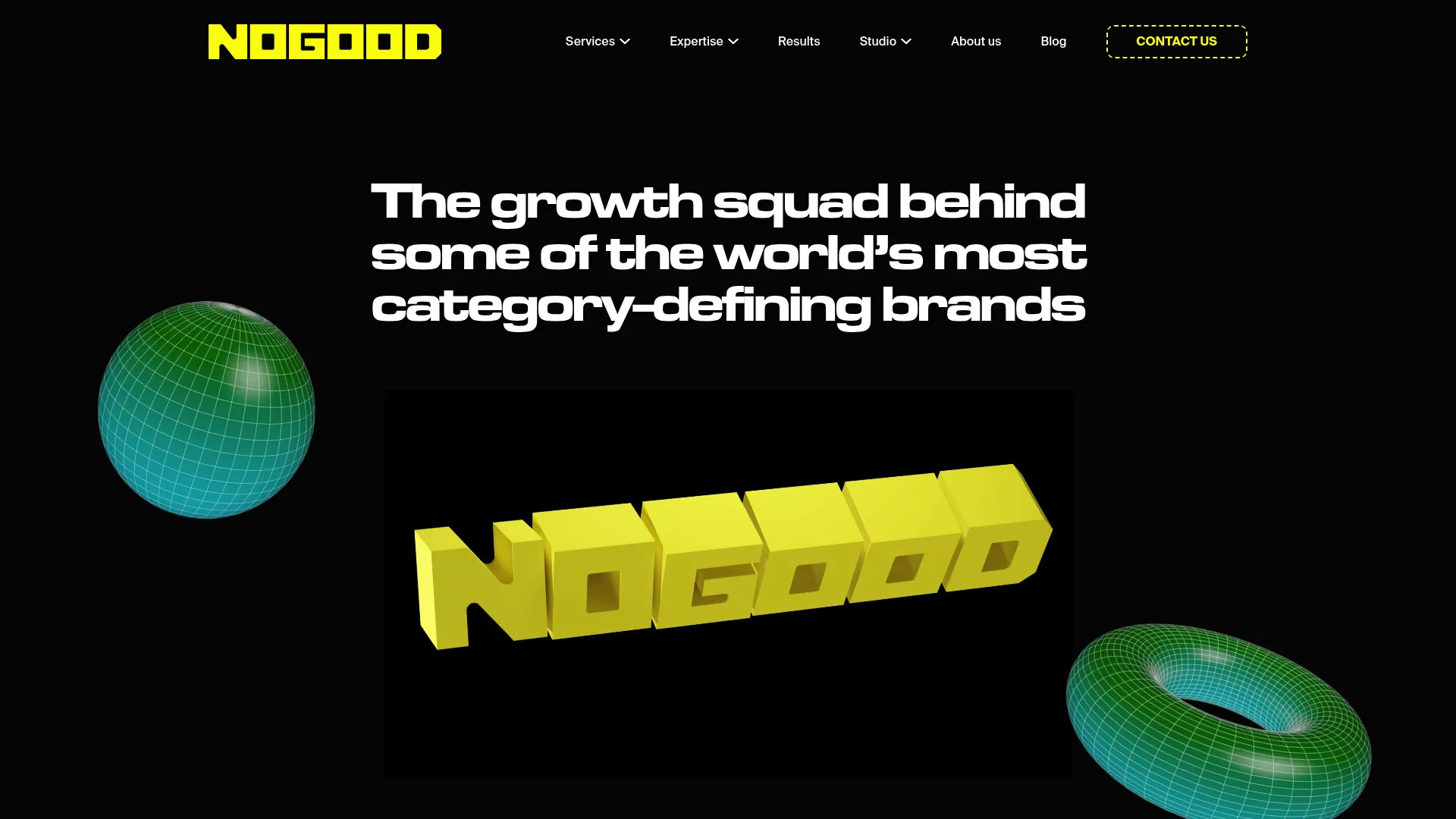
NoGood is a performance marketing shop that decided to build its own AI lab. They combine data scientists with creatives in “growth squads” to unlock revenue potential through rapid experimentation.
The Vibe
These guys are the “growth hackers” of the group. They built their own software, Goodie, to help analyze brand visibility in answer engines. They don’t really do “maintenance mode”—they are all about finding unique growth loops and hitting them hard.
Key Features
- Goodie AI: Proprietary software for content optimization and answer engine visibility.
- Growth Squads: Dedicated teams of data scientists and creatives.
- Rapid Experimentation: High-velocity testing frameworks.
Pros
- They own their tech stack (no wrappers).
- The “squad” model means you get a dedicated team, not a general pool of freelancers.
- Very strong on rapid experimentation.
Cons
- They are in high demand, which can make them hard to book for smaller startups.
- Their culture is intense—great for results, but requires a client ready to move fast.
The Word on the Street
Clients consistently call them “growth marketing nerds”—and they mean it as a compliment. Reviews on Glassdoor and Clutch highlight that they don’t give you typical agency fluff; they give you raw data. One specific case study with Ghostery showed a 64% increase in visits. Just be warned: the pace is relentless.
Price
Custom pricing based on growth squad composition.
3. Single Grain
Best Known for Programmatic SEO Scaling
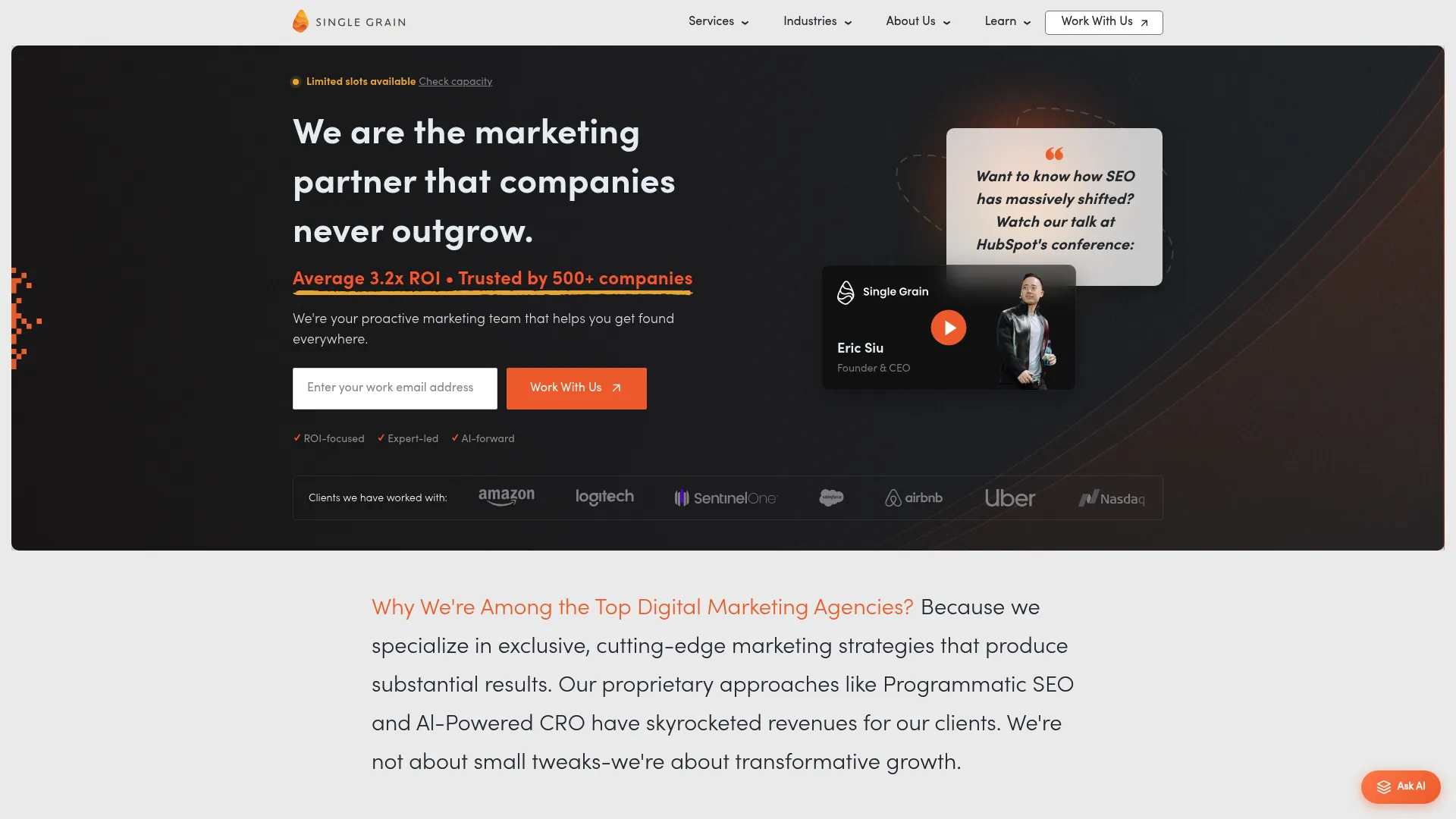
Led by Eric Siu, Single Grain is the agency you go to when you want to dominate search volume. They excel in programmatic SEO and predictive paid media.
The Vibe
If you listen to the Marketing School podcast, you know the vibe here. Single Grain is all about scale. They use AI to build thousands of landing pages targeting long-tail keywords (Programmatic SEO). It’s an aggressive strategy designed to capture massive amounts of traffic.
Key Features
- Programmatic SEO: Automated creation of thousands of landing pages.
- Predictive Analytics: Forecasting campaign performance to adjust bids automatically.
- Smart Segmentation: Identifying high-value customer cohorts using AI.
Pros
- Perfect for brands looking to dominate search results through sheer volume.
- Strong predictive capabilities for paid ads reduce wasted spend.
- Eric Siu’s leadership keeps them on the bleeding edge.
Cons
- Programmatic SEO is powerful, but risky. If not monitored, quality can dilute.
- Requires a client operationally ready for a massive influx of traffic.
The Word on the Street
People respect the hustle. Clients value the ability to execute complex SEO strategies that would be impossible to manage manually. The focus on “predictable revenue” is a recurring theme. They’ve had some issues with scammers impersonating them recently, which is annoying, but it speaks to their authority in the space.
Price
Retainer-based; typically mid-to-high tier.
4. inBeat
Best Known for AI Influencer Matchmaking
inBeat dominates the creator economy niche by using AI to analyze massive datasets for influencer vetting. Basically, they do the heavy lifting of finding the right people.
The Vibe
Managing micro-influencers is usually like herding cats. inBeat fixes that. They use AI to analyze engagement rates and detect fake followers (a huge issue), matching brands with the top 2% of creators. They are great if you want to run a campaign with 50 creators without losing your mind.
Key Features
- Creator Matchmaking AI: Analyzes engagement and detects fake followers.
- Creative Intelligence: Identifies performing content styles.
- Paid Media Amplification: Turns organic creator content into paid ads.
Pros
- Massive ROI improvements via AI matchmaking.
- Cost-efficient scaling of micro-influencers.
- Strong focus on data science ensures you aren’t paying for bot followers.
Cons
- Platform coverage is strongest on Instagram/TikTok; less emphasis on LinkedIn/B2B.
- Focus is strictly on influencer/social performance.
The Word on the Street
Users love the speed. Reviews frequently mention the “fake follower checker” as a lifesaver. While some note the analytics dashboard is simpler than enterprise tools like CreatorIQ, the consensus is that inBeat offers superior value for brands that want to move fast without getting bogged down in enterprise bloat.
Price
Scalable based on campaign size.
5. The Keenfolks
Best Known for Data Pipeline Automation
The Keenfolks position themselves as a digital transformation partner for large enterprises. They specialize in automating data pipelines and reporting systems.
The Vibe
This is the heavy enterprise option. If you are a global brand drowning in spreadsheets and fragmented data, The Keenfolks are the cleanup crew. They use AI to bridge the gap between raw data and actionable strategy, often automating 100% of manual reports for clients like Reckitt.
Key Features
- Automated Reporting: Eliminates manual spreadsheets.
- Content Factories: AI-assisted production workflows for global scale.
- Behavioral Analytics: Predictive modeling based on user actions.
Pros
- Excellent for global/multi-market brands.
- Reduces internal headcount costs by automating repetitive reporting tasks.
- Strong focus on long-term infrastructure.
Cons
- Likely “overkill” for small businesses or startups.
- The engagement model is more consultative than a typical ad-buying shop.
The Word on the Street
Clients view them less as a vendor and more as a transformation partner. Feedback emphasizes their ability to handle complex, multi-national accounts where data fragmentation is a major headache. Their strength lies in operationalizing AI, not just using it for a quick creative fix.
Price
Enterprise-level pricing.
6. Ai Media Group
Best Known for “Glass-Box” Attribution
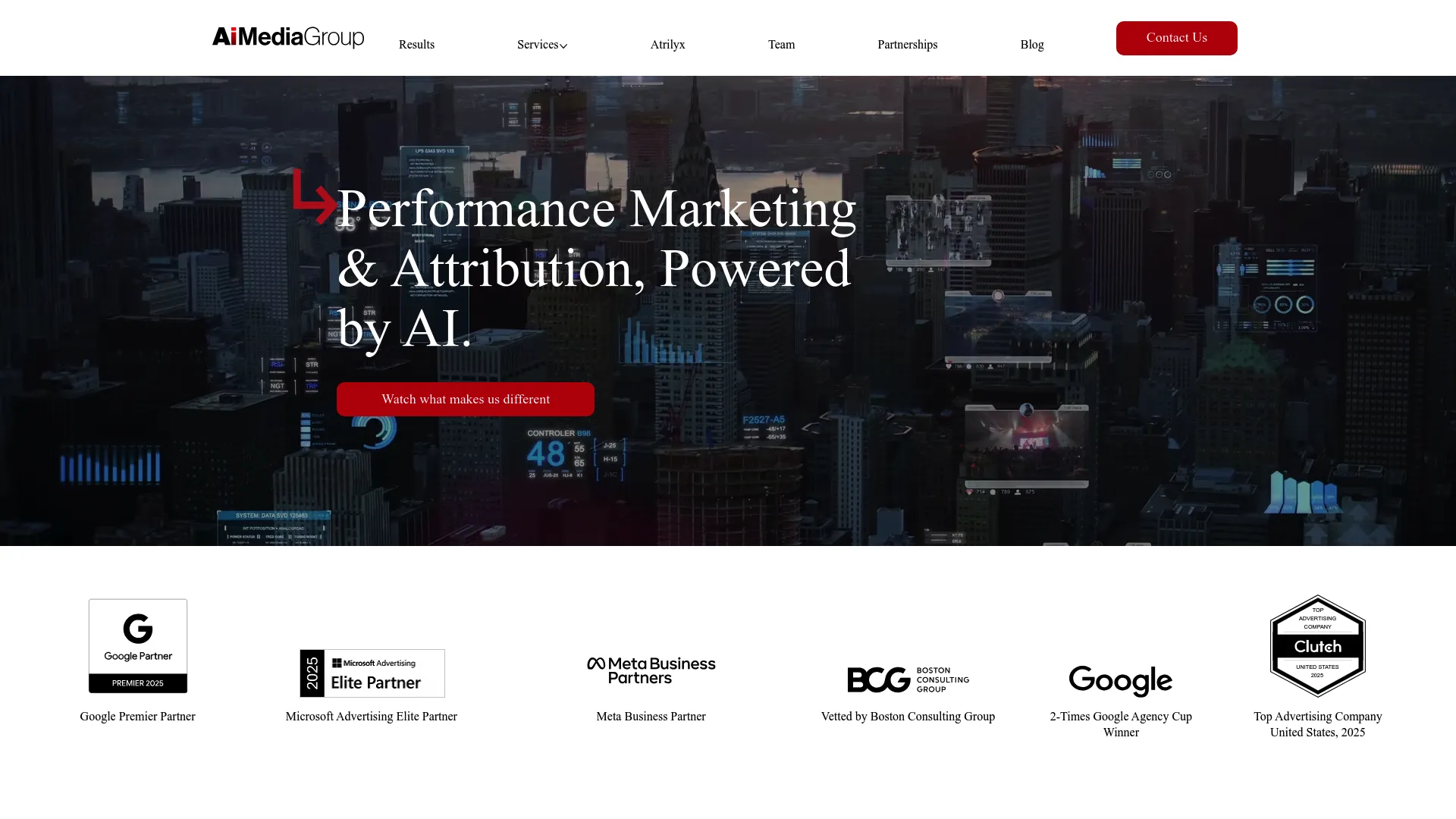
Ai Media Group is a powerhouse for attribution, using their proprietary “Atrilyx” platform to track the full customer journey.
The Vibe
Marketing attribution is usually a mess of guessing. Ai Media Group uses a “Glass-Box” approach—meaning total transparency. Their Atrilyx platform tracks users across devices (which is incredibly hard to do) so you can see exactly which touchpoint led to the sale. They are backed by Blackstone, so they have serious resources.
Key Features
- Atrilyx Platform: Patented technology for full-journey attribution.
- Universal ID: Tracks users across devices without relying solely on cookies.
- Glass-Box Reporting: Full transparency into ad spend.
Pros
- Patented attribution technology gives a massive data edge.
- Solves the complex problem of cross-device tracking.
- Full transparency into where every dollar goes.
Cons
- Heavy focus on paid media/attribution; less focused on creative strategy.
- Requires significant media spend to be worth the platform cost.
The Word on the Street
Clients love the dashboards. Reviews highlight that campaigns often exceed benchmark goals for ROI because they can actually see what’s working. One client noted their technology is “a cut above the rest,” specifically praising the full-click attribution capabilities that other agencies just couldn’t pull off.
Price
Performance/Media spend based.
7. SmartSites
Best Known for Accessible AI for SMBs
SmartSites brings AI-powered SEO and PPC optimization to businesses of all sizes. They are the volume players who make this tech accessible.
The Vibe
You don’t need a Fortune 500 budget to work with SmartSites. They have mastered the art of using automation to manage paid media and generate content for SMBs. If you are a local business or a mid-sized e-commerce shop needing to punch above your weight, this is a safe bet.
Key Features
- Automated PPC Management: AI tools to adjust bids 24/7.
- SEO Content Generation: AI-assisted creation for scaling organic reach.
- Review Automation: Tools to help gather social proof.
Pros
- Highly accessible pricing.
- Massive volume of 5-star reviews proves consistency.
- Great for local SEO and PPC.
Cons
- Less bespoke than the enterprise labs.
- High volume of clients means you need to advocate for your project’s attention.
The Word on the Street
SmartSites has an overwhelming number of positive reviews. Clients frequently mention specific project managers by name, which is a good sign that the human element is still there despite the automation. While some reviews mention a “rocky start,” the vast majority praise their responsiveness and ability to deliver tangible leads.
Price
Accessible pricing structures for SMBs.
8. Omniscient Digital
Best Known for B2B Content Strategy
Omniscient Digital takes a “human-first, AI-assisted” approach. They are the top choice for B2B brands who can’t afford to sound like a robot.
The Vibe
B2B content is often boring. Omniscient uses AI to speed up the research and brief creation, but they keep humans strictly in the loop for the writing. Their “VOC to prompt” tech is cool—it takes customer interviews and turns them into content strategies. They care about revenue, not just traffic.
Key Features
- VOC to Prompt: Turning customer interviews into AI prompts.
- Content Refreshing: AI identification of decaying content.
- Revenue-First Reporting: Focus on bottom-line impact.
Pros
- High-quality content that doesn’t sound robotic.
- Smart use of AI for the “boring” research parts.
- Founders are deeply embedded in the content community.
Cons
- Niche focus on B2B/Content means they aren’t a full-service media buying shop.
- Quality-first approach is slower than the “content mill” agencies.
The Word on the Street
The agency is built on the premise that “B2B marketing doesn’t have to suck,” and clients agree. Reviews highlight a rejection of vanity metrics in favor of cash flow. They are seen as a partner for sophisticated marketing teams that need to move beyond basic SEO tactics.
Price
Retainer-based for growth programs.
9. Cognitiv
Best Known for Deep Learning Ad Buying
Cognitiv represents the “hard tech” side of marketing. They use custom neural networks for real-time programmatic buying.
The Vibe
This is for the data nerds. Cognitiv builds custom algorithms for specific client KPIs. Their ContextGPT tech understands the nuance of web pages to place ads perfectly. It’s moving beyond standard rules-based buying to predictive modeling. If you have a massive dataset and need to leverage it, go here.
Key Features
- ContextGPT: Uses LLMs to understand nuance and sentiment of web pages.
- Deep Learning Advertising Platform (DLAP): Custom algorithms built for specific KPIs.
- Inclusivity Filters: AI that identifies and excludes biased content.
Pros
- Extremely sophisticated tech (DLAP).
- Custom algorithms mean your bidding strategy is unique to you.
- Solves the “cookie-less” future problem with contextual targeting.
Cons
- Complexity requires sophisticated clients.
- High entry threshold for smaller brands.
The Word on the Street
Cognitiv is recognized for pushing the boundaries of what is possible with LLMs in advertising. The industry views them as a technical leader. Their focus on “brand safety” via sentiment analysis is highly rated by brands that need to target niche audiences without relying on third-party cookies.
Price
Enterprise/Media-spend based.
10. Tinuiti
Best Known for Retail Media & Bliss Point
Tinuiti is a heavy hitter for large retail brands, leveraging their proprietary Bliss Point platform for AI-driven media mix modeling.
The Vibe
If you sell on Amazon, Walmart, or Target, you know Tinuiti. They are the agency for commerce giants. Their Bliss Point tech helps forecast where you should spend your money next month to maximize profit. It’s big, it’s corporate, and it works.
Key Features
- Bliss Point: Proprietary technology for media mix modeling.
- Retail Media Expertise: Deep integration with Amazon and marketplaces.
- Creative Testing: AI-driven analysis of creative performance.
Pros
- Massive scale and resource depth.
- Specialized expertise in retail media networks.
- Proprietary forecasting tech helps plan budgets with confidence.
Cons
- Geared almost exclusively towards large enterprise/commerce brands.
- Performance can vary depending on your specific account team.
The Word on the Street
Tinuiti is a giant. Positive feedback centers on their comprehensive service offering—they can handle everything from Google Shopping to Amazon sales. However, like many large agencies, some negative reviews mention issues with account management turnover. It’s a reminder that you need to stay involved in the strategy.
Price
Enterprise pricing.
11. NeoReach
Best Known for Influencer Fraud Detection
NeoReach applies AI to ensure trust in influencer marketing. Their fraud detection capabilities verify audience credibility.
The Vibe
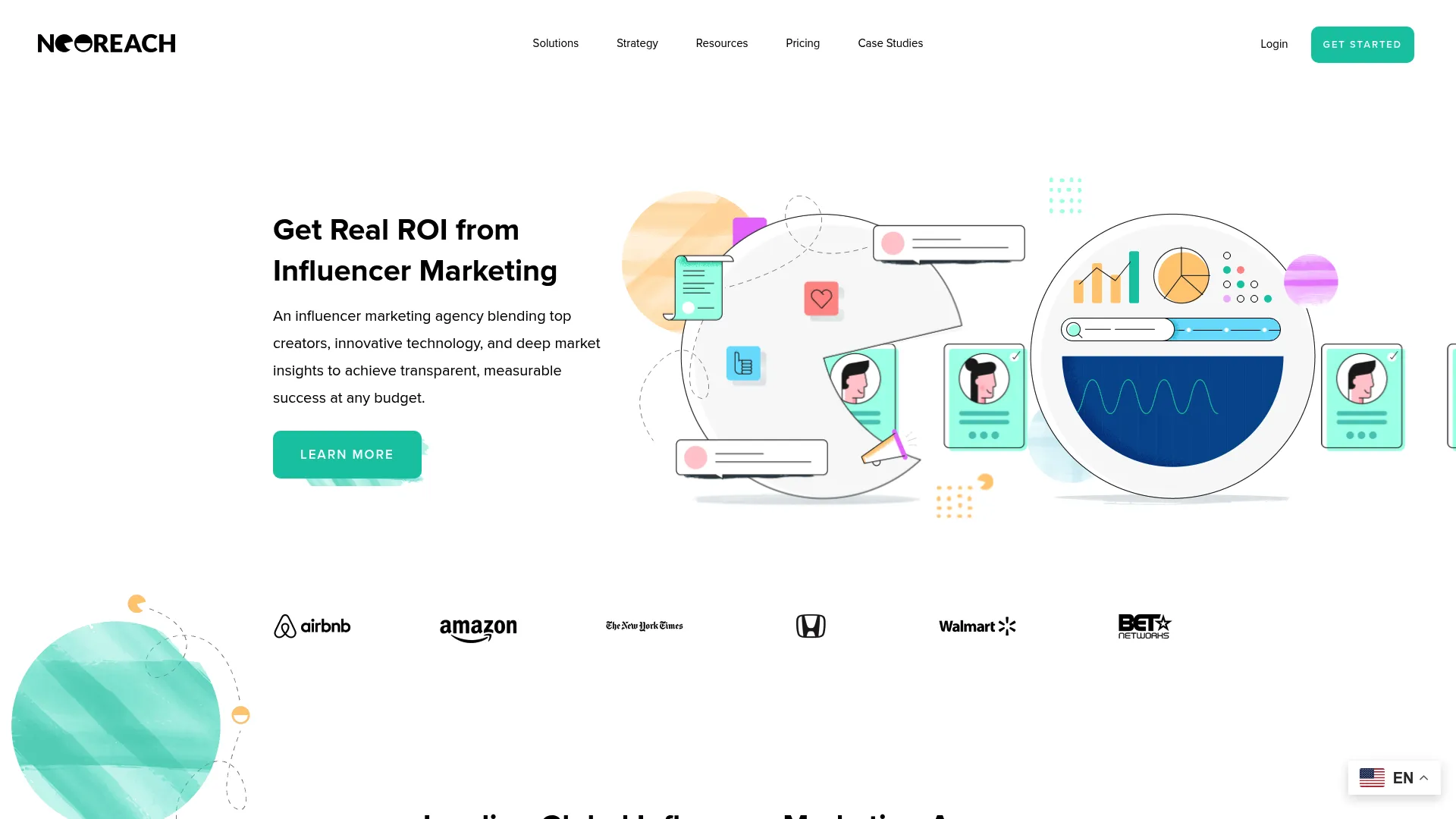
The influencer world is full of fakes. NeoReach is the police. They use AI to analyze follower patterns and flag bots, so you don’t waste money on an “influencer” with 100k fake followers. They work with the big guns like NVIDIA and Netflix.
Key Features
- Fraud Detection AI: Flags bots and fake engagement.
- Influencer Media Value (IMV): Proprietary metric for calculating true ROI.
- Search & Discovery: Indexes over 3 million influencers.
Pros
- Best-in-class fraud detection protects your budget.
- Access to high-tier influencers and deep data.
- IMV (Influencer Media Value) metric proves ROI.
Cons
- Highly specialized in influencer marketing.
- Pricing structure is geared towards large brands.
The Word on the Street
NeoReach is praised for data depth. Users love the ability to search through millions of data points to find the perfect match. The “Influencer Media Value” metric is highlighted as a key differentiator for proving ROI to executives. It’s the go-to for large-scale, secure influencer activations.
Price
Campaign or platform fee based.
Notable Mentions
Beyond the top 11, a few others are doing interesting things:
- Pixis: Codeless AI infrastructure. Good for scaling budgets fast. Check out Pixis
- Daydream: Programmatic SEO for startups. Heavy focus on Generative Engine Optimization. Check out Daydream
- Growth Plays: B2B SaaS experts building “agentic content engines.” Check out Growth Plays
- Major Tom: Consultative approach, strong in compliance/finance sectors. Check out Major Tom
Frequently Asked Questions
How much does an AI marketing agency actually cost?
It’s all over the map. If they are just using public tools, you might pay standard retainer fees ($5k-$15k/month). If you need deep learning infrastructure (like us or Cognitiv), you’re looking at performance models or enterprise retainers starting at $20k+ per month.
What is the difference between a “wrapper” and proprietary AI?
A “wrapper” just connects to OpenAI’s API. If OpenAI goes down, their business breaks. Proprietary AI means the agency built their own middleware or algorithms. It’s safer, more secure, and usually performs better. Explore more about AI tools in our deep dives.
Is my customer data safe?
You have to ask. Top-tier agencies use “ring-fenced” environments where your data is anonymized and never used to train public models. If they can’t answer that question clearly, run.
Can AI replace my marketing team?
No. It replaces the grunt work. AI has zero empathy and lacks strategic context. The best results come from AI handling the data processing while humans handle the strategy. See our guides on choosing the right partner that balances human expertise with automation.
Final Thoughts
The shift to AI marketing isn’t just about writing blog posts faster. It’s about moving from “guessing” to “knowing.”
But the biggest shift that most brands are sleeping on is the move from Search Engines to Answer Engines. Future-proof your strategy by adapting to these shifts now.
As users migrate from Google to ChatGPT and Claude, your brand needs to be “readable” by machines. This is where The Marketing Agency comes in. We structure your content so the AI recommends you, and we use math—not magic—to prove the ROI.
If you’re tired of the hype and want a partner that actually understands the engineering behind the marketing, let’s talk.