


Look, I get it. You’re sitting there with seven Google reviews (three of them are basically “meh”) and your competitor down the street has 47 glowing five-stars. You know at least some of theirs are fake. So why shouldn’t you level the playing field?
Here’s why: In 2019, the FTC dropped a $12.8 million fine on a weight loss supplement retailer for fake Amazon reviews. But that’s not even the scary part. The scary part is what happens inside your company before Google ever catches you. You start making decisions based on lies you told yourself.
When you buy Google reviews, you’re not buying credibility. You’re buying organizational blindness wrapped in a package that looks like success. And it’s going to screw you in ways you haven’t even thought about yet.

What’s Actually in This Post
I’m going to show you why buying reviews destroys your business from the inside out (not just the Google penalty everyone talks about), how it poisons your advertising data, and what actually works instead. The main sections cover the internal damage to your team, the customer experience debt you’re creating, why platforms are getting vicious about enforcement, how fake reviews screw up your paid campaigns, and how to build real review volume without buying it.
If you’re in a hurry, skip to the section on building review volume without buying it.
The Short Version
Buying Google reviews creates an internal culture problem where your team optimizes for fake metrics instead of real customer satisfaction. You’re generating customer experience debt that compounds over time as real customers encounter service that doesn’t match inflated ratings. Google’s detection systems now use behavioral signals and cross-platform data that make purchased reviews increasingly risky. Fake reviews poison your paid advertising data by attracting the wrong customers and skewing conversion metrics. Legitimate review generation strategies focus on reducing friction in the ask, not incentivizing the response. Attribution modeling and data-driven strategies help you understand which touchpoints naturally generate authentic customer advocacy.
The cost of buying reviews extends far beyond the transaction itself. You’re creating organizational dysfunction that spreads through every department, making it impossible to identify what’s working and what’s failing.
The Incentive Misalignment Nobody Talks About
Everyone talks about the ethics of buying reviews or the risk of getting caught. Whatever. Let’s talk about something worse.
The real damage happens inside your company, before Google flags anything. You break the feedback loop that tells your team what’s actually working. Your staff starts optimizing for a fictional version of your business instead of the real one.
According to ReviewTrackers research, Google has made it clear that review content should reflect a customer’s genuine experience at a business location, and unlike review sites like Yelp which place consumer alerts on businesses with fake reviews, Google can actually take down the entire listing of the violating business. This isn’t just about losing reviews. It’s about losing your entire digital presence.
But that’s still focusing on the external consequences. What happens inside your organization is far more insidious.
Your Dashboard Becomes a Lie You Tell Yourself
You check your Google Business Profile. 4.7 stars. Your team’s celebrating, management’s patting themselves on the back, and everyone’s convinced you’re crushing it.
Except you’re not.
The reviews you bought aren’t just inflating your rating. They’re actively preventing you from seeing the real problems your customers are experiencing. That friction point in your checkout process? Hidden. The rude staff member who’s driving people away? Invisible. The product quality issue that’s been building for months? Buried under five-star fiction.
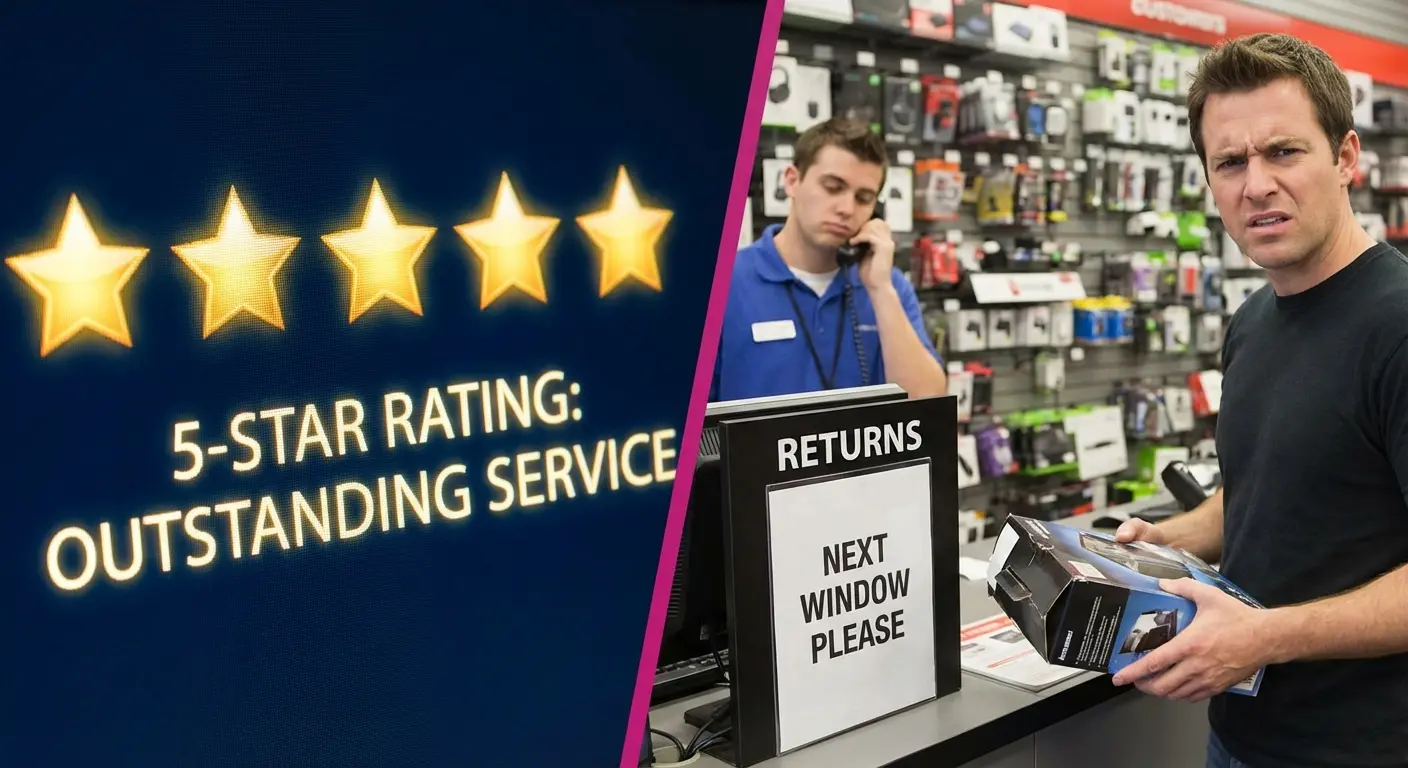
Your team makes decisions based on this data. They double down on strategies that aren’t working. They ignore warning signs because the numbers look fine. You’ve essentially paid money to make yourself blind to your own business problems.
Understanding the broader implications of Google My Business optimization strategies becomes impossible when your basic review data is corrupted. You’re building on quicksand and calling it bedrock.
The Optimization Trap
And then it gets stupider. Your employees start believing the fake metrics.
Your customer service team sees great reviews and assumes they’re doing excellent work. Why would they push for process improvements when customers are clearly satisfied? Your product development team stops prioritizing quality fixes because the feedback looks positive.
Your marketing team crafts messaging around a customer experience that doesn’t exist.
Everyone’s working hard. Everyone’s trying to improve. But they’re all optimizing for a version of your business that only exists in your review section. The real business (the one customers interact with) continues to have the same problems it always had. Maybe those problems get worse because nobody’s addressing them.
You’ve created an organization that’s completely disconnected from reality.
I know a dentist in Phoenix. Let’s call him Dr. Martinez. He bought 40 five-star reviews over three months. His office manager kept telling him the waiting room was a disaster, patients were pissed about wait times, front desk was overwhelmed. But when she brought these concerns to him, he’d just pull up his 4.8-star rating on his phone. “Patients love us,” he’d say.
She eventually quit. The practice kept operating with the same broken scheduling system for another year, losing dozens of patients who simply stopped returning and never left reviews because they quietly switched to competitors. The fake reviews had created a blind spot that cost them way more than the reviews themselves. He still doesn’t know why his patient retention numbers are garbage.
When you buy a review or decide to buy Google reviews in bulk, you’re not solving a marketing problem. You’re creating an organizational one. The gap between perceived performance and actual performance grows wider every day, and your team has no way to see it happening. When businesses pay for Google reviews, they’re essentially paying to obscure the very feedback that could help them improve.
What Happens When Your Team Believes the Numbers
Fake review data doesn’t stay contained in your marketing department. It spreads through your organization, affecting hiring decisions, training priorities, and resource allocation. When your internal teams can’t trust the feedback that should guide their work, they start making decisions based on intuition or politics instead of customer needs.
The result? An organization that drifts away from what customers actually want, even as leadership believes everything’s improving.
Training Programs Built on Quicksand
You bring in new hires. Part of onboarding? Reading through customer feedback to understand what makes customers happy. They scroll through your glowing Google reviews and learn all the wrong lessons.
They think customers love your speed. (That review was purchased.) They believe your product quality is exceptional. (It’s mediocre, but the real reviews are buried.) They assume your pricing is fair. (Customers are actually frustrated, but those complaints never made it to your 4.8-star average.)
Now these new employees have a completely distorted understanding of what customers actually want. And they’re going to make hundreds of small decisions based on this false foundation. Every customer interaction they have will be slightly off because they’re responding to needs that don’t exist and ignoring needs that do.

The damage compounds. Each new hire learns from the fabricated feedback. They train the next wave of employees. The organizational knowledge base becomes increasingly detached from customer reality. This is what happens when you buy Google 5 star reviews. The internal consequences cascade far beyond the initial deception.
Resource Allocation Based on Fiction
Your quarterly planning meeting rolls around. Leadership looks at performance data across departments. Customer satisfaction looks strong, according to those reviews. The team decides to invest heavily in growth and acquisition rather than retention and experience improvements.
This might be exactly the wrong decision.
Your real customer experience might be mediocre at best. You might be losing customers as fast as you’re acquiring them. But you won’t know because your feedback is compromised.
You’ll spend money attracting new customers into an experience that’s not ready for them. Your customer acquisition cost goes up. Your lifetime value goes down. The math stops working, but you won’t understand why because all your satisfaction metrics look fine.
Buying reviews creates a cascading series of misallocated resources. Each decision builds on the previous one. Each quarter takes you further from sustainable growth.
|
Decision Area |
What Fake Reviews Tell You |
What Reality Might Be |
Business Impact |
|---|---|---|---|
|
Training Focus |
“Customers love our speed” |
Speed is adequate, but quality is inconsistent |
New hires prioritize wrong skills |
|
Budget Allocation |
“Invest in acquisition” |
Need retention improvements first |
Higher churn, wasted ad spend |
|
Product Development |
“Current offering is excellent” |
Core features need significant work |
Competitive position erodes |
|
Staffing Levels |
“Current team is sufficient” |
Understaffed in critical areas |
Employee burnout, service degradation |
|
Pricing Strategy |
“Customers accept current pricing” |
Price sensitivity is high |
Revenue ceiling, market share loss |
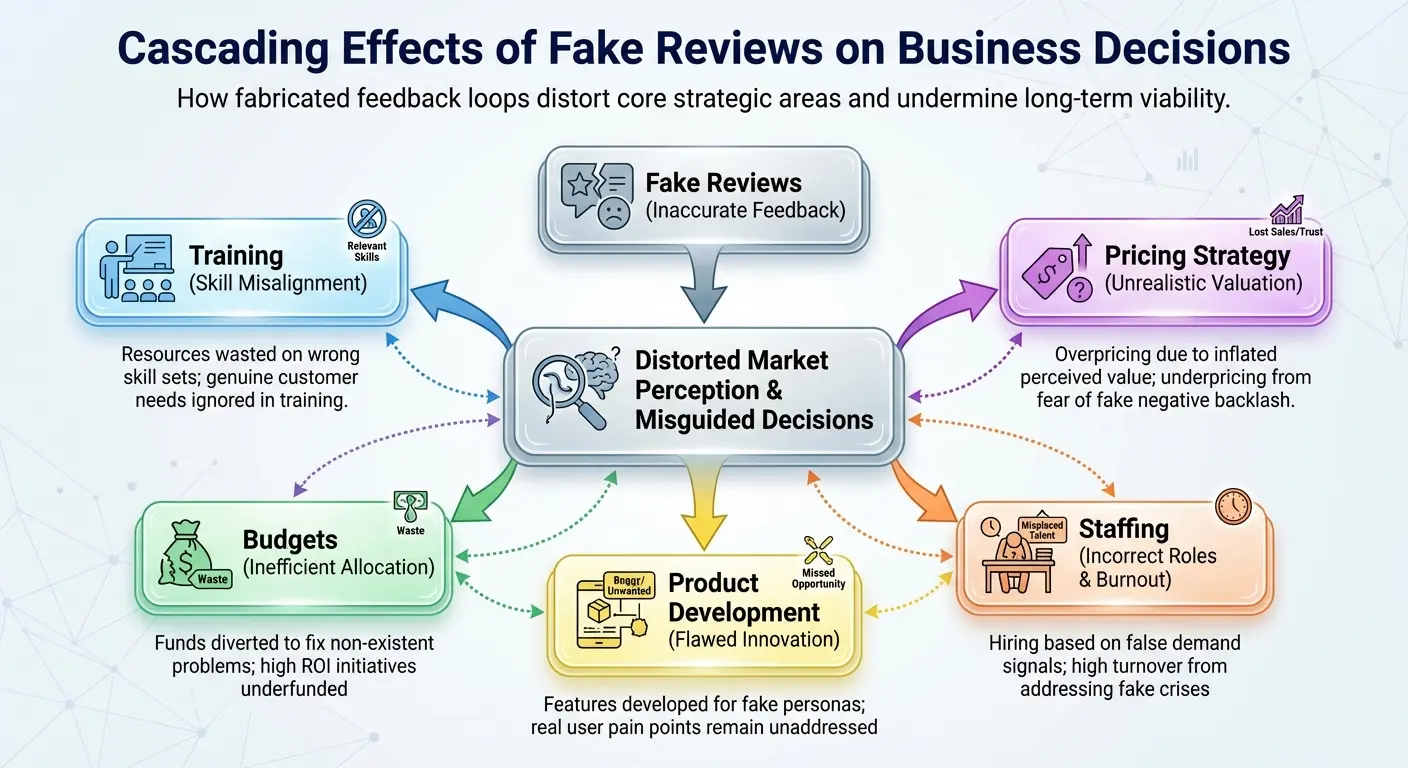
When you buy Google 5 star reviews, you’re not just purchasing fake social proof. You’re purchasing strategic blindness. Every department in your organization will make worse decisions because they’re working with corrupted data. The temptation to buy review volume might seem like a shortcut, but it’s actually a long-term liability that spreads like a virus through your entire operation.
The Customer Experience Debt You’re Creating
Purchased reviews create a specific type of problem. Call it customer experience debt. When potential customers see inflated ratings and then encounter a mediocre reality, they don’t just feel disappointed. They feel deceived.
This gap between promised experience and delivered experience affects customer psychology, retention, and word-of-mouth in ways that compound over time and become increasingly expensive to fix.
The Expectation Gap Gets Weaponized
A potential customer finds you. They see 4.6 stars and dozens of glowing reviews. They’re expecting excellence.
Then they show up and your business is… fine. Maybe even good. But it’s not 4.6-stars good. It’s not “exceeded all expectations” good. It’s decent.
That customer now feels cheated. They don’t think “well, this was okay.” They think “this was nowhere near as advertised.” You’ve weaponized the expectation gap against yourself. The gap between expectation and reality has turned a neutral or even mildly positive experience into a negative one.
And some of these disappointed customers? They’re going to leave real reviews. And because they feel deceived, those real reviews will be harsher than they would’ve been if you’d just been honest from the start.
The Spiral Accelerates
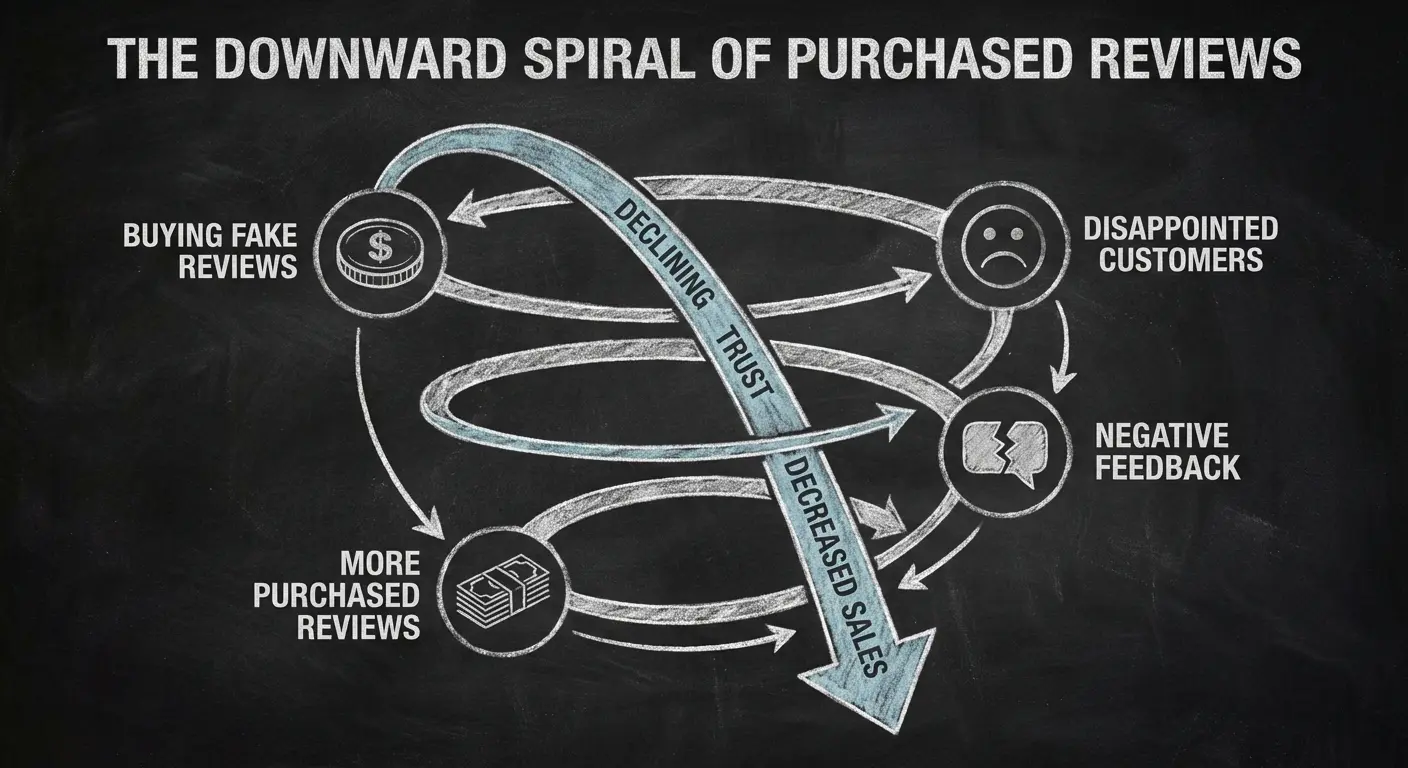
You now have a mix of fake positive reviews and real negative reviews. The real negative reviews are disproportionately harsh because customers feel misled. You panic. You buy more positive reviews to bury the negative ones.
The cycle continues. Each round of purchased reviews raises expectations higher. Each cohort of real customers feels more deceived. The real reviews get harsher. You buy more fake ones. The debt compounds.
Eventually, you’re spending significant money every month just to maintain a rating that’s actively hurting your customer satisfaction. You’re paying to make your own business worse. When businesses buy Google maps reviews or buy 5 star google reviews, they’re essentially investing in their own decline.
Word-of-Mouth Turns Toxic
Here’s what doesn’t show up in your Google reviews: the conversations happening outside of them.
Your customers talk to their friends. They say things like “Don’t trust the reviews, it’s not that good” or “I think they’re buying reviews or something because it’s way overhyped.” Your brand becomes associated with deception even among people who’ve never used your service.
This word-of-mouth damage is invisible. It doesn’t show up in your analytics. You can’t measure it. But it’s killing your organic growth and making your acquisition costs higher because you’re fighting against a reputation for dishonesty.
There’s a boutique hotel in Charleston that bought 60 reviews over six months, bringing their rating from 3.9 to 4.6 stars. Bookings increased initially, but within three months, they noticed something weird: guests who booked directly (after reading the reviews) had a 40% higher complaint rate than guests who came through travel agencies or repeat referrals.
The reviews promised “impeccable service” and “luxury amenities,” but the hotel was solidly mid-range. Guests arrived expecting boutique excellence and found standard accommodations. The hotel’s response rate to complaints tripled, their staff morale tanked from constant negative interactions, and their actual review average began dropping as disappointed guests left honest feedback. The purchased reviews had set expectations the property simply couldn’t meet.
When you pay for Google reviews or buy Google reviews in any form, you’re not just risking platform penalties. You’re creating a debt that accrues interest in the form of disappointed customers who expected better and received less.
Why Platforms Are Getting Smarter (And Meaner)
Google’s review detection systems have evolved way beyond simple pattern matching. The platform now uses behavioral signals, cross-platform data analysis, and machine learning models that identify suspicious review patterns months after they’re posted.
The penalty structures are becoming more severe and harder to reverse.
According to a 2026 analysis published by Morgan Hill Times in partnership with ReviewGrow, Google’s AI has become increasingly sophisticated at detecting review fraud. The report notes that “Google’s algorithm prioritizes businesses that show consistent engagement and positive sentiment,” but it can also identify clusters of accounts that leave suspiciously positive reviews for multiple businesses across different industries and cities. Patterns that are invisible to individual business owners but clear to Google’s cross-platform analysis systems.
Can you buy Google reviews and get away with it? The answer is increasingly no.
Behavioral Signals You Can’t Fake
Google doesn’t just look at the review text anymore. They’re analyzing dozens of behavioral signals that are nearly impossible to fake at scale.
Did the reviewer visit your location? Google knows. They have location data from Android devices and Google Maps users. If someone leaves a review for your restaurant but their phone was never within 100 meters of your address, that’s a red flag.
Did the reviewer interact with your business in other ways? Did they view your website? Call your phone number? Look at your menu? Real customers leave digital foot prints across multiple Google properties. Fake reviewers typically don’t.
How long did the reviewer spend writing the review? Real reviews show natural typing patterns with pauses and edits. Fake reviews (especially ones written by the same person or copied from a template) show suspiciously similar composition patterns.
Google’s checking if your reviewer’s phone was actually near your business. They’re looking at whether that person visited your website, called you, or checked your hours. They’re analyzing how long it took to write the review and whether the typing pattern looks natural. They can see if the account reviews random businesses across different cities and industries. A pattern that screams fake.
When you buy Google 5 star reviews from any service, you’re betting that they can fake all of these signals convincingly. They can’t. Whether you’re looking to buy 5 star google review packages or buy reviews on google through supposedly sophisticated services, the detection systems are more advanced than the deception tactics.
The Cross-Platform Data Problem
You might think you’re safe because you’re using a sophisticated review service that uses real accounts and varies the review text. You’re not safe.
Google correlates review data across thousands of businesses. They can see that the same account left suspiciously positive reviews for 15 different businesses across 8 industries in 3 cities. They can identify clusters of accounts that all created reviews for the same set of businesses within a narrow time window.
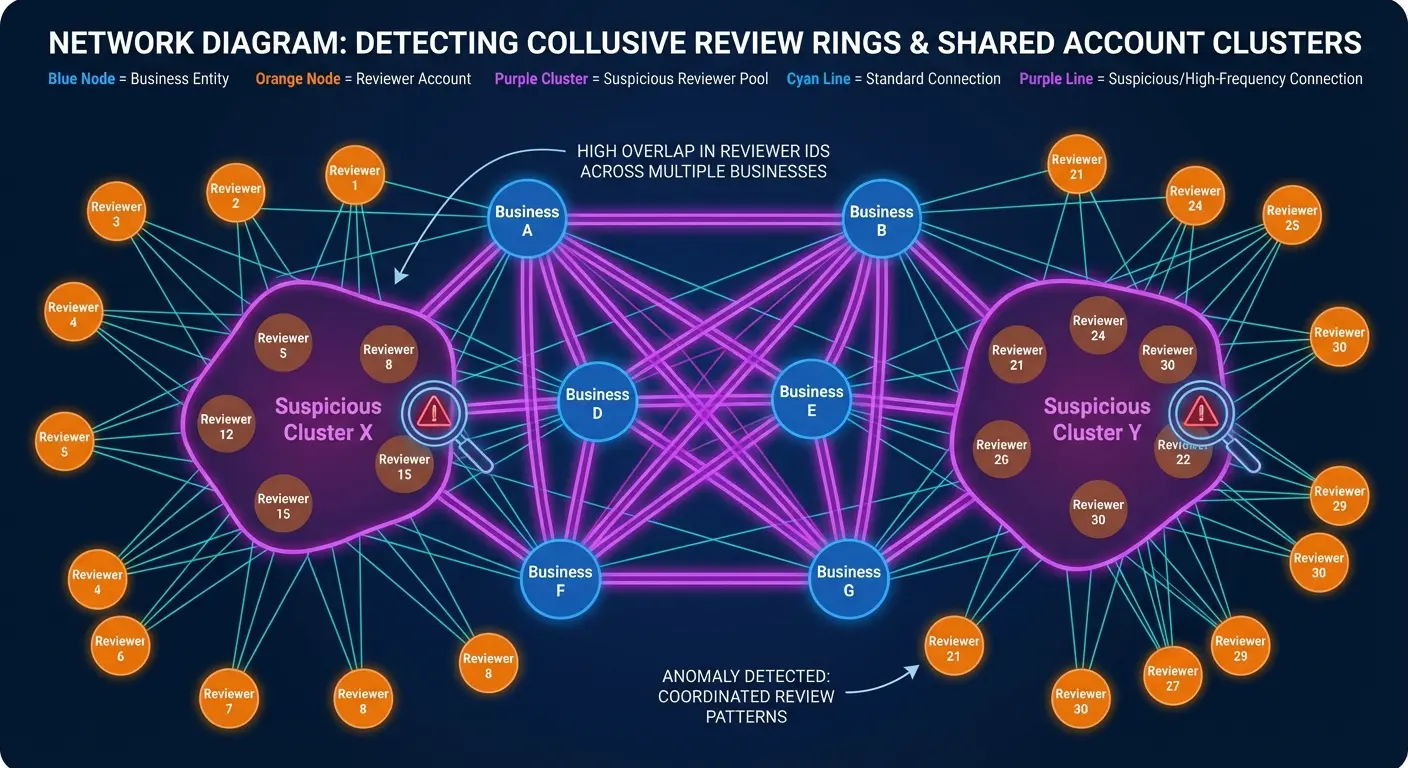
These patterns are invisible to you. You’re only seeing your own review profile. Google is seeing the entire network. They’re identifying the review sellers by analyzing patterns across millions of businesses, then retroactively flagging all reviews from those networks.
Your reviews might get removed six months after you bought them, long after you’ve paid for them and built your strategy around them.
The gap between what buying reviews looks like to you and what it looks like to Google is massive. You see individual transactions. They see network patterns that scream fraud.
The Penalty Structure Has Changed
Google doesn’t just remove fake reviews anymore. They’re doing worse.
Businesses caught buying reviews may see their entire Google Business Profile suppressed in search results. You’ll still appear on Google Maps if someone searches your exact name, but you won’t show up in category searches or “near me” queries. For many local businesses, this is functionally equivalent to being delisted.
Some businesses are seeing their review sections frozen, where new reviews (even legitimate ones) aren’t being published. Others are getting permanent flags on their profiles that warn users the business has been caught manipulating reviews.
These penalties are often applied algorithmically and are extremely difficult to reverse. You can’t just remove the fake reviews and go back to normal. The platform has lost trust in your entire review profile.
The risk situation has fundamentally shifted. According to ReviewTrackers, when it comes to improving online brand presence, reviews and SEO are a powerful combination, which is why Google reviews have become integral to many companies’ local SEO strategy but if you buy Google reviews to reach the top of local search results, you risk a sharp decline in rankings once Google discovers that your reviews are not an authentic reflection of the customer experience. The platform’s ability to detect and penalize fake reviews has made the practice exponentially riskier than it was even two years ago.
The Downstream Effects on Your Paid Campaigns
Fake reviews don’t just affect your organic presence. They poison your paid advertising data too. Inflated ratings attract the wrong customer segments, skew your conversion data, and make it impossible to optimize your paid campaigns effectively.
Let’s look at the specific ways that purchased reviews interact with PPC attribution models and why this creates compounding problems for your entire marketing setup.
You’re Attracting the Wrong Customers
Your Google Ads are running. People click through. They see your 4.7-star rating and dozens of glowing reviews. They convert.
But they’re converting based on false expectations. You’re attracting customers who are looking for a premium experience because that’s what your reviews promise. Your business delivers a mid-tier experience. These customers have a higher likelihood of returns, refunds, complaints, and negative word-of-mouth.
Your customer acquisition cost looks fine. Your conversion rate looks fine. But your lifetime value is terrible and you don’t know why.
You start optimizing your paid campaigns to attract more of these “high-intent” customers who convert easily. You’re optimizing to attract more of the wrong people. Customers who are predisposed to be disappointed by your offering.
This disconnect between review signals and actual performance creates the same attribution problems discussed in our PPC case study analysis, where false success metrics lead to systematic misallocation of advertising budgets.
Attribution Models Break Down
Modern paid advertising relies heavily on attribution modeling. You need to understand which touchpoints drive conversions and which channels deliver the highest-quality customers.
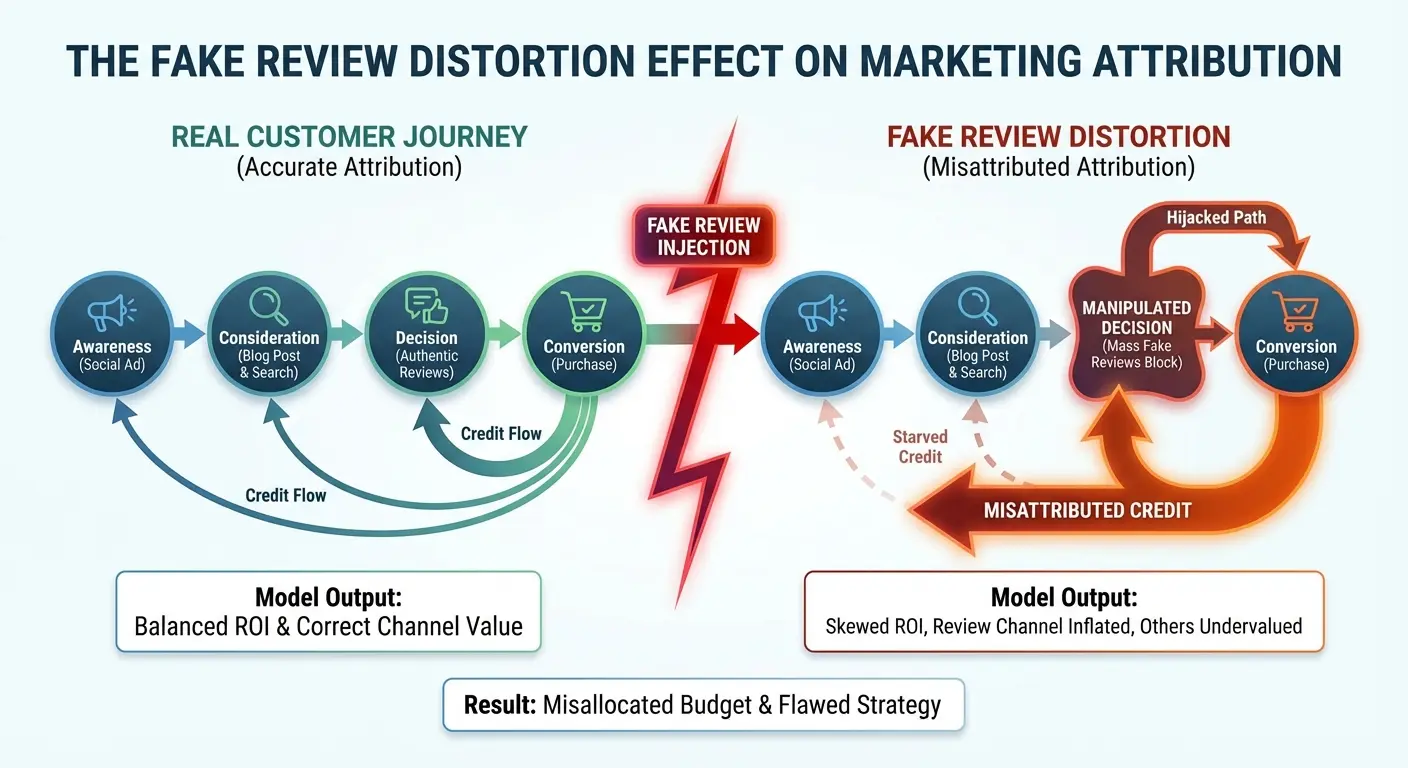
Fake reviews scramble this data. Customers who convert because they saw great reviews are being attributed to your last-click ad campaign. Your attribution model says your Google Ads are performing excellently. In reality, the fake reviews are doing the heavy lifting, and your ads are just capturing demand that would’ve converted through any channel.
You increase your Google Ads budget based on this false signal. Your ROI decreases because you’re overpaying for conversions that were already going to happen. Your attribution model can’t tell you this because it doesn’t know your reviews are fake.
When you buy Google 5 star reviews or pay for Google reviews, you’re not just corrupting your reputation data. You’re corrupting your entire marketing measurement setup.
|
Marketing Metric |
What You See |
What’s Actually Happening |
Long-Term Consequence |
|---|---|---|---|
|
Conversion Rate |
8% (excellent) |
Inflated by false expectations |
Attracts wrong customer segment |
|
Cost Per Acquisition |
$45 (on target) |
Misleading (reviews doing the work) |
Overspending on underperforming channels |
|
Customer Lifetime Value |
$380 (declining) |
High churn from disappointed customers |
Profitability erosion |
|
Return on Ad Spend |
4.2x (strong) |
Artificially elevated by review halo effect |
Budget misallocation across campaigns |
|
Attribution Accuracy |
Appears valid |
Last-click getting credit for review influence |
Strategic decisions based on false signals |
The Optimization Paradox
Here’s the cruel part: the better you get at paid advertising, the worse this problem becomes.
You optimize your ad creative. You improve your targeting. You increase your bids on high-converting keywords. All of this brings more traffic to your inflated reviews. More people convert based on false expectations. Your short-term metrics look better and better while your business performance gets worse and worse.
You’re in a situation where improving your marketing effectiveness is hurting your business. That’s not sustainable.
There’s a SaaS company I know that sells project management software. They bought 85 reviews claiming their platform was “intuitive,” “easy to implement,” and “perfect for teams of any size.” Their Google Ads campaigns began performing exceptionally well. Click-through rates increased 34%, trial signups doubled. The marketing team was celebrated.
But three months later, the customer success team was drowning. Trial-to-paid conversion dropped from 28% to 11%. Churn in the first 90 days hit 47%. Support tickets tripled. The reviews had attracted companies expecting enterprise-level ease of use, but the software required significant technical setup and ongoing management. The paid campaigns were optimized to bring in more of exactly the wrong customers. Ones who would never succeed with the product but converted eagerly based on the fake social proof.
Buying reviews creates a marketing machine that’s optimized to disappoint customers at scale.
How to Build Review Volume Without Buying It
Let’s get practical. You need strategies for generating legitimate review volume. The focus here is on reducing friction in the review process rather than incentivizing reviews, which violates platform policies and creates its own problems.
The emphasis is on systematic approaches that integrate review requests into existing customer touchpoints and use data to identify which customers are most likely to leave positive feedback.
A 2026 report published by Los Gatan in cooperation with Followerzoid found that “around 90 percent of people check reviews before buying” and that “a few years back, 10 reviews felt trustworthy. Now, most businesses need 30+ reviews to stay competitive.” This shift in consumer behavior means businesses can no longer afford to ignore systematic review generation, but the solution isn’t purchasing fake feedback. It’s building processes that make leaving authentic reviews frictionless for satisfied customers.
If you’re wondering how to buy Google reviews or searching for where to buy Google reviews, you’re asking the wrong question. The right question is: how do I build systems that generate reviews naturally?
Reduce Friction, Don’t Add Incentives
The biggest barrier to getting reviews isn’t that customers don’t want to leave them. It’s that the process requires too many steps.
You need to make leaving a review as easy as possible. Send a direct link to your Google review page, not your general business page. Send it via text message, not email (open rates are higher and the customer is likely already on their phone). Send it at the exact moment when customer satisfaction is highest, not days later when the experience has faded.

Time the request based on customer behavior, not arbitrary schedules. If you run a restaurant, send the review request 30 minutes after the check is closed. If you’re a service business, send it immediately after project completion or delivery confirmation. The closer you are to the positive experience, the more likely the customer is to act.
Building these systematic touchpoints is part of what we explore in our guide to marketing automation strategies that create consistent customer engagement without manual intervention.
Here’s what actually works (text message format):
“Hi [Customer Name]! Thanks for choosing [Business Name] today.
We’d love to hear about your experience. Could you take 30 seconds to leave us a quick review?
[Direct Google Review Link]
Your feedback helps us serve you better and helps other customers find us.
Thanks!
[Your Name/Team Name]”
Key things that make this work: It’s personalized with the customer’s actual name. It’s sent within an hour of a positive interaction. It includes a direct link to the review page (not your homepage). It gives a specific time estimate (“30 seconds” not “a few minutes”). It explains the value (helps us improve AND helps others). It’s from a real person, not “Management” or a generic sender. There’s no incentive offered (which violates platform policies). And there’s a single call-to-action.
Segment Your Review Requests
Not all customers are equally likely to leave positive reviews. You need to identify which customers had genuinely great experiences before you ask them to review you.
Use post-interaction surveys (even just a simple 1-10 rating) to gauge satisfaction before requesting a public review. Only ask customers who rate their experience 8 or above to leave a Google review. Customers who rate lower get routed to private feedback channels where they can share concerns without damaging your public profile.
This isn’t manipulation. You’re not suppressing negative feedback, you’re creating appropriate channels for different types of feedback. Customers with problems want solutions, not a review form. Customers with great experiences are often happy to share them publicly if you make it easy.
Instead of trying to buy 5 star Google review volume, you’re systematically identifying the customers who would naturally give you five stars and making it effortless for them to do so.
Build Review Generation Into Your Operations
The businesses that consistently get high review volume don’t treat it as a marketing activity. They build it into their operational workflow.
Your point-of-sale system should automatically trigger review requests. Your project management software should send review requests when tasks are marked complete. Your customer service team should have scripts that include review requests for resolved issues. Customers who had problems that you fixed are often your best reviewers.
This isn’t something you do manually. It’s something that happens automatically as part of your normal business operations. The volume comes from consistency, not from periodic campaigns.

Use Data to Find Your Natural Advocates
Some customers are naturally more likely to leave reviews than others. You can identify them.
Look at your CRM data. Which customer segments have the highest engagement? Who opens your emails? Who follows you on social media? Who refers other customers? These are your natural advocates. They’re already invested in your success.
Prioritize review requests to this segment. They’ll have higher response rates and more detailed, credible reviews. They’re also less likely to feel bothered by the request because they already have a relationship with your brand.
The math is compelling when you build systematic approaches. According to ReviewTrackers, instead of buying Google reviews to improve rankings and drum up business, businesses should develop effective strategies for asking for reviews organically this kind of proactive outreach benefits businesses in the long run and should help strengthen customer relationships while connecting the business to the voices that matter most. Combined with monitoring local search rankings, businesses can eventually compete with and overtake local competition in visibility, driving genuine customer acquisition rather than manufactured credibility.
Rather than searching for how to buy google review volume or trying to buy reviews on google, invest that time and money into building systems that generate authentic feedback at scale.
When The Marketing Agency Can Actually Help
Many businesses buy Google reviews because they’re struggling with a deeper problem: they don’t have a systematic approach to customer feedback and reputation management.
Let me be honest about when outside help actually makes sense. It’s not about hiring someone to “fix your reviews.” It’s about understanding why your customers aren’t naturally advocating for you and building the infrastructure to change that.
The Attribution Problem
You might be struggling to get reviews because you don’t know which parts of your customer experience drive satisfaction. You’re asking everyone for reviews instead of identifying and amplifying the touchpoints that naturally create advocates.
Attribution modeling can help here. By analyzing your customer journey data, you can identify which interactions correlate with high satisfaction and positive word-of-mouth. This tells you where to focus your review generation efforts and (more importantly) where to improve your customer experience.
If you’re spending money on customer acquisition but struggling with retention and reviews, the problem might not be your review strategy. It might be that you’re acquiring the wrong customers or setting incorrect expectations. Data-driven attribution analysis can show you where the disconnect is happening.
Our work with advanced analytics for strategic growth helps businesses understand not just how to generate reviews, but which operational improvements will naturally lead to better customer advocacy.
Building Systems That Scale
Getting a few reviews is easy. Getting a consistent flow of reviews month after month requires systems. You need automated workflows, segmentation logic, and feedback loops that connect review data back to your operational improvements.
This is where strategic guidance makes a difference. Helping businesses build review generation into their existing marketing setup (email sequences, CRM workflows, customer success processes) so it happens automatically rather than requiring constant manual effort. The goal is to create a system where review volume grows naturally as your business grows, without requiring you to buy Google reviews or constantly remind your team to ask for them.

If you’re considering whether to buy Google reviews online, buy Google business reviews, or buy positive Google reviews, stop. That money would be better spent building infrastructure that generates authentic reviews indefinitely. The upfront investment is higher, but the compounding returns are exponentially better.
The Work You’re Avoiding
Buying reviews feels efficient. You pay money, you get stars, your profile looks better. The transaction is clean and immediate.
But what you’re really buying is permission to avoid harder questions. Why aren’t customers naturally leaving reviews? What about your experience isn’t worth talking about? Where are you failing to create moments that people want to share?
These questions are uncomfortable. Answering them requires you to examine your operations, your product quality, your customer service, and your value proposition. You might discover that parts of your business aren’t working as well as you thought. You might need to make changes that are expensive or difficult.
But these are the questions that improve your business. Buying reviews lets you pretend you don’t need to answer them. You get to maintain the comfortable fiction that everything’s fine while your competitive position slowly erodes.
I’ve watched three clients tank their businesses this way. They didn’t get caught by Google (that would’ve been merciful). They got caught by their own spreadsheets showing growth while their actual customers quietly disappeared.
The Compounding Problem
Every dollar you spend on fake reviews is a dollar you’re not spending on improvements that would generate real ones. Every month you operate with fake feedback is a month your team isn’t getting the signals they need to improve.
This snowballs against you. Your competitors who are doing the hard work of building review-worthy experiences are getting better every quarter. They’re learning from real feedback, fixing real problems, and building real competitive advantages. You’re standing still while your metrics lie to you about your progress.
The gap between you and them grows. Eventually, no amount of purchased reviews can hide the difference in quality. Customers figure it out. Your growth stalls. You’re left with an expensive review-buying habit and a business that hasn’t improved in years.
Last week I saw a business owner showing me his 4.7-star rating on his phone while two of his employees were literally arguing with a customer in the background. He didn’t even notice. That’s what fake reviews buy you. The ability to ignore reality until reality stops being ignorable.
Build the Business That Deserves the Reviews
You already know what you need to do. Stop buying Google reviews. Start fixing the things that prevent customers from wanting to leave them naturally. Build systems that make it easy for satisfied customers to share their experiences. Use real feedback to guide real improvements.
It’s slower. It’s harder. You’ll have to confront uncomfortable truths about your current performance. But it’s the only approach that actually makes your business better instead of just making your profile look better.
The reviews you earn will be more credible, more resilient to platform changes, and more useful for guiding your team. More importantly, you’ll be building a business that’s worth the rating it displays.
That’s not the easy path. But it’s the one that works.
Questions about where to buy Google reviews, is it legal to buy Google reviews, or how to buy genuine Google reviews all miss the point. The question should be: how do I build a business that customers want to recommend? That’s the only question worth answering.
When you’re tempted to buy Google reviews for my business, remember what you’re actually purchasing. You’re not buying credibility. You’re buying organizational blindness, customer disappointment, and strategic drift. The price tag might seem reasonable, but the true cost is your business’s future.
Can you buy Google reviews? Yes. Should you? Absolutely not.